
Features
Proposal for a shorter alternative route

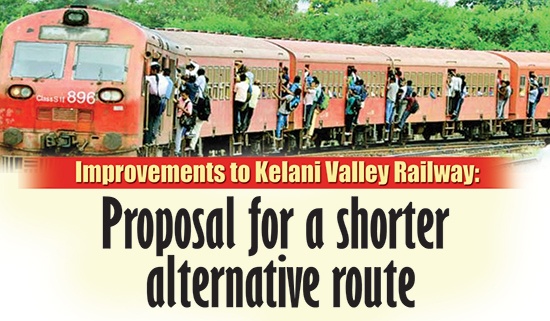
Improvements to Kelani Valley Railway:
By Dr Janaka Ratnasiri
The writer’s article on the above which appeared in The Island of 09.11.2020 brought some responses among which is reference to the Megapolis Transport Master (MTM) Plan released in November 2016, prepared by the Ministry of Megapolis and Western Development under the former regime. This Master Plan has forecasted future demand for transport in the Western Province up to 2035 and proposed ways and means of meeting the demand by road, rail and water transport systems.
Though the terms of reference for undertaking the feasibility study of the Colombo Suburban Railway Project (CSRP) discussed in the writer’s above mentioned article said “Collect and review all available relevant studies, reports, materials, documents, and information including findings from the project preparatory team”, it appears that no reference whatsoever has been made to the MTM Plan in the CSRP Feasibility Study.
NEW RAILWAY LINES PROPOSED IN THE MEGAPOIS MASTER PLAN
The MTM Plan has proposed two new railway lines in the Western Province, one from Kottawa to Horana and a second from Kelaniya to Kosgama linking with the KV railway line. Regarding the first, the Plan says “The detailed design and implementation of Kottawa–Horana new rail line (22km) is planned to be commenced after six months and before three years to be completed on or before 2020. The estimated project duration for the whole project is three years and the cost is estimated to be USD 309 million”. Once completed (if at all), this railway could draw passengers now using the 120 bus route for travelling from Horana to Colombo. The proposed Ruwanpura Highway will also have an exit at Horana which will be an alternative route to travel from Horana to Colombo via the proposed elevated highway from the New Kelani Bridge to Athurugiriya via Rajagiriya. This could affect the forecasted traffic expected to use the railway from Horana.
The more relevant new railway line is the second option, that is from Kelaniya to Kosgama. The MTM Plan has marked out this railway line shown as a crow-flying path, touching Sapugaskanda and Biyagama Export Processing (BEP) Zone. About the line, the MTM Plan says “The Kelaniya to Kosgama via Biyagama, and Dompe (30km) to be constructed which gives access to the proposed plantation city at Avissawella. This project is to be commenced as a long-term intervention. A feasibility study needs to identify the demand and finalize the trace. This can be either electrified or use the locomotives that are taken out due to electrification on other lines”. It will be necessary to build a bridge across Kelani River close to Pugoda for this railway line.
ECONOMIC BENEFITS OF THE PROPOSED NEW RAILWAY LINE
The railway line from Kelaniya to Kosgama targets both passengers as well as freight transportation. The line passes the Sapugaskanda oil refinery which makes it possible to use it for oil transportation as well. As a matter of fact, a railway line up to Sapugaskanda was planned several decades ago, and land acquired, but the project was abandoned and the land slowly got occupied by encroachers.
The present refinery built in 1969 meets only 25% of the country’s oil requirement, producing about 1.6 Mt of refined products annually (Petroleum Ministry website). Presently, the refinery is served by two pipelines built in 1969 to transfer crude oil from the Port and refined products to the Kolonnawa Petroleum Storage Complex (PSC). However, the design life span of these petroleum pipelines is only 25 years and hence these need replacements. However, with problems of land and environment clearance, laying of new pipelines is no easy task. Efforts to replace leaky pipelines from the Port to Kolonnawa PSC have been planned for over a decade but still nothing could be realized for various reasons.
As an alternative to a new pipeline, transport of oil to and from the refinery in bowsers could be considered. Assuming one road bowser could hold 20,000 litres, transfer of 16 Ml of oil a day will require 800 bowsers a day. However, if rail wagons are used for transporting oil, using 50,000 litres capacity wagons, a day’s output could be transported in about 320 wagons. If all this oil is transported to the Kolonnawa Complex by pipelines or wagons it will saturate the storage capacity there. Instead, it will be more convenient if this amount could be transported directly to consumer points.
PLANS FOR EXPANDING THE REFINERY CAPACITY
Plans for the expansion and modernization of the refinery were made over the last decade, and according to Petroleum Ministry’s Performance Report for 2012, the cost of such modernization was estimated to be USD 500 million in 2010. However, the matter was not pursued that time as the technology offered when bids were called was found unsuitable. It is very likely that the cost of the project with the latest technology would exceed USD 1 billion today. The Cabinet approval was granted on 02.11.2020 to call for fresh bids for modernizing the refinery and expanding its capacity to 100,000 barrels (16 Ml) per day or 5.0 Mt per year. This is about three times the present capacity. However, it appears that authorities have not given thought to the optimum way to transport away the expanded output of the refinery.
Currently, the Corporation maintains 11 bulk depots island-wide out of which 10 are built adjoining railway stations, and oil is transported to them from the Kolonnawa Complex by railway. If a railway line is available to the refinery, refined products could be transported direct to regional depots from the refinery itself. This could be done by using several trains each carrying about 20 wagons. This will ease the congestion at the Kolonnawa Complex in handling the entire oil distribution to the country by itself. The proposed railway link to the refinery will meet this requirement.
In addition, the containers presently transporting goods from the Biyagama EPZ as well as Seethawaka EPZ on road vehicles to the Port for export, could use this railway line after building suitable facilities for loading containers on to the railway carriages at the Zone. This will ease the congestion on highways presently experienced when a large fleet of containers use the highways through the city.
AVAILABILITY OF A NEW RAILWAY TRACK TO AVISSAWELLA
A more significant factor is that the new route proposed in the MTM Plan will reduce the distance to Kosgama from Maradana by at least 17 km compared to the route via Padukka. If the Kelaniya–Kosgama trace is taken as a base line, the route via Padukka appears to be a semi-circle. So, naturally, it is about 50% longer. The British moved the original trace via Padukka because a direct route via Hanwella would be over flood-prone land. In building the High Level Road, considerable amount of land filling had to be done to avoid inundation by floods.
The stretch between Padukka and Kosgama is special in that there is no roadway parallel to the railway line along this stretch. Hence to cater to the villagers living in this area, Sri Lankan Railways (SLR) operates a rail-bus service from Padukka to Kosgama at regular intervals. This is an ingenious system developed by a SLR engineer, comprising two normal road buses coupled back-to-back with the road wheels replaced by rail wheels and driven by the normal bus engine. This is a much cheaper system apparently not to the liking of fellow engineers who preferred more expensive conventional locomotive system.
Under the project undertaken for the improvement of the Kelan Valley Railway line as a part of CSRP, it is proposed to build an elevated double track electrified line from Maradana up to Makumbura and from Makumbura to Padukka, build a double track electrified line at grade. The segment from Padukka to Avissawella will be a single track at-grade following the existing line with certain improvements. The total distance of the existing line from Maradana to Avissawella is 58 km. On the other hand, the proposed new track from Maradana to Avissawella via Kelaniya, Biyagama, Dompe and Kosgama will be about 41 km, thus saving 17 km.
AMENDING THE PROPOSED IMPROVEMENTS TO KV RAILWAY LINE
The development of the KV railway line up to Padukka may be undertaken as proposed in the CSRP. The stretch between Padukka and Kosgama could remain as it is with slight improvements where necessary to be serviced by rail-buses as done presently. If necessary, the frequency of this service could be increased with additional units introduced. It will be cheaper to use these than using diesel multiple units (DMU) at higher costs. However, if the rail-buses are not fast enough, DMUs may be introduced.
Under the CSRP, a passenger travelling to Avissawella from Maradana will have to alight from the electric train at Padukka and get into a diesel train to continue his journey to Avissawella. The entire journey is expected to take about two hours, excluding the waiting time at Padukka while changing trains. This does not look attractive enough for a bus passenger to shift to a train ride. The SLR also proposes to extend the KV line from Padukka to Nonagama via Ingiriya, Ratnapura and Embilipitiya. Hence, the KV line up to Padukka may be developed with this plan in mind rather than as a continuation of service to Avissawella, which could be serviced by the new line from Kelaniya to Kosgama.
ADOPTION OF A NEW RAILWAY LINE TO AVISSAWELLA
It is proposed that the Government adopts the new track via Kelaniya, Biyagama and Kosgama as the main railway line to Avissawella and include it in the SLR programme as a priority project. It is the shortest route with a distance of only 41 km compared to 58 km via Padukkaka. People will not want to waste their time travelling in a railway going on a circuitous track. This area North of the Kelani River has less population and less traffic flow than those covered by the present KV line. The new track between Maradana and Kosgama via Biyagama could be double track and electrified, but need not be elevated and hence built at lower cost.
The stretch between Kosgama and Avissawella could be developed as a part of the development of the new line proposed in the MTM Plan up to Kosgama. The topography of the area does not allow moving the track away from the present track very much as the A4 highway runs close to the railway line along this stretch and also the presence of hilly terrain. Also, the railway line crosses the A4 highway at four places and this should be avoided either with flyovers or re-laid tracks as decided by experts after studying the terrain.
If the new line up to Kosgama is built with double tracks and electrified, it is necessary to continue this system up to Avissawella, so that passengers will not have to change trains at Kosgama. The distance between Maradana and Avissawella along this new line being about 41 km and with a fewer number of stations, EMUs will be able to cover this distance in about an hour compared to two hours via Padukka even after improvement. If trains are available in short intervals, people will not hesitate to take a train ride rather than a bus ride to travel to Colombo, even if the fare is slightly high. The freight trains could be operated at night time when there is less demand for passenger transport. Spurs could be laid to link with the refinery for transport of oil as described previously and with the Biyagama EPZ as well as the Seethawaka EPZ enabling transport of containers between the EPZs and the Port or the Airport. This will ease the congestion of traffic on the highways.
CONCLUSION
It is a pity that the CSRP Feasibility Report has not looked at the MTM Plan prepared during the previous regime which had proposed a shorter track from Maradana to Kosgama via Biyagama. It will reduce the travel time from Avissawella to Colombo to about one hour compared to two hours with the trains proposed in the CSRP, and has the advantage to be able to distribute the oil production from the expanded refinery and transport containers from the EPZs at Biyagama and Seethawaka. The Government may give priority to develop this railway line and limit developing the present KV railway line under CSRP only up to Padukka.
The Western Region Megapolis Transport Master Plan was developed encompassing all aspects of transportation to provide a framework for urban transport development in Western Region up to 2035. It included recommendations for improving the bus transport system, railway electrification of main, coastal and KV lines and introducing the light rail transit system.
It is unfortunate that this master plan developed at great cost by local experts appears to have been discarded in favour of a plan developed by foreign consultants costing hundreds of millions of Dollars, yet found unsuitable for reasons described above. This just is one example where plans developed by one regime at great cost are discarded by the succeeding regime despite the fact that some of them have merit. Naturally, the country cannot show any progress if this is the accepted practice.

 It may be some time before the full impact of food inflation is felt in the West. Until such time the world would continue to keep itself in suspense over whether the Trump administration is in earnest when it seeks to convey the impression that it is backing a negotiated solution in West Asia.
As is usually the case, consumer stress would be one of the final determinants of political change. To the degree to which the average US consumer somehow ‘muddles through’ and puts the food on the table, to the same extent would the Republican sections of the US public in particular be tolerant of the Trump administration’s inconsistent handling of the West Asian war and the main issues stemming from it. That is, there would be no grave popular disaffection and a demand for political change in the short term.
However, the indications are that the Trump administration’s support base is suffering some erosion in the wake of the current economic crisis. While reports indicate that Democratic sections are firming-up their opposition to the political centre, Republican support for Trump is also showing signs of waning, we are given to understand.
The above developments are probably why Trump is on record as having given Israeli Prime Minister Benjamin Netanyahu a ‘dressing down’ recently on his seeming intransigence on the question of giving negotiations a chance in West Asia. The show of displeasure could be really aimed by Trump at containing the impatience of the American public.
However, the current ground situation in the Middle East, particularly the uncontained bloodshed, is likely to impress on the thinking sections of the world that more than temporary political change is needed in West Asia and the US.
A well thought out political solution that addresses all the contentious issues at the heart of the Middle East conflict is what enlightened opinion would demand, and very rightly. Right now, the ‘peace efforts’ initiated by the Trump administration give the impression of being piecemeal solutions at best.
There have been, of course, numerous initiatives in the past aimed at bringing permanent peace to the Middle East. These failed mainly because they did not address in full the root causes of the conflict.
At bottom the Middle East conflict is mainly about race and religious hate bred by socio-economic and material inequalities. For instance, if the Palestinian people were not displaced and deprived of land occupied by them at the time of the founding of the Israeli state, ethnic enmities would not have grown to the current unmanageable proportions.
When addressing the above questions, though, it must be remembered that the Israelis too were a displaced people who were entitled to land and a state of their own in the Middle East. Basically, out of these seemingly irreconcilable and conflicting demands have grown the Middle East imbroglio.
Middle East peace is considerably about reconciling these demands and arriving at a solution that would ensure the creation of two states that would opt for peaceful co-existence thereafter.
As long as the US does not see the need for a non-partisan solution that addresses the needs of both ethnicities and religions and goes all-out, as it were, to have it implemented, the Middle East would continue to bleed.
However, staunching the blood flow through the creation of two states would be only half the job done, though a very important part of it. More pernicious, pervasive and difficult to remedy are the inter-ethnic and inter-religious hatreds that have been unleashed over the decades.
However, if substantial, long-lasting peace is to be fostered in the region the latter ‘demons’ would need to be exorcised from the hearts and minds of the communities concerned. No doubt an uphill task but one that must be undertaken by those who wish the region well.
The UN would need to put its ‘best foot forward’ in such undertakings but it is time that it dawned on the international community and other caring quarters that Middle East peace, and all other such uphill challenges, require proactive peacemaking on the part of all civilized sections for their effective management. That is, public involvement in peacemaking too is a must.
Since hatreds are harboured in the human consciousness the enmities embedded in the latter need to be managed and defused judiciously alongside other undertakings in a peace process. In the case of West Asia, such enmities could be even spread globe-wide besides being multi-dimensional. For instance, it ought to be thought-provoking that Iran is insistent on a peace initiative that would also include Lebanon.
Besides security considerations it is also ethnic and religious affiliations that account for Iran making this demand. For instance, the Shias are a numerically important religious community in Lebanon and they provide a significant number of Hizbollah fighters, who are in a vital sense carrying out a ‘proxy war’ for Iran. It also needs to be factored in that Iran is a Shia-majority country.
Thus trans-border religious affiliations could add to the complexities and enormity of ethno-religious conflicts. However, the task of managing centuries-long enmities needs to be launched and prodded on with by peacemakers since a downing of arms alone would not guarantee substantive peace.
It is not realized sufficiently that the process of ending hatreds begins with mutual apologies by antagonists to a conflict for the harm inflicted on each other. This would be anathema in some ears but there is no getting away from the requirement. It is the vital first step to permanent peace anywhere.
In fact there could be no reconciliation worth speaking of without such mutual apologies. It is a point worth re-iterating in these times when even the government of Sri Lanka is voicing the need for national reconciliation. Well, without the words, ‘I am sorry’, there could be no permanent end to enmities – they would do well to remember.
The above requirements may not go down very well with governments, but they resonate in the hearts and minds of most people, since they are inheritors of religious traditions of some kind.
This is a principal reason why peacemaking works well when publics too are involved in them. The effectiveness of such campaigns increases several fold when they have a Mahatma Gandhi or a Jawaharlal Nehru at their helm. A strong proactive involvement by the public in peace could lead to the emergence of such leaders at some point in these campaigns.
Official Digital Partner of the 2026 ‘Dakshina Prabha’ National Vesak Zone
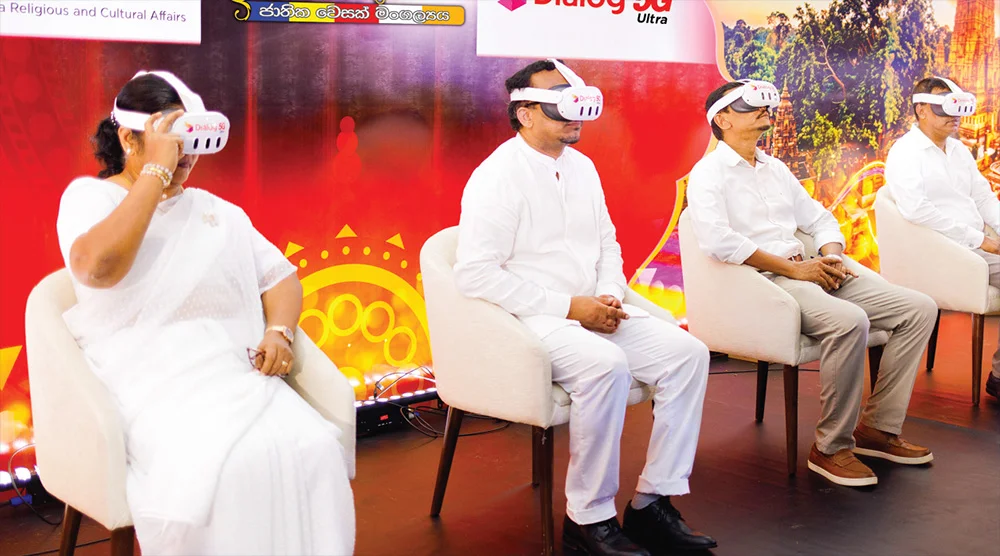
Dialog Axiata PLC, Sri Lanka’s #1 connectivity provider, collaborated with the Ministry of Buddha Sasana, Religious and Cultural Affairs to bring one of Sri Lanka’s largest and most technologically advanced Vesak experiences to the ‘Dakshina Prabha’ National Vesak Zone. The three-day celebration, in Matara attracted more than hundred thousand visitors, who engaged with a series of innovative digital activities powered by Dialog 5G Ultra, including Artificial Intelligence (AI) and Virtual Reality (VR) experiences, digital pandols and a Data Dansala. The opening ceremony was attended by Hon. Sunil Handunnetti, Minister of Industry and Entrepreneurship Development and Hon. Saroja Savithri Paulraj, Minister of Women and Child Affairs, along with distinguished guests and Dialog’s senior management.
One of the key attractions at the venue was the Dialog 5G Ultra-powered Virtual Reality (VR) experience, which attracted more than 35,000 participants. The activation enabled devotees to virtually visit and pay homage to sacred Buddhist sites, including the Jaya Sri Maha Bodhi in India and the Atamasthana in Anuradhapura, directly from the Vesak zone in Matara.
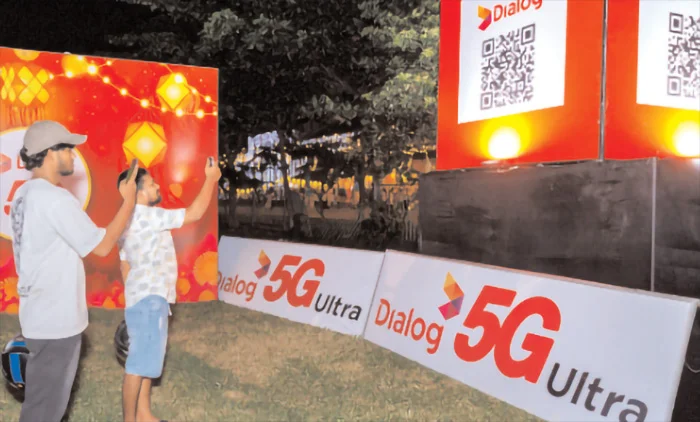
Visitors receive complimentary mobile data through Dialog’s QR-powered Data Dansala.
Dialog also conducted an AI Digital Vesak Greeting Card Competition from 21 May to 01 June 2026, attracting numerous entries from across the country. The shortlisted designs were showcased across 20 large LED screens throughout the venue and across Matara City, and were also made available for download via mobile devices. Further, through the use of AI, traditional Jathaka Katha were reimagined in a digital format, demonstrating how technology can be used to preserve and enhance cultural and religious heritage. Together, these initiatives blended traditional Vesak celebrations with emerging technologies, offering visitors a unique and immersive way to engage with Vesak traditions.
Extending the spirit of Vesak through connectivity, Dialog conducted a special Data Dansala powered by its QR Reload platform, enabling visitors to receive complimentary mobile data by scanning QR codes placed across the venue. In addition to the Matara National Vesak Zone, similar Data Dansala activations were also conducted at the Gangaramaya and Bauddhaloka Vesak zones in Colombo.Visitors also had the opportunity to create personalised Vesak-themed digital photos through an AI Photo Booth, generating AI-enhanced portraits using their own photographs and adding a contemporary digital element to the Vesak celebrations.
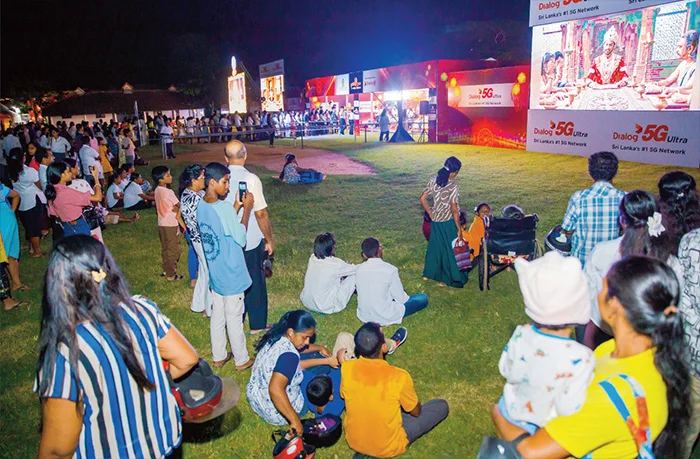
Visitors watch AI-generated Jathaka Katha
Commenting on the initiative, Hon. Sunil Handunnetti, Minister of Industry and Entrepreneurship Development, said, “The 2026 Dakshina Prabha Vesak Festival marked the first time AI-powered digital innovations were incorporated into a National Vesak Festival in Sri Lanka. Presenting Buddhist stories and teachings through technology created a new and engaging way for visitors to connect with these traditions. We thank Dialog for supporting this initiative and for working closely with us to bring our vision to life. Their contribution played an important role in making this first-of-its-kind event a reality.”
Lasantha Theverapperuma, Group Chief Marketing Officer of Dialog Axiata PLC said, “We thank the Government of Sri Lanka for the opportunity to support the 2026 Dakshina Prabha National Vesak Festival and for embracing technology as part of this year’s celebrations. As the Official Digital Partner, we were privileged to contribute through our Dialog 5G Ultra and AI capabilities, creating new ways for visitors to engage with Vesak traditions while preserving their cultural significance for future generations.”
Beyond supporting the National Vesak Zone in Matara, Dialog also enhanced the Gangaramaya and Bauddhaloka Vesak zones through a range of digital activations during the Vesak season. The company additionally continued its sustainability initiatives, including the Thirasara Aloka Poojawa, which illuminated rural places of worship through solar-powered lighting solutions.

Universal Woman is an international pageant focused on “beauty, elegance, and talent” for women, positioning itself as a platform to shape global ambassadors. The 2026 edition will be held in Cambodia, and Sri Lanka will be there, as well.
According to reports coming my way, contestants, at the international event, will work with industry trailblazers, under international standards.
Sri Lankan supermodel, runway and pageant trainer Chulpadmendra Kumarapathirana, is the National Director for Universal Woman Sri Lanka 2026.
With over two decades in the industry, Chula was crowned Miss Sri Lanka 2006, and has since shaped the next generation of titleholders through her Colombo-based Chulpadmendra Catwalk Studio, widely regarded as one of the country’s leading modelling academies.

The team behind Universal Woman Sri Lanka 2026
A former host of Derana Miss Sri Lanka for Miss World 2008 and a judge for Miss Universe Sri Lanka 2025, Chula now serves as National Director for Universal Woman Sri Lanka 2026, leading the franchise’s search for Sri Lanka’s delegate to the international final in Cambodia.
Applications for Universal Woman Sri Lanka 2026 are being taken, via WhatsApp: 077 659 4994, says Chula.
The judging panel for Universal Woman Sri Lanka 2026 includes Senaka De Silva, Pageant Aesthetic Advisor & Chairperson of the Judging Panel, Angela Seneviratne, Caroline Jurie, Rozelle Plunkett, and Suraj Mapa.
Universal Woman Sri Lanka 2026 officially began its journey with a first round of auditions, held in Colombo, marking the start of an exciting new chapter in Sri Lanka’s pageant industry.

Launching the first round of auditions
The platform aims to empower women while selecting an intelligent, confident, and inspiring representative to compete at the Universal Woman International Pageant 2026 in Cambodia, this September.
Universal Woman Sri Lanka now moves forward with the vision of creating one of the country’s most prestigious and empowering pageants while preparing to crown a queen who will proudly represent Sri Lanka on the international stage.

SLC name squads for Tri-Nation ‘A’ series and Four-Day series
SLC name squads for West Indies Emerging Tour of Sri Lanka 2026

ICC delegation visits Bangladesh to ‘review developments linked to the BCB’

Indonesia’s rupiah falls to record low against US dollar

INS Airavat makes port call in Colombo

Netanyahu downplays US-Israel rift after Trump confirms criticism

‘Dates have the highest sugar content to fight Coronavirus’

Sunday Island 27 December – Headlines

#SundayIsland 17th December – Headlines

Sunday Island – 28th March

Sunday Island Headlines – 21 March

Sunday Island – 21st February – Headlines
-
 News6 days ago
IMF urges Lanka not to meddle with exchange rate
-

 News3 days ago
Lankan duo emerge winners in Latin dance championship held in Blackpool, UK
-
 Business7 days ago
Sri Lanka’s construction industry losing ground while no one watches
-

 Business4 days ago
IMF’s unstated rate:Sri Lanka’s $695m loan costs about 5.33% per annum
-
 News6 days ago
State of emergency extended
-
 Features7 days ago
The Division Bell Mystery
-
 Features5 days ago
Are threats to Buddha Sasana external or from within?
-
 News4 days ago
UNP challenges NPP move to amend Vihara – Devalagam Act