
News
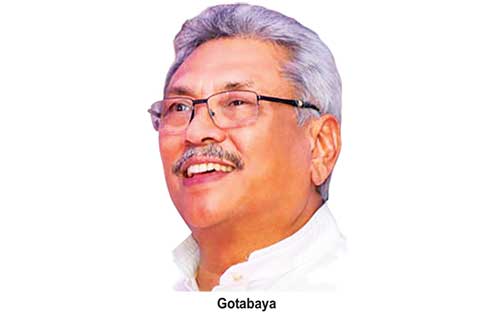
Prez to consolidate power

* Constitutional Council to be abolished
* No provision for civil society members
* Dual citizens can enter parliament
* A person aged 30 can run for President
* Restriction on number of Cabinet ministers, deputies removed
* Parliament can be dissolved within one year
* Romesh de Silva heads team tasked with preparing draft new Constitution
By Shamindra Ferdinando
The Constitutional Council (CC) introduced in terms of the 19th Amendment in 2015 is to be abolished by the 20th Amendment (20A) gazetted yesterday (3).
In place of the 10- member CC, the 20A has proposed a Parliamentary Council comprising the Prime Minister, the Speaker, the Opposition Leader and nominees (one each) of the Prime Minister and the Opposition Leader.
The 20th Amendment stipulates that the nominees of the Premier and the Opposition Leader belong to the communities other than the communities represented by the Prime Minister, the Speaker and the Opposition Leader.
In terms of the 19th Amendment, the CC headed by the Speaker, included three civil society representatives as well as a representative of the President. The 20A has done away with both civil society representatives and the presidential nominee.
Cabinet spokesman Mass Media Minister Keheliya Rambukwella and co-cabinet spokespersons, Ministers, Dr. Ramesh Pathirana and Udaya Gammanpila refrained from commenting on the provisions of the 20A in spite of the media repeatedly seeking their comments.
The Attorney General on Sept 2, ruled that the 20A could be enacted by a two-thirds vote sans a referendum. SLPP National List member Justice Minister Ali Sabry, PC, worked out the 20th Amendment.
In line with 20A, the President will have the authority to make appointments to the Election Commission, the Public Service Commission, the National Police Commission, the Human Rights Commission of Sri Lanka, the Commission to Investigate Allegations of Bribery or Corruption, the Finance Commission and the Delimitation Commission (all in Schedule I) having obtained observations of the Parliamentary Council.
The President will seek the observations of the Parliamentary Council in appointing the Chief Justice and judges of the Supreme Court, the President and the judges of the Court of Appeal and the members of the Judicial Service Commission other than the Chairman (all under Schedule II/Part I) and the Attorney General, the Auditor General, the Parliamentary Commissioner for Administration (Ombudsman) and the Secretary General (Schedule II/Part II).
In terms of the 20th Amendment, the immunity of the President, both in official and private capacity has been restored.
The SLPP, both at the presidential and parliamentary elections held in Nov 2019, and Aug 2020, respectively, campaigned for a two-thirds majority to do away with the 19th Amendment. The SLFP obtained 145 seats and with the support of its allies can muster the required two thirds.
There is provision in the 20th Amendment for the President to remove the nominees of the Prime Minister and the Opposition Leader in the Parliamentary Council.
The Parliamentary Council has to submit its observations as regards the President’s nominees to the above mentioned offices within one week. In case, the Parliamentary Council fails to respond within a week after the President sought its observations, there is provision for the President to go ahead with the appointments.
There is provision for leaders of recognised political parties to propose suitable persons to the Commissions categorized under Scheduled I for the President’s consideration.
The 20th Amendment also seeks to do away with the restriction on the number of ministers to 30 and non-cabinet ministers to 40 introduced by the 19th Amendment. The President will be head of the cabinet.
The 20th A seeks to provide space for the President, in consultation with the President, if necessary, to determine the number of ministers and also appoint ministers who are not members of the cabinet of ministers. There is also provision for the appointment of Deputy Ministers, from time to time, in consultation with the Prime Minister, if necessary, to assist members of the cabinet.
In terms of the 20th Amendment, the President can remove Prime Minister, a member of the cabinet, any other minister or a Deputy Minister.
The President has retained the constitutional authority to dissolve parliament after completion of sittings for a period of one year. The 19th Amendment, deprived the President the power to dissolve parliament until the House completed four and half years of five-year term.
The 20th Amendment has retained the five-year term for the President and two term restriction.
The 20th Amendment provides for the introduction of emergency Bills.
The age of presidential contestants has been reduced to 30 from 35. The 20th Amendment also paved the way for dual citizens to contest parliamentary election.
Addressing the media at the Information Department, cabinet spokesperson said that a nine member expert committee headed by Romesh De Silva, PC had been asked to prepare a new draft Constitution. The media was told that the 20th Amendment was temporary measure until consensus could be reached on a brand new Constitution. The team comprises Gamini Marapana, PC, Manohara de Silva, PC, Sanjiva Jayawardena, PC, Samantha Ratwatte, PC, Professor Nasima Kamurdeen, Dr. A Sarweswaran, Professor Wasantha Seneviratne and Professor G. H. Peiris.






Latest News
Workshop Explores Integration of Enterprise Development Programmes with the “Prajashakthi” National Movement

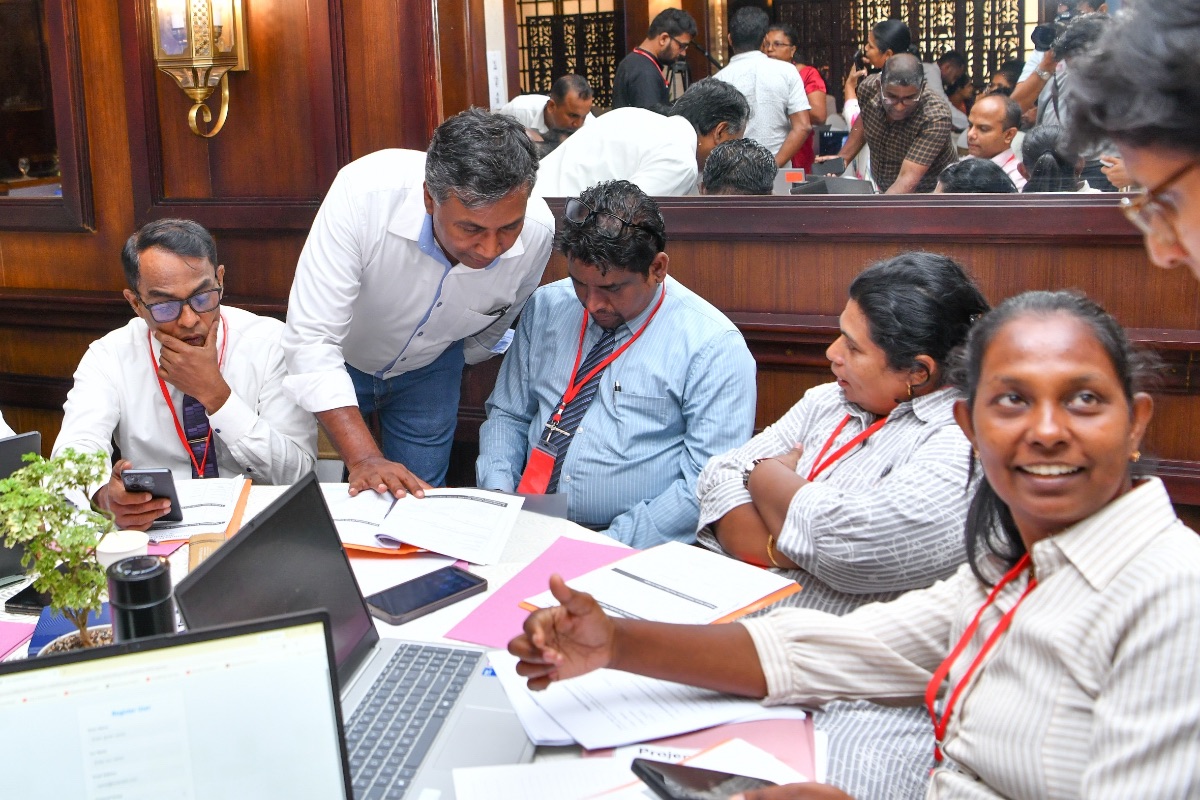
A special workshop was held today (06) at the Presidential Secretariat to explore the possibility of integrating programmes currently implemented by state institutions that directly contribute to enterprise development with the “Prajashakthi” National Movement.
Discussions focused on identifying development projects undertaken by government institutions for micro, small and medium-sized enterprises (MSMEs) and incorporating relevant information into a unified data management system.
Attention was also directed towards formulating a strategic framework for the coordinated implementation of these programmes, as well as identifying the nature, scope and eligibility criteria of the initiatives carried out by the respective institutions.
The participating government officials were further briefed on the criteria for selecting beneficiaries for programmes directly related to enterprise development.
In addition, discussions centred on identifying programmes that could be implemented independently or jointly by the relevant state institutions and the “Prajashakthi” National Movement. Particular attention was paid to preventing duplication and overlap in programme selection and implementation.
Senior Additional Secretary to the President Kapila Janaka Bandara, Secretary to the Ministry of Rural Development, Social Security and Community Empowerment Sampath Manthrinayake, resource persons Kalum Jayaveera and Madhava Muthukudaarachchi, officials of the Ministry of Rural Development, Social Security and Community Empowerment, government officials, and representatives of the Prajashakthi Secretariat were among those who attended the workshop.
(PMD)

Wrapping up their goodwill and replenishment visit, the Pakistan Navy ships ‘PNS Taimur’ and ‘PNS Aslat’, along with the submarine ‘PNS/M Hangor’, departed the island on 04 Jun 26. The naval units, which arrived in Sri Lanka on 01 June, were accorded a traditional naval send-off by the Sri Lanka Navy at the Port of Colombo, upon their departure.
During their stay, the Commanding Officers of Pakistan Navy ships and submarine called on the Commander Western Naval Area and the Flag Officer Commanding Naval Fleet at the Western Naval Command Headquarters, where discussions were held on several matters of mutual interest.
Meanwhile, Sri Lanka Navy personnel had the opportunity to visit the visiting Pakistan Navy ships and submarine. Furthermore, the crews of the visiting vessels explored the rich heritage of Sri Lanka, taking time to tour several culturally significant landmarks across the island.
News
China, Lanka intensify cooperation to fight cross-border crimes spreading across Asia and beyond

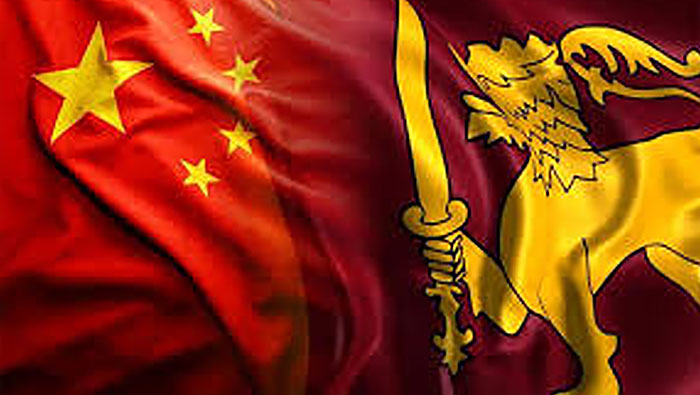
China and Sri Lanka have intensified joint law enforcement efforts to combat cross-border online gambling and telecom fraud, crimes that authorities warn are increasingly spreading across Asia and beyond.
The Chinese Embassy in Colombo said both countries are working closely to dismantle scam centres and fraud networks that have relocated to Sri Lanka from other parts of Southeast Asia. The Embassy noted that such operations often intertwine with human trafficking and other serious crimes, posing grave risks to public security and social stability.
China’s position on cross-border gambling remains firm: Chinese capital is prohibited from investing in overseas casinos, citizens are barred from operating them, and foreign casinos are forbidden from soliciting Chinese nationals. The Embassy stressed that gambling “almost invariably leads to financial ruin,” with tens of thousands of Chinese citizens suffering losses and harm. Recent amendments to China’s Criminal Law have criminalised cross-border gambling activities.
The Embassy pointed out that Sri Lankan authorities have carried out multiple raids in recent months, dismantling gambling and fraud dens and arresting suspects from several countries. Several Chinese nationals, involved in fraud-related crimes, have been handed over to Chinese authorities, producing what officials described as a strong deterrent effect.
The Chinese Embassy praised the efforts of Sri Lanka’s ministries of Foreign Affairs, Finance, and Public Security, particularly immigration and police officials, for their cooperation.
It warned that without firm and immediate measures, the spread of illegal gambling and fraud could damage Sri Lanka’s international image, undermine social stability, and harm the safety and security of its people.
China has already conducted similar law enforcement cooperation with countries including Spain, the UAE, Myanmar, and Cambodia, leading to arrests and repatriations of overseas fraud suspects. It has also proposed the creation of an international alliance against telecom and online fraud to coordinate global efforts, it said.
Going forward, China pledged to actively implement the Global Security Initiative and Global Civilization Initiative, while continuing to deepen law enforcement and security cooperation with Sri Lanka.
The Embassy said these efforts aim to safeguard lives and property, protect financial security, and build a “clean, safe, and beautiful Sri Lanka,” while contributing to a new global framework for combating transnational crime.

Workshop Explores Integration of Enterprise Development Programmes with the “Prajashakthi” National Movement

England make inroads after New Zealand set 254 to win

Rusty West Indies face upbeat Sri Lanka with series on the line

Pakistan naval trio leaves Colombo after goodwill visit

PEOTV secures media rights for FIFA World Cup

Anthropic urges AI labs to pause, warns humans risk losing control

‘Dates have the highest sugar content to fight Coronavirus’

Sunday Island 27 December – Headlines

#SundayIsland 17th December – Headlines

Sunday Island – 28th March

Sunday Island Headlines – 21 March

Sunday Island – 21st February – Headlines
-

 News5 days ago
Lankan duo emerge winners in Latin dance championship held in Blackpool, UK
-

 Business6 days ago
IMF’s unstated rate:Sri Lanka’s $695m loan costs about 5.33% per annum
-
 Latest News3 days ago
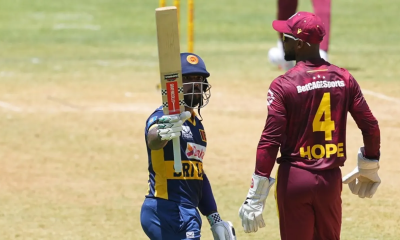
Kusal Mendis, Pathum Nissanka, bowlers put Sri Lanka 1-0 up
-
 News3 days ago
New US tariffs proposed on 60 countries, including Sri Lanka
-

 Business6 days ago
Sri Lankan scientist-innovator Milinda Edirisinghe introduces AI-integrated gem testing system to gemological world
-
 Features7 days ago
Are threats to Buddha Sasana external or from within?
-
 News6 days ago
UNP challenges NPP move to amend Vihara – Devalagam Act
-
 Features2 days ago
Power crept into the Sangha and is now tearing it apart