
News
Power Minister assures retention of competitive bidding process even after amending Electricity Act


By Saman Indrajith
Minister of Power and Energy, Kanchana Wijesekera on Wednesday told Parliament that the proposed amendments to the Sri Lanka Electricity Act would not lead to the abolition of the competitive bidding process for procurement of electricity.
The Minister said that they were only trying to make the implementation of sustainable energy products easier subject to approval by the Sustainable Energy Authority.
“There is also a misconception that the changes to the Act allows various companies including foreign ones to increase electricity prices according to their whims and fancies,” he said.
Minister Wijesekera said that even after the amendments, it was the Ceylon Electricity Board (CEB) that had the authority to determine the price of a unit of electricity.
“The CEB has a pricing formula to buy electricity. The formula is implemented by officials at CEB, the Ministry and Sustainable Energy Authority. The government and the Cabinet can’t decide the rate at which we would buy energy from the supplier”, he said.
In the past the CEB had done its best to thwart renewable energy projects, the minister said. The existing act helps the CEB to place obstacles for those willing to invest in renewables, he said.
There were discussions to change the act since August 2013, he said. However, certain powerful sections of the CEB had been opposed to changes that would reduce their powers.
“Only some engineers are opposed to the amendments. These are people who pushed for thermal power plants and thwarted attempts to boost renewables. The CEB last week asked me to increase electricity tariffs by 300 percent. The cost of electricity production is over 755 billion rupees a year. Our income is 250 billion rupees a year. There is a gap of 500 billion rupees. We pay tremendous amounts of money for diesel and to pay officials. The salaries of officers increase by 25 percent, once every three years.
“Do we need to pay for these unnecessary cost overruns by placing extra burden on the people? No, we must do this by reducing cost”, he said.
The Minister said that he would not present proposals to increase electricity tariffs, unless the CEB took steps to boost renewable energy that is low cost and clean.
Minister Wijesekera said that it was CEB officials who had entered into agreements with various power suppliers. The cost of a unit of electricity at Lakvijaya power station is 41.80 rupees, it is 80.50 rupees at Sojitz Kelanitissa Pvt Ltd, 61.56 rupees at Power Plant B, Sapugaskanda, 66.42 rupees at Power Plant A, Sapugaskanda, 62.14 rupees at the Barge, 65.52 at Uthuru Janani, 68.20 at west Coast, 98.40 rupees at Kelanitissa Combined Cycle, 137.60 at Kelanitissa G-T7, and182.40 at Kelanitissa Frame 5, the Minister said.
“The unit of electricity produced using renewable sources costs 16.80 rupees. Solar is bought at 22.50 rupees. A unit of electricity through hydro costs 4.35 rupees. Don’t take steps to thwart renewable energy. Right now, the energy permit is given a year after the tentative approval even if you own the land where the project will be implemented,” he said.
The Minister said that 800 million dollars was needed to purchase coal for the next year. The government spent 100 million dollars a month for diesel, needed to produce thermal power.
“We will produce more than what the country needs through these power projects. I think we must connect our electricity grid with India. We will be selling electricity to India soon,” he predicted.
Meanwhile, Opposition Leader, Sajith Premadasa said that they were supportive of renewable power and wanted to empower domestic energy producers. However, the real objective of the amendments to the Electricity Act was to allow certain foreign companies to monopolise the renewable energy sector, he asserted.
Those opposed to the amendments to the Act were not against boosting renewable energy production, Premadasa said. They were only opposed to the attempts made by the government to take away the competitiveness of the procurement process, he said.
“We will end up letting these foreign companies dominate the industry and pay them in dollars. And we will pay them double of what we pay domestic producers. By amending Section 43 of the act, we will only take away competitiveness. It will facilitate the monopolization of renewable energy,” he said.
Meanwhile, Ven. Aturaliye Rathana Thera said that even countries that had vast oil and coal reserves were shifting towards renewable energy sources. Sri Lanka had not attempted to exploit solar and wind power, which are abundant here, he said. The United Nations Development Programme allocates about 100 million US dollars a year to support such projects, but Sri Lanka had never tried to access those funds, the thera said.
The President in his election manifesto said that Sri Lanka needed to produce 70 percent of electricity through renewable energy sources, he said.
“Now, we get 65 percent of our power from diesel and coal. Nothing has been done since the President came to power. Has the CEB made long term generation plans based on the President’s vision? Did the government not see this crisis coming? A lot of people tried to warn the government. Instead of amending bits and pieces of the Act, the government must present a national policy on electricity, which it promised to do,” Rathana Thera said.
The Thera added that the Prime Minister had promised to establish a committee of experts and representatives of all parties when making important decisions. That had not been done with regard to changing the important Act, he said.
The Thera also said that he was supportive of renewable energy. However, there was reason to believe that the amendments to the Act were aimed at creating a monopoly over solar and wind power for the benefit of a foreign company.
“Not only will we keep on bleeding dollars, but we will also lose energy sovereignty. We need to amend the Act, but if you are trying to encourage unsolicited bidding under the guise of promoting renewable energy it will only have disastrous consequences. There is no problem with allowing unsolicited bids from investors who want to produce less than 25 megawatts through renewable energy”, he said, adding that there were many Sri Lankans abroad and they would send solar panels and batteries to their homes if the process was facilitated.
“The government will have to bear little cost. Let’s encourage rooftop solar panels, if most people set up these systems, we won’t have any problems. We don’t need to overthink this. We don’t need to try to create massive companies. We can produce a gigawatt of energy through rooftop solar with ease and if we can do this, we won’t have a crisis.”



Wrapping up their goodwill and replenishment visit, the Pakistan Navy ships ‘PNS Taimur’ and ‘PNS Aslat’, along with the submarine ‘PNS/M Hangor’, departed the island on 04 Jun 26. The naval units, which arrived in Sri Lanka on 01 June, were accorded a traditional naval send-off by the Sri Lanka Navy at the Port of Colombo, upon their departure.
During their stay, the Commanding Officers of Pakistan Navy ships and submarine called on the Commander Western Naval Area and the Flag Officer Commanding Naval Fleet at the Western Naval Command Headquarters, where discussions were held on several matters of mutual interest.
Meanwhile, Sri Lanka Navy personnel had the opportunity to visit the visiting Pakistan Navy ships and submarine. Furthermore, the crews of the visiting vessels explored the rich heritage of Sri Lanka, taking time to tour several culturally significant landmarks across the island.
News
China, Lanka intensify cooperation to fight cross-border crimes spreading across Asia and beyond


China and Sri Lanka have intensified joint law enforcement efforts to combat cross-border online gambling and telecom fraud, crimes that authorities warn are increasingly spreading across Asia and beyond.
The Chinese Embassy in Colombo said both countries are working closely to dismantle scam centres and fraud networks that have relocated to Sri Lanka from other parts of Southeast Asia. The Embassy noted that such operations often intertwine with human trafficking and other serious crimes, posing grave risks to public security and social stability.
China’s position on cross-border gambling remains firm: Chinese capital is prohibited from investing in overseas casinos, citizens are barred from operating them, and foreign casinos are forbidden from soliciting Chinese nationals. The Embassy stressed that gambling “almost invariably leads to financial ruin,” with tens of thousands of Chinese citizens suffering losses and harm. Recent amendments to China’s Criminal Law have criminalised cross-border gambling activities.
The Embassy pointed out that Sri Lankan authorities have carried out multiple raids in recent months, dismantling gambling and fraud dens and arresting suspects from several countries. Several Chinese nationals, involved in fraud-related crimes, have been handed over to Chinese authorities, producing what officials described as a strong deterrent effect.
The Chinese Embassy praised the efforts of Sri Lanka’s ministries of Foreign Affairs, Finance, and Public Security, particularly immigration and police officials, for their cooperation.
It warned that without firm and immediate measures, the spread of illegal gambling and fraud could damage Sri Lanka’s international image, undermine social stability, and harm the safety and security of its people.
China has already conducted similar law enforcement cooperation with countries including Spain, the UAE, Myanmar, and Cambodia, leading to arrests and repatriations of overseas fraud suspects. It has also proposed the creation of an international alliance against telecom and online fraud to coordinate global efforts, it said.
Going forward, China pledged to actively implement the Global Security Initiative and Global Civilization Initiative, while continuing to deepen law enforcement and security cooperation with Sri Lanka.
The Embassy said these efforts aim to safeguard lives and property, protect financial security, and build a “clean, safe, and beautiful Sri Lanka,” while contributing to a new global framework for combating transnational crime.

An assistant manager and a security officer, attached to a state bank branch in Horana, have been arrested in connection with the robbery of more than Rs. 30 million that was being transported to replenish automated teller machines (ATMs), Police said.
The two suspects were taken into custody on Friday after statements were recorded from them regarding the incident, which occurred on Wednesday afternoon at the Horana branch of the People’s Bank.
According to Police, a bank employee was carrying two bags containing cash through the rear entrance of the bank at around 2.45 p.m. when an individual, who had arrived on foot, allegedly snatched the bags and fled the scene.
The stolen money, amounting to approximately Rs. 30.5 million, had been prepared for distribution to ATM machines and transportation to other bank branches. Earlier reports had estimated the loss at around Rs. 35 million.
Investigators subsequently arrested a suspect believed to have been directly involved in the robbery and recovered Rs. 17 million of the stolen cash.
Police have not disclosed the exact circumstances that led to the arrest of the assistant manager and security officer but said investigations uncovered information linking them to the incident.
The Western Province North Crime Division is conducting further investigations to determine whether additional suspects were involved and to recover the remaining stolen money.
The daring daylight robbery has raised concerns over security procedures employed during transportation of large sums of cash to/from banking institutions.Further investigations are continuing.
by Norman Palihawadane

England make inroads after New Zealand set 254 to win

Rusty West Indies face upbeat Sri Lanka with series on the line

Pakistan naval trio leaves Colombo after goodwill visit

PEOTV secures media rights for FIFA World Cup

Anthropic urges AI labs to pause, warns humans risk losing control

Iran footballers issued US visas for World Cup, says White House

‘Dates have the highest sugar content to fight Coronavirus’

Sunday Island 27 December – Headlines

#SundayIsland 17th December – Headlines

Sunday Island – 28th March

Sunday Island Headlines – 21 March

Sunday Island – 21st February – Headlines
-

 News4 days ago
Lankan duo emerge winners in Latin dance championship held in Blackpool, UK
-

 Business5 days ago
IMF’s unstated rate:Sri Lanka’s $695m loan costs about 5.33% per annum
-

 Latest News2 days ago
Kusal Mendis, Pathum Nissanka, bowlers put Sri Lanka 1-0 up
-
 News2 days ago
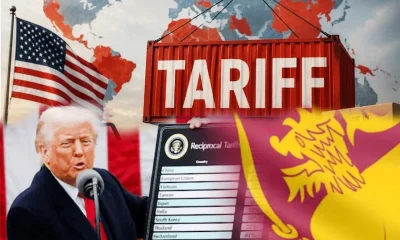
New US tariffs proposed on 60 countries, including Sri Lanka
-

 Business5 days ago
Sri Lankan scientist-innovator Milinda Edirisinghe introduces AI-integrated gem testing system to gemological world
-

 Features6 days ago
Are threats to Buddha Sasana external or from within?
-

 News5 days ago
UNP challenges NPP move to amend Vihara – Devalagam Act
-

 Features1 day ago
Power crept into the Sangha and is now tearing it apart