
Features
MY FIRST OVERSEAS BUSINESS VISIT

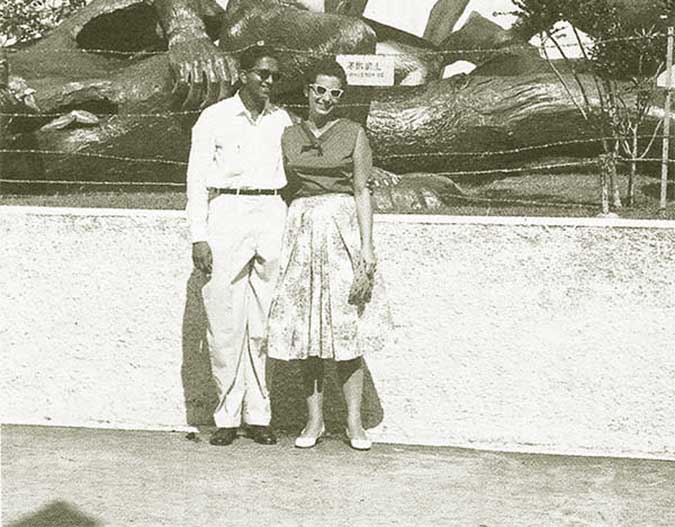
Excerpted from the autobiography of Merril. J. Fernando
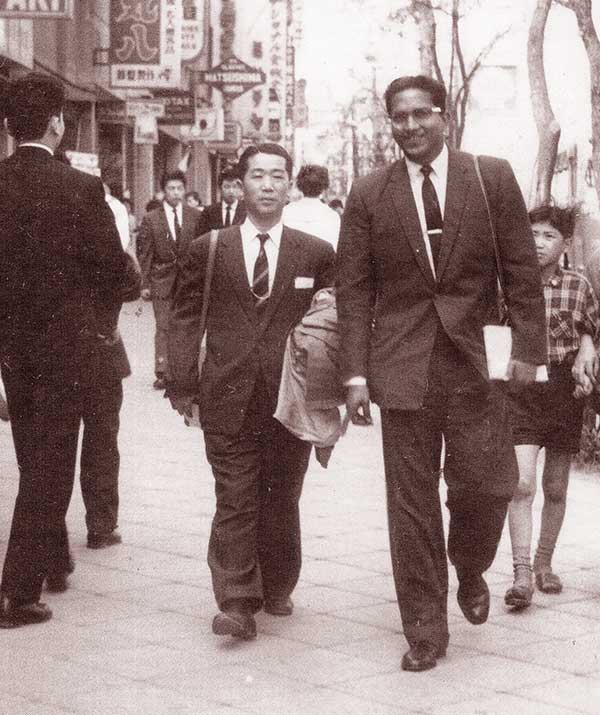
Before I set out for Jap1an, in 1960, on my first overseas business trip, I was advised by Terrence Allan of AF Jones to be extremely careful in the manner that I dealt with our agents in Japan, H. J. Kramer Limited, a Japanese company headed by Otto Gerhardt, a German national. Apparently, Gerhardt had been very apprehensive when he heard that I was due to visit him, as, previously, he had had only British Directors of the company on business visits.
He had been very concerned for his business and the interviews we had arranged. He did not know me personally and may have been very doubtful of my competence, whilst the fact that I was an unknown and unproven Asian would have also contributed significantly to his misgivings.
My first official meeting in Japan was with our biggest importer, Mitsui Norin. Two of its Directors, Messrs. Evakura and Saito, invited me to a tasting session – much to the surprise of Gerhardt. He was very nervous about the possible outcome, as if I did anything to displease or disappoint the Japanese clients, there was the possibility of losing a very good customer.
I started tasting the teas which had been set out and, at one point, came to a very zippy tea, much like a very good Darjeeling. When my hosts asked me about the identity of the tea, quite naturally I said that it was a Darjeeling but they disagreed and said that it was a Japanese tea. I responded that it could not be since in Japan they produced only Green Tea, Sencha, as I was unaware then that Japan produced quality Black Tea.
After the tasting session Otto told our Japanese hosts that he was taking me to Atami because I wanted to see Mount Fuji and, jokingly, invited them to join. To his very pleasant surprise, they welcomed the idea and accompanied us. Atami is a picturesque seaside resort, south west of Tokyo, set within the Fuji-Hakone-Izu National Park and also the home to Mount Fuji. On our way to Fuji we broke journey and checked into a traditional Japanese hotel in Atami itself. I was shown to a rather bare room which had a clothes cupboard but no bed. When I inquired I was told that a bed would be provided.
Japanese hospitality
Soon afterwards a traditionally-dressed Japanese lady came into my room, undressed me completely, and took me into a Japanese-style bathing stall. I sat on a large cane box whilst she poured soothing warm water over me. Thereafter, I was led back in to the bedroom which, by then, had been equipped, not with a conventional bed but a Japanese-style sleeping mattress and comfortable sheets.
The dinner which followed was again of delicately-prepared Japanese dishes and local wine. Right through the meal we were attended to by Geisha type hostesses, who sat demurely by each guest’s side and, unobtrusively, but with perfect timing, anticipated our minutest needs. After two very pleasant and adventurous days, we returned to Tokyo to resume our business discussions.
To Otto’s surprise and apprehension, Evakura and Saito invited me to their office for another tea tasting session. When I arrived I was confronted with a batch of teas, which included the same Japanese equivalent of Darjeeling tea. After tasting the samples, when I identified those teas as Japanese, my hosts contradicted me and said that it was Darjeeling, despite my repeated insistence to the contrary. Notwithstanding this disagreement, the visit ended very well. I am still convinced that I was right and they were simply testing my competence as a taster. Had they been disappointed, I am certain that they would have made it known in some way.
Consequent to my visit, our business with Japan increased fourfold — much to the annoyance of Lipton, then the major supplier to Japan. In fact, Claude Godwin, Lipton’s then Managing Director, asked me not to visit Japan ever again. Indeed, my first business visit overseas on behalf of A. F. Jones resulted in very satisfactory outcomes for the company. Following the visit to Japan, at different times, I made several visits on behalf of A. F. Jones to Libya and Iraq, two of our most productive markets in that period.
My success at A. F. Jones and Co. Limited, which was appreciated by my employer, was due to both good fortune and extremely hard work. I was personally deeply satisfied by the favourable results I was able to secure, despite the fact that many aspects of the relevant operations were quite new to me.
Opening of the USSR market
The General Election of 1956, which swept out the United National Party (UNP) and brought in the Mahajana Eksath Peramuna (MEP) coalition forces led by S. W. R. D. Bandaranaike, soon had its impact on international relations between Sri Lanka and the rest of the world. The anti-imperialist orientation of Premier Bandaranaike’s regime encouraged stronger ties with Marxist governments and, in December 1958, during my time at A. F. Jones, the Union of Soviet Socialist Republics (USSR – Russia) established its first Embassy in Ceylon.
This development was a consequence of formal diplomatic relations between the two countries being established in 1957. Subsequently, the many bilateral agreements signed between the two countries included the export of tea, rubber, coconut oil, and coir products. These agreements were renewed and updated in 1964, 1975, and 1977.
Traditionally, Russians were big tea drinkers, with imports being largely Black Tea from China. The first consignments of Ceylon Tea had reached Russia in the 1890s, with exports from Ceylon going up to about 18 million pounds annually by 1910. However, this was minimalistic in comparison to imports from China, which then were around 120 million pounds. After trade relations were disrupted consequent to the 1917 Bolshevik revolution in Russia, there was a four-decade lull in trading activity with Ceylon.
The first USSR Ambassador to Ceylon, Alexander Nikolaevich Yakovlev, was introduced to me by a mutual friend. Yakovlev was a friendly man and got on well with us. He requested me to help his Trade Counsellor, Felix I. Mikailchenkov, to set up a tea tasting facility in a house on Thurstan Road leased out by them for that purpose. When it was completed in mid-1958, Felix said: “I am entrusting you with the responsibility of purchasing our entire requirements of Ceylon Tea.” I did not realize how big the business would be until their orders arrived.
They turned out to be quite substantial, around three to four million kg per month, mainly of good High Grown BOPS and Pekoes. In view of the volume of tea involved, many of the larger firms operating in Colombo attempted to secure the purchasing, but the relationship I had already established with the Russian representatives stood me, and A. F. Jones, in good stead.
That rapid and unexpected increase in Russian buying had a significant impact on the auction, as our large purchases of High Grown tea became a regular feature. It resulted in A. F. Jones becoming the sole buyer on behalf of Russia and a big player at the auction. The Jones family was very grateful for my contribution to this welcome business development and presented me with a silver plaque, inscribed with the legend ‘MOCKBA — December 8, 1958’. It is still displayed prominently in my office at Peliyagoda.
Until the sudden development of the Russian market, the bulk of the AFJ business centred on the Middle East, with strong attachments in Libya, Iraq, and Iran. Whenever a Russian ship arrived in port to collect their tea, which was often at short notice, there would be a major crisis in our office. We used to start processing just prior to arrival of the vessels, as the tea chests arriving from the estates were not opened but shipped out in bulk, in their original form.
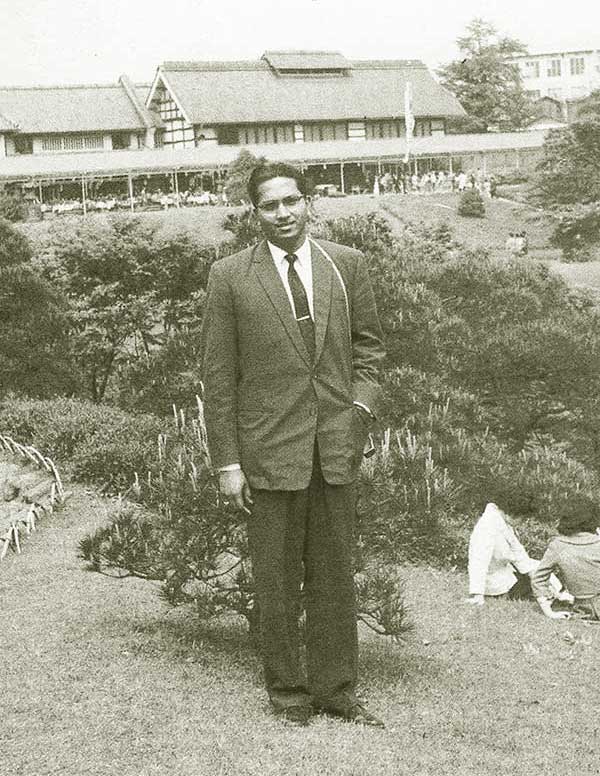
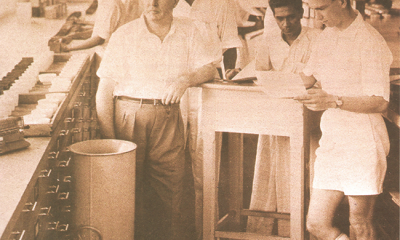
Sightseeing in japen -1960
However, four sides of each chest had to be marked with Russian text, defining the various Russian brands under which the product would be sold in Russia. Senior Managers at the Port, especially C. D. Chinnakoon, were of great assistance to me in such emergency situations. He would buy me time by holding ships in the outer harbour, pending berthing, and somehow providing berths when we were ready with our consignment.
Our Colombo Harbour then had limited alongside berthing facilities. Chinnakoon was a great friend and I always kept in touch with him. Unfortunately, he had an untimely death and I pray that he is in the hands of God.
We serviced the Russian market until the Sri Lankan Government entered in to a direct agreement with the Russian administration, and the tea buying was entrusted to Consolexpo.The Russian rubber business was carried out by C. W. Mackie under the supervision of Karu Jayasuriya, business manager now turned politician.
My Russian connections
Yakovlev, a senior Russian diplomat even at the time he arrived in Ceylon, became well known in the country for his very effective interaction with his Ceylonese counterparts, whilst his tireless promotion of USSR interests within the country, apart from tea, earned him many friends in the business community. On conclusion of his term in Ceylon he returned to the Foreign Ministry in Moscow. He subsequently served a 10-year term (1973-1983) as Russia’s Ambassador to Canada.
He was a very powerful party official in Russia, apparently very close to Prime Minister Mikhail Gorbachev. After his return from Canada on completion of his ambassadorial assignment, he served for several years as a member of both the Politburo and the Secretariat of the Communist Party of the Soviet Union. He is identified as the primary intellectual force behind ‘Glasnost’ and `Perestroika,’ highly influential in guiding Gorbachev’s hand in the latter’s political reform initiatives.
In ‘Gorbachev’ by William Taubman, possibly the most comprehensive original English biography of the architect of Perestroika, the author refers to Yakovlev as Gorbachev’s closest ally in Government. Until his death in 2005, Yakovlev remained politically very active and was also the author of several books, on diverse aspects of Russian contemporary political history.
In 1970, Yakovlev was replaced in Ceylon by Rafiq Nishonov, again a friendly, warm-hearted man. Eventually, both he and Rano, his gracious and friendly wife, became our family friends. One of his daughters, Firouza, was actually born during his term in Sri Lanka and together, they would frequently accompany me for holidays at my upcountry retreat, Melton Estate, in Lindula.
Rafiq, of Uzbek origin, served as Russian Ambassador in Sri Lanka from 1970-1978. During his period our tea export operations, supported by generous Russian patronage, grew considerably. Rafiq was always helpful to the local tea trading community, but ensured that his country’s interests were never compromised. Consequent to his return to USSR, he became heavily involved in party activities in his native Uzbekistan and between 1986 and 1989, served terms as Chairman of the Presidium of the Supreme Soviet of the Uzbek Soviet Socialist Republic and also, as First Secretary of the Communist Party of the Uzbek SSR.
I later learnt from him that he had been actively involved in assisting then Prime Minister Gorbachev, whom he was very close to, in resolving some tricky issues connected to the Russian entanglement in Afghanistan. I also understood that they were covert operations, deliberately withheld from the public domain.
On many visits to Moscow, I had several meetings with both Rafiq and his wife. Several times I was taken to his holiday ‘dacha’ in the country and also to the special hospital reserved for senior parliamentarians when I needed any medical attention. He also introduced me to several important Government officials, including the present Foreign Minister of Russia, Sergei Lavrov, who served in Ceylon during Rafiq’s tenure as Ambassador. In fact, during Rafiq’s term as Ambassador in Ceylon, because of Lavrov’s fluent command of Sinhala, he also served as Rafiq’s interpreter on official occasions.
Rafiq’s Deputy at the USSR Embassy was the big, powerfully-built Sasha Lysenko, a man of considerable influence in local diplomatic circles. Our business association developed in to personal friendship as well, and he and his wife became great friends with me. My close interaction with Russian diplomatic and trade representatives in Sri Lanka, provided me with highly-beneficial access to their counterparts and associates in Moscow. These contacts and relationships built up over the years were of great help to me subsequently in the development of my Dilmah brand.
I made my first business visit to Russia in 1962. Most of the Russian officials serving in various capacities in Sri Lanka, who I met in the course of my business, also became great personal friends. Without exception, I found them to be warm and friendly, naturally gregarious and, as a group, with a great capacity for enjoyment. Most of the Russians I met, both in Sri Lanka and in their home country, were, by and large, Asiatic in their unaffected friendliness and camaraderie, though they did take time to measure you. Once the ice was broken, they took you into their hearts and their homes. The difference between them and the typical Westerners, with their more restrained and often-guarded responses, was easily discernible.





SERIES: THE GREAT DIGITAL RETHINK — PART IV OF V
 Higher education spent 30 years going paperless. It digitised the lecture, the library, the exam hall and the staffroom. Then a student typed ‘write me an essay on Keynesian economics’ into a chatbot and handed it in. Now universities are doing something they have not done since the typewriter arrived: they are bringing back the pen.
The Most Digitised Place on Earth
If you wanted to find the institution most thoroughly transformed by digital technology, over the past three decades, the university is a strong candidate. The library card catalogue, once a tactile index of civilisation, is a database accessible from a phone in bed. Essays are submitted through portals, graded on screen, returned with tracked-change comments. Research is conducted on platforms, published in digital journals, cited by algorithms. Administrative life, timetabling, enrolment, fees, complaints, is almost entirely online. The university is, in the most literal sense, a paperless institution.
But the pen is coming back. And the reason is artificial intelligence, the very technology that was supposed to represent the final and irresistible triumph of digital over analogue in higher education.
Digital technology entered universities promising to make assessment smarter, faster and more flexible. It has instead produced a crisis of academic integrity so acute that the most sophisticated educational institutions in the world are responding by retreating to the oldest assessment technology available: a human being, a piece of paper, a pen, and a room with a clock on the wall.
Seven Thousand Caught. How Many Not?
In 2025, investigative reporting revealed that UK universities recorded nearly 7,000 confirmed cases of AI-assisted cheating in the 2023-24 academic year alone, roughly five cases per 1,000 students, five times the rate of the previous year. Experts quoted in the reporting were consistent in their view that confirmed cases represent a fraction of actual AI-assisted submissions. Nobody knows what the real number is. That, in itself, is the problem.
A student who prompts a language model to draft an essay on Keynesian economics, then edits the output to match their own voice and argumentation style, may produce something that no detection tool can reliably identify as machine-generated. The model writes fluently, cites credibly and argues coherently. The student submits with a clear conscience, having persuaded themselves that they were ‘using a tool’, in the same way they might use a calculator or a spell-checker.
Universities have responded with a spectrum of policies ranging from total prohibition of AI to the handwritten exam re-enters the story.
5,000 cases of AI cheating confirmed in a single year in UK universities. Experts say that’s the tip of the iceberg. The pen is suddenly looking very attractive again.
The Comeback of the Exam Hall
The move back is being driven not by a sudden rediscovery of pedagogical virtue but by the uncomfortable realisation that the alternatives, take-home essays, online submissions, project-based work submitted asynchronously, are now so vulnerable to AI assistance that they cannot reliably measure what the degree certificate claims to certify.
There is an additional irony, familiar to readers of this series, in the fact that AI-based exam has itself been in retreat since 2024, after mounting evidence of privacy violations, algorithmic bias and the fundamental absurdity of software that flags a student as a potential cheat for looking away from the screen to think. The technology brought in to protect digital assessment from human dishonesty has been replaced, in an increasing number of institutions, by a human invigilator. The wheel has turned.
The Open Laptop and Wandering Mind
The evidence is clear that open laptops in lectures serve, for a significant proportion of students, as gateways to everything except the lecture. Social media, news sites, messaging apps and casual browsing are the default destinations. The problem is not merely the student who disappears into their own digital world, research has documented a ‘second-hand distraction’ effect in which one student’s off-task screen use degrades the concentration of those seated nearby, whose peripheral vision catches the movement and brightness of the screen. A single open laptop in a lecture theatre affects not one student but several. The lecturer at the front of the room is competing, without knowing it, with whatever is trending on social media three rows back.
The note-taking research is more nuanced, as this series has noted previously. The finding that handwritten notes produce better conceptual understanding than typed notes is real but context-dependent, and the effect is attenuated when laptop users are trained to take generative rather than transcriptive notes. The practical takeaway for university teaching is not ‘ban laptops universally’ but something more specific: that the design of teaching environments, the explicit instruction given about how to take notes.
One student’s open laptop in a lecture degrades the concentration of every student seated nearby. The screen in your peripheral vision is not your problem. It’s everyone’s.
Critical Hybridity: What Comes After the Backlash
 Universities are too large, too diverse and too committed to digital infrastructure to undergo the kind of clean reversal visible in Nordic primary schools. They are not going to remove learning management systems, abandon online submission portals or stop using video conferencing for international collaboration. The digital transformation of higher education is, in most respects, real, useful and irreversible. The question is not whether to be digital, but which parts of university life benefit from being analogue.
What is emerging, hesitantly and imperfectly, might be called critical hybridity: the deliberate combination of digital and analogue practices based on what each is genuinely good for, rather than on what is cheapest, most fashionable or most convenient for administrators. Digital tools are excellent for access to information, for collaboration across distance, for rapid feedback on low-stakes work, for accessibility accommodations. Analogue settings, the supervised exam, the handwritten essay, the seminar discussion, the laboratory session, are excellent for demonstrating individual capability under conditions that cannot be delegated, automated or faked.
And What About the Rest of the World?
The universities of Finland, Sweden, Australia, the UK and their peers in the wealthy world have the institutional capacity, the data, the legal frameworks, the staff development resources, the research culture, to navigate this transition with some sophistication.
Universities in lower-income systems face a different set of pressures. Many are still in the phase of building digital capacity, installing platforms, training staff to use them, extending online learning to students in geographically dispersed or underserved communities. For them, the digital transformation of higher education is still a project in progress, still a marker of institutional modernity, still a goal rather than a problem. The AI cheating crisis, visible and acute in well-resourced universities, is less immediately pressing in systems where AI tool access is still uneven and where examination culture has remained more traditional.
But the AI tools are coming, and they are coming fast, and they are not arriving with an instruction manual explaining how to use them honestly. The universities that are grappling with this are acquiring knowledge that should, in principle, be shared. Whether it will be is the question this series will address in its final instalment: who learns from whom in global education, and who is always left holding the bill for everyone else’s experiments.
SERIES ROADMAP Part I: From Ed-Tech Enthusiasm to De-Digitalisation | Part II: Phones, Pens & Early Literacy | Part III: Attention, Algorithms & Adolescents | Part IV: Universities, AI & the Handwritten Exam (this article) | Part V: A Critical Theory of Educational De-Digitalisation
(The writer, a senior Chartered Accountant and professional banker, is Professor at SLIIT, Malabe. The views and opinions expressed in this article are personal.)
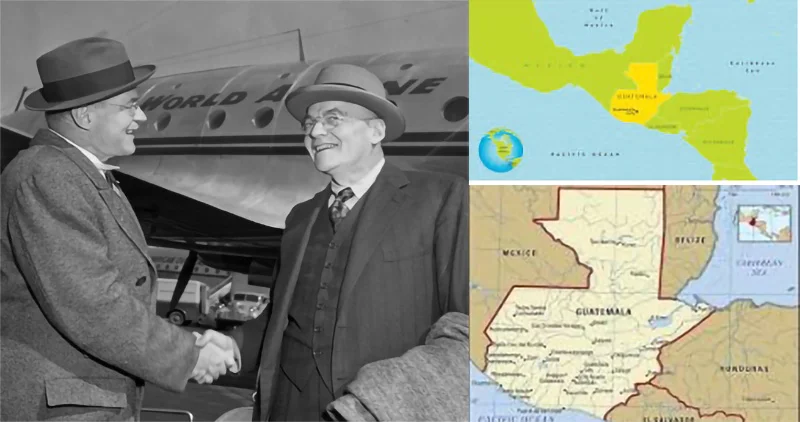
In 1944 Juan José Arévalo was democratically elected President of Guatemala. At the time a Boston-based banana company in Guatemala, called the United Fruit Company (UFC), had established and was running the country’s harbour, railways and electricity, to facilitate UFC’s fruit export business. It was a ‘state within a state’. The UFC received many concessions, yet corruption was rampant and local workers got a mere pittance as wages ($90 per year). Some 70% of the citizens, mostly of Mayan Indian origin, worked for 3% of the landowners who owned in excess of 550,000 acres. In fact, more than half of government employees were in the payroll of UFC. Needless to say, life under those tyrannical conditions was tough for ordinary Guatemalans who were illiterate and owed their souls to the UFC.
Those were the days of the ‘Cold War’, when a Communist was supposedly seen behind every bush – or a ‘Red under the bed’ – by US Senator Joseph McCarthy and all anti-Communists. A few years later, teachers in Guatemala, and other workers in general, demanded higher wages and were involved in strikes.
In 1951 there was another democratic election, and Jacobo Árbenz was appointed President with a promise to make the lives of Guatemala’s three million citizens better. He implemented a land reform act (No. 900) which forced UFC to sell back undeveloped land to the government, who in turn distributed it to the poor folk for farming sugar, coffee and bananas. It had been UFC’s practice not to develop all the land they owned, keeping some of it on ‘standby’ in case of hurricanes or plant disease. In fact, UFC had utilised only 15% of the land they owned. The new Guatemalan President himself contributed a sizable amount of his own land to the new scheme, while compensation paid to UFC, based on declared land value in the company’s own tax declarations, amounted to US$1.2 million.
However, it was USA’s Secretary of State, John Foster Dulles (after whom Dulles International Airport in Washington, DC is named), not UFC, who sent a letter to the Guatemalan government demanding the enormous sum of US$16 million in reparations. John Dulles and his brother, Allen W. Dulles, then head of the Central Intelligence Agency (CIA), had worked together as partners of the law firm Sullivan & Cromwell – which, not coincidentally, represented UFC. Allen Dulles was also a shareholder and board member of UFC.
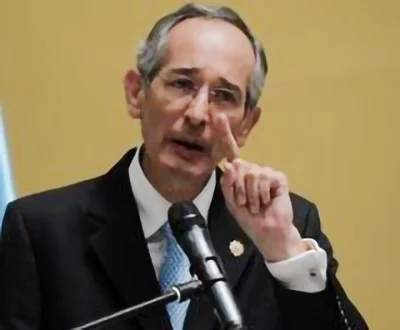
Jacobo Árbenz
The Dulles brothers were staunch Calvinists by religious denomination, and to them everything had to be ‘black or white’. At a secret meeting with the UFC board the two brothers were sold a lie saying that President Árbenz was a Communist, which was in turn conveyed to US President Dwight Eisenhower, who allocated money for covert operations to be conducted in Guatemala. Correspondents of The New York Times and Time magazine, sent to Guatemala and paid for by the UFC, began fabricating stories, known today as ‘fake news’, which were duly published by those respected and widely read publications.
One day in Washington, DC, Allen Dulles met Kermit Roosevelt – son of the late US President Theodore Roosevelt – who was in the process of engineering an Iranian regime change, and Dulles offered Roosevelt the opportunity to do something similar in Guatemala. But Roosevelt refused, claiming that there were too many loose ends to contend with. Subsequently, John E. Peurifoy was appointed as US Ambassador to Guatemala to direct operations from within.
The first attempt to undermine the Guatemalan government, code-named ‘Operation PBFORTUNE’, failed due to information leaks. A second attempt, dubbed ‘PBSUCCESS’, was launched later. Using a CIA-established radio station in Miami, Florida, called ‘The Voice of Liberation’ and pretending to be a rebel radio station inside Guatemala, the incumbent President Árbenz was accused of being a Communist. But in reality he was not a Communist, and did not have a single member of the Communist Party in his government. All he had done was to legalise the Communist Party in Guatemala, saying that they were all citizens of the country and democracy demanded it. Yet disinformation was spread liberally by the CIA, by means of fake radio broadcasts and aerial leaflet drops from unmarked American airplanes flown by foreign pilots. The same aircraft were then used to bomb Guatemala.
These American antics were observed by a young Argentinian doctor who happened to be in Guatemala at the time. His name was Ernesto ‘Che’ Guevara, who despite his anti-imperialist revolutionary fervour, chose not to become involved. Later, however, ‘Che’ went to Mexico where he joined the Cuban Castro brothers, Fidel and Raul, in their ultimately successful revolution which culminated in the dethroning of Cuba’s pro-US President Fulgencio Batista, and establishment of a Communist government in the Caribbean’s largest island.
Meanwhile in Guatemala, demoralised by the flood of fake news, in 1954 President Jacobo Árbenz stepped down from office and sought refuge in the Mexican Embassy. He was replaced as President by a US-backed, exiled military man, Carlos Castillo Armas, who was described as “bold but incompetent”.
Carlos Castillo Armas
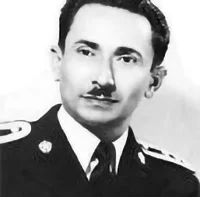
Carlos Castillo Armas
Guatemalan citizens loyal to the old regime were eliminated according to hit lists prepared by the CIA. Unmarked vans kidnapped people who were tortured and burnt to death. Ultimately, land was given back to the UFC.
It was a rule by terror that lasted for nearly 40 years, during which an estimated 200,000 people died. According to The Guardian, thousands of now declassified documents tell how the US initiated and sustained a murderous war conducted by Guatemalan security forces against civilians suspected of aiding left wing guerrilla movements, with the USA responsible for most of the human rights abuses.
This, I believe, became a template for destabilising and inducing regime change by the USA in other countries.
In the words of former US President Bill Clinton in 1999: “It is important that I state clearly that support for military forces or intelligence units which engaged in violent and widespread repression of the kind described in reports was wrong, and the United States must not repeat that mistake. We must and we will instead continue to support the peace and reconciliation process in Guatemala.”
God Bless America and no one else!
BY GUWAN SEEYA

Representatives of almost all the main opposition parties were in attendance at the recent book launch by Pivithuru Hela Urumaya leader Udaya Gammanpila. The book written by the PHU leader was his analysis of the Easter bombing of April 2019 that led to the mass killing of 279 persons, caused injuries to more than 500 others and caused panic and shock in the entire country. The Easter bombing was inexplicable for a number of reasons. First, it was perpetrated by suicide bombers who were Sri Lankan Muslims, a community not known for this practice. They targeted Christian churches in particular, which led to the largest number of casualties. The bombing of Sri Lankan Christian churches by Sri Lankan Muslims was also inexplicable in a country that had no history of any serious violence between the two religions.
There were two further inexplicable features of the bombing. The six suicide bombings took place almost simultaneously in different parts of the country. The logistical complexity of this operation exceeded any previously seen in Sri Lanka. Even during the three decade long civil war that pitted the Sri Lankan military against the LTTE, which had earned international notoriety for suicide attacks, Sri Lanka had rarely witnessed such a synchronised operation. The country’s former Attorney General, Dappula de Livera, who investigated the bombing at the time it took place, later stated, upon retirement, that there was a “grand conspiracy” behind the bombings. That phrase has remained central to public debate because it suggested that the visible perpetrators may not have been the only planners behind the attack.
The other inexplicable factor was that intelligence services based in India repeatedly warned their Sri Lankan counterparts that the bombings would take place and even gave specific targets. Later investigations confirmed that warnings were transmitted days before the attacks and repeated again shortly before the explosions, yet they were not acted upon. It was these several inexplicable factors that gave rise to the surmise of a mastermind behind the students and religious fanatics led by the extremist preacher Zahran Hashim from the east of the country, who also blew himself up in the attacks. Even at the time of the bombing there was doubt that such a complex and synchronised operation could have been planned and executed by the motley band who comprised the suicide bombers.
Determined Attempt
The book by PHU leader Gammanpila is a determined attempt to make explicable the inexplicable by marshalling logic and evidence that this complex and synchronised operation was planned and executed by Zahran himself. This is a possible line of argumentation in a democratic society. Competing interpretations of public tragedies are part of political discourse. However, the timing of the intervention makes it politically more significant. The launch of the PHU leader’s book comes at a critical time when the protracted investigation into the Easter bombing appears to be moving forward under the present government.
The performance of the three previous governments at investigating the bombing was desultory at best. The Supreme Court held former President Maithripala Sirisena and several senior officials responsible for failing to act on prior intelligence and ordered compensation to victims. This judicial finding gave legal recognition to what victims had long maintained, that there was a grave dereliction of duty at the highest levels of the state. In recent weeks the investigation has taken a dramatic turn with the arrest and court production of former State Intelligence Service chief Suresh Sallay on allegations linked directly to the attacks. Whether these allegations are ultimately proven or disproven, they indicate that the present phase of the investigation is moving beyond negligence into possible complicity.
This is why the present moment requires political sobriety. There is a danger that the line of political division regarding the investigation into the Easter bombing can take on an ethnic complexion. The insistence that the suicide bombers alone were the planners and executors of the dastardly crime makes the focus invariably one of Muslim extremism, as the suicide bombers were all Muslims. This may unintentionally narrow public attention away from the unanswered questions regarding intelligence failures, possible political manipulation, and the allegations of a broader conspiracy that remain under active investigation. The minority political parties representing ethnic and religious minorities appear to have realised this danger. Their absence from the book launch was politically significant. It suggests an unwillingness to be drawn into a narrative that could once again stigmatise an entire community for the crimes of a handful of extremists and their possible handlers.
Another Tragedy
It would be another tragedy comparable in political consequence to the havoc wreaked by the Easter bombing if moderate mainstream political parties, such as the SJB to which the Leader of the Opposition belongs, were to subscribe to positions merely to score political points against the present government. They need to guard against the promotion of anti-minority sentiment and the fuelling of majority prejudice against ethnic and religious minorities. Indeed, opposition leader Sajith Premadasa in his Easter message said that justice for the victims of the 2019 Sri Lanka Easter Sunday attacks remains a fundamental responsibility of the state and noted that seven years on, both past and present governments have failed to deliver accountability. He added that building a society grounded in trust and peace, uniting all ethnicities, religions and communities, is vital to ensure such tragedies do not occur again.
Sri Lanka’s post war history offers too many examples of how unresolved security crises become vehicles for majoritarian mobilisation. The Easter tragedy itself was followed by waves of anti-Muslim suspicion and violence in some parts of the country. Responsible political leadership should seek to prevent any return to that atmosphere. There are many other legitimate issues on which the moderate and mainstream opposition parties can take the government to task. These include the lack of decisive action against government members accused of corruption, the passing of the entire burden of rising fuel prices on consumers instead of the government sharing the burden, and the failure to hold provincial council elections within the promised timeframe. These are issues that touch the daily lives of citizens and the health of democratic governance. They offer the opposition ample ground on which to build credibility as a government in waiting.
The search for truth and justice over the Easter bombing needs to continue until all those responsible are identified, whether they were direct perpetrators, negligent officials, or political actors who may have exploited the tragedy. This is what the victim families want and the country needs. But this search must not be turned into a partisan and religiously divisive matter such as by claiming that there are more potential suicide bombers lurking in the country who had been followers of Zaharan. If it is, Sri Lanka risks replacing one national tragedy with another. coming together to discredit the ongoing investigations into the Easter bombing of 2019 is an unacceptable use of ethno-religious nationalism to politically challenge the government. The opposition needs to find legitimate issues on which to challenge the government if they are to gain the respect and support of the general public and not their opprobrium.
by Jehan Perera

Trump announces two-week ceasefire as Iran agrees to reopen Hormuz Strait

Yashasvi Jaiswal powers Royals past Mumbai Indians in 11-over thrash

Showers will occur at several places in the Western, Sabaragamuwa, Southern and North-western provinces and in Kandy, Nuwara-Eliya and Monaragala districts after 1.00 p.m.

The Sun is directly overhead Warakapola, Aranayaka, Gampola, Bibile, Inginiyagala, and Akkaraipattu at about 12:12 noon today (08)

AKD admits import of substandard coal, blames technicalities and supplier

‘Sri Lanka – China relations: Community with a Shared Future’ launched

‘Dates have the highest sugar content to fight Coronavirus’

Sunday Island 27 December – Headlines

#SundayIsland 17th December – Headlines

Sunday Island – 28th March

Sunday Island Headlines – 21 March

Sunday Island – 21st February – Headlines
-

 Features4 days ago
Ranjith Siyambalapitiya turns custodian of a rare living collection
-

 News7 days ago
2025 GCE AL: 62% qualify for Uni entrance; results of 111 suspended
-

 News4 days ago
Global ‘Walk for Peace’ to be held in Lanka
-

 Editorial7 days ago
Search for Easter Sunday terror mastermind
-

 News2 days ago
Lankan-origin actress Subashini found dead in India
-

 Opinion6 days ago
Hidden truth of Sri Lanka’s debt story: The untold narrative behind the report
-

 Opinion7 days ago
Is there hope for Palestine?
-

 Features4 days ago
Beyond the Blue Skies: A Tribute to Captain Elmo Jayawardena