
Foreign News
New charges for son of Norway’s crown princess on trial for rape


Prosecutors in Norway have charged the son of Norway’s crown princess with reckless behaviour and violating a restraining order a month after he went on trial for rape and dozens of other alleged offences.
Marius Borg Høiby was arrested the day before his trial began at the start of February, on suspicion of threats and violence against a woman in his flat in Oslo. Police remanded him in custody for the first four weeks of the trial.
Although allegations of bodily harm and knife threats have been dropped, prosecutors say the 29-year-old has admitted reckless behaviour and violating a restraining order.
He now faces a total of 40 charges and denies the most serious allegations.
Marius Borg Høiby is the son of Crown Princess Mette-Marit and grew up in the royal family, but he is not a member of Norway’s royal house. He was four when his mother married Crown-Prince Haakon in 2001.
He has admitted some of the 40 charges against him, but denies four counts of rape which all involve a woman who was either asleep or incapacitated after they had had intercourse.
The latest charges against him relate to a woman from the upmarket Frogner area of Oslo, who he was banned from contacting at the time.
He already admitted violating a restraining order relating to the same woman at the start of the trial and partially admits other allegations that date back to 2024.
Marius Borg Høiby was first arrested after a violent incident at the woman’s Frogner flat, and spoke at the time of suffering from mental issues for years.
Although it is unusual for further charges to be added during a trial, state prosecutor Sturla Henriksbø explained that this was possible if the defendant admitted the offences. Reckless behaviour can command a jail term of up to two years in prison.
By Tuesday the trial at Oslo District Court was 17 days into the 28 days allocated for the case, which is taking place amid tight restrictions requiring no images of either the defendant or the four women he is alleged to have raped.
The only woman who can be identified is a former girlfriend, Nora Haukland, who he denies abusing. She has already given evidence to the court that he kicked, punched and choked her during their relationship between 2022-23.
Last week an audio recording was played to the court of an argument in which Marius Borg Høiby could be heard hurling abuse at Ms Haukland, a Norwegian influencer with more than 100,000 followers on Instagram.
He denies being violent and his defence counsel says his ex-girlfriend did not in any way “live in a regime of fear”.
During Tuesday’s proceedings, the court heard from Nora Haukland’s former boyfriends, including one who spoke of their “peaceful break-up” and his respect for her, and another who described their relationship as turbulent.
If found guilty of the more serious charges he could spend at least 10 years in jail.
[BBC]

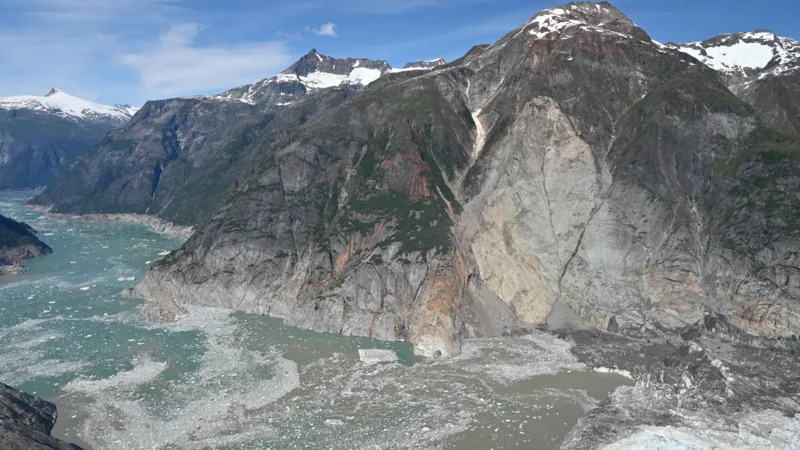
A massive ‘megatsunami’ wave created when part of an Alaskan mountain crumbled into the sea is the second tallest ever recorded – and a reminder of the risks posed by melting glaciers, say scientists.
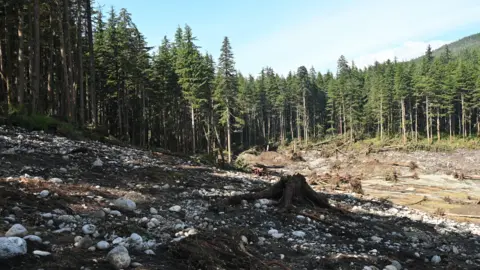
Last summer a giant wave swept through a remote fjord in southeast Alaska leaving destruction in its wake.
The event went largely unreported at the time, but a new scientific analysis shows it was caused by a massive landslide.
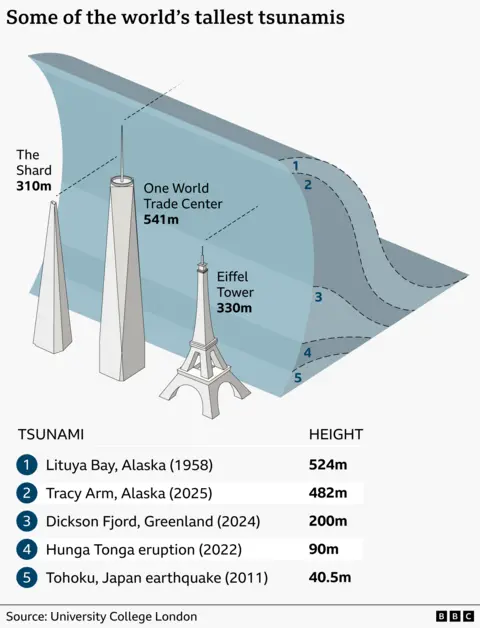
An incredible 64 million cubic metres of rock – the equivalent of 24 Great Pyramids – splashed into the water below. The sheer power of that amount of rock plunging into the fjord in under a minute created a gigantic wave almost 500 metres tall.
Only the time it happened – in the early hours of the morning – prevented tourist cruise ships being caught up in the devastation, say the researchers.
Dr Bretwood Higman, an Alaskan geologist, who saw for himself the damage at Tracy Arm Fjord, said it was “a close call”.
“We know that there were people that were very nearly in the wrong place,” he said. ‘I’m quite terrified that we’re not going to be so lucky in the future.”
These huge waves, labelled megatsunamis, happen when a landslide caused by either an earthquake or loose rock hit water below. They are usually localised and dissipate quickly.
The other type of tsunamis happen in the open ocean and are directly triggered by earthquakes, or occasionally other powerful events such as underwater volcanoes.
They, like the 2011 Japan tsunami, can travel for thousands of miles, hitting populated areas and causing widespread devastation and loss of life.
The biggest megatsunami was in the 1950s and was over 500 metres. This latest megatsunami was the second largest.
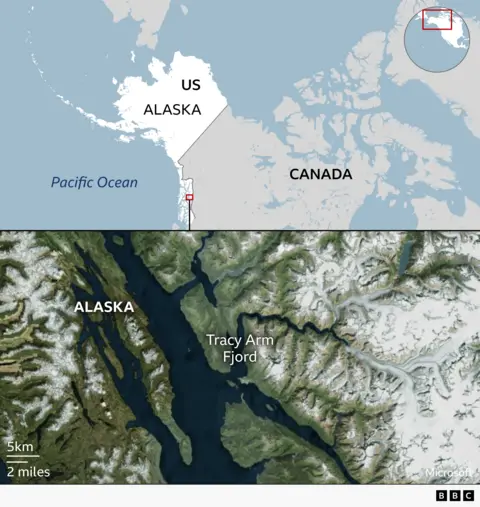
Dr Higman arrived on the scene a few weeks after the tsunami hit at the Tracy Arm Fjord – a destination popular with cruise ships exploring the natural wonders of Alaska.
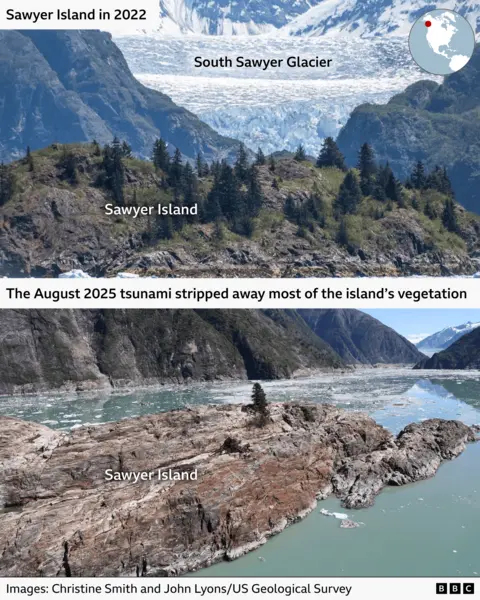
He found broken trees littering the mountainside and hurled into the water, and vast swathes of scarred rock stripped of soil and vegetation.
Alaska is especially vulnerable to megatsunamis because of its steep mountains, narrow fjords and frequent earthquakes.
Now new research published in Science suggests glacier melt driven by climate change is making such collapses far worse.
The team combined field work, seismic and satellite data to reconstruct a domino chain of events and trace the height of the wave.
Dr Stephen Hicks of University College London said the glacier was previously “helping to hold up this piece of rock”, and so when the ice retreated, it exposed the bottom of the cliff face, “allowing that rock material to suddenly collapse into the fjord”.
He and his colleagues have studied tsunamis for decades and are worried.
“More people are now going to remote areas – often these tourist cruises are going to see the natural beauty of the area to actually learn more about climate change – but they are also dangerous places to be.”
Dr Higman said there is little doubt that the risks of megatsunamis are increasing.
“At this point, I’m pretty confident that these are increasing not just a little bit, but increasing a lot,” he said.
“Maybe in the order of 10 times as frequent as they were just a few decades ago.”
The scientists are calling for wider monitoring of hazards in parts of Alaska that might be vulnerable to megatsunamis.
Some cruise companies have announced they are to stop sending ships into Tracy Arm amid safety fears.
[BBC]
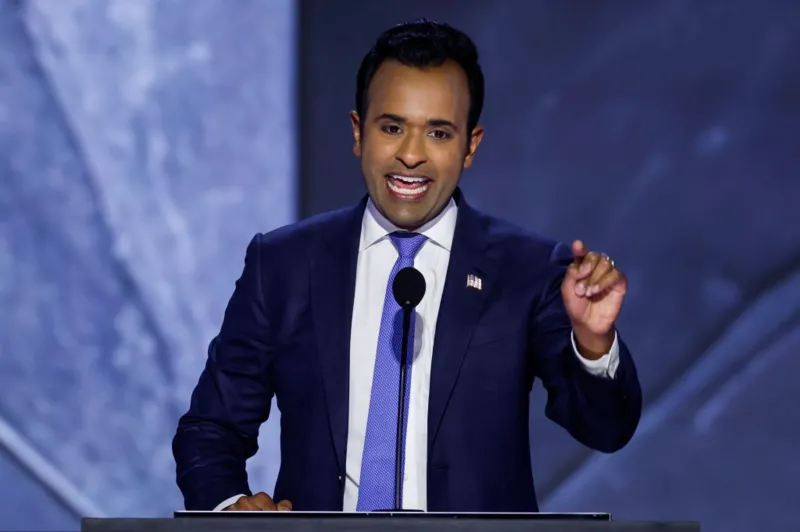
Vivek Ramaswamy won the Republican nomination for Ohio governor on Tuesday, putting the staunch ally of Donald Trump on a path to running the Rust Belt state.
In unofficial results, he defeated Casey Putsch, a car designer with an automotive-themed YouTube channel, for a place in the general election, according to US media reports.
Ramaswamy, a health-technology entrepreneur, gained national recognition during his unsuccessful run against Trump for president in 2024. He later threw his support behind Trump.
In the Ohio primary, even as he ran against Republicans, he focused on Democratic nominee Amy Acton, the former Ohio public health director who guided the state’s response to the Covid pandemic and ran unopposed.
During a victory speech, Ramaswamy thanked Ohio voters “for getting us to this point”, adding, “The real destination is in November.”
Acton, who will face Ramaswamy in the general election, said during her own victory speech that she is running for governor to make Ohio more affordable again.
“It shouldn’t be this hard,” she said. “It is time to put working families first.”
Ohio’s current governor, Republican Mike DeWine, cannot run for re-election because of term limits.
Trump boosted Ramaswamy in a social media post on Tuesday: “I know Vivek well, competed against him, and he is something SPECIAL. He is Young, Strong, and Smart!”
Vice President JD Vance, who previously represented Ohio in the US Senate, travelled to Cincinnati on Tuesday to cast his ballot for Ramaswamy and others.
The state has shifted towards Republicans in recent years, and Ramaswamy benefitted from name recognition and shuffling in the top ranks of the state’s Republican Party caused by the ascension of Vance to the vice presidency.
Ramaswamy burst onto the national political scene in 2023 as a neophyte with a knack for using social media and podcast appearances to bolster his image. His mile-a-minute cadence and brash attacks resulted in viral moments during the 2024 Republican presidential debates, but he dropped out early due to lackluster support from voters.
Ramaswamy went on to serve as a top Trump surrogate during the 2024 presidential race and was involved in the effort to start Trump’s Department of Government Efficiency, before ceding control of the project to Elon Musk.
When he announced his run for Ohio governor, Ramaswamy cleared the Republican primary field of most competitors. He has drawn on his personal fortune to help fund his campaign; The Columbus Dispatch reported he loaned his operation $25m (£18.4m).
His victory sets up a general election campaign focused on the lingering fallout from the Covid-19 pandemic.
Acton had a highly visible role as the state’s public health director during the height of the crisis. Under DeWine’s leadership, Ohio took a more moderate approach to the pandemic response than other Republican-controlled states. Still, Ohio suspended in-person dining and postponed its presidential primary in 2020 as the virus spread.
But ongoing political backlash to Covid-19 restrictions, including masking and school closures, has opened up a path for Republicans to attack Acton six years later.
Ramaswamy recently released an ad claiming that Acton “called off Ohio’s election at the last minute, defying a judge’s order and abusing her power.”
DeWine – who has endorsed Ramaswamy – took the unusual step of defending Acton from the ad’s claims.
“I told her to issue the health order,” DeWine told NBC4 news station. “The decision was mine.”
The race promises to get more intense and expensive heading into the general election in November.
Meanwhile, seven Republican senators in Indiana who voted against Trump’s redistricting plan faced challengers in Tuesday’s primary election.
Five of the Trump-backed challengers have beat the incumbents, while one has lost. Results for the seventh race have not yet been determined.
The Indiana Republicans defied intense pressure from Trump last December by rejecting his demands to pass a voting map meant to favour their party in midterm elections, scheduled for November.
In one of the most conservative states in the US, 21 Republicans in the Senate joined all 10 Democrats to torpedo the redistricting plan last year.
Trump warned at the time that Republicans who did not support the initiative could risk losing their seats.
[BBC]
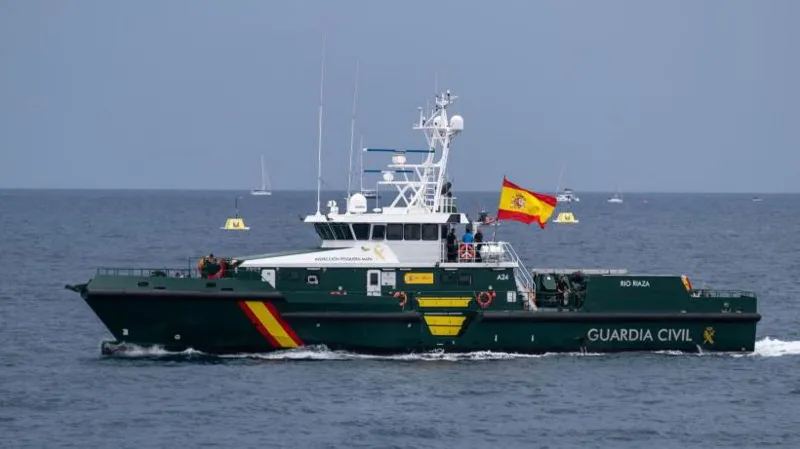
Spanish police have seized what is thought to be a national record haul of cocaine from a ship in the Atlantic Ocean.
Between 30,000 to 45,000kg were found when the Civil Guard intercepted a freighter in international waters, the body’s main union, the AUGC, announced. It called the move a “historic blow to drug trafficking”.
The vessel was intercepted off Spain’s Canary Islands on Friday and around 20 people were arrested, the AUGC told the AFP news agency. It had travelled from Sierra Leona and was on its way to Libya.
The Civil Guard has declined to give details of the investigation for legal reasons.
Interior Minister Fernando Grande-Marlaska told reporters in Madrid that the seizure was “one of the biggest, not only nationally but internationally”.
The Civil Guard shared a photograph on X showing the drugs stuffed into the hold of the intercepted vessel.
“Today history is being written in the Maritime Service of the Civil Guard,” it wrote.
“Intercepted in international waters the largest known seizure: between 30,000 and 45,000 kg of cocaine on board a freighter.”
While the boat was headed to Libya, AFP reported that the pattern of previous operations suggests that it was due to offload the drugs onto smaller vessels for distribution in Europe.
In January, Spanish authorities made its biggest seizure of cocaine at sea from a ship that was carrying almost 10 tonnes.
[BBC]

Debutant Awais leads Pakistan’s strong reply after Abbas five-for

Peter Magyar sworn in as Hungary’s PM, ending Orban’s 16 years in power

Senior Sri Lankan monk arrested for alleged child sex crimes

Trade, Investment and Tourism Cooperation Forum strengthens economic ties between Sri Lanka and Vietnam

Accelerate projects related to resolving the public’s drinking water issues – President Instructs Officials

President of Vietnam and delegation departs Sri Lanka

‘Dates have the highest sugar content to fight Coronavirus’

Sunday Island 27 December – Headlines

#SundayIsland 17th December – Headlines

Sunday Island – 28th March

Sunday Island Headlines – 21 March

Sunday Island – 21st February – Headlines
-

 News3 days ago
MIT expert warns of catastrophic consequences of USD 2.5 mn Treasury heist
-
 News5 days ago
CJ urged to inquire into AKD’s remarks on May 25 court verdict
-

 News6 days ago
USD 3.7 bn H’tota refinery: China won’t launch project without bigger local market share
-

 News7 days ago
Easter Sunday Case: Ex-SIS Chief concealed intel, former Defence Secy tells court
-

 Business7 days ago
Dialog Surpasses 1,000 5G Sites, Strengthening Nationwide 5G Coverage
-

 Editorial3 days ago
Clean Sri Lanka and dirty politics
-

 Editorial6 days ago
Deliver or perish
-

 Opinion5 days ago
Security, perception, and trust: Sri Lanka’s delicate balancing act