
News
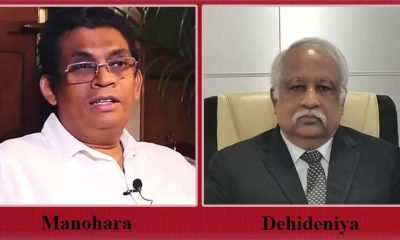
Manohara makes strong case for draft Constitution, responds to criticism


By Shamindra Ferdinando
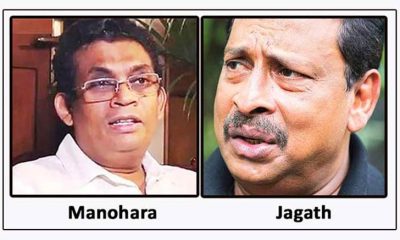
President’s Counsel Manohara de Silva has strongly defended the retaining of the controversial 13th Amendment introduced at the behest of India in the new draft Constitution formulated by a 9-member committee appointed by former President Gotabaya Rajapaksa.
Manohara, one of the members of the committee headed by Romesh de Silva, PC, emphasised that the controversial Amendment enacted in the wake of the Indo-Lanka Accord signed in July 1987 had been diluted by the draft Constitution therefore Provincial Council system no longer posed a threat to the country’s unitary status.
An outspoken critic of foreign intervention, Manohara said so at a symposium organized by the Buddhasasana Karyasadaka Mandalaya at Sri Lanka Foundation (SLF) recently.
The constitutional expert challenged those skeptical of the draft Constitution to prove the committee wrong. The lawyer appreciated the Buddhist grouping taking the lead in educating the public on the proposed Constitution in the absence of the Wickremesinghe-Rajapaksa government taking any interest in the ex-President’s project.
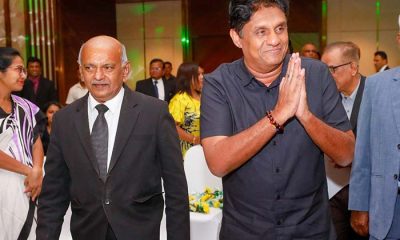
However, on behalf of the Coalition Against Partition of Sri Lanka, its Convener retired Lt. Gen. Jagath Dias sought an explanation from the committee regarding the representations made by the Tamil National Alliance (TNA), one-time LTTE ally, pertaining to new constitutional proposals.
The Gajaba Regiment veteran also asked whether the discourse on the draft Constitution initiated on Oct. 12 would continue and the availability of an opportunity to make suitable amendments having considered fresh views in that regard.
Lt. Gen. Dias, who has declared that the full implementation of the 13th Amendment would undermine Sri Lanka’s unitary status, stressed the need for wider consultations regarding constitutional amendments.
President’s Counsel Romesh de Silva declined to reveal the submissions made by the TNA delegation, led by its leader R. Sampanthan. De Silva received the backing of four members of his committee, namely Manohara de Silva, Sanjeewa Jayawardena, PC, Samantha Ratwatte, PC and Navin Marapana, PC.
The team leader said that the dialogue between them and the TNA or any other party couldn’t be discussed publicly though necessary amendments could be effected following discussions. The committee explained that their responsibility was to produce a draft Constitution and further actions should be the prerogative of the government in power. The committee acknowledged that since the handing over of the draft Constitution to the then President, nothing has been done. The gathering was told that based on further discussions on the subject matter the process could be advanced in consultation with relevant parties.
Manohara de Silva said that in the absence of the Gotabaya Rajapaksa government and the Wickremesinghe-Rajapaksa government sleeping on it, Buddhasasana Karyasadaka Mandalaya, invited them to educate the public of the initiative. “We are only invitees here. Perhaps, they’ll continue this process,” the top lawyer said.
Ven. Athureliye Rathana, MP, threw his weight behind the effort. The MP monk asserted that the draft Constitution cleverly proposed a way out of a sensitive issue as it involved India and couldn’t be dealt with haphazardly. The monk stressed the need to further improve the section that dealt with waste, corruption and irregularities and closer look at economic policies. The former JHU heavyweight pointed out how Sri Lanka handled the power sector without adhering to tender procedures, thereby causing enormous loss to the national economy.
In his speech, Manohara de Silva responded to criticism directed at their draft Constitution. Declaring that what had been proposed was not the 13th Amendment that was already in the Constitution now, the lawyer said that they opposed it because the Provincial Council exercised more powers than the government.
The crux of the matter is in case Provincial Councils enacted a law in terms of the current Constitution, the Parliament has no say. The 13th Amendment to the Constitution has been enacted at the expense of Parliament, Manohara said, adding that the Supreme Court that was sharply divided on the issue allowed the law to be passed on the basis the Parliament with a two-thirds majority could do away with it.
Therefore, the 13th Amendment diluted the power of Parliament, the lawyer said, declaring that draft Constitution proposed that though the Provincial Councils could enact laws relevant, Parliamentary laws wouldn’t be undermined by them. De Silva explained that the 13th Amendment compelled the Governors of the Provinces appointed by the President to work in consultation with the provincial ministers. Alleging it dented the executive authority pertaining to what he called provincial subjects, Manohara said that they proposed measures to be taken against in case Provincial Councils resorted to wrong executive decisions.
Perhaps one of the most significant proposals was to do away with elections to the Provincial Councils, the lawyer said, explaining how the required number of PC members could be elected at the Local Government polls, thereby saving quite a considerable amount of funds. Manohara de Silva stressed that what was proposed by them were not the PCs established under the current law.
“Some asked why the whole thing was not scrapped altogether. We discussed this matter. We could have formulated the draft constitution without the relevant section on Provincial Councils,” he said, referring to various constitution making attempts with the focus on the project undertaken by M.A. Sumanthiran, MP, and the then UNP National List Member Dr. Jayampathy Wickremaratne during the Yahapalana administration.
Warning the audience of the threat posed by President Ranil Wickremesinghe’s declaration that he intended to build on the Yahapalana constitutional project, De Silva said that political parties represented in Parliament, and outside, wanted the PC system to continue. Those who had appeared before the committee sought the continuation of the PCs as they wanted their offspring and henchmen to use them as launching pads for parliamentary careers. Therefore, the only option available was to dilute the PCs as the Parliament wouldn’t allow abolition of PCs, the lawmaker said, declaring no government would do so. An irate de Silva said that those represented in Parliament wanted the expansion and strengthening of the system.
Manohara said that members of the nine-member committee could have produced nine different drafts. But, they decided to sink whatever the differences to produce one document that took into consideration views expressed by political parties represented in Parliament and outside.







Appointment of committee eyewash, says UNP
The government is considering changes to prison regulations pertaining to the treatment of Buddhist monks serving jail terms, including their right to wear monastic robes when taken outside prison.
Justice and National Integration Minister Harshana Nanayakkara announced the proposed changes yesterday (14) following the submission of an interim report by a committee appointed to review the rules and procedures governing prisons.
The report was handed over to Secretary to the President Dr Nandika Sanath Kumanayake at the Presidential Secretariat.
One of the key recommendations is to amend Prison Standing Order 356 by introducing a new provision, 356(A). The proposed revision would require prison authorities to consult the Department of Buddhist Affairs on the removal of a monk’s robes upon admission to prison. The Commissioner of Prisons would be allowed 10 days to notify the department and take the necessary steps.
A separate amendment to Departmental Order 550 would allow Buddhist monks to wear their robes whenever they are taken outside prison, unless their respective Nikaya formally requests that the privilege be withdrawn.
The committee has also recommended extending similar arrangements, with suitable modifications, to members of other religious clergy who are imprisoned.
The proposals follow concerns raised over the treatment of Ven. Galagoda Aththe Gnanasara Thera after he was taken into custody. President Anura Kumara Dissanayake subsequently held discussions with representatives of the three main Buddhist Nikayas and appointed the committee to examine the existing legal framework.
Nanayakkara said the interim report had been forwarded to the Acting Commissioner General of Prisons, along with instructions to revise the relevant standing orders in accordance with its recommendations.
The proposed amendments have yet to be confirmed as formally implemented.
Meanwhile, the UNP yesterday criticised the government’s decision to appoint a committee to make recommendations on the attire to be worn by imprisoned Buddhist monks and other religious leaders when taken outside prison, describing the move as unnecessary.
In a statement issued yesterday (14), the UNP said the procedures governing the matter were already clearly set out in the Department of Prisons’ Standing Orders, making the appointment of a separate committee unwarranted.
The party cited remarks by Professor G.L. Peiris, Convenor of the Janathawadi Joint Opposition, who had described the committee’s appointment as a
“complete eyewash” and questioned the need for such a move.
Referring to Standing Order 550 of the Prisons Department, the UNP said convicted prisoners appearing before court for legal proceedings should not be required to wear prison uniforms.
It further stated that the regulations allowed prisoners to wear civilian clothing consistent with what they wore before imprisonment, including attire appropriate to their cultural and religious backgrounds.
The UNP accused the government of unnecessarily prolonging the issue by appointing a committee, despite the existence of regulations governing prisoners’ attire.
The party also called on the government to seek forgiveness from the Mahanayake Thera and the Sangha Council of the Kotte Sri Kalyani Samagri Dharma Maha Sangha Sabha of the Siyam Maha Nikaya over the decision concerning the religious attire of Ven. Galagoda Aththe Gnanasara Thera.
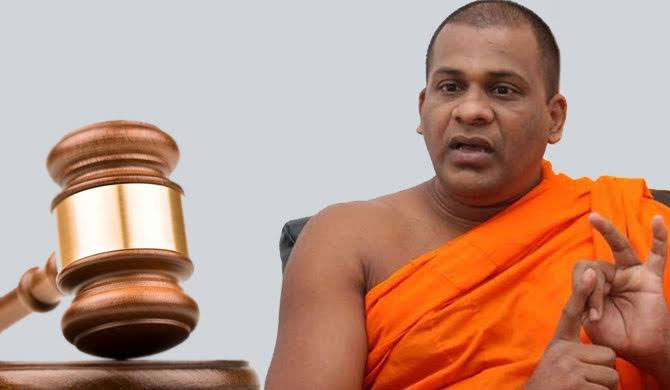
Court of Appeal President Justice Rohantha Abeysuriya yesterday withdrew from the bench hearing petitions challenging the decision by prison authorities to require Ven. Galagoda Aththe Gnanasara Thera to wear prison attire following his imprisonment.
The decision was announced when the petitions seeking to invalidate the prison authorities’ decision were taken up for consideration on October 14.
Following his withdrawal, a three-judge bench was appointed to hear the petitions.
The petitions relate to the prison authorities’ decision to require Gnanasara Thera to wear prison attire after he was taken into custody to serve the remainder of his sentence for contempt of court.
In September this year, the Supreme Court annulled the presidential pardon granted to Gnanasara Thera by former President Maithripala Sirisena in May 2019.
Following the ruling, the Court of Appeal directed the Commissioner General of Prisons to take the necessary steps to enforce the remainder of the monk’s prison sentence.
Gnanasara Thera had originally been sentenced to six years’ imprisonment for contempt of court but had served only around nine months before receiving the presidential pardon in 2019.
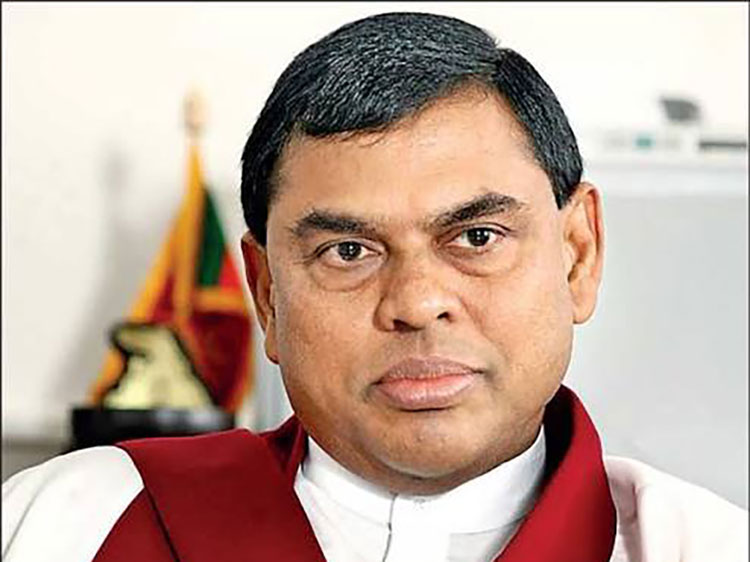
The Fort Magistrate’s Court yesterday issued an arrest warrant for former Minister Basil Rajapaksa over the alleged misuse of funds belonging to the Sri Lanka Tourism Promotion Bureau during the 2014 Uva Provincial Council election.
The Magistrate also directed the CID Illegal Assets Investigation Division to take necessary steps to obtain a Red Notice through Interpol.
The orders were issued following submissions made by the CID in connection with the alleged financial irregularities.
The CID’s Illegal Assets Investigation Unit informed the court that Rs. 7.8 million allocated to the Sri Lanka Tourism Promotion Bureau in 2014 had allegedly not been used for the Bureau’s promotional activities.
Instead, the funds had allegedly been used to provide 12,000 T-shirts during the Uva Provincial Council election, causing a financial loss to the government, the CID told court.

Showers or thundershowers will occur at most parts of the island

Prison rules to be revised over monks’ attire

AC President recuses himself from hearing prison attire case pertaining to Gnanasara Thera

Court orders steps to obtain INTERPOL Red Notice against Basil

CID informs Fort Magistrate’s Court investigation into money laundering case against Namal completed

No force used to make Gnanasara Thera wear prison garb – Prisons

‘Dates have the highest sugar content to fight Coronavirus’

Sunday Island 27 December – Headlines

#SundayIsland 17th December – Headlines

Sunday Island – 28th March

Sunday Island Headlines – 21 March

Sunday Island – 21st February – Headlines
-

 News6 days ago
NDB fraud Rs 60mn more than reported
-

 News6 days ago
Removing monk’s robes matter for Sangha to decide: Mahanayake Theras
-
 News5 days ago
NPP govt. reminded of its responsibilities as US warship leaves Colombo
-

 News4 days ago
Sri Lanka escalates anti-graft drive with Shiranthi’s jailing
-
 Latest News6 days ago
Farhan, Sadaqat help Pakistan ace 183 chase to go 1-0 up
-
 News6 days ago
BHC, Colombo: “LTTE remains a proscribed org. in the UK”
-

 Latest News4 days ago
Farhan and Sadaqat help Pakistan seal series in style
-

 News4 days ago
Iranian ships stranded, Lanka fears US sanctions