
Features
Lighter moments in the University of Ceylon in the 1960s

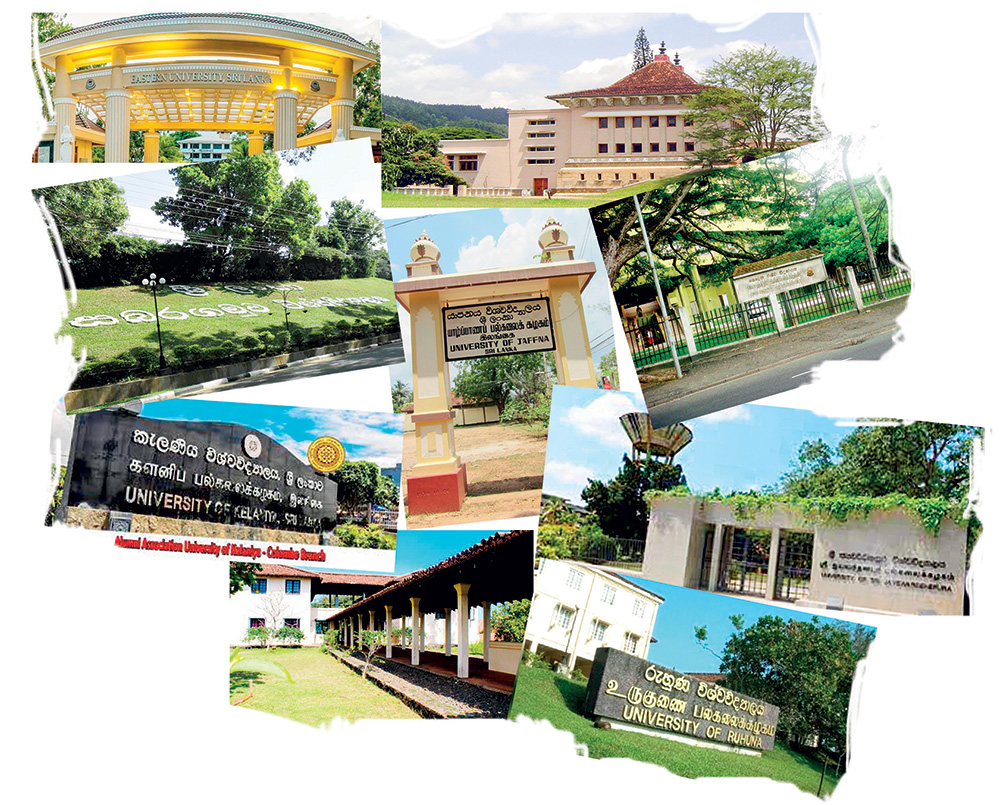
In the 1950’s and early 60’s the only sure path for students to pursue a professional career was through the University of Ceylon. The most difficult University to get into was one’s own. Why? Because everyone wanted to get in, so the competition was tough. Allowing for the differences in schooling opportunities and teaching standards across the country, and vagaries such as examination blues, keen competition ensured that only the creme-de-la-crème of the youth of our time entered the hallowed portals of the two campuses in Colombo and Peradeniya. It follows that the University, by many measures, was the “academic citadel” for the youth of our time.
The unique status of the University of Ceylon at the time was depicted by a ditty that likened it to the institution of marriage: The title tells it all in the midst of serious study, assignments/ course-works whilst burning mid-night oil.
‘Those who are in it, are trying to get out;
Those who are out, are trying to get in;
Those who tried to get in, and coul
d not get in;
Speak ill of the institution.’
Vice Chancellors And Professors
At the time I entered the University, the Vice Chancellor of theUniversity of Ceylon was Sir Nicholas Attygalle, a powerful and charismatic personality, who was concurrently the Dean of the Faculty of Medicine. The Dean of the Faculty of Science was Professor B. L. T. de Silva, whose specialty was Botany. All university final exam results had to be approved by the University Senate. Heads of all Faculties, including the two senior professors mentioned above, were members of the Senate. The non-voting member was the University Registrar.
While Senate sessions to approve examination results were largely a formality, there were occasions when some discretion was required to resolve the cases of students with marginal performance at the finals. As a rule, Sir Nicholas took the stand that a medical doctor cannot be released into society unless the pass mark has been reached in ‘all’ subjects. He was against passing a medical student who was ‘a marginal case’. He was firm in his conviction.
The day came when the issue was whether to grant a pass to a veteran student taking Botany Honours. The student had failed in his two previous attempts at the final examinations. Finals were held only once a year. At his third ‘shy’ the student had passed in three subjects; in the fourth, his score was 37, three short of the pass mark of 40. The Senate had to agree to raise the score of 37 to 40 for this student to be awarded the degree. A key condition to do so was agreement by the subject matter Professor. As it was Botany, B.L.T. de Silva’s approval was mandatory.
B.L.T. de Silva assumed a stance similar to Nicholas Attygalle in refusing to grant a degree if a student had not achieved the pass mark in all four subjects. Nicholas found this exasperating, probably because he appreciated the enormity of a “veteran” student having to come back again to sit the examination in another year’s time if he were not granted his degree at these
sessions.
Nicholas had the final say as the Chairman of the Senate and Vice Chancellor, and cajoled: ‘I say, BLT, push the bugger up, push the bugger up, please. Only a bloody plant will die!’ BLT acceded and there is a baby boomer botanist today who owes his career to Sir Nicholas Attygalle.
Rendezvous
From the stately library building at the Peradeniya Campus, it is a short trek on the footbridge across the Mahaweli to Akbar- Nell Hall, the hall of residence located adjacent to the Faculty of Engineering (affectionately referred to as the EFac). The EFac itself had its lecture rooms and laboratories in hangar-like halls on either side of a wide and open corridor some 400 meters long. The layout presented an impressive open-air vastness particular to this Faculty. At one end of the corridor was the canteen and at the other the Akbar-Nell Hall, home to many EFac students. Of all the academic faculties in Peradeniya, the EFac probably had students from the widest socio-economic range of Sri Lankan society.
Among them, in our time, was a student from a wealthy family who had the only car among the Akbar-Nell residents. To his credit, he was a clean living and charitable soul. He lent his car to friends in a spirit of camaraderie, with no questions asked about the purpose for which it was to be used.
‘Machang! I need to take Beatrice out tonight for a film,’ was enough for him to lend the car. On another day it was another friend taking Latha out. No questions about what might happen in the back seat with Latha. He also obliged friends who were taking out Kamala, Lolita, Nirmalee or Pathma (all fictional names randomly picked and any resemblance to anybody living is completely unintentional).
But this student had one failure (a couple, in fact): he failed to get through his exams in the first attempt. The Dean of the Engineering Faculty was Professor E.O.E. Pereira, a mustachioed, pipe smoking, charismatic Burgher gentleman. His exterior was stern, but on the inside he was a kind and fatherly figure to the students.
The Annual Sessions of the Institution of Engineers was held in 1968 in Colombo. The guest speakers included Professor EOE (as he was affectionately called) and the General Manager of Railways (GMR). An interesting conversation took place on the podium.
‘Hello, EOE, how are you?’ asked the GMR
‘Very well; and how is the railway network?’ ‘Progressing smoothly. But EOE, I have a problem.’ ‘What is it?’
I have a nephew studying under you. He is a bright chap, but he is failing his exams,’ was the GMR’s uneasy answer. ‘What is his name?’
The name was provided by GMR. EOE’s eyes lit up in understanding.
‘Has he got a car?’ ‘Yes, yes he has a car, you know him EOE?’ asked the GMR,
with excitement in his voice. ‘I know him well, I trust’, EOE said. ‘That is a relief. I hope you can help him, EOE?’ ‘I can, but he has to study harder.’ ‘How do you mean?’ was the troubled GMR’s query about his nephew. ‘I go to the Faculty Club every night for a drink and then drive up Hantane Hill to my residence at about ten o’clock in the night for dinner.’
If the GMR was wondering what EOE’s time of returning home at 10 in the night had to do with his nephew, he was about to learn its significance.
‘When I return home from the club, I see his car parked near the Hantane bypass, and he is with his girl-friend in the car,’ and EOE added, ‘You will have to ask him to pull up his pants and start studying seriously!’
It would have been fascinating to have been a fly on the wallduring the subsequent meeting between the uncle and the nephew: the nephew strongly denying any nightly escapades, and the uncle discounting any arguments on the basis of the unimpeachable witness’ account of the Dean of the Faculty of Engineering!
EOE in 1969 deservedly became the Vice Chancellor. The nephew of the GMR, I am glad to say, put his head down following EOE’s advice, and graduated. He retired as a very successful Hospital Engineer, and resident in a chic suburb not far from London.
Peradeniya Rest House and The Man Of God
The most popular restaurant among Peradeniya undergrads in 60’s was Lyons in Kandy. This was the place where the fare was easy on the pocket and the portions generous, an attractive combination to the campus fraternity with tight budgets. The up-market place was El Sombrero, a part of Queen’s Hotel. At Lyons, a mixed grill of steak, bacon, sausage and a “bulls-eye” was Rs 2.50 and a bottle of beer was Rs 3.00; at El Sombrero they were Rs 4.50 and Rs 4.00 respectively. Thus the latter location was reserved for a very special occasion. Being on about Rupees Ten (10) pocket money per week one had to choose the eating places wisely.
Then there was the East China Hotel opposite the lake. Here a plate of fried rice was served with a boiled egg. This was a clincher to cut down on costs, especially if there was a “biju- terian” (the Peradeniya vernacular for an egg eating-vegetarian!) in the group as the cost of ordering a special vegetable dish would also be averted.
However the pride of place for a meal went to the Peradeniya Rest House located much closer to the campus: it was set in a grove of trees opposite the entrance to the Botanical Gardens. The Rest House was run by the Kandy Municipality, which
adhered strictly to local government regulations. The rule that guests had to register in the guest book was not an issue, but an annoying quirk in the regulations – namely, that liquor could not be sold to those living within the Peradeniya local government area – was a hindrance, as this meant that students in the university campus would not be served liquor at the Rest House. So a strategy had to be hatched to beat the inequity of this rule.
An Engineering Faculty (EFac) undergrad and friends from Akbar Nell Hall signed in the Guest Book as ‘Bevis Perera (not his real name) and friends’ from Kollupitiya. The waiter winked knowingly. Several glasses of beer and an excellent meal were enjoyed and the bill was settled with the waiter the recipient of a decent tip and a participant in the ‘crime’. The culprits spread the message and there were many entries of ‘Bevis Perera and friends’ in the Guest Book during the ensuing months.
Bevis Perera was however a real person, a final year student at the EFac. He was a man with a missionary zeal to spread God’s message, and widely regarded as eccentric in his ways. Bevis also had a genuine difficulty: he invariably failed his examinations. He attributed these failures to divine interference in that the longer he spent at Peradeniya, the more he could spread the Lord’s word.
Perhaps his problem arose from the fact that his analytical judgments did not often align with the requirements of his course. For example, a dynamic vibration problem was given with the flywheel rotating at 1,800 revolutions per minute. The Professor had required the students to state assumptions in solving the vibrating frequencies of the flywheel. Bevis’s simple assumption was, ‘Let’s assume that the flywheel does not rotate and is stationary’. He reduced the problem in Dynamics to one of Statics. The examiner was not amused and gave him ‘zero’ for the assignment. This type of eccentricity marked his career and destined Bevis to a long innings at Peradeniya.
Bevis had never ever graced the Peradeniya Rest House and was oblivious to the chicanery committed in his name. The charade at the Rest House went on for about three months. Waiters with quivering palms were very happy to have Bevis arriving in many forms. This innocent deception would have continued if Bevis’s father, a top bureaucrat and head of a government corporation, had not visited the Rest House.
Near midnight on the fateful day, there was a commotion in the corridors of a Residential Hall and one could hear an elderly man’s shouting. The door to Bevis’s room was open and a man was seen severely chastising Bevis. The doors of the adjoining rooms on either side of the corridor opened and the male students in various stages of undress streamed towards Bevis’s room.
‘I know why you are failing exams,’ was the elderly man’s bellow, with finger pointing directly at Bevis. ‘You haunt the Rest House and that is why you fail!’ was the old man’s charge.
‘What are you saying, Dad?’ was Bevis’s mild reply in his state of confusion. ‘Don’t pretend, Bevis. When did you last go to the Rest House?’ shouted the dad. ‘I have never been to the Rest House,’ was the nonplussed Bevis’s reply.
What had happened was that Bevis’s father Wilfred Perera had come ‘on circuit’ visiting branch offices under him in Matale and Kandy. The tired man had checked into the Rest House at 11 p.m for a good night’s sleep and signed the Guest Book. Immediately his attention was attracted by the preceding entry, ‘Bevis Perera and friends’ from Kollupitiya. Going back on records confirmed that his son had been spending considerable money and time at the Rest House, evidently neglecting his studies.
Tired as he was, he immediately ordered his driver to take him to the Hall where Bevis was a residential student. This was a bad case of his father jumping to conclusions (leading to a thoppi and malle pol dialogue). But putting yourself in his shoes, can you blame Mr Perera? Bevis would have had a trying time to convince his father that all those entries in the Rest House register were pranks by friends who did not, in fact, wish him ill.
With friends like them, why would Bevis need enemies? In the event, after a long stay of seven years, Bevis finally scraped through the examinations to qualify as an engineer. He is now in the USA serving in a Christian Mission. Apparently, his father continued to disbelieve Bevis’s denials even after Bevis’ graduation.
By Nihal Kodituwakku ✍️
(Excerpted from 15 autobiographical anecdotes)


The world marked World Otter Day 2026 recently. Conservationists are warning that Sri Lanka’s rapidly disappearing wetlands, polluted waterways and unplanned development are placing increasing pressure on one of the island’s most elusive freshwater predators, the Eurasian otter (Lutra lutra).
The species, locally known as “Diya Balla”, is the only otter found in Sri Lanka and is regarded as a key indicator of healthy freshwater ecosystems. Yet despite its ecological importance, experts say the animal remains poorly studied and largely overlooked in national conservation planning.
Naturalist and conservationist Chaminda Jayasekara, who has spent years documenting otters in Sri Lanka, said the species is facing mounting environmental pressures across the island.
Speaking to The Island, Jayasekara said habitat destruction, chemical pollution, road kills, sand mining, and increasing human disturbance are fragmenting the waterways on which otters depend.
“Otters are extremely sensitive animals. When wetlands are degraded or rivers become polluted, they disappear very quickly. Their survival is directly linked to the health of freshwater ecosystems,” he said.
Jayasekara, who specialised in MSc Environmental Management at the University of Hertfordshire, noted that while the species has been recorded across Sri Lanka’s wet zone, dry zone and coastal wetlands, scientific data on population numbers and distribution remain limited.
According to him, the decline of wetlands has become one of the most serious environmental issues facing Sri Lanka. Marshes, mangroves, irrigation tanks and riverine habitats are increasingly being altered by urban expansion, tourism infrastructure, encroachment and agricultural runoff.
He warns that the loss of these habitats not only threatens otters, but also weakens flood control systems, freshwater security and biodiversity resilience at a time when climate-related disasters are becoming more frequent.
Jayasekara said otters play a vital ecological role by helping maintain balanced fish populations and healthy aquatic ecosystems.
“When otters thrive, it tells us the river system is functioning properly. Their presence is a sign that water quality, fish diversity and habitat conditions remain healthy,” he explained.
One of the best-known locations for otter sightings in Sri Lanka is Aranga Pond, within the Horton Plains National Park, where the species has adapted to the island’s cold montane ecosystem.
However, conservationists stress that even protected areas are not immune to broader environmental degradation occurring outside park boundaries.
Jayasekara’s own work on otters gained prominence through long-term conservation efforts at Jetwing Vil Uyana, where a former degraded chena landscape was restored into a functioning wetland ecosystem.
The restored habitat eventually attracted Eurasian otters, fishing cats, grey slender lorises and numerous wetland bird species.
Over 14 years, Jayasekara carried out field observations, camera trapping and awareness programmes involving hotel staff, surrounding schools and local communities.
“What happened at Vil Uyana clearly showed that habitat restoration works. If degraded ecosystems are given time to recover, wildlife can return naturally,” he said.
He added that wetland restoration should become a central component of Sri Lanka’s environmental policy, particularly as climate change intensifies droughts, floods and biodiversity loss.
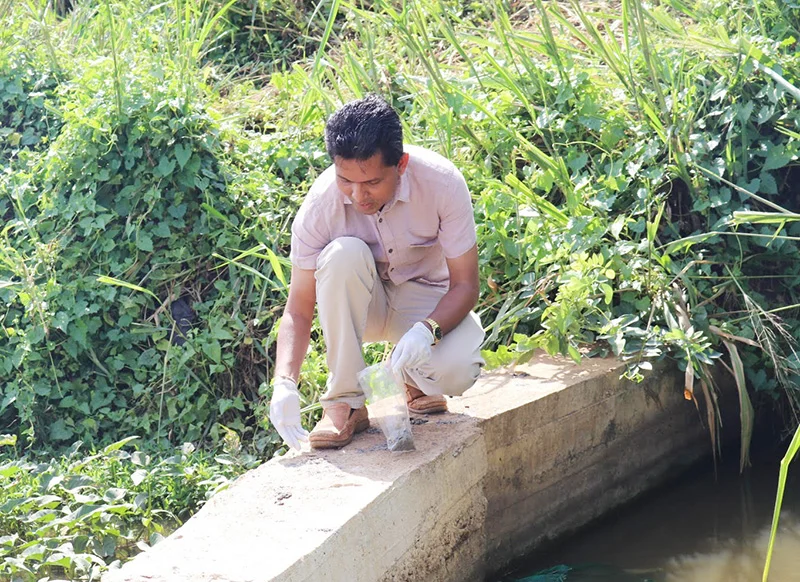
Chaminda collecting scat for research purposes in Sigiriya
He says wetlands are among the planet’s most productive ecosystems, functioning as natural water filters and carbon sinks while providing breeding grounds for fish, amphibians and aquatic mammals.
Yet globally, wetlands are disappearing at an alarming rate, and Sri Lanka is no exception.
Conservation groups have repeatedly warned that illegal waste disposal, pesticide contamination and poorly planned infrastructure projects are severely affecting freshwater ecosystems throughout the country.
Jayasekara also highlighted the importance of stronger environmental education and community participation in conservation.
“Awareness is still very limited. Many people living close to wetlands do not realise the ecological importance of otters or the threats they face,” he said.
According to him, involving local communities in conservation monitoring is essential if Sri Lanka hopes to safeguard the species in the long term.
He also pointed to the growing international interest in otter conservation.
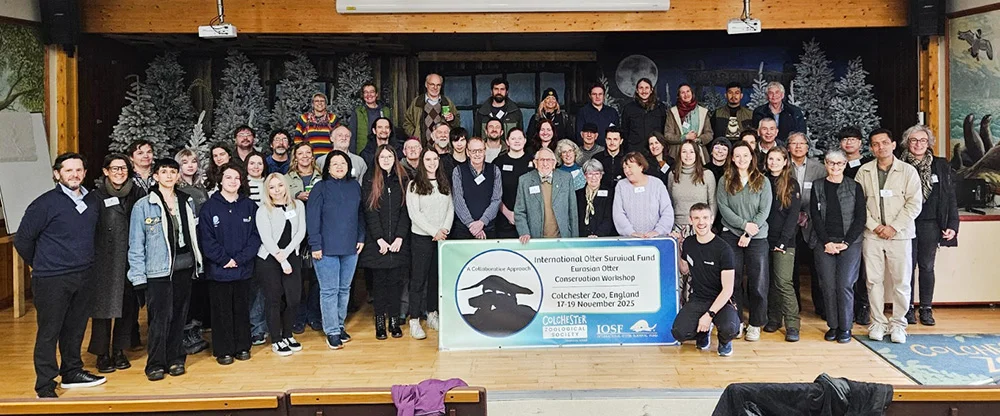
In November 2025, Jayasekara represented Sri Lanka at the International Eurasian Otter Conservation Workshop held at Colchester Zoo and organised by the International Otter Survival Fund.
The workshop brought together nearly 100 researchers, conservationists and wildlife experts from 33 countries to discuss emerging threats facing Eurasian otter populations.
Jayasekara presented Sri Lanka’s experience under the theme Rewilding Through Hospitality, focusing on how habitat restoration and sustainable tourism practices at Vil Uyana contributed to otter conservation.
“The international response was extremely encouraging. Many delegates were surprised that a tourism property in Sri Lanka had quietly carried out wetland conservation work for more than a decade,” he said.
Discussions at the workshop also examined wider environmental concerns including river pollution, declining fish stocks, illegal killings and habitat fragmentation affecting otter populations across Europe and Asia.
New conservation technologies such as AI-assisted wildlife tracking and environmental DNA surveys were also highlighted as emerging tools for monitoring elusive species.
Jayasekara said Sri Lanka urgently requires more scientific surveys, stronger environmental law enforcement and greater investment in freshwater conservation research.
He warned that unless wetlands and waterways are protected, several lesser-known freshwater species could face severe decline in the coming decades.
Environmentalists say otter conservation should not be viewed in isolation but as part of a broader effort to protect entire freshwater ecosystems that millions of Sri Lankans depend on for drinking water, irrigation and livelihoods.
He further noted that healthy wetlands also strengthen climate resilience by absorbing floodwaters, reducing soil erosion and supporting groundwater recharge.
As Sri Lanka experiences increasingly erratic weather patterns linked to climate change, conservationists argue that protecting wetlands is becoming both an ecological and economic necessity.
Jayasekara believes Sri Lanka still has an opportunity to become a regional example in balancing tourism, biodiversity conservation and habitat restoration.
“The otter teaches us an important lesson,” he said. “If rivers are protected and wetlands are respected, nature has an incredible ability to recover.”
This year’s observance of World Otter Day 2026 is, therefore, serving not only as a celebration of one of the world’s most charismatic mammals, but also as a reminder of the urgent need to conserve the fragile freshwater ecosystems upon which both wildlife and human communities ultimately depend.

Eurasian otter
By Ifham Nizam
In their Vesak messages this year, President Anura Kumara Dissanayake and Prime Minister Harini Amarasuriya highlighted the values of reconciliation, coexistence and justice as essential to Sri Lanka’s future. President Dissanayake emphasised that Buddhism’s teachings remain deeply relevant to contemporary society and described Vesak as a symbol of “mutual understanding, unity and coexistence among all communities” and of reconciliation itself. Prime Minister Amarasuriya similarly called for the building of a society in which justice is assured to all irrespective of caste, race or religion. These messages were not merely religious aspirations, they were a direct challenge to the most serious failures in Sri Lanka’s post-independence history. These include the three-decade-long war, its human rights violations and the inability to implement a political solution.
These have been and continue to be the challenges that have prevented Sri Lanka from reaching its full potential. Added to this have been the persistence of social and economic inequalities that continue to marginalise communities at the bottom of the social hierarchy. One of the most enduring examples of such injustice is the experience of the Malaiyaha Tamil community. The scale of the original exclusion is worth understanding clearly. According to the 1946 Census, the Malaiyaha Tamil community numbered approximately 780,600 persons and constituted 11.73 percent of the country’s population making them the second largest ethnic community, larger than the Sri Lankan Tamil community who numbered 733,700 or 11.02 percent of the population at the time
The denial of citizenship and voting rights to the Malaiyaha Tamil community was the first major injustice inflicted on an ethnic minority in post-independence Sri Lanka. The consequences were devastating and long-lasting. A community that had contributed enormously to the country’s economy through its labour on the plantations was excluded from political participation and denied basic rights. This was a political and moral failure that cast a long shadow over the country’s post-independence history. Responsibility for that injustice needs to be shared widely. Political leaders across ethnic lines failed to resist it. The result was the marginalisation of a community whose contribution to national prosperity far exceeded the recognition it received. Today, nearly eight decades later, Sri Lanka has an opportunity to correct that historic wrong but only if economic reform is matched by genuine social inclusion.
Longstanding Grievances
The NPP government has repeatedly acknowledged the need to address the longstanding grievances of the Malaiyaha Tamil people. In its election manifesto, the NPP pledged to improve living conditions in plantation areas, strengthen land and housing rights, ensure equal access to education and public services, and integrate plantation communities more fully into national development. The NPP’s Nuwara Eliya Declaration of 2023 similarly recognised that the plantation community had suffered generations of exclusion and promised measures to address disparities in housing, land ownership, infrastructure, education and economic opportunity. The need for such action is plain to see. While citizenship issues have largely been resolved over time, the socio-economic consequences of decades of exclusion remain deeply entrenched and continue to shape daily life in plantation communities. A conference organised by the Institute of Social Development to mark International Tea Day on May 21 at the BMICH brought out this and many other salient issues. Headed by P Muthulingam the organisation has advocated for the rights of the Malaiyaha Tamil people for the past 35 years to be equal citizens who enjoy social and economic justice.
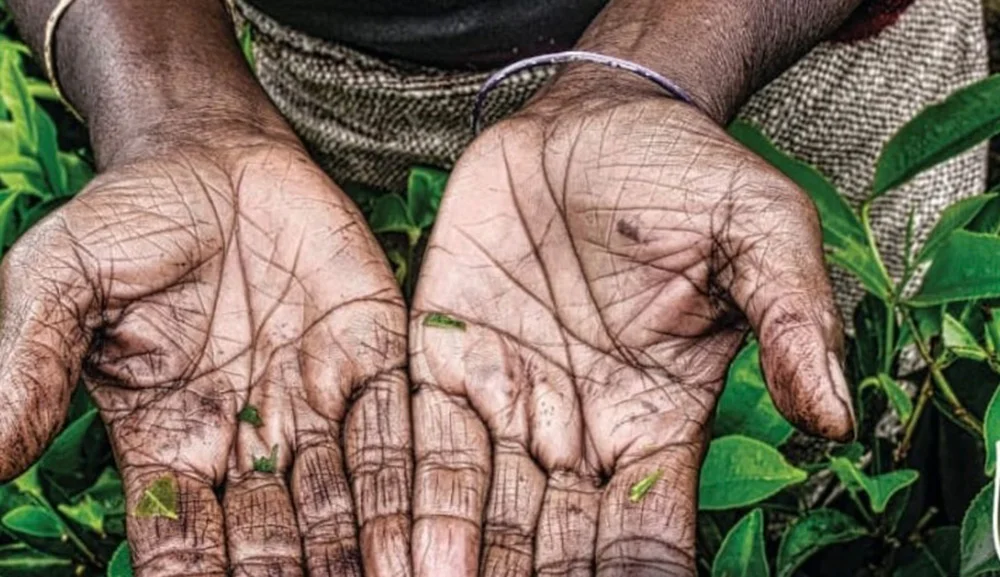
The central problem facing many plantation workers is the low level of income they receive. Daily wages remain among the lowest in the country relative to the difficulty and intensity of the work. Plantation labour continues to depend heavily on methods that have changed little over generations. Productivity remains low compared to competing tea-producing countries — not because workers lack capability, but because sustained investment in their welfare, skills and economic mobility has been withheld. Workers consequently remain trapped in a cycle of low wages and limited economic mobility. Their housing situation compounds these difficulties. Many plantation families continue to live in housing owned either by plantation companies or the state. Lack of secure ownership limits their ability to accumulate assets, access credit or make independent decisions regarding their future. When Cyclone Ditwah damaged plantation housing, it exposed the inability of those living in that housing to access state compensation as they did not own the housing in which they lived.
The problems extend beyond the central highlands. Plantation workers living in private estates and smallholdings in other parts of the country face similar challenges. A recent Amnesty International report documented serious abuses affecting Malaiyaha Tamil workers in private tea estates in the Southern Province. These include wage withholding, debt dependency, restrictions on movement and intimidation and practices the report argued correspond to internationally recognised indicators of forced labour. These findings are not peripheral. They reveal that the structural exclusion of the Malaiyaha Tamil community is not a relic of the past but an active, ongoing condition. Economic vulnerability and social marginalisation continue to leave many plantation workers without effective protection or access to justice. It is against this backdrop that the government’s recent plantation reform initiative assumes special significance.
Second Phase
The government has announced the second phase of a programme to make underutilised plantation lands and assets available for investment. The objective is to transform underperforming assets into productive enterprises capable of generating employment, attracting investment and revitalising regional economies. The programme seeks to modernise the plantation sector, improve productivity and create new opportunities in tourism, renewable energy and export-oriented industries. These objectives are necessary and welcome. However, economic reform alone will not be sufficient and Sri Lanka’s own history provides the warning. Previous rounds of plantation modernisation pursued productivity gains without addressing the structural disempowerment of the people at the centre of the industry. The result was investment that generated wealth without distributing it. The workers who produced the wealth were once again treated as labour inputs rather than as beneficiaries. If the current reform follows the same logic, it risks reproducing the same failure.
For reform to succeed, plantation workers must be recognised not merely as a labour force but as stakeholders with rights, aspirations and a legitimate claim to share in the benefits of development. Housing ownership, secure land tenure, quality education, vocational training and entrepreneurship need to be built into the reform process from the outset. The government’s commitments to the Malaiyaha Tamil community therefore need to be incorporated into every stage of the reform process. On the contentious question of land, the government should consider establishing an independent national land commission. Such a body should include respected government officials, professionals and representatives from all ethnic and religious communities. It should review land policy comprehensively, develop transparent principles for allocation and use, ensure fairness in decision making and provide a trusted mechanism for resolving disputes. A credible land commission would help build public confidence that land reforms are being undertaken in the national interest rather than for the benefit of particular groups.
The correction of historic injustices should not be viewed as a concession to one community. It should be understood as an investment in national unity, because societies do not become stronger by maintaining the exclusion of those they have wronged. On the contrary, they become stronger by ending it. The first great injustice committed against an ethnic minority after independence cannot be undone. But its consequences can be addressed, and doing so would strengthen reconciliation, enhance social cohesion and bring Sri Lanka closer to the vision of a country in which all communities live with equal dignity and equal hope. This is what the Vesak messages of the President and Prime Minister promised. The plantation reform now underway is the moment to make good on that promise not in words alone, but in sustained policy that endures beyond any single government and reaches the people who have waited longest for it.
by Jehan Perera

The IMF’s latest decision to release approximately US$695 million to Sri Lanka provides an important measure of financial relief, but it should not be mistaken for full economic recovery. While the approval reflects progress in stabilisation, fiscal discipline, and reform implementation, the country still faces deep structural weaknesses, social pressures, and external risks. The real test begins now: whether Sri Lanka can convert this temporary breathing space into lasting reform, productive growth, stronger institutions, and national resilience. This moment should not be used for political celebration, but for serious national reflection and responsible action. Sri Lanka must now resolve to support a clear policy direction, a practical reform programme, and a long-term national development path — not merely an individual, a party, or a political camp.
1. IMF Relief: A Necessary Step, but Not a Final Solution
The IMF Executive Board recently completed the combined Fifth and Sixth Reviews under Sri Lanka’s Extended Fund Facility, allowing the country immediate access to SDR 508 million, approximately US$695 million. This decision represents an important step in Sri Lanka’s ongoing economic recovery process following the severe crisis that led to sovereign debt default, shortages of essential goods, high inflation, and the collapse of foreign reserves in 2022.
However, this decision must be understood with great sensitivity. IMF relief is not the same as full economic recovery. It gives Sri Lanka temporary breathing space, helps rebuild a certain level of international confidence, and supports the continuation of the reform programme. However, this relief is not a magic solution that can automatically resolve the country’s deep-rooted economic problems. Fundamental challenges such as the debt burden, weak productive capacity, low export earnings, poor public revenue performance, weak fiscal management, excessive dependence on imports, corruption, and inefficient state-owned enterprises still remain unresolved. Addressing these challenges requires domestic reforms, disciplined policies, stronger production and export capacity, and a long-term national development programme. Therefore, the IMF decision should not be treated as a political victory or as proof of complete economic success. Rather, it should be seen as a reminder that Sri Lanka still has a long and difficult journey ahead.
2. Sri Lanka’s Progress Recognised by the IMF and Its Limits
The IMF’s approval indicates that Sri Lanka has made progress in several important areas. Inflation has been brought under control compared to the extreme levels experienced during the crisis. Foreign reserves have improved, the exchange rate has shown greater stability, and fiscal management has become more disciplined. The government has also continued to implement reforms in taxation, public finance, energy pricing, and debt restructuring.
According to the IMF assessment, performance under the programme has generally been strong. Several quantitative performance targets have been met, while many structural benchmarks have either been achieved or implemented with some delay. This shows that Sri Lanka has remained broadly committed to the reform path agreed under the IMF-supported programme.
Yet this progress remains fragile. Stability achieved through external support must now be converted into genuine economic strength.
3. Conditions and Responsibilities Attached to the IMF Programme
IMF support does not come merely as financial relief; it comes with a set of important reform conditions and responsibilities that Sri Lanka must fulfil. Key among them are maintaining fiscal discipline, improving government revenue, continuing cost-reflective pricing for fuel and electricity, strengthening public financial management, restructuring state-owned enterprises, protecting institutional independence, and preventing the accumulation of new external payment arrears.
The main objective of these conditions is to restore macroeconomic stability, strengthen fiscal credibility, and rebuild international confidence in Sri Lanka. However, these reforms also carry social and political consequences. Higher taxes, market-based utility pricing, and strict expenditure controls can place a heavy burden on ordinary citizens, especially low-income families, small businesses, pensioners, and salaried workers. Therefore, in implementing reforms, economic discipline alone is not enough. Fairness, transparency, and social sensitivity towards vulnerable groups must also be treated as essential priorities.
4.The Impact of IMF Conditions on People and the Economy
One major social consequence of the IMF programme is the increased pressure it can place on household incomes and living standards. When electricity, fuel, and other essential services are priced on a cost-recovery basis, people may have to face a higher cost of living. Although such reforms are necessary to reduce the losses of state-owned enterprises and maintain fiscal discipline, they can weaken the purchasing power of ordinary citizens if strong social protection programmes are not in place.
Another important consequence is the pressure placed on the operating costs and stability of small and medium-sized enterprises. Higher taxes, increased utility costs, fuel and electricity expenses, and the rising cost of borrowing can affect business survival, job creation, and new investment decisions. If reforms are implemented without sufficient attention to production, exports, and small businesses, the country may achieve short-term fiscal stability, but long-term economic growth could remain weak.
There is also a political risk that cannot be ignored. If people feel that the burden of reform is not being shared fairly, reform fatigue and public frustration may emerge. If ordinary citizens are expected to make sacrifices while corruption, waste, and political privileges continue, public confidence in the reform process will decline. Therefore, for IMF-supported reforms to succeed, fairness, transparency, and social sensitivity must be firmly ensured alongside economic discipline.
5. The Real Test Before Sri Lanka
Sri Lanka’s real test begins now. Beyond temporary financial relief, the country must now prove that it can build a strong economy that generates income and can withstand external shocks. Therefore, our objective should not be limited to securing the next IMF tranche. While an IMF tranche may provide short-term breathing space, it does not guarantee long-term economic independence or stability. The real objective should be to create an economy that does not have to return to the IMF repeatedly during every crisis, but can stand on its own productive strength, export earnings, and fiscal discipline.
This requires fiscal discipline. However, discipline alone is not enough; economic growth is also necessary. Taxation is necessary. But increasing taxes alone is not a solution; production, investment, and exports must also be expanded. Debt restructuring is necessary. But beyond reducing the debt burden, Sri Lanka must also build an economic foundation that does not depend excessively on borrowing in the future. Sacrifices may be asked of the people. But for those sacrifices to be fair, accountability, transparency, and exemplary conduct from leaders are also essential.
Economic recovery cannot be sustained in the long term through financial assistance alone. Such support can provide breathing space during a crisis, but a country is rebuilt on the strength of its own institutions, productive capacity, export competitiveness, and public trust. Therefore, what Sri Lanka needs today is strong institutions, income-generating industries, a broader export base, food security, energy security, and a system of governance that people can trust.
6. Policy Priorities for Sustainable Recovery
Sri Lanka must now move from crisis management to national transformation. First, fiscal discipline should continue, but it must be fair. Revenue mobilisation should not rely only on increasing taxes on the same groups of people. The tax base must be broadened, tax administration must be improved, and tax evasion must be reduced.
Second, social protection must be strengthened. The most vulnerable groups should be protected through well-targeted assistance. Reforms will be more acceptable if people feel that the poor, elderly, disabled, and low-income families are not abandoned.
Third, state-owned enterprise reform should be carried out with transparency and public accountability. The objective should not merely be privatisation, but efficiency, professionalism, financial discipline, and better service delivery.
Fourth, Sri Lanka must prioritise export-led growth. The country cannot build a stable future by depending mainly on borrowing, remittances, and consumption. Agriculture, tourism, manufacturing, IT services, logistics, education, and value-added exports must become central pillars of national development.
Fifth, governance reform is essential. Without reducing corruption, political interference, wasteful expenditure, and weak implementation, no IMF programme can create lasting recovery. Economic reform and governance reform must move together.
7. From Temporary Relief to Lasting Recovery
The IMF decision gives Sri Lanka an important opportunity. It provides the country with space to strengthen economic stability, rebuild international confidence, and move forward with essential reforms. However, it is not a guarantee of success. It is only a step that gives the country some breathing space. It is now Sri Lanka’s responsibility to use that space wisely, with discipline and accountability to the people.
The country must now decide whether it will continue the old cycle of crises, debt, temporary relief, and political blame, or whether it will build a new national programme based on discipline, productive capacity, fairness, and accountability.
At this moment, true success cannot be measured by the amount of money received. It must be measured by whether Sri Lanka can build an economy that produces more, exports more, saves more, is governed better, and protects its people more effectively. The real victory is not receiving IMF relief, but building a strong national economy that will not depend excessively on such relief in the future.
Public Appeal: Let Us Choose a Programme, Not a Personality
This US$695 million will not solve every problem in our country. It may provide temporary financial relief and support the continuation of reforms, but it cannot replace the hard work required to build a productive, disciplined, inclusive, and self-reliant economy.
Therefore, this is the right time for all Sri Lankans to rise above narrow political loyalties and support a clear policy direction, a practical reform programme, and a long-term national development agenda — not merely an individual, a party, or a political camp. What Sri Lanka needs today is not the victory of a personality, but the victory of a responsible national programme that can restore confidence, protect the vulnerable, promote production, strengthen exports, ensure accountability, and secure a better future for the next generation. The question before us is simple but decisive: are we ready to make that choice?
by Prof. Ranjith Bandara,
PhD (Qld.,)

Nuwan Thushara among 46 men’s cricketers to be awarded SLC contracts

Pakistan naval trio arrives at Colombo Port

Sri Lanka Cricket relieved at ICC’s mild response to Transformation Committee

ICC approves red-to-pink ball change to reduce bad-light impact in Test cricket

LPL introduces impact subs for 2026 season

Protesters call on Kenyan government to halt femicide crisis

‘Dates have the highest sugar content to fight Coronavirus’

Sunday Island 27 December – Headlines

#SundayIsland 17th December – Headlines

Sunday Island – 28th March

Sunday Island Headlines – 21 March

Sunday Island – 21st February – Headlines
-
 News4 days ago
IMF urges Lanka not to meddle with exchange rate
-
 Business5 days ago
Sri Lanka’s construction industry losing ground while no one watches
-
 News4 days ago
State of emergency extended
-
 Midweek Review7 days ago
Israeli-US aggression won’t go unanswered -Iranian Ambassador
-

 Business2 days ago
IMF’s unstated rate:Sri Lanka’s $695m loan costs about 5.33% per annum
-

 Features5 days ago
The Division Bell Mystery
-
 News2 days ago
UNP challenges NPP move to amend Vihara – Devalagam Act
-
 News6 days ago
RTI query of Ditwah funds: Presidential Secretariat mum on key questions