
Latest News
Hendricks’ maiden T20I ton hands South Africa first series win since August 2022

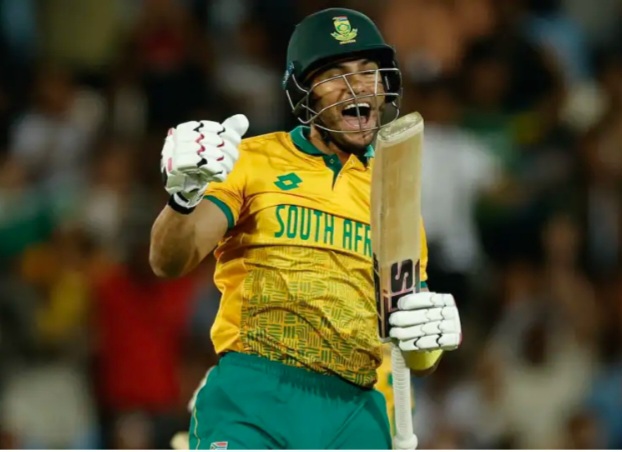
Reza Hendricks scored his first T20I century, in his tenth year of being an international cricketer, as South Africa registered their first bilateral T20I series win since August 2022. They registered the third-highest successful chase at SuperSport Park to break a T20I trophy drought that has extended for eight series, since they beat Ireland more than two years ago. It is also Rob Walter’s first T20I series win since taking over the white-ball coaching job in March 2023.
After being asked to field first, South Africa conceded the fifth-highest first-innings total at SuperSport Park and chased it down with three balls to spare. Hendricks and Rassie van der Dussen, batting at No.4, shared a third wicket partnership of 157 off 83 balls to form the spine of the chase. Van der Dussen scored his seventh T20I fifty and hit the winning runs with stand-in captain Heinrich Klaasen at the other end.
Pakistan were guilty of an over-reliance on the slower ball, which they sent down liberally, but that may not be where they lost the game. Although they crossed 200, they could have had many more. They were 103 for 1 after 11 overs and 136 for 4 after 16.
In that five over period, South Africa took 3 for 33, thanks to debutant Dayyaan Galiem and left-arm spinner George Linde. Despite those strikes, Pakistan’s innings was built on two big partnerships: Babar Azam and Saim Ayub put on 87 off 45 balls for the second wicket before Ayub and Irfan Khan posted 73 of 32 balls for the fifth wicket to propel their score over 200.
It was not enough thanks to Hendricks and van der Dussen, two older hands, who took South Africa home.
Dayyaan’s dream (and nightmare) debut
Galiem was planning to be at this match, but not playing in it. He had hospitality suite tickets and was due to be sitting with his domestic team-mates enjoying the start of the December holidays with some drinks but on his way home from the gym this week, he got a call he never expected. Anrich Nortje had broken his left big toe and Galiem was called up to the national squad. He was given a debut on his home ground and then handed the new ball.
His first over cost just three runs. Exactly why he didn’t bowl another in the powerplay is for Klaasen to answer but in that period he dropped Ayub on 3, which proved costly. He was brought back on in the seventh over, and erred once in length with a short, wide ball but taken off again. In his third spell, Galiem got his first international wicket when Usman Khan top-edged him to Kwena Maphaka at deep third but his moment came in his final over. It was only the second, he bowled in succession and Tayyab Tahir popped a leading edge back up to him and Galiem took a sharp catch. It would not have made up for his earlier miss but it gave him good figures of 2 for 21 in four overs, with 12 dot balls, in his first international outing. But that wasn’t the end of Galiem. He was at long-on when Ayub hit Donovan Ferreira just about straight to him. Galiem got himself into an awkward position and the ball burst out of his hands.
Sensational Saim but he would have wanted two more
Pakistan separated RizBar as they continue to experiment with their opening combination and Ayub has made the case to continue in the role. He scored three runs off the first eight balls he faced before swatting a Ferreira delivery to debutant Galiem at point, who could not hold on to the chance. The next ball Ayub faced, he muscled over deep midwicket for six at the start of a spectacular takedown of Maphaka. The next two balls brought back-to-back boundaries before three dot balls ended the most expensive over of the Powerplay. The slog sweep proved a favourite shot of Ayub’s as he perfectly complemented Babar.
Ayub’s career-best, and also his first half-century in the format came off 33 balls in the 11th over, so he had the time and opportunity to double up. After Babar was dismissed, Ayub brought out more classical strokes like the square drive. He continued to take on Maphaka, and hit him for three sixes in his final over to stand on the edge of 90, with three overs left. In a cruel twist, Ayub only faced six balls in the last three overs, and none in the last over, and was left unbeaten on 98.
Jahandad’s double strike
Brought into the side in place of wristspinner Sufiyan Muqeem, Jahandad Khan almost immediately showed what he can do. His second delivery moved away from the left-handed Ryan Rickelton, who could not help but play at it with minimal foot movement and edged to Rizwan to end the opening partnership on 6. In his next over, Jahandad played with his lengths and speeds, delivered a slower ball and then and ended with a short ball which Matthew Breetzke attempted to pull but could only sky to mid-on. Shaheen Shah Afridi took a simple catch to leave South Africa 28 for 2 after four overs.
A day after being dropped from the ODI side to play Pakistan next week and with questions swirling over his continued presence in national squads, Hendricks silenced his critics by showing he still has what it takes at this level. He operated at a run-a-ball 14 off the first 14 balls he faced and then tucked into a short Haris Rauf delivery to top-edge him over fine leg for six before putting a slower ball into the stands over deep square for six more. A third six saw South Africa finish the powerplay on 52 for 2, seven runs ahead and a wicket more than Pakistan’s 45 for 1 at the same stage.
He went on to smash two more sixes, including one off Abbas Afridi which brought up his fifty off 29 deliveries, by the halfway stage. South Africa were 94 for 2; at the same stage Pakistan were 90 for 1. Hendricks dealt in boundaries and leapt into the nineties with three more sixes and two fours before bringing up triple figures when he hit Rauf over midwicket. His hundred came off 54 balls, and he finished with 117 off 63 balls, including seven fours and 10 sixes and left South African on the brink of victory. When Hendricks was dismissed, they needed 21 runs off 14 balls, and got there off 11.
Brief scores:
South Africa 210 for 3 in 19.3 overs (Reza Hendricks 117, Rassie van der Dussen 66*; Jahandad Khan 2-40, Abbas Afridi 1-46 ) beat Pakistan 206/5 in 20 ove4s (Saim Ayub 98*, Babar Azam 31, Irfan Khan 30; Dayyaan Galiem 2-21, Ottnneil Baartman 2-51, George Linde 1-28 ) by five wickets
(Cricinfo)


Latest News
I extend my heartfelt wishes to all the sons and daughters of our country for a Happy World Children’s Day – President

Children’s Day Message from President Anura Kumara Dissanayake:
“Children are the most valuable asset of a nation. Ensuring their physical and mental well-being and creating an environment conducive to their proper development is a primary responsibility of any government. Children’s imagination, aspirations and creativity will determine the shape and colour of the country tomorrow. The country we build for children must not merely be a country prepared to be handed over to them in the future; it must be a country that gives space to their dreams today, listens to their voices and provides opportunities for them to realise their potential.
For the best interests of children, we are taking the necessary steps to ensure equal access to education, guidance, social protection, opportunities for sport, leisure and recreation, proper nutrition and access to healthcare, while protecting children from all forms of violence and discrimination and safeguarding their rights.
Race, religion, economic status, geographical background or any other circumstance should not be a barrier to any child’s education or proper development. Every child should have equal and fair opportunities to realise their potential, pursue their dreams and create the future they wish for themselves. To this end, we have already begun the process of reforming the education system in Sri Lanka, transforming it towards a skills-based system suited to the new world, one that does not place a burden on parents or cause distress to children.
Our aim is to ensure that no child is left behind in the new Sri Lanka we are building, and to provide every child with opportunities for development in a safe environment. It should be emphasised that the fundamental objective of all the programmes being implemented, from expanding educational scholarships to securing the future of children growing up in child development centres and those in need of care, is to create a dignified and secure tomorrow for every child in the country.
It is the aspiration of every parent to give their children a better life than the one they themselves experienced. We are currently steering the country’s economy towards a correct and stable direction in order to provide children with a safe and happy childhood, free from the shadows of an unstable economy. At the same time, we have launched the national operation “A Nation United” (Ratama Ekata), bringing everyone together to free the younger generation from the menace of illicit drugs.
At a time when we are working towards the goal of building a safe and better country for children, I greatly appreciate the initiative of the Ministry of Women and Child Affairs in organising this year’s World Children’s Day celebrations under the theme “Strong Minds – Enriched Children”, declaring a National Children’s Day Week and conducting a range of meaningful programmes aimed at strengthening children’s rights, well-being, protection, education and freedom.
I extend my heartfelt wishes to all the sons and daughters of our country for a Happy World Children’s Day”.

Sri Lanka won the toss and elected to bowl first in the Asian games semifinal clash against India.
Sri Lanka XI: Lasith Croospulle, Sineth Jayawardene, Sohan de Livera (wk), Ashen Bandara, Sahan Arachchige (c), Nuwanidu Fernando, Chamika Karunaratne, Wanuja Sahan, Tharindu Rathnayake, Binura Fernando, Vijayakanth Viyaskanth

ICC introduces pink-ball daytime Test trial, new time-wasting penalties

Discussion on Anuradhapura Sacred City Development Plan

India enter Asian Games final after Kishan and Bumrah ride roughshod over Sri Lanka

I extend my heartfelt wishes to all the sons and daughters of our country for a Happy World Children’s Day – President

Sri Lanka bowl first in semi final clash against India

Trump hints US could strike Iran, warns time coming

‘Dates have the highest sugar content to fight Coronavirus’

Sunday Island 27 December – Headlines

#SundayIsland 17th December – Headlines

Sunday Island – 28th March

Sunday Island Headlines – 21 March

Sunday Island – 21st February – Headlines
-

 Editorial6 days ago
Birth of a bad law
-

 Features7 days ago
Beyond traditional jobs: Why Sri Lanka needs to facilitate the gig economy
-

 News4 days ago
Police remove Thileepan statue in Jaffna
-
 Latest News7 days ago
Kusal, Wellalage star as Sri Lanka defend 322 in Headingley thriller
-

 News6 days ago
TIN mandatory for key transactions from Nov. 1
-

 Features4 days ago
The 22nd Amendment, constitutional recovery and illiberal slippage
-

 Features4 days ago
Of foreigners as CEOs of Lankan ventures
-

 News4 days ago
Sajith rejects Jt. Opp. protest sabotage claim; SJB TU chief demands remedial action