
News
Health sector strikes must not drag on – Nalinda

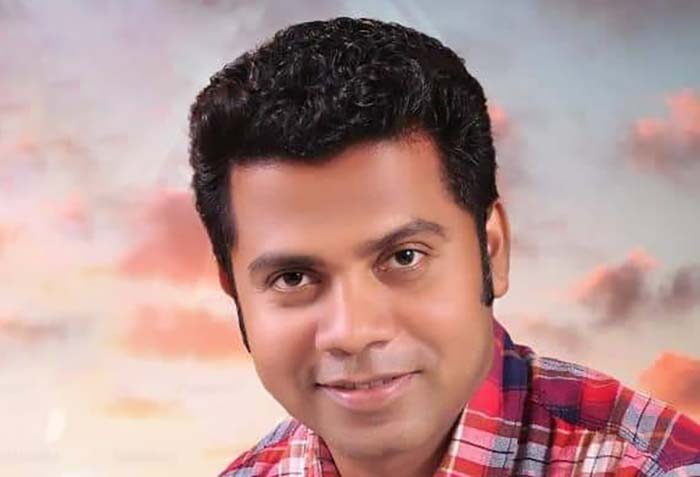
Government creating animosity between doctors and others
By Saman Indrajith
The Sri Lankan healthcare system has been allowed to atrophy since 1977 due to a lack of funding, National People’s Power (NPP) stalwart and former MP, Dr. Nalinda Jayatissa said.
He said that the country’s hospital system was established by the British as a necessity for its colonial economy, and by 1948, Sri Lanka had a robust healthcare system. And, until 1977, successive governments were investing about five percent of the GDP in health.
“Things changed dramatically after 1977. Since 1977, governments have washed their hands off of state-funded healthcare, and by 2020, out-of-pocket expenses on healthcare by people was about 60 percent.
“Then the economic crisis happened, and now we see a significant increase in people coming into government hospitals. The government hospitals can’t deal with this influx. There are no medicines, the quality of medicine available is suspect, healthcare professionals are leaving the country, and the equipment is broken.”
Dr. Jayatissa said politicians and bureaucrats are keen on buying expensive machinery but are less interested in maintaining the equipment.
“Most of these machines need to be operated in controlled environments. There should be trained staff, and the machines should be periodically repaired. None of this happens, and the machines break down. This is a serious situation, and the Health Ministry is virtually headless,” he said.
The NPP stalwart added that the government is also deliberately causing friction. It gave the doctors a 35,000 DAT increase, and other unions are up in arms about this.
“We are very concerned about the impact of union action on healthcare. At the end of the day, these strikes affect people. The government is also harassing people on a daily basis. However, the demands of the unions are just.”
He said that health staff are under tremendous stress and they deserve a salary hike, like everyone else in the country.
“We must also wonder if the government wanted to create problems between various staff categories. Now the animosity between doctors and other staffers is at an all-time high. There have been fisticuffs between doctors and other staffers. Unions must also understand the politics behind some maneuvers. We must try to win our demands with minimal impact on people.”
Dr. Jayatissa said that during the economic crisis, many nations offered to help the Sri Lankan healthcare system. Politicians and some senior officials used these opportunities to enrich themselves. What is happening in the health system is the best example of why the country needs a change in political leadership.
“About four years ago, Japan offered to develop angiogram units in five locations after identifying that about 45 percent of people die due to stroke and heart attacks. This was a 28 billion-rupee project, with 27 billion from Japan, to expand angiogram units in Kandy, Kurunegala and Anuradhapura hospitals and establish new units in Badulla, and Trincomalee. The Health Ministry recruited new people, and discussions were ongoing. The Japanese government then unilaterally cancelled the deal because there were allegations that one Minister solicited bribes from a Japanese company. The Minister was not penalized, but the project was halted. How many people were affected by this? Corruption is a main reason why we are not getting help,” he said.
Dr. Jayatissa said there is also a mechanism to predict the amount of medicine the country needs per year. There are also some in-built mechanisms to reduce corruption.
“We have the NMRA, SPC and medical supplies unit. We have three separate units as a way to keep tabs on each other. However, politicians have paralyzed these institutions to help them embezzle. The health ministry purchased a counterfeit human immunoglobulin consignment and paid a corrupt company a billion rupees. We have paid a billion rupees for coloured water. Imagine the level of corruption?” he said.
The former MP added that the Ministry of Health has an institution that was established to regulate private healthcare providers. However, the institution has done very little to ensure private healthcare producers provide a quality service.
“90 percent of resident patients are in government hospitals. However, 50 percent of OPD patients go to the private sector. An NPP government will regulate the private sector and strengthen government hospitals. Then people will choose where they want to go,” he said.


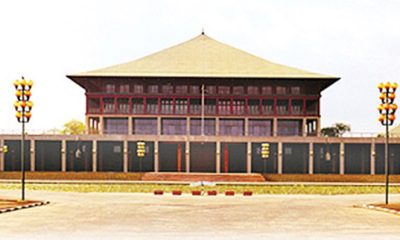








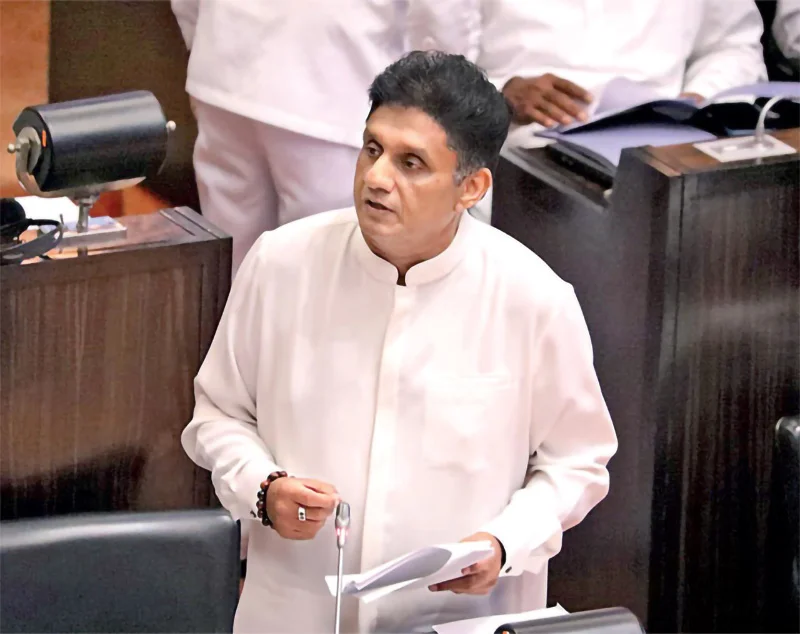
Opposition and SJB Leader Sajith Premadasa yesterday raised concerns over the recent suspension of Parliament’s Deputy Secretary General and Chief of Staff, G.K.A. Chaminda Kumara Kularatne, alleging that the process appeared to be mala fide. Addressing Speaker Jagath Wickramaratne in Parliament, Premadasa said that the existence of a personal disagreement between the Speaker and the suspended official had created a potential conflict of interest.
Premadasa said disciplinary action against senior parliamentary officials had to be taken in keeping with established parliamentary precedents. He also questioned the legality and propriety of a lower-ranking official leading an inquiry against a senior officer.
“For the first time, we are witnessing a rift between the Speaker and the staff of the Secretary-General. All parties must step back, act democratically and ensure that the fundamental rights of Chaminda Kularatne are safeguarded,” he added.
ITAK Batticaloa District MP Shanakiyan Rasamanickam said Kularatne had not been given an opportunity to respond to the allegations made against him.
“This is a disgraceful situation. A complaint has been lodged against you with the Bribery Commission. Parliament is the supreme institution of democracy in this country, and the precedent being created here is dangerous,” Rasamanickam said, addressing the Speaker.
SJB Kandy District MP Chamindranee Kiriella said the Speaker was duty-bound to inform the House before disciplinary action was taken against a parliamentary official. SJB MP Ajith P. Perera said it was unethical for the Speaker to assume a leadership role in the inquiry, and called for the matter to be entrusted to an independent authority.
Responding on behalf of the Government, Chief Government Whip and Health and Mass Media Minister Dr Nalinda Jayatissa said the chief investigating officer, S.K. Liyanage, an Additional Secretary, had been appointed by the Staff Advisory Committee on 25 August, 2025. He said Liyanage had been selected from a pool of qualified officers at the Ministry of Public Administration and had prior experience in conducting investigations.
Leader of the House and Transport Minister Bimal Rathnayake said the Staff Advisory Committee had agreed on the respective powers of parliamentary officials, noting that the Secretary General would hold powers equivalent to those of Ministry Secretary, while the Deputy Secretary General would hold powers equivalent to those of an Additional Secretary.
“There is no irregularity in the conduct of the investigation or in the appointment of the investigating officers,” Rathnayake said.
On 24 January, 2026, Parliament announced the immediate suspension of Deputy Secretary General and Chief of Staff Chaminda Kularatne with effect from 23 January, citing concerns relating to his appointment. Kularatne had assumed duties on 15 September, 2023.
On Monday, Kularatne filed a complaint with the Commission to Investigate Allegations of Bribery or Corruption against Speaker Jagath Wickramaratne, alleging corruption. His legal counsel, Attorney-at-Law Mithun Dias, said the complaint had been filed against the Speaker in his personal capacity and not against the government.
However, Dr Jayatissa told the House that the investigation into Kularatne was based on concerns relating to his appointment, qualifications and the process by which he had been confirmed in that post and was not linked to any personal dispute with the Speaker.
By Saman Indrajith
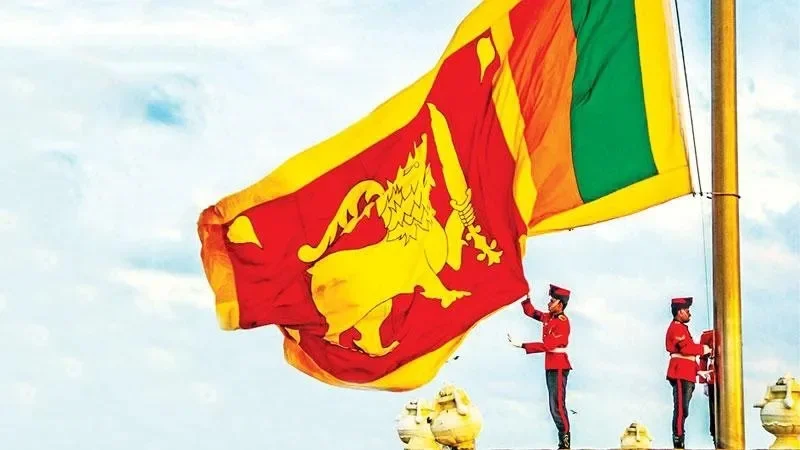
The 78th Independence Day celebrations in the Central Province are scheduled to be held today from 8:00 AM at the Bogambara Stadium, Kandy.
The celebrations are jointly organised by the Central Provincial Council and the Kandy District Secretariat. The Governor of the Central Province, Prof. S.B.S. Abeykoon, is expected to grace the occasion as the Chief Guest.
The event will also see the participation of Kandy District Members of Parliament, the Chief Secretary of the Central Province, Mr. Ajith Premathilake, as well as representatives from the Tri-Forces, Police, school students, and various voluntary organisations.
The ceremony will feature a formal parade and cultural performances by school children.
By S.K. Samaranayake
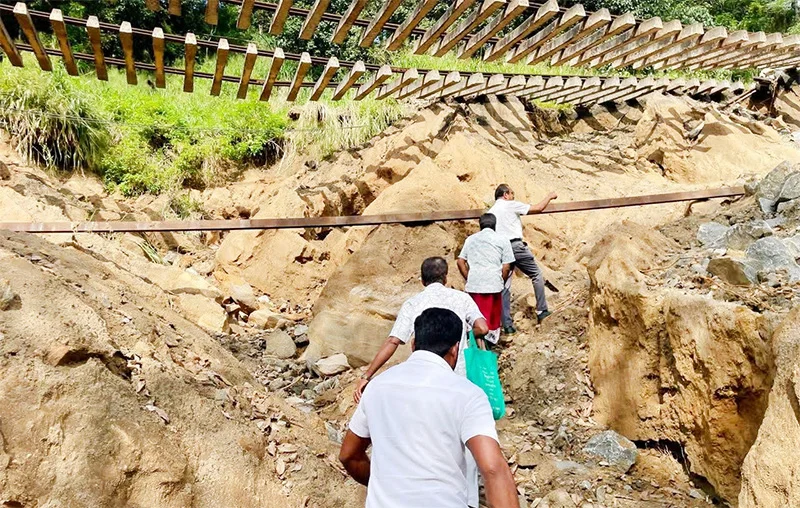
Minister of Transport, Highways, and Urban Development, Bimal Rathnayake, has announced that the reconstruction of the Colombo-Kandy railway line, which was severely damaged by landslides in the Balana and Kadugannawa areas, will be completed within this year to restore normal train services.
The Minister made this statement during the Kandy District Development Committee meeting held at the District Secretariat. He noted that work will commence following the observations and technical reports provided by the National Building Research Organisation (NBRO) regarding the stability of the landslide-affected areas.
Financial Management and Development
Minister Rathnayake emphasised that the government possesses the necessary funds for development projects.
“Our government has the funds. However, all officials must ensure these funds are managed efficiently so that they are fully utilised for development, without being returned to the Treasury at the end of the year,” he stressed.
Improvements in Public Transport
Highlighting the progress in the transport sector, the Minister shared several key updates
• Recruitment: 700 new employees have been recruited to the Sri Lanka Transport Board (SLTB) and are currently undergoing training.
• School Transport: Steps are being taken to strengthen the ‘Sisu Sariya’ school bus service within the Kandy District.
• Infrastructure: The reconstruction of the Peradeniya Black Bridge (Kalu Paalama), which was damaged during the ‘Ditwah’ disaster, is nearing completion.
Welfare facilities for Private Transport Workers
The Minister also revealed plans to support the welfare of private bus drivers and conductors.
“We must look after the workers in the private transport sector as well. We are planning to establish a welfare fund for them and are taking steps to include them in the Employees’ Provident Fund (EPF) system,” he added.
Concluding his remarks, the Minister urged state officials to perform their duties responsibly and ensure that the inefficiencies seen under previous administrations do not recur.
By S.K. Samaranayake

BCB receives investigation report on sexual misconduct allegation

Trump confirms talks with Iran as US military shoots down Iranian drone

Shower will occur in the Northern, North-central, Eastern and Uva provinces and in Nuwara-Eliya and Matale districts

House erupts over suspension of Deputy Secretary General

78th Independence Day celebrations at Bogambara Stadium

Colombo-Kandy railway line to be fully restored this year – Minister Bimal

‘Dates have the highest sugar content to fight Coronavirus’

Sunday Island 27 December – Headlines

#SundayIsland 17th December – Headlines

Sunday Island – 28th March

Sunday Island Headlines – 21 March

Sunday Island – 21st February – Headlines
-
 Opinion5 days ago
Sri Lanka, the Stars,and statesmen
-
 Business6 days ago
Climate risks, poverty, and recovery financing in focus at CEPA policy panel
-

 Business4 days ago
Hayleys Mobility ushering in a new era of premium sustainable mobility
-

 Business1 day ago
SLIM-Kantar People’s Awards 2026 to recognise Sri Lanka’s most trusted brands and personalities
-
 Business4 days ago
Advice Lab unveils new 13,000+ sqft office, marking major expansion in financial services BPO to Australia
-
 Business4 days ago
Arpico NextGen Mattress gains recognition for innovation
-

 Business3 days ago
Altair issues over 100+ title deeds post ownership change
-
 Business3 days ago
Sri Lanka opens first country pavilion at London exhibition