
Editorial
Guilty until proven innocent?


Monday 2nd October, 2023
There are no signs of an early détente between India and Canada. The two countries continue to trade allegations. Other nations are divided along the lines of strategic alliances rather than anything else. Interestingly, the US government is seen to be tilting towards Canada.
What the ongoing diplomatic row of epic proportions, and Washington’s stance thereon signify is that India has not received full membership of the club of powerful nations. The US firmly stands behind India only when the latter locks horns with China, which the West is all out to keep at bay for economic and security reasons, but when India happens to cross swords with a western nation, it cannot depend on the US to have its six, so to speak. The US has no permanent friends, as has been the experience of Pakistan, which Washington used in the Cold War era and then discarded. Perhaps, the painful diplomatic knock New Delhi has received from Ottawa could not have come without Washington’s knowledge; it could be attributed to strong economic ties India continues to maintain with Russia, refusing to toe the western line over the war in Ukraine. The Indian refineries are reported to have snapped up discounted Russian oil since the West imposed sanctions against Russia.
Canadian Prime Minister Justin Trudeau may not have expected India to strike back with might and main, resorting to tit-for-tat expulsion of diplomats when he went public with his ‘credible allegation’ of India’s involvement in the killing of a Khalistan activist on Canadian soil and ordered an Indian diplomat out of the country. Indian commentators have asked how an allegation could ever be considered credible. Whether the term ‘credible allegation’ is a contradiction in terms, as India has claimed in a bid to deride PM Trudeau, may be a moot point, but it can be used against Canada as well. One can argue that India’s allegation that Canada has become a haven for terrorists is credible, and therefore Canada should be dealt with in the same manner as the other countries that harbour terrorists and face hostile action at the hands of the West.
The Trudeau government’s judgement and its ability to engage in critical inquiry, which involves gathering facts, questioning assumptions, evaluating evidence, considering multiple perspectives and arriving at well-reasoned conclusions, are in serious doubt. It was only the other day that a nonagenarian Nazi veteran was mistaken for a Ukrainian freedom fighter, brought to the Canadian parliament and honoured during Ukrainian President Volodymyr Zelensky’s visit. (The Fuhrer would backflip in his grave in glee if he knew the Canadian government’s faux pas!)
An extreme course of action such as expelling diplomats is something that a country should resort to as pis aller, if at all, only after ascertaining irrefutable evidence to substantiate an allegation against another nation.
Whether India actually did what it is accused of having done in Canada, one may not know, but it behoves Canada, which PM Trudeau proudly calls a country that upholds the rule of law, and other nations which have taken upon themselves the task of protecting global democracy, to respect the cardinal principle of justice that every person accused of a crime is presumed to be innocent unless and until his or her guilt is established beyond a reasonable doubt. Before crossing the Rubicon, Trudeau should have ascertained irrefutable evidence to support his claim that India had a hand in the killing of the Sikh activist.
Credibility is something subjective influenced by various factors including an individual’s beliefs, experiences, knowledge and biases. If ‘credible allegations’ are to be accepted as the basis of offensive action or casus belli, PM Trudeau would find himself on a sticky wicket; a former Indian diplomat named Deepak Vohra has accused Trudeau of having been high on drugs during his recent visit to India to attend the G20 summit, and claimed Trudeau’s plane was found to be full of cocaine. Trudeau’s office has denied this allegation vehemently. What if the Canadian public were to go by the inversion of the principle of presumption of innocence, buy into the former Indian diplomat’s claim and consider Trudeau guilty of drug abuse until he is proven innocent?
Trudeau may have thought India would take his ‘credible allegation’, and the diplomatic offensive based thereon, meekly, the way Sri Lanka did anent his genocide allegation. It is popularly said in this country that the woodpecker, which damages trees by drilling holes in them, finds itself in a bind when it sinks its restless beak into a fibrous banana trunk.









Thursday 4th June, 2026
The government has locked horns with private bus operators, who are demanding a fare hike amidst soaring fuel prices. The former has rejected the fare hike demand out of hand, claiming that it is unfair. President of the Lanka Private Bus Owners’ Association Gemunu Wijeratne has threatened to launch a bus strike unless a fare increase is granted forthwith. He has claimed that there is legal provision for the annual bus fare revision due in July to be advanced. The government and the irate private bus owners are now playing a game of chicken.
School vehicle operators have warned that they will have to increase fees. Trishaw owners have also demanded a fare hike. Container truck operators have already increased freight charges by 5% to offset surging operating expenses, primarily driven by higher diesel prices, inflated costs of tyres and spare parts.
A brutal one-two combination—fuel price hikes and rupee depreciation—has sent all vehicle owners, save a few, to the canvas, so to speak. The prices of spare parts, lubricants and tyres have also skyrocketed. It is only natural that transport operators are demanding fare revisions. The government should stop making political statements and address the issues facing the transport sector. The public cannot take any more shocks, and another fare hike is something everyone needs like a hole in the head. It may not be feasible to grant the bus operators’ request for a fuel subsidy, but the government may be able to help them lower costs in some other way.
It will not be possible to overcome Sri Lanka’s balance of payments woes, strengthen the rupee and shore up foreign currency reserves without a proper strategy to reduce the national fuel bill, which accounts for more than 20% of the total value of imports. President Anura Kumara Dissanayake has pointed out that the country’s monthly fuel import expenditure has surged nearly six-fold. Driven by escalating tensions in West Asia, the fuel import bill rose from USD 98 million in February to USD 522 million in May, according to him. There is no gainsaying that drastic measures need to be adopted to reduce fuel consumption urgently. However, increasing fuel prices is not the only way to achieve this goal.
A country does not need a government to curtail the demand for fuel through price hikes. The JVP-NPP administration should be able to strategise to reduce fuel consumption through other means if it is to be considered worth its salt. Minister Anura Karunathilake and Ceylon Petroleum Corporation Chairman D. J. A. S Rajakaruna have gone on record as saying that action will be taken to have the QR-based fuel rationing system strictly regulated. Why didn’t the government care to do so earlier? If the fuel quota system is to be effective, the practice of motorists sharing the QR codes must be brought to an end. If the national fuel consumption has reached an unmanageable level, as President Dissanayake has said, will the government explain why fuel quotas were increased.
President Dissanayake and his government should learn from India’s efforts to reduce fuel consumption and adopt a top-down national austerity approach to conserve foreign exchange amidst external economic pressures. India’s strategy emphasises reducing official fuel use, adopting digital alternatives to travel, and promoting public transportation to manage energy consumption. After all, the JVP-led NPP came to power, promising austerity measures, which it must now adopt to curtail state expenditure while reducing the burgeoning import bill.
The JVP-NPP government is slow in responding to emergencies. Its disaster response following the landfall of Cyclone Ditwah was woefully tardy. It ignored warnings and waited until the country’s fuel reserves were almost depleted to introduce the QR-based rationing. It cannot wish away the threat of a private bus strike. It must get the bus owners around the table and have a serious discussion on how to resolve the transport sector woes instead of bellowing rhetoric.
Wednesday 3rd June, 2026
Opposition Leader Sajith Premadasa is reported to have lamented that in Sri Lanka, politicians who are adept at lying succeed at the expense of those who work really hard. He never misses an opportunity to project himself as a hardworking politician, and therefore his political rivals may claim that his lament smacks of self-promotion. Nevertheless, his argument is not untenable. During the last several decades, we have heard zillions of lies uttered by numerous political leaders, who have overtaken Machiavelli, Goebbels and even Matilda, who told “such dreadful lies” as made “one grasp and stretch ones’ eyes”. Opposition parties are lucky that people lose interest in their campaign lies after elections.
Lying is the name of the game in Sri Lankan politics. False promises made by politicians out of power should also be considered lies, for they are intended to deceive the public. What are usually described as the incumbent government’s lies are the false promises contained in the NPP manifesto or made by JVP/NPP politicians before the 2024 elections.
It has now become clear that the JVP/NPP leaders lied to the public when they said they were opposed to the manner in which debt was restructured and, if voted into office, they would renegotiate the bailout agreement signed between the IMF and the previous government. But after forming a government they opted to keep the agreement intact, and wisely so. The SJB has been saying something similar about the IMF programme, and it would have been exposed for lying if it had been able to form a government.
Some Opposition parties that have banded together to challenge the government claim that they would have handled the current energy crisis differently and granted relief to the people by reducing taxes on fuel. Accusing its political rivals of lying to garner favour with the public, the government insists that there is no way the fuel prices can be slashed. It finds itself in an IMF straitjacket, and has to fulfill the bailout conditions or lose IMF assistance. It is required to increase state revenue and ensure that energy prices are cost reflective, the JVP/NPP says. So, the only way the Opposition can disprove the government’s claim that it has to increase fuel prices to recover costs is to obtain a detailed cost breakdown and prove that the fuel prices are way above costs. The Opposition politicians shedding copious tears for the public ought to present facts and figures to support their claim that the government is jacking up fuel prices to meet the cost of extra diesel stocks purchased to operate the oil-fired power plants to make up for the Norochcholai generation loss caused by fraudulently procured low-grade coal. Mere rhetoric won’t do. Parliament is the best forum where the Opposition should pressure the government to reveal how fuel prices are determined.
Meanwhile, an SJB spokesman has said something that is construed in some quarters as an unwitting admission that the Opposition’s claim that the JVP-NPP government is not on the right course to strengthen the economy is false. Likening the JVP-NPP government, which is making a frantic effort navigate a host of vexed issues to straighten up the economy, to the proverbial bullocks pulling loaded carts up the steep slope of Haputale, SJB MP Mujibur Rahman has said the SJB is waiting until that task is completed to capture power. It is advisable to get the JVP-led administration to tackle the current economic issues because the JVP/NPP, after losing its hold on power, will never allow a future government to do so, he has said. He may have sought to make his party out to be smarter than the JVP/NPP, but what was intended as a back-handed compliment became an unintended compliment for the government besides exposing the Opposition’s hypocrisy. What one gathers from his statement is that the SJB is waiting to enjoy the fruits of the JVP-NPP government’s labour while criticising the ongoing economic recovery programme. In other words, the SJB knows that the government is doing what is necessary to strengthen the economy. If it is as patriotic as it claims to be, it should subjugate its political agenda to the national interest and help strengthen the economy.
Tuesday 2nd June, 2026
A pickup truck ploughed into a crowd near a Vesak dansala at the Meegoda junction on Sunday night, killing six people. More than 12 others were seriously injured. The driver of the vehicle was arrested while fleeing the scene of the accident, and the police said he was under the influence of alcohol. Produced before the Homagama Magistrate, he was remanded until 16 June.
Sunday’s tragedy at Meegoda has triggered an outpouring of public anger at the hit-and-run driver. There have been calls for stringent legal action against him. Some social media activists have gone to the extent of demanding that he be hanged straightway. Their consternation is understandable. If he had been sober, cautious and considerate, he would have been able to prevent the tragedy. It is hoped that all motorists will take lessons from Sunday’s accident and exercise caution when navigating crowded areas, especially during festivals.
Nothing can be cited in extenuation of the offence of driving under the influence of alcohol and killing people. However, there is a broader issue that must not go unaddressed if tragic accidents are to be prevented.
Most dansel are held by the roadside with no special arrangements to ensure the safety of those who visit them, much less facilitate the flow of vehicular traffic. They are characterised by utter chaos. Vehicles are parked haphazardly near them blocking roads, and people flock there from all directions with no heed for passing vehicles. Traffic laws apparently fall silent near dansel.
Dansel are not alone in causing havoc on roads. In this country, no public event is apparently considered complete unless they obstruct roads, worsen traffic congestion and cause maximum possible inconvenience to road users. Political rallies are mostly held at busy intersections, much to the inconvenience and resentment of motorists, who suffer in silence for want of a better alternative. The same is true of religious ceremonies and open-air musical shows. They make busy roads impassable, with the police prioritising everything else over ensuring the movement of vehicular traffic.
Most roads become veritable velodromes, come the Sinhala and Tamil New Year. Bicycle races are held on them, and contestants and their supporters become a law unto themselves. Police, who readily grant permission for such events, do precious little to rein in unruly ‘cheer squads’ on motorcycles, speeding, waving flags menacingly and threatening or even setting upon motorists who fail to get out of their path. They act just like the OMGs (Outlaw Motorcycle Gangs) with impunity. This practice must end. Races must not be held on busy roads.
The Kalutara North police deserve praise for having arrested more than 50 motorcyclists for riding in a reckless manner during the last couple of days. Such riders are a public nuisance, and must be severely dealt with, according to the law. The good work of the Kalutara North police is however the exception that proves the rule. Motorcycles with unauthorised modifications, such as illegal deafening exhausts are ubiquitous on the road, especially during festive seasons. Complaints abound that nocturnal motorcycle drag races frequently disturb Colombo’s suburbs, but the police do not seem to care.
Dansel cannot be held without prior registration and a health evaluation by the Public Health Inspectors to ensure food safety. They are reportedly monitored to check whether they adhere to health guidelines. These measures are welcome, and the health authorities should be thanked for their intervention to guarantee food hygiene. Similarly, it must be made mandatory for the police to ensure that every dansala is located at a safe distance from traffic lanes of busy roads and cordoned off to prevent accidents. Safety must take precedence over free food.

SLC name squads for Tri-Nation ‘A’ series and Four-Day series
SLC name squads for West Indies Emerging Tour of Sri Lanka 2026

ICC delegation visits Bangladesh to ‘review developments linked to the BCB’

Indonesia’s rupiah falls to record low against US dollar

INS Airavat makes port call in Colombo

Netanyahu downplays US-Israel rift after Trump confirms criticism

‘Dates have the highest sugar content to fight Coronavirus’

Sunday Island 27 December – Headlines

#SundayIsland 17th December – Headlines

Sunday Island – 28th March

Sunday Island Headlines – 21 March

Sunday Island – 21st February – Headlines
-
 News6 days ago
IMF urges Lanka not to meddle with exchange rate
-

 News3 days ago
Lankan duo emerge winners in Latin dance championship held in Blackpool, UK
-
 Business7 days ago
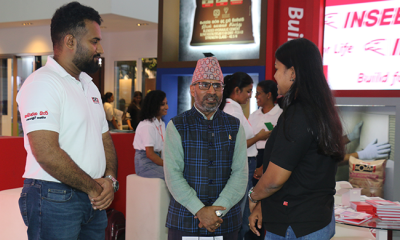
Sri Lanka’s construction industry losing ground while no one watches
-

 Business4 days ago
IMF’s unstated rate:Sri Lanka’s $695m loan costs about 5.33% per annum
-
 News6 days ago
State of emergency extended
-
 Features7 days ago
The Division Bell Mystery
-
 Features5 days ago
Are threats to Buddha Sasana external or from within?
-
 News4 days ago
UNP challenges NPP move to amend Vihara – Devalagam Act