
News
Fresh comprehensive review of PTA underway

Govt. briefs international community ahead of Geneva sessions
The government has assured the Colombo-based diplomatic community that the restoration of the provisions in the 19th Amendment, by the enactment of the 21st Amendment, would strengthen parliamentary democracy, enhance oversight of the executive branches of government and ensure independence of key institutions.
The government also said that comprehensive review of the Prevention of Terrorism Act (PTA) was underway.
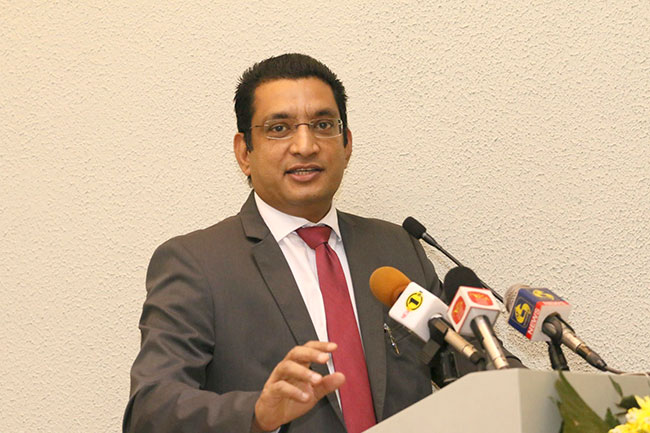
Foreign Minister Ali Sabry, Attorney General Sanjay Rajaratnam, PC, Foreign Secretary Aruni Wijewardane, and Finance Secretary Mahinda Siriwardana, on Monday (15), briefed the diplomatic community on current developments. The Foreign Ministry said that the briefing was organized in view of the forthcoming 51st session of the Human Rights Council in Geneva.
Minister Sabry outlined the current developments in Sri Lanka, including the democratic transition of the office of the President, in accordance with the Constitution. He outlined several areas of progress, already visible, in addressing some of the immediate challenges which has led to a greater degree of stability for the people. On the political front, the Minister briefed, regarding the work underway towards forming an All-Party Government. He also recalled that the 21st Amendment to the Constitution which effectively restores the 19th Amendment, has been gazetted and is before Parliament. This measure will contribute towards strengthening parliamentary democracy, oversight of the executive branches of government and the independence of key institutions. He also explained the progress that has been initiated towards a comprehensive review of the PTA. The government is taking focused measures to mitigate the adverse impact of the current economic situation on the vulnerable sectors of the population, in order to ensure the economic and social rights of the people and to prevent further disparities. The Minister also noted that despite the unprecedented situation in the country, in recent years, including in the aftermath of the COVID pandemic, advancements have been made in the area of human rights and reconciliation, through domestic processes. The government is in the process of building consensus so that further progress can be made on matters, related to human rights, justice and equity. The Foreign Minister emphasized that Sri Lanka will continue its constructive engagement with the Human Rights Council at the upcoming 51st session.
Finance Secretary Siriwardana made a presentation on the current economic situation, focusing on the social safety measures that the Government has adopted for vulnerable groups, with a view to mitigating adverse impacts. The Attorney General elaborated on the legal framework related to the Government’s response to the recent incidents, related to protests, and the imposing of the State of Emergency. Foreign Secretary Wijewardane highlighted Sri Lanka’s continuing and extensive engagement with several procedures and processes of the United Nations Human Rights framework.
During the discussion, that followed the presentations, the Resident Coordinator of the United Nations, Hanaa Singer-Hamdy, expressed appreciation for the consistent efforts of the Government in facing the challenges and expanding the social safety net of vulnerable groups. She also acknowledged the review of the PTA. The UN Resident Coordinator announced that the UN will be partnering with the Government of Sri Lanka on a five-year framework of cooperation which will include areas of social and economic rights and social cohesion amongst others.

Latest News
Heat Index at Caution Level in the Western, Sabaragamuwa, Southern, Eastern, North-western, Northern and North-central provinces and in Monaragala district.


Warm Weather Advisory
Issued by the Natural Hazards Early Warning Centre
Issued at 3.30 p.m. on 09 April 2026, valid for 10 April 2026.
The Heat index, the temperature felt on human body is likely to increase up to ‘Caution level’ at some places in the Western, Sabaragamuwa, Southern, Eastern, North-western, Northern and North-central provinces and in Monaragala district.
The Heat Index Forecast is calculated by using relative humidity and maximum temperature and this is the condition that is felt on your body. This is not the forecast of maximum temperature. It is generated by the Department of Meteorology for the next day period and prepared by using global numerical weather prediction model data.

Effect of the heat index on human body is mentioned in the above table and it is prepared on the advice of the Ministry of Health and Indigenous Medical Services.
ACTION REQUIRED
Job sites: Stay hydrated and takes breaks in the shade as often as possible.
Indoors: Check up on the elderly and the sick.
Vehicles: Never leave children unattended.
Outdoors: Limit strenuous outdoor activities, find shade and stay hydrated.
Dress: Wear lightweight and white or light-colored clothing.
Note:
In addition, please refer to advisories issued by the Disaster Preparedness & Response Division, Ministry of Health in this regard as well. For further clarifications please contact 011-7446491.
Latest News
Sun directly overhead Chilaw, Bingiriya, Halmillawewa, Panduwasnuwara, Gokarella, Kawudupelella, Koppaveli and Kirankulam about 12:12 noon. today (09)

On the apparent northward relative motion of the sun, it is going to be directly over the latitudes of Sri Lanka from the 05th to 15th of April this year.
The nearest areas of Sri Lanka over which the sun is overhead today (09th) are Chilaw, Bingiriya, Halmillawewa, Panduwasnuwara, Gokarella, Kawudupelella, Koppaveli and Kirankulam about 12:12 noon.
Latest News
Heat Index at Caution Level in the Western, Sabaragamuwa, Southern, Eastern, North-western, Northern and North-central provinces and in Monaragala district

Warm Weather Advisory
Issued by the Natural Hazards Early Warning Centre
Issued at 4.30 p.m. on 08 April 2026, valid for 09 April 2026.
The Heat index, the temperature felt on human body is likely to increase up to ‘Caution level’ at some places in the Western, Sabaragamuwa, Southern, Eastern, North-western, Northern and North-central provinces and in Monaragala district.
The Heat Index Forecast is calculated by using relative humidity and maximum temperature and this is the condition that is felt on your body. This is not the forecast of maximum temperature. It is generated by the Department of Meteorology for the next day period and prepared by using global numerical weather prediction model data.
Effect of the heat index on human body is mentioned in the above table and it is prepared on the advice of the Ministry of Health and Indigenous Medical Services.
ACTION REQUIRED
Job sites: Stay hydrated and takes breaks in the shade as often as possible.
Indoors: Check up on the elderly and the sick.
Vehicles: Never leave children unattended.
Outdoors: Limit strenuous outdoor activities, find shade and stay hydrated.
Dress: Wear lightweight and white or light-colored clothing.
Note:
In addition, please refer to advisories issued by the Disaster Preparedness & Response Division, Ministry
of Health in this regard as well. For further clarifications please contact 011-7446491.

Transgender women banned from women’s PDC darts

Heat Index at Caution Level in the Western, Sabaragamuwa, Southern, Eastern, North-western, Northern and North-central provinces and in Monaragala district.

PSL 2026: Iftikhar’s all-round show seals last-ball win for Zalmi

BCCI curbs movement of benched IPL players in latest rules

Prasidh trumps Miller in last-ball finish as Gujarat Titans clinch thriller

Greece to ban social media for under-15s from next year

‘Dates have the highest sugar content to fight Coronavirus’

Sunday Island 27 December – Headlines

#SundayIsland 17th December – Headlines

Sunday Island – 28th March

Sunday Island Headlines – 21 March

Sunday Island – 21st February – Headlines
-

 Features5 days ago
Ranjith Siyambalapitiya turns custodian of a rare living collection
-

 News5 days ago
Global ‘Walk for Peace’ to be held in Lanka
-

 News3 days ago
Lankan-origin actress Subashini found dead in India
-

 Features5 days ago
Beyond the Blue Skies: A Tribute to Captain Elmo Jayawardena
-
 Opinion7 days ago
Hidden truth of Sri Lanka’s debt story: The untold narrative behind the report
-

 Features5 days ago
Aspects of Ceylon/Sri Lanka Foreign Relations – 1948 to 1976
-

 Business23 hours ago
Hayleys Mobility introduces Premium OMODA C9 PHEV
-

 Features7 days ago
The Ramadan War