
News
Eran reveals SJB’s economic policies

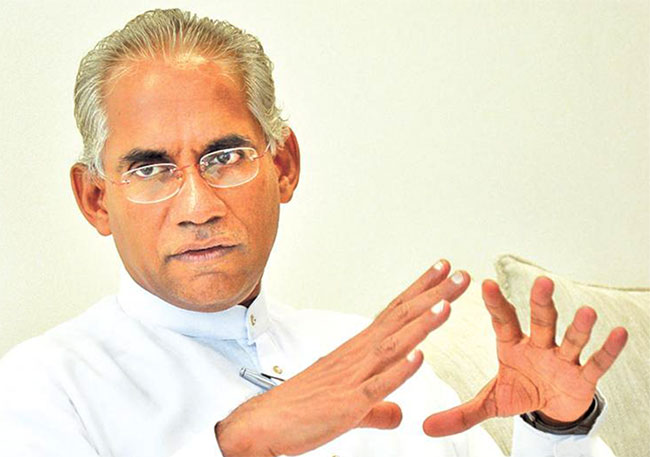
Explaining the economic policy of the future SJB government, Eran Wickramaratne M.P. said that the SJB has already decided to allow the use of chemical fertiliser in order to promote export-oriented value-added commercial agriculture. He also said that the future SJB government will give priority to exports and the government will mediate directly to seek foreign market opportunities for small and medium scale entrepreneurs. Actions would also be taken to provide the required technology to SME sectors on a priority basis. Further, in order to give equal opportunity for women in obtaining employment in the private sector, a scheme will be introduced to provide financial relief for maternity leave to private sector employees.
Speaking at a media briefing held at the Opposition Leader’s Office in Colombo on the theme ‘The Right Path to the Economy’, Mr. Wickremaratne said: The crisis that started with the food shortages under this government which has no economic policy or plan has now spread to all sectors of the economy, leading to a collapse in exports and a large number of unemployment due to import restrictions on intermediary goods used for exports caused by a severe dollar shortage.
This government came in to office by spreading falsehoods, inciting racism and with distorted public opinion as it had no policies for governance. The Thera of Kelaniya Rajamaha Viharaya performed a drama of a Cobra emerging from Kelani river with a sacred relic, then had a play on arrest of ‘Ranaviruvan’, later staged a play on ‘MCC’ agreement and made another play about the Singapore Sri Lanka Free Trade Agreement. Now the entire country has realized that this government knows nothing about governance, economic and financial management.
Now they are making a soundtrack and using it to get the Attorney General to withdraw cases against politicians of the ruling family and their cronies. Now the latest drama is about chemical fertilizers, power cuts and gas explosions.
At a time when everything has turned upside down under this government, some ministers have started preaching to deceive the people saying that they should think positively. The government is now creating a dream of the future by misleading the people forgetting the reality.
The Governor of the Central Bank has told a foreign channel on January 24 that Sri Lanka has all the food stocks that it needs.
“But when you go to a shop, you are given only one packet of milk powder per customer. A notice to that effect has also been displayed. Don’t MPs and ministers see this reality?” Eran asked. The government advises people to be positive in the face of such market crisis. In order to do so, there must be clarity about the government’s policies and programmes.
The economy that exists in this country is where not even a bag of cement is freely available. A delegation from the packaging industry told us that there was no corrugated paper in the market. Shortage of intermediary goods to manufacture cartons for export of goods, not only disrupts exports but also leads to the collapse of local industries and unemployment. The food crisis in the country has spread one by one and affected the entire sectors but the government has no practical solution.
The current economic and financial crisis is unique to Sri Lanka. It is important to critically examine why it happened to Sri Lanka alone. In March 2020, Corona epidemic was reported. In the second quarter of 2020, the apparel industry fell by 42 percent. Construction fell by 30 percent. Tourism, which had a direct impact on Corona, fell by 64%. Consumption also declined during this time. Inflation has now risen sharply due to rising commodity prices due to short supply. The MP said the government, without realizing the depth, was deluded into believing that the issue could be resolved by printing money.
The Colombo Consumer Price Index for January 2022 is 14.2 % was up from 12.1%, in December 2021 and food inflation was 25%. Accordingly, Sri Lanka has been ranked as the 12th country in the world where inflation has risen rapidly. This government will soon make it the first country in the world.
The control and handling of the market without any policy or basis has led to increase in the prices of rice – samba, red rice and nadu rice, milk powder, dhal vegetables, dried chillies, potato onion gas etc. by about 30% to 150%. Before providing solutions to present crises the economic experts should make a thorough study on the issue to arrive at a decision whether these were due to issues in supply, production or demand side. The government’s ill-advised solution of money will definitely further aggravate the situation creating more hardships to the people. Therefore, Wickramaratne said that further increase in inflation cannot be prevented.



India are through to the semi-finals of the Asian Games men’s tournament, with persistent rain and a damp outfield in Nisshin forcing the abandonment of their quarter-final against Afghanistan 16 minutes before the scheduled toss. India’s higher seeding – determined by the ICC T20I team rankings – ensured they went through at Afghanistan’s expense.
India will next face the winners of Tuesday’s quarter-final between Nepal and Sri Lanka in Thursday’s second semi-final. As one of the four seeded teams – India, Pakistan and Bangladesh are the others – to qualify directly for the quarter-finals, Sri Lanka will progress to the semi-finals if their match against Nepal is washed out too.

By Shamindra Ferdinando
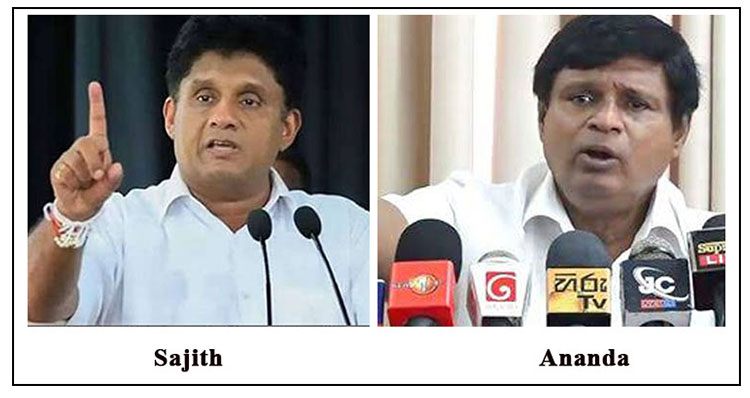
Alleging that the Samagi Jana Balawegaya (SJB) had betrayed the joint protest campaign, planned on 24 Sept., at Polduwa junction, against the enactment of the 22nd Amendment without securing public approval at a referendum, SJB trade union leader Ananda Palitha emphasised that SJB and Opposition Leader Sajith Premadasa should take remedial measures to restore the alliance against the NPP government.
Responding to The Island queries, the trade union activist said that he spoke on behalf of the vast majority of the SJBers who felt betrayed by the sudden declaration made by Colombo District SJB lawmaker S.M. Marikkar that they didn’t expect Opposition political parties’ participation, except that of the UNP.
Pointing out that at the behest of Premadasa, MP Marikkar belittled those who had pledged on 17 Sept. to join the SJB-led protest, Palitha emphasised the Opposition leader should be held responsible for restoring the shattered alliance. Palitha warned that the NPP, which was rapidly moving on a dictatorial path, would be the beneficiary of such treacherous actions.
When The Island raised the allegations pertaining to the 24 Sept. protest, Colombo District MP Premadasa said there was no basis for such claims. MP Premadasa called the accusations directed at him ‘rubbish.’
Palitha said that the pathetic failure on the part of the Opposition to genuinely challenge the authoritarian NPP should be examined, taking into consideration the government following an agenda almost 100 percent against the election pledges. Except the much touted anti-corruption campaign, the NPP reneged on all its election promises.
Recalling massive rice imports after having promised to stop the same in the run up to the national elections in 2024, Palitha alleged that the utterly corrupt NPP created an artificial shortage to enable import of large stocks of salt for their benefit. Massive earnings were made through commissions, Palitha said, urging the SJB to reiterate its commitment to the 17 Sept. pledge. According to him, the SJB’s irresponsible action sabotaged the joint Opposition agreement reached on the eve of President Anura Kumara Dissanayake completing two years in Office.
Palitha said that the disruption of a genuinely joint protest, at the last moment, caused irreparable harm to the Opposition. The unexpected eleventh hour declaration made by the SJB upset their efforts to organise a large scale two-day protest on 24 and 25 Sept. Palitha emphasised the responsibility on the part of the SJB leadership and its top management to spearhead an all-out campaign against the government. The former petroleum sector employee said that a strong and transparent campaign could undermine the NPP within as a section of its parliamentary group was deeply dismayed by the current policies and strategies.
Palitha, in his capacity as the trade union leader, invited the Bar Association of Sri Lanka (BASL) to join the trade unions’ protest on 25 Sept. to intensify pressure on the government. BASL President Rajeev Amarasuriya told The Island that they didn’t accept that invitation.
Former SLPP Kalutara District MP Sanjeewa Edirimanna said that the SJB was far more keen to organise a large-scale protest to counter the SLPP’s highly successful Anuradhapura rally held on 12 September than a genuine joint protest against the 22nd Amendment or the government. Edirimanna said that they realised that the SJB would probably join a joint protest campaign only after organising a gathering to counter the SLPP. According to him, the SJB hadn’t been honestly interested in a joint protest campaign. Instead, it sought to resist possible challenges from rival political parties, he said.
An aide to UNP leader and former President Ranil Wickremesinghe said that though the SJB announced they were welcome to join the 24 Sept. protest, the party never received an invitation. The official said that some UNPers joined the protest on their own though the party neither directed supporters to join or boycott the event. As the Janathawadi Joint Opposition decided against participating for want of formal invitations, the UNP, as part of that group, decided not to join the 24 Sept. protest.
By Norman Palihawadane
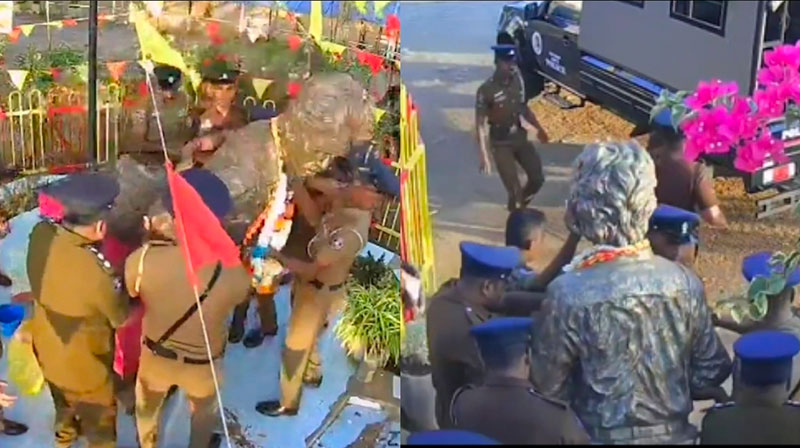
Police have removed a memorial statue of former LTTE member Rasaiah Parthipan, alias Thileepan, from the Thileepan Memorial Square in Nallur, Jaffna, following the conclusion of commemorative events, marking the 39th anniversary of his death.
The statue was removed in the early hours of yesterday (27), a day after the final day of the commemoration was held at the site.
CCTV footage from the memorial reportedly shows police officers removing the statue and taking it away in a vehicle.
Tamil National People’s Front (TNPF) Secretary and MP Selvarasa Gajendran alleged that more than 15 police officers arrived at the site, without prior notice, entered the premises wearing footwear, and forcibly removed the statue.
The reason for the removal and the legal basis for the police action had not been officially announced as of yesterday.
Thileepan, a former political wing leader of the LTTE, died in September 1987, after undertaking a hunger strike in Nallur, while making several demands of the Indian Government.
The memorial events, marking the 39th anniversary of his death, were held at the site on Saturday (26). A statue had been erected at the location in connection with the commemoration.

Mexico’s Pacific coast braces for Hurricane Polo

Washout against Afghanistan sends India into semi-finals

‘Still a lockdown’: Deadly floods hit Nepal tourism as peak season begins

Tharanga wins highly anticipated Asian Games gold

Tharanga on cusp of Asian Games Gold

Rain threat looms over lopsided India vs Afghanistan quarter-final

‘Dates have the highest sugar content to fight Coronavirus’

Sunday Island 27 December – Headlines

#SundayIsland 17th December – Headlines

Sunday Island – 28th March

Sunday Island Headlines – 21 March

Sunday Island – 21st February – Headlines
-

 News6 days ago
Mastermind Naufer Moulavi among 15 found guilty
-

 Midweek Review6 days ago
Thileepan’s fast unto death: An authentic narrative that many missed
-
 News7 days ago
Protest against setting up of cement factory in highly populated area near BIA
-

 Editorial7 days ago
Trouble beginning in earnest
-

 Latest News5 days ago
Showers above 100 mm are likely at some places in the Western, Sabaragamuwa, Central and North-western provinces and in Galle and Matara Districts
-
Editorial6 days ago
Big Bad Bills
-
 News7 days ago
Police may seek clarification from US
-
 News7 days ago
Govt. confident of 2/3 majority despite NPP split speculation