
News
Foreign Ministry refutes claims made by Ambika Satkunanathan to the European Parliament’s Subcommittee on Human Rights


The Foreign Ministry on Friday noted with concern the numerous misleading statements contained in the testimony of the Chairperson of the Neelan Tiruchelvam Trust Ambika Satkunanathan, during an exchange of views on the situation of human and labour rights in Sri Lanka at the European Parliament’s Subcommittee on Human Rights on 27 January, 2022.
The Ministry in a release said: Ms. Satkunanathan’s testimony completely ignores the progress made by the government of Sri Lanka on many fronts and creates doubts about the government’s intents and sincerity, particularly at a time when it is engaged in a long-standing cooperation with the UN human rights mechanisms and the UN Human Rights Council and is delivering on its commitment to address accountability and reconciliation through domestic processes and institutions.
The Ministry is disappointed that among the recommendations made by Ms. Satkunanathan is that the EU uses its leverage on GSP plus facility to exert pressure on the government on human rights. If Sri Lanka loses the EU GSP plus facility, particularly at a time when livelihoods of millions of Sri Lankans belonging to all communities are already affected by the ongoing COVID-19 pandemic, the resulting losses would exacerbate poverty and income inequality. Some of the worst affected sectors will be fisheries and agriculture which are among the key industries in the North and the Eastern Provinces of Sri Lanka.
The Ministry also notes that the unfounded allegations about discrimination of ethnic communities in her testimony are reminiscent of LTTE propaganda that once stoked hatred among communities. In a multi-ethnic and multi-religious country such as Sri Lanka, such allegations need to be refuted in the interest of social harmony and to prevent the spread of dangerous fallacies about Sri Lanka in the international community.
The Ministry refutes Ms. Satkunanathan’s claims on ‘a culture of impunity’. The Ministry wishes to point out that the government is engaged in a long-standing cooperation with the UN human rights mechanisms as well as with the UN Human Rights Council. Sri Lanka is delivering on its commitment to address accountability and reconciliation through domestic processes and institutions. The government has been actively engaging the international community including the UNHRC’s Universal Periodic Review and Special Procedures to address the various concerns that have been raised. This includes the allegations of systematic torture. The Government has made it clear that additional reforms will be undertaken to further strengthen rule of law, access to justice, and accountability. It remains open to a constructive discussion on suggestions and further steps to address shortcomings.
The Ministry notes that Ms. Satkunanathan makes references to ‘Sinhala Buddhist nationalism’ and ‘militarisation’ as driving the actions of the Government. She makes vague claims of racial profiling in the absence of any concrete evidence of discrimination against minorities. In reply, the Ministry wishes to point out that Sri Lanka is a secular country and all citizens, irrespective of their religion or ethnicity share the same fundamental rights under the Constitution. Furthermore, Sri Lanka ensures access to public services such as free education and free health facilities without any discrimination on the basis of ethnicity or religion. In fact, even during the military conflict when large areas of the Northern and the Eastern Provinces were under the control of the LTTE, the government continued with the provision of such public services to the areas so that the civilians, who were mainly ethnic Tamils and Muslims, would not be affected.
Ms. Satkunanathan points to the Presidential Task Force on Archaeology which she accuses of being a tool for land grabbing and changing the demographics of minority-heavy areas and the Presidential Task Force on “One-Country One Law” which she accuses of stoking ethnic hatred and violence. After the war, as displaced persons returned to the Northern and the Eastern Provinces, there has been an increase in unauthorized encroachment into forest areas inevitably leading to destruction of archaeological sites. So, there is an urgent need to take concrete measures in order to protect these sites. There is no truth in the claims that the Presidential Task Force on Archaeology is a pretext for land grabbing and introducing the Sinhalese to these areas. It may be noted that there is representation of all ethnic communities in this Task Force. With respect to the Presidential Task Force on “One Country One Law,” it should be noted that it is expected to play an advisory role only. The Task Force’s recommendations will be first studied by the Justice Ministry, then the Cabinet of Ministers and finally the Parliament following the democratic traditions.
With regard to her allegations that the Northern and Eastern Provinces are ‘occupied’ by the military, it should be pointed out that the the majority (more than 92%) of the private lands occupied by the military at the end of the conflict in year 2009 have already been released to legitimate land owned civilians. A mechanism is already in place to expedite the process of releasing remaining private lands.
It is particularly disappointing to see Ms. Satkunanathan’s allegations that ‘civic space’ is shrinking and that informal and extra-legal processes are used to curtail the activities of civil society organizations. The Ministry asserts that government views NGOs as partners and not as adversaries. The government acknowledges the constructive contributions made by civil Society organisations in the work of the Office for National Unity and Reconciliation (ONUR) and Sustainable Development Council of Sri Lanka. It has also introduced certain policy changes to facilitate the work of NGOs such as bringing the NGO Secretariat under the Foreign Ministry. It must be reiterated that apart from operating routine security networks in the interest of national security, particularly after the devastating Easter Sunday terrorist attacks, the Security Forces and intelligence agencies are not engaged in monitoring or targeting any specific group of people in the country.
The Ministry refutes Ms. Satkunanathan’s claims of extra-judicial killings and arrests under the pretext of a “war and drugs.” With regard to the PTA, it should be noted that the government is in the process of amending the Act, which is now at the final stage and the international community is being briefed on that process.
Ms. Satkunanathan also alleges that the government is exploiting its friendship with China to “undermine the efforts of states that call for accountability for human rights violations” in Sri Lanka. On the contrary, mindful of strategic competition that is increasing in the Indo-Pacific region, our main foreign policy directive is to maintain neutrality, in line with the non-aligned foreign policy we have adopted since Independence. The Ministry wishes to point out that apart from China, Sri Lanka has entered into partnerships with several countries such as India and Japan to fill gaps in national infrastructure development. Such partnerships have no bearing on Sri Lanka’s commitment to address accountability and reconciliation through domestic processes and institutions.

Latest News
Landslide Early Warnings issued to the districts of Colombo, Galle, Gampaha, Hambanthota, Kalutara, Kandy, Kegalle, Kurunegala, Matara, Nuwara Eliya and Ratnapura


The National Building Research Institute has issued landslide early warnings to the districts of Colombo, Galle, Gampaha, Hambanthota, Kalutara, Kandy, Kegalle, Kurunegala, Matara, Nuwara Eliya and Ratnapura from 16:00 hrs on 25.09.2026 To 16:00 hrs on 26.09.2026
Accordingly,
LEVEL III [RED] landslide early warnings have been issued to the Divisional Secretaries Divisions and surrounding areas of Neluwa, Nagoda, Niyagama and Thawalama inthe Galle district, Ganga Ihala Korale, Udapalatha, Doluwa and Pasbage Korale in the Kandy district, and Kothmale West, Ambagamuwa, Kotmale East and Norwood in the Nuwara Eliya district.
LEVEL II [AMBER] landslide early warnings have been issued to the Divisional Secretaries Divisions and surrounding areas of Elpitiya, Baddegama and Karandeniya in the Galle district, Walallawita in the Kalutara district, Deltota, Udunuwara, Gangawata Korale, Yatinuwara and Panvila in the Kandy district, Aranayake, Dehiowita, Mawanella, Deraniyagala and Yatiyanthota in the Kegalle district, Thalawakelle in the Nuwara Eliya district and Ratnapura and Pelmadulla in the Ratnapura district.
LEVEL I [YELLOW] landslide early warnings have been issued to the Divisional Secretaries Divisions and surrounding areas of Seethawaka and Padukka in the Colombo district, Attanagalla and Mirigama in the Gampaha district, Katuwana and Walasmulla in the Hambanthota district, Ingiriya and Bulathsinhala in the Kalutara district, Hatharaliyadda, Poojapitiya, Medadumbara, Kundasale, Ududumbara, Thumpane, Akurana, Pathadumbara, Harispattuwa and Pathahewaheta in the Kandy district, Warakapola, Bulathkohupitiya, Galigamuwa, Kegalle and Ruwanwella in the Kegalle district, Mallawapitiya, Alawwa, Polgahawela and Mawathagama in the Kegalle district, Pitabeddara, Kotapola and Pasgoda in the Matara district, Nuwara Eliya in the Nuwara Eliya district and Elapatha, Ayagama, Nivithigala, Kuruwita and Kalawana in the Ratnapura district

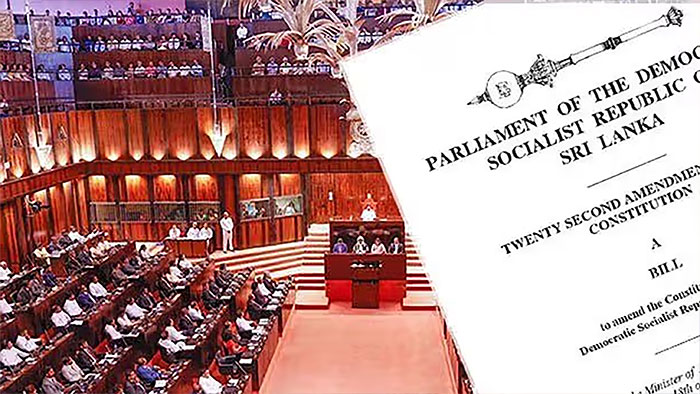
Parliament yesterday passed the Twenty-Second Amendment to the Constitution Bill and the Judicature (Amendment) Bill with two-thirds majorities, with 158 MPs voting in favour and 63 against each Bill.
The Illankai Tamil Arasu Kadchi (ITAK) and Sri Lanka Muslim Congress (SLMC) voted with the SJB against the Bills.
NDF MPs Ravi Karunanayake and Faizer Musthapha and SJB Badulla District MP Nayana Wasalathilaka were not present when the votes were taken.
The final vote on the Judicature (Amendment) Bill was announced at around 8.08 p.m. after Opposition MPs called for divisions on its clauses during the Committee Stage.
The votes followed a two-day debate which commenced on Thursday (24), after Justice and National Integration Minister Harshana Nanayakkara presented the Bills for their Second Reading.
The Supreme Court’s determination on the Bills was presented to Parliament on Tuesday (22) by Speaker Dr Jagath Wickramaratne. The Court determined that the 22nd Amendment Bill did not require approval at a referendum and could be passed by a special two-thirds majority in Parliament.
The amendment provides for raising the mandatory retirement age of Supreme Court judges from 65 to 67 and that of Court of Appeal judges from 63 to 65. It also provides for the Chief Justice to retire at 67 or after completing six years in office, whichever comes earlier.
The Speaker informed Parliament that the Judicature (Amendment) Bill could be passed by a simple majority.
The SJB opposed the legislation and its MPs attended Parliament dressed in black yesterday. The party also staged a protest at Polduwa Junction, Battaramulla, under the theme “No to 22, which destroys democracy”, with Opposition Leader Sajith Premadasa and several SJB politicians participating.
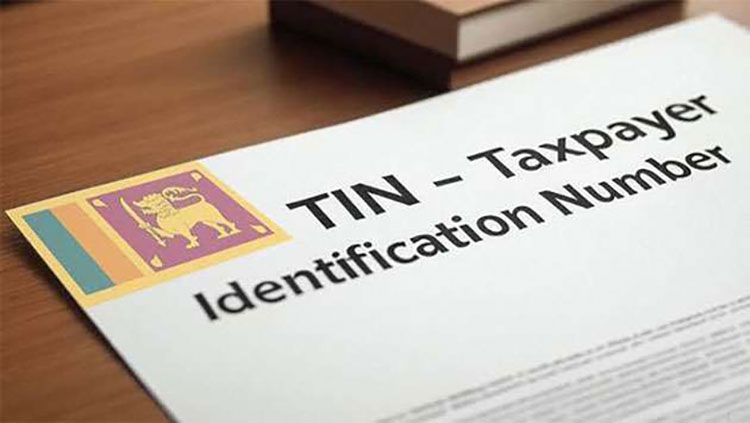
A valid Taxpayer Identification Number (TIN) Certificate will be required for a range of key transactions in Sri Lanka from November 1, 2026, the Inland Revenue Department (IRD) has announced.
The requirement, introduced under the Inland Revenue (Amendment) Act, No. 11 of 2026, applies to transactions specified under Section 102(3) of the Inland Revenue Act.
Accordingly, individuals will be required to produce a valid TIN Certificate when opening an account at a bank or financial institution, obtaining approval for a building plan, registering or renewing the licence of a motor vehicle, registering land or title to land, registering a business, transferring shares in a company incorporated in Sri Lanka or obtaining a credit card.
In the case of share transfers, both the transferor and transferee will be required to provide TIN certificates.
The IRD said officials handling such transactions had been instructed to ensure that a valid TIN Certificate was submitted before processing or completing the relevant transaction.
The Department advised those who do not already have a TIN to obtain one in advance through its e-Services platform.
It said a printout of the TIN verification result showing the applicant’s National Identity Card number and TIN could also be accepted instead of the certificate.The IRD also reiterated that obtaining a TIN is mandatory for resident individuals aged 18 and above under the applicable provisions.

Landslide Early Warnings issued to the districts of Colombo, Galle, Gampaha, Hambanthota, Kalutara, Kandy, Kegalle, Kurunegala, Matara, Nuwara Eliya and Ratnapura

Showers in the Western, Uva and Sabaragamuwa provinces and in Galle, Matara, Kandy, Nuwara-Eliya, Batticaloa and Ampara districts.

22A, Judicature Amendment Bills passed with 2/3 majority

TIN mandatory for key transactions from Nov. 1

Navy brings 25 Indonesian fishermen ashore after trawler capsizes

Former Mineral Sands Chairman arrested over recruitment irregularities

‘Dates have the highest sugar content to fight Coronavirus’

Sunday Island 27 December – Headlines

#SundayIsland 17th December – Headlines

Sunday Island – 28th March

Sunday Island Headlines – 21 March

Sunday Island – 21st February – Headlines
-

 News6 days ago
Namal Rajapaksa Buddhist gambit fails, bail denied
-

 Features6 days ago
Why the spelling Sri Lankan names in English vary
-

 Features6 days ago
Three bands, a new identity: Sri Lankan wolf snake recognised as distinct species
-

 Business6 days ago
SLIIT holds largest-ever convocation
-

 News6 days ago
Vehicle prices drop by up to Rs. 1 mn, says importers’ body
-

 News6 days ago
Govt monitors reported Saudi death sentence – Foreign Ministry
-
 Business6 days ago
Lanka’s famed beach shack battles demolition
-

 Business6 days ago
All-new Bolero MaXX Pik-Up unveiled in Lanka