
News
‘Sarasavi Diriya Abhiman’ programme launched under PM’s patronage

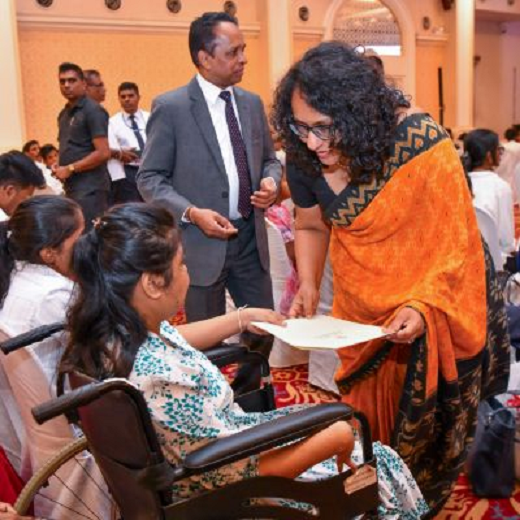
The inaugural ceremony of the ‘Sarasavi Diriya Abhiman’, a special scholarship programme implemented by the President’s Fund for students with disabilities studying at Sri Lanka’s state universities who have not allowed physical limitations to stand in the way of their educational aspirations, was held under the patronage of Prime Minister Dr Harini Amarasuriya at Temple Trees on Saturday (11) morning .
Under this programme, all students with disabilities currently studying at state universities in Sri Lanka are recognised, with the President’s Fund providing each student with a one-off scholarship grant of Rs. 100,000.
At the inaugural ‘Sarasavi Diriya Abhiman’ ceremony, 236 university students with disabilities were recognised, while the total number of students eligible for the programme is close to 400. Taking into consideration the difficulties faced by students in travelling to Colombo, a programme for the Northern, North Central and Eastern Provinces is also scheduled to be held in August.
A notable feature of today’s scholarship presentation was that the scholarships were presented by approaching the beneficiary students at their respective seats.
The ‘Sarasavi Diriya Abhiman’ programme, implemented by the President’s Fund, provides national recognition for the dedication, abilities and educational achievements of students with disabilities. It is a significant social empowerment initiative that reaffirms the Government’s position that no physical limitation should stand in the way of educational aspirations.
Addressing the gathering, Prime Minister Dr Harini Amarasuriya stated that the current Government is formulating state policies based on the principle that persons with disabilities must enjoy the same rights as everyone else in society.
Prime Minister further addressing the gathering, said:
“Today is a very special day in the history of our country and, in particular, in the history of the President’s Fund. Another significant step taken during the past one and a half years is being implemented today. It must be said that today marks another successful step in our efforts to create a people-oriented President’s Fund.
Gaining a university education in our country is not easy. It is not an opportunity available to everyone. Although hundreds of thousands of students pass the GCE Advanced Level Examination, only a relatively small number gain admission to universities. Those present here today are a group of extremely courageous and determined citizens pursuing a university education. You have overcome numerous challenges and continue to face those challenges every day to reach this point. I am pleased that we have the opportunity to recognise you. You are truly an example to society and to the entire country. We respect your courage.
Persons with disabilities are part of society. Our Government is formulating policies based on the principle that persons with disabilities are entitled to the same rights enjoyed by everyone else in society. We must take a broad and inclusive approach and send a clear message that these diversities are recognised within our education system. We must build confidence within society that people can learn, progress and reach the highest levels despite these differences.
Students with disabilities were admitted to the university system only after a long struggle. Today, students have been guaranteed the right to study any subject of their choice. It is the responsibility of all of us to create the necessary environment for students exercising that right to pursue their education without barriers.
Every university should have a special unit dedicated to students with disabilities. The Task Force on the Digitalisation of Education should study this matter. A pilot project has already been launched in this regard. We have a responsibility to create universities capable of embracing all forms of diversity. This is a responsibility that cannot be abandoned.
We cannot build a developed society while leaving behind a section of society. Under the first phase of this programme, 236 students with special needs studying at the majority of universities across the island are being recognised today. On behalf of the Government, I commend this valuable initiative undertaken by the President’s Fund, which has allocated Rs. 23.6 million for your benefit. I also wish to pay tribute to your parents. They have fought a tremendous battle on your behalf. We know that you have worked tirelessly, day and night, to secure the future of your children.
As a Government, we will make every possible effort to create opportunities for you to use the higher education you receive to contribute to the sustainable development of the country and to provide the necessary career guidance to achieve this. You are not a burden on the country.
You are a valuable human resource to the nation. You are an integral part of this society. I wish for all your dreams to come true”.
Speaker of the Parliament of Sri Lanka Dr Jagath Wickramaratne said:
“The President’s Fund will mark its 50th anniversary in 2028. A programme of this nature for students with disabilities pursuing higher education is being implemented by the President’s Fund just two years before it completes half a century. When discussions were held on providing this assistance to you, everyone was genuinely pleased.
One of the main sources of revenue for the President’s Fund is a portion of the income generated through the sale of lottery tickets by the Development Lotteries Board. Therefore, all the people of this country contribute towards the funds being provided to you. After 48 years, the President’s Fund has truly become a fund belonging to the people.
Instead of centralising all the activities of the President’s Fund, the current Government has taken steps to decentralise its operations. It is remarkable to witness the level of efficiency with which the President’s Fund operates today. The President’s Fund has now been taken directly to the people.
At present, the President’s Fund is providing assistance to patients, students and identified families with various needs. In 2025 alone, Rs. 4.46 billion was allocated for education. A fresh transformation and change is taking place in the education sector.
While ensuring that social and educational benefits are provided equally to everyone, you will not be left behind for any reason. Today, the President’s Fund has become a fund close to the hearts of the people. The President’s Fund is truly the people’s fund.
Do not harbour the doubts that existed in the past. It must be said that today, the President’s Fund has been transformed into a fund dedicated to the welfare of the people and to building their future”.
Minister of Rural Development, Social Security and Community Empowerment Dr Upali Pannilage said:
“As a Government, we highly appreciate the step taken by the President’s Fund on behalf of persons with disabilities. Despite our efforts concerning persons with disabilities in our country, changing societal attitudes is a long-term process. We are continuously working towards achieving this change. In particular, as a Government, we are committed to ensuring that persons with disabilities are accorded the dignified place they deserve in society.
Our sole objective is to ensure that you are able to lead a dignified life in society. In line with international conventions, we are preparing legislation to safeguard the rights of persons with disabilities and are ready to have it enacted within a very short period.
For the thousands of persons with hearing impairments, a separate Bill on sign language has been drafted. The drafting process has now been completed, and steps are being taken to enact it into law. We are working to grant legal recognition to sign language, alongside Sinhala, Tamil and English in our country”.
Member of Parliament Sugath Wasantha de Silva said:
“Today is a special day. A person with a disability is compelled to wage a major struggle on two fronts. On the one hand, they must contend with their own disability, while on the other, they must struggle against the social, economic, political and physical factors that create disabling barriers.
Engaging in this struggle is difficult and challenging. To overcome these challenges, one must possess unwavering courage and determination. You are a group that possesses such courage.
The recognition presented by the President’s Fund is not being given because of their disabilities. It is because they have inspired society as a whole by demonstrating that it is possible to overcome life’s challenges. These undergraduates have demonstrated the power of inspiration and determination. This is a social investment. What the President’s Fund has done today is an investment in the light provided by these beacons of hope.
The President’s Fund has been rapidly democratised and brought closer to the people. It has developed the capacity to address different sections and diverse groups within society. That is why it has reached out to persons with disabilities who inspire the nation.
Every rupee in this Fund represents the hard work of the people as a whole. The benefits you receive from the President’s Fund should inspire you to become even more determined”.
Secretary to the President Dr Nandika Sanath Kumanayake said:
When we took over the President’s Fund, we could not be satisfied with the manner in which it was being administered. Only a very small group of people benefited from it, and there was no transparency. We wanted to administer the President’s Fund transparently. As an initial step, measures were taken to digitalise the President’s Fund.
Through this initiative, the services of the President’s Fund were expanded islandwide. Its services have now reached the villages. There is no longer a need to travel all the way to Colombo. We have created a system that enables you to access the services you require conveniently through Divisional Secretariats. As a result, the provision of benefits increased by 59% in 2025 compared with 2024.
The President’s Fund has now undergone a transformation. It provides medical assistance and allowances to low-income families, among other forms of support. Today, the President’s Fund also provides more scholarships to students pursuing their education.
The President’s Fund makes a significant contribution towards the provision of Mahapola scholarships. Going beyond this, we have launched a number of programmes. We awarded Rs. 100,000 each to the ten students who achieved the highest results in each subject stream at the GCE Advanced Level Examination. Assistance is also provided to children from families engaged in selling lottery tickets, whose contribution to the President’s Fund is significant.
We are providing assistance in many different ways. In parallel with these initiatives, the programme being implemented today provides Rs. 100,000 through the President’s Fund to university students with disabilities as an incentive to support their educational pursuits”.
Minister of Rural Development, Social Security and Community Empowerment Dr Upali Pannilage; Member of Parliament Sugath Wasantha de Silva; Secretary to the Prime Minister Pradeep Saputhanthri; Chief of Presidential Staff Prabath Chandrakeerthi; Secretary to the President’s Fund and Senior Additional Secretary to the President Roshan Gamage; members of the Board of Governors of the President’s Fund Sarath Chandrasiri Mayadunne and Professor J. R. P. Jayakody; Secretary to the Ministry of Education, Higher Education and Vocational Education Nalaka Kaluwewa; Chairman of the University Grants Commission Senior Professor Kapila Seneviratne; Vice-Chancellors of universities; members of the National Council for Persons with Disabilities; members of the Policy Committee on the Community of Persons with Disabilities; government officials and parents, among others, attended the event.
[PMD]



The Bar Association of Sri Lanka (BASL) yesterday called on all political parties, represented in Parliament, to allow their members to vote on the proposed 22nd Amendment to the Constitution according to their conscience, stressing that the responsibility for deciding whether the Bill should be enacted now rests with Parliament.
In a statement issued after the Supreme Court’s determination on the 22nd Amendment Bill, BASL President Rajeev Amarasuriya and General Secretary Nalin de Silva have said the SC’s determination should not be interpreted as an endorsement of the proposed constitutional amendment as a matter of policy.
The BASL has said the SC’s jurisdiction, under Articles 120, 121 and 123 of the Constitution, was to determine the constitutional requirements for the enactment of the Bill, including whether the Bill, or any of its provisions, required approval at a referendum under Article 83.
“The determination is therefore not a determination as to whether the proposed amendment is good or bad policy, desirable or undesirable, wise or unwise, or whether Parliament ought to enact it,” the BASL said.
Full text of the BASL statement: The Supreme Court has now delivered its Determination on the Twenty-Second Amendment to the Constitution Bill and determined that the Bill does not require the approval of the People at a Referendum.
In terms of Articles 120, 121 and 123 of the Constitution, the jurisdiction of the Supreme Court in relation to the Bill is to determine the constitutional requirements for its enactment, including importantly whether the Bill, or any provision thereof, requires the approval of the People at a Referendum by virtue of Article 83.
The Determination is therefore not a determination as to whether the proposed Amendment is good or bad policy, desirable or undesirable, wise or unwise, or whether Parliament ought to enact it.
This distinction is also evident from Sri Lanka’s previous constitutional amendments. During the 48 year history of the second republican Constitution there have been many amendments which passed constitutional muster but nevertheless had a negative effect on democracy, constitutionalism, the independence of the judiciary and the rule of law.
The question that now arises is whether Parliament ought to enact the proposed Amendment. That responsibility rests with Parliament and with each individual Member of Parliament when they vote on the Bill.
In making that decision, Members of Parliament should be mindful of the possible and probable consequences the 22nd Amendment will have on our nation. They should also consider the lack of transparency and a proper consultative process in the introduction of the 22nd Amendment. As representatives of the people they should also consider the concerns that have been expressed in relation to the proposed Amendment by a broad cross-section of society including the Maha Nayakes of the Three Nikayas, the Catholic Bishops’ Conference in Sri Lanka, the Church of Ceylon, the Bar Association of Sri Lanka, the Judicial Service Association, the Commonwealth Lawyers Association, LAWASIA, the International Association of Judges, the United Nations Special Rapporteur on the Independence of Judges and Lawyers, the French National Bar Council, and more than 40 Professional Associations and Unions, including the Government Medical Officers’ Association and other leading professional bodies.
Accordingly, the Bar Association of Sri Lanka calls upon all the political parties in Parliament to allow the Members of Parliament to speak and vote on the 22nd Amendment according to their conscience.
The responsibility now lies with Members of Parliament, when called upon to vote, to take a principled position according to their conscience giving due consideration to their constitutional responsibility, their representative capacity and most importantly their duty to the sovereign People of Sri Lanka.

SL to regain access to international financial and capital markets next year in line with IMF projections
Sri Lanka is on course to regain access to international financial and capital markets around 2027, in line with the International Monetary Fund’s (IMF) current economic projections, IMF Mission Chief Evan Papageorgiou said yesterday.
Papageorgiou said the IMF’s core assumptions under Sri Lanka’s economic programme continued to envisage the country returning to international capital markets in 2027.
“Our previous assumption that Sri Lanka will go back to capital markets still stands. We still have a good trajectory to achieving this in 2027 or thereabouts, and that should be the goal,” he said.
Papageorgiou stressed that Sri Lanka could not rely solely on domestic sources of financing to build long-term economic resilience and would need a diversified funding strategy.
“Every country needs to have a good ability to access funds both in domestic markets, as it already has, as well as international markets for eurobonds and other modes,” he said.
He said a return to international capital markets would have significant implications for Sri Lanka’s external debt composition, while strengthening foreign exchange reserves would remain essential as the country prepares to meet future debt-servicing obligations.
The IMF’s assessment comes amid improving international investor sentiment towards Sri Lanka and positive developments in the country’s sovereign credit ratings.
Papageorgiou cited Fitch’s recent upgrade of Sri Lanka’s credit rating as a positive development, saying global investors were increasingly viewing the country from a more constructive perspective.
Sri Lanka remains under the IMF’s Extended Fund Facility (EFF) programme, which is scheduled to continue until March 20, 2027. Regaining access to international capital markets remains a key milestone under the country’s broader economic recovery.
The IMF has stressed the importance of rebuilding Sri Lanka’s foreign exchange buffers and maintaining stability in domestic financial markets as the country approaches substantial external debt repayments.
A sustained improvement in these areas would help strengthen the country’s capacity to return to international markets while safeguarding macroeconomic stability, the IMF has indicated.
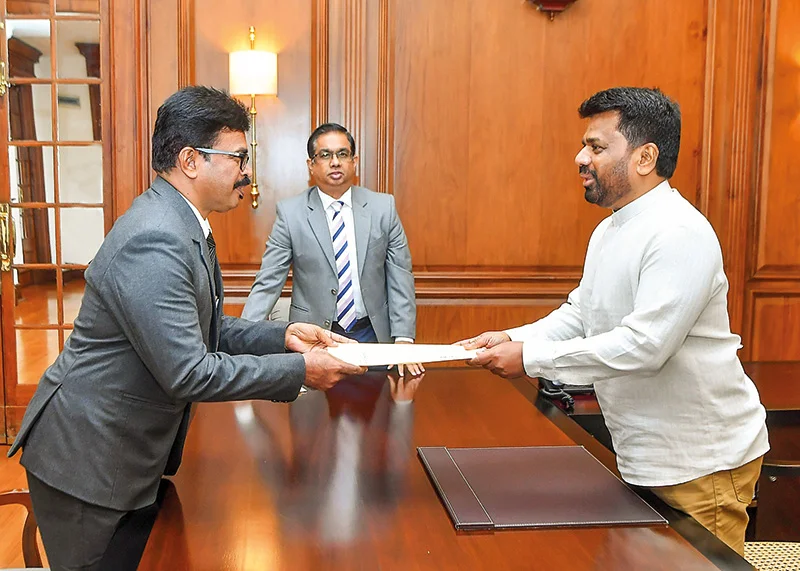
President Anura Kumara Dissanayake yesterday (23) handed over appointment letters to three Special Grade officers of the Judicial Service as High Court Judges, at a ceremony held at the Presidential Secretariat, according to the President’s Media Division (PMD).
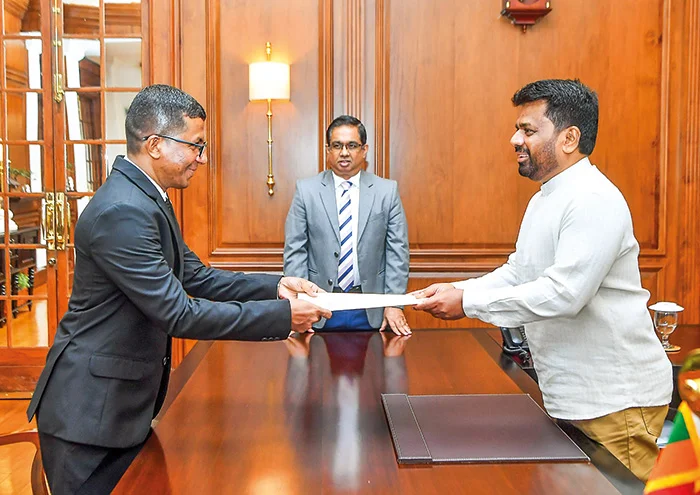
The new appointees are Perumal Sivakumar, District Judge of Jaffna; Anandi Kanagaratnam, Senior Assistant Secretary of the Judicial Service Commission; and Gnanesha Lalith Kannangara, District Judge of Colombo.
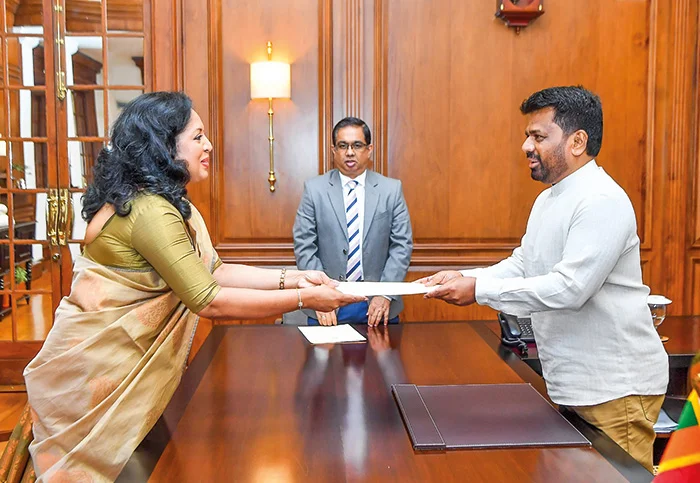
The three senior Judicial Service officers will take up duties as High Court Judges following their appointments.
The appointments were made from among Special Grade officers of the Judicial Service, the PMD said.

Showerss above 100 mm are likely at some places in the Western, Sabaragamuwa, Central and North-western provinces and in Galle and Matara Districts

Mirabai Chanu wins Asian Games silver as Ri breaks weightlifting record

Trump greets China’s Xi Jinping on arrival for three-day US

BASL calls for conscience vote on 22nd Amendment

IMF: Sri Lanka on course for 2027 market return

President appoints three new judges to High Court

‘Dates have the highest sugar content to fight Coronavirus’

Sunday Island 27 December – Headlines

#SundayIsland 17th December – Headlines

Sunday Island – 28th March

Sunday Island Headlines – 21 March

Sunday Island – 21st February – Headlines
-

 News6 days ago
Shanakiyan urges urgent action over reported death sentence for Lankan in Saudi Arabia
-

 News7 days ago
Bid for Basil’s extradition nears final stage: Police
-

 News5 days ago
Namal Rajapaksa Buddhist gambit fails, bail denied
-

 Features5 days ago
Why the spelling Sri Lankan names in English vary
-

 Features5 days ago
Three bands, a new identity: Sri Lankan wolf snake recognised as distinct species
-
 Business5 days ago
SLIIT holds largest-ever convocation
-

 News5 days ago
Govt monitors reported Saudi death sentence – Foreign Ministry
-

 Business5 days ago
All-new Bolero MaXX Pik-Up unveiled in Lanka