
News
Elpitiya and beyond – what are the options?


by Anura Gunasekera
The Elpitiya Pradeshiya Sabha election results have revived the flagging spirits of the opposition to the NPP/JVP regime, and injected energy to what is clearly the most lukewarm general election campaign in recent memory, the NPP/JVP excepted. Whilst President Dissanayake (AKD) is covering each district, addressing massive crowds, the opposition, Sajith Premadasa (SP) and his associates, and the leaders of other minority parties, are holding meetings in small halls, living rooms of large houses and other such restricted spaces, pontificating to select audiences of the already converted. Ranjan Ramanayake’s recent “Eksath Prajathanthravadi Voice” convention, ended as a public relations disaster. Press conferences are frequent, with opponents flaying the NPP government, countered by Minister Vijitha Herath with measured, credible rebuttals.
SP’s favourite theme is the IMF agreement, which he dissects ponderously, whilst Harsha de Silva and Eran Wickremaratne offer more digestible analyses. Dilith Jayaweera (DJ), entrepreneur, media moghul and committed capitalist, incongruously representing the Communist Party of Sri Lanka, along with other left-leaning alliances, backed by political discards Udaya Gammanpila, Wimal Weerawansa, Gevindu Cumaratunga, Dilum Amunugama and retired Marxist, DEW Gunasekera, declares that his party, the Mawbima Janatha Pakshaya, is the only hope for a better Sri Lanka.
Ranil Wickremasinghe (RW), has emerged from his retreat and is offering lessons to Prime Minister, Harini Amarasuriya, on the country’s constitution; rather baffling, as very few of Sri Lanka’s leaders have treated the country’s constitution and the judiciary, with the contempt that RW has. Several of his recent executive determinations and decisions have been challenged, successfully, in the Supreme Court of Sri Lanka.
In the meantime, President AKD is crisscrossing the country, delivering the same simple message at each meeting; to hear one is to hear all. He addresses everyday issues which preoccupy the minds and lives of ordinary people; the high cost of essential items, public transport problems, issues faced by the farming community, difficulties faced by school children, the disruption to family life arising from overseas employment of married women, and, of course, corruption in high places. In simple, palatable language, he explains to the gatherings the steps taken so far by his “interim government”, and the actions that a new government will take, once in power. He does not fail to highlight the undesirability of the previous parliament and the fact that his victory alone, has compelled about 60 of those undesirables to immediately declare voluntary retirement from “service to the public”.
The speech content is unambiguous and appealing. AKD concludes each address by requesting that the NPP/JVP be returned to power with a powerful mandate, which will enable it to deliver on its manifesto. His deliveries are credible because they address the depressing realities of ordinary lives. To my mind, he is the only leader of the country, since Ranasinghe Premadasa, to articulate, and empathize with the grievances of the massive proportion of our people – urban, suburban and rural – to whom life is an endless, daily grind.
President AKD’s detractors, which includes all political opponents, with the exception of Nuwan Bopage (Jana Aragala Viyaparaya – People’s Struggle Movement), have accused AKD of not delivering on pre-election promises, dismissing the reasonable argument that an interim government with three ministers, can only be a stop-gap arrangement till a permanent government is established.
Moving on to the impending general election, there is one main contender – the NPP – and an immeasurably remote possibility – the SJB. Sajith Premadasa has been very quick to extrapolate the Elpitiya PS result, as a very possible outcome in the general election. Realistically, the 2024 result (47.63% – 15 seats), compared to the 2019 result(5.87% – two seats), is equivalent to the gain in the presidential election ( 2019- 3.84% and 2024- 42.31%), although the NPP may be justifiably disappointed, that the momentum of AKD’s victory did not provide a more convincing result. The very poor voter out-turn of 63% would also have been a factor in the outcome, although there is no way of computing the advantage, had there been a higher out-turn.
RW has gleefully predicted that the general election outcome would be inconclusive and result in a “hung parliament”, and that the Elpitiya result reinforces his statement. Sajith Premadasa, two-time loser in the presidential contest, views the Elpitiya result as a portent of a reversal of NPP fortunes, and the opportunity to become the Prime Minister of the post-election government. This is despite the discontent within his party, as evident from public airing of discord by various members of the SJB. All indications are that SP is running a dictatorial leadership, very similar to RW, who clung like a limpet to the leadership of the UNP, lost every election he fought, and eventually reduced the most dominant political party in the country to zero. If the SJB is to survive and emerge as a viable opposition for the future, it surely needs to reconsider leadership options. A man who has lost three national elections in succession and is undemocratic to boot, is not the best choice.
In the context of the ongoing speculation, a scrutiny of the 2024 presidential election statistics would be useful. Converted notionally to seats, it would be NPP – 105 with 5,634,915 votes, SJB – 78 with 4,363,035 votes, with preferences, and RW (Independent) 37 with 2,999,767 votes. An interesting factor – had half of those who voted for RW marked a preference for Premadasa, he would have overtaken AKD. The fact that SP was not considered a second choice by those who voted for RW, suggests that in a general election, the majority of those voters would make a selection, other than the SJB.
It is unlikely that voters who opted for AKD in the presidential election, would vote in large numbers for another party in the general election. As the incumbent president’s party it will probably attract more voters. Therefore, in a worst-case scenario for the NPP, it is most likely that it will still secure a minimum of around 100 seats. As for SP –SJB, in the presidential election, the majority of the seats were in the North, North East, Eastern and the Central Provinces, where the minority Muslim, Tamil contribution determines the winner. In a general election these electorates will be strongly represented by ethnic minority parties, and victories for either the SJB or the NPP will be marginal. Therefore, in a parliamentary election, the SJB is most likely to shrink from the present, notional 78 seats to less than 50 actual seats. Some of the smaller, newly formed parties may benefit, with the once all-powerful SLPP also feeding off the crumbs. That Namal Rajapakse, heir to the Rajapakse political dynasty, has taken refuge in the relative safety of the National List, is a reflection of its decline.
Current indications are that key Tamil parties are likely to align themselves with the NPP, even if the latter does not obtain a simple majority in parliament. Douglas Devananda of the EPDP has already declared support to AKD. From time to time, there have been indications of satisfactory engagements between AKD and the minority parties. For those articulating minority issues, minority agendas, and seeking solutions for regional problems, it would self-defeating to align themselves with an opposition – however large – in defiance of an all-powerful president and his party.
A simple majority for the NPP, with collaboration on important national issues from a major segment of the opposition, reinforced by a corruption-free regime, would be sufficient to run an efficient government. His manifesto merits that mandate. But the massive parliamentary support that AKD is exhorting the electors to deliver, implying a two-thirds majority, may eventually spell tragedy for the entire nation. Examples are so recent that they need not be described here.
The emergence of the NPP, from political irrelevance to the seat of ultimate political power in the country, within five years, is the result of the abject failure of the Gotabaya Rajapaksa tenure and the pathetic opposition provided by RW and SP. AKD offered a totally different alternative to a nation sickened by the venality and stupidity of a succession of leaders. The “Aragalaya” was the consequence and its immediate illegitimate child, Ranil Wickremasinghe, and, finally, the legitimate offspring, Anura Kumara. Yet, he was not the most desired choice, but the least unpopular and, in the circumstances, the only desirable choice.
There are issues that AKD and his regime will need to address very quickly. Recently, there have been several instances of police brutality and partisan conduct, which was an institutionalized feature during successive Rajapaksa regimes. The rice mafia needs to be brought to heel, and a mechanism quickly implemented to stifle their manipulation of the market. Security threats, such as that escalated by the occupation of Israelis at Arugam Bay, need to be resolved in a manner which convinces the public that the government is in control. It is also a reality that, in popular tourist resorts, there are many business establishments run by foreigners, denying opportunities to local entrepreneurs, whilst not paying taxes on revenue. It is an issue ignored by successive governments and needs to addressed. Unresolved crimes and frauds, implicating the once mighty and powerful need to be resolved quickly. AKD must be aware that, otherwise, both he and his regime, can be buried under the weight of the expectations, that he himself created in the minds of the voter.
All indications are that AKD is a pragmatic individual with clarity of vision, a clever strategist and a balanced thinker. As a politician, fashioned from youth in the harsh, JVP crucible, he would be more aware than any other leader, of the anger of the dispossessed, the frustrated and the marginalized. Gotabaya’s ouster was an example that a maddened nation is not prepared to wait for elections, for a different result, although one would not even care to visualize an alternative to a failed AKD presidency.

Latest News
Workshop Explores Integration of Enterprise Development Programmes with the “Prajashakthi” National Movement

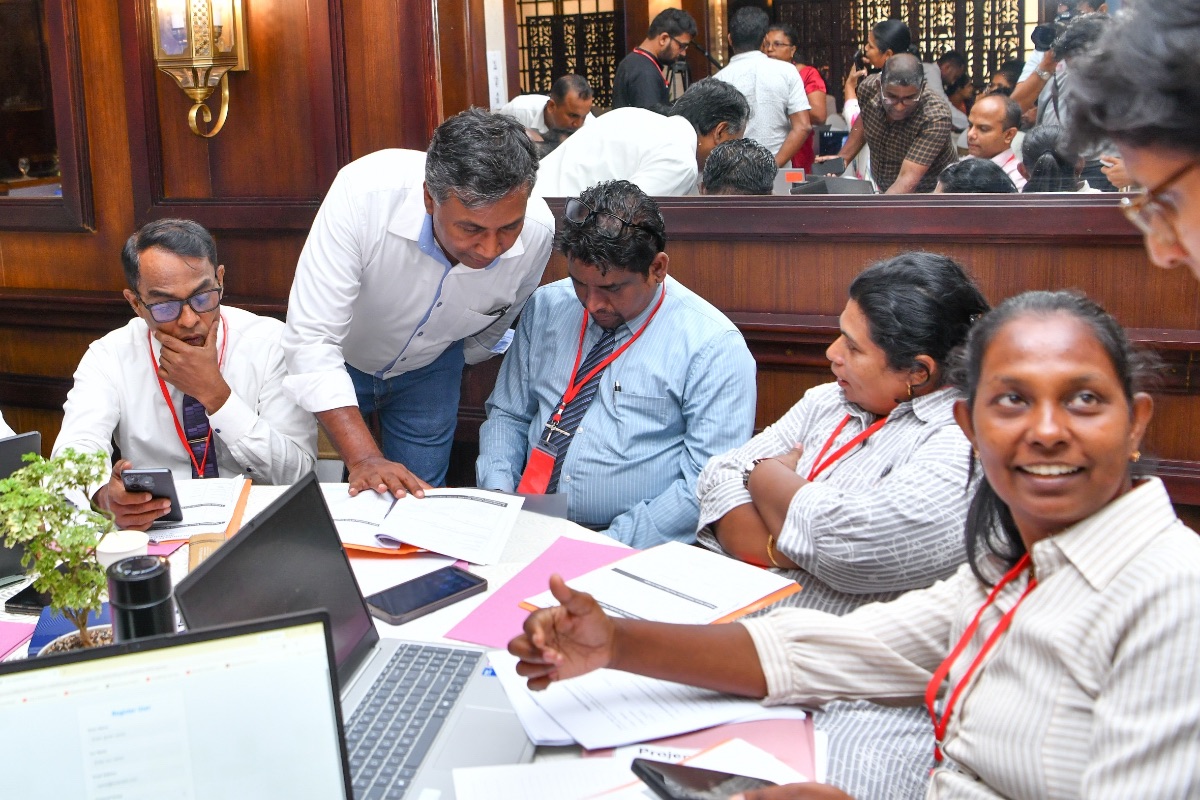
A special workshop was held today (06) at the Presidential Secretariat to explore the possibility of integrating programmes currently implemented by state institutions that directly contribute to enterprise development with the “Prajashakthi” National Movement.
Discussions focused on identifying development projects undertaken by government institutions for micro, small and medium-sized enterprises (MSMEs) and incorporating relevant information into a unified data management system.
Attention was also directed towards formulating a strategic framework for the coordinated implementation of these programmes, as well as identifying the nature, scope and eligibility criteria of the initiatives carried out by the respective institutions.
The participating government officials were further briefed on the criteria for selecting beneficiaries for programmes directly related to enterprise development.
In addition, discussions centred on identifying programmes that could be implemented independently or jointly by the relevant state institutions and the “Prajashakthi” National Movement. Particular attention was paid to preventing duplication and overlap in programme selection and implementation.
Senior Additional Secretary to the President Kapila Janaka Bandara, Secretary to the Ministry of Rural Development, Social Security and Community Empowerment Sampath Manthrinayake, resource persons Kalum Jayaveera and Madhava Muthukudaarachchi, officials of the Ministry of Rural Development, Social Security and Community Empowerment, government officials, and representatives of the Prajashakthi Secretariat were among those who attended the workshop.
(PMD)

Wrapping up their goodwill and replenishment visit, the Pakistan Navy ships ‘PNS Taimur’ and ‘PNS Aslat’, along with the submarine ‘PNS/M Hangor’, departed the island on 04 Jun 26. The naval units, which arrived in Sri Lanka on 01 June, were accorded a traditional naval send-off by the Sri Lanka Navy at the Port of Colombo, upon their departure.
During their stay, the Commanding Officers of Pakistan Navy ships and submarine called on the Commander Western Naval Area and the Flag Officer Commanding Naval Fleet at the Western Naval Command Headquarters, where discussions were held on several matters of mutual interest.
Meanwhile, Sri Lanka Navy personnel had the opportunity to visit the visiting Pakistan Navy ships and submarine. Furthermore, the crews of the visiting vessels explored the rich heritage of Sri Lanka, taking time to tour several culturally significant landmarks across the island.
News
China, Lanka intensify cooperation to fight cross-border crimes spreading across Asia and beyond

China and Sri Lanka have intensified joint law enforcement efforts to combat cross-border online gambling and telecom fraud, crimes that authorities warn are increasingly spreading across Asia and beyond.
The Chinese Embassy in Colombo said both countries are working closely to dismantle scam centres and fraud networks that have relocated to Sri Lanka from other parts of Southeast Asia. The Embassy noted that such operations often intertwine with human trafficking and other serious crimes, posing grave risks to public security and social stability.
China’s position on cross-border gambling remains firm: Chinese capital is prohibited from investing in overseas casinos, citizens are barred from operating them, and foreign casinos are forbidden from soliciting Chinese nationals. The Embassy stressed that gambling “almost invariably leads to financial ruin,” with tens of thousands of Chinese citizens suffering losses and harm. Recent amendments to China’s Criminal Law have criminalised cross-border gambling activities.
The Embassy pointed out that Sri Lankan authorities have carried out multiple raids in recent months, dismantling gambling and fraud dens and arresting suspects from several countries. Several Chinese nationals, involved in fraud-related crimes, have been handed over to Chinese authorities, producing what officials described as a strong deterrent effect.
The Chinese Embassy praised the efforts of Sri Lanka’s ministries of Foreign Affairs, Finance, and Public Security, particularly immigration and police officials, for their cooperation.
It warned that without firm and immediate measures, the spread of illegal gambling and fraud could damage Sri Lanka’s international image, undermine social stability, and harm the safety and security of its people.
China has already conducted similar law enforcement cooperation with countries including Spain, the UAE, Myanmar, and Cambodia, leading to arrests and repatriations of overseas fraud suspects. It has also proposed the creation of an international alliance against telecom and online fraud to coordinate global efforts, it said.
Going forward, China pledged to actively implement the Global Security Initiative and Global Civilization Initiative, while continuing to deepen law enforcement and security cooperation with Sri Lanka.
The Embassy said these efforts aim to safeguard lives and property, protect financial security, and build a “clean, safe, and beautiful Sri Lanka,” while contributing to a new global framework for combating transnational crime.

Workshop Explores Integration of Enterprise Development Programmes with the “Prajashakthi” National Movement

England make inroads after New Zealand set 254 to win

Rusty West Indies face upbeat Sri Lanka with series on the line

Pakistan naval trio leaves Colombo after goodwill visit

PEOTV secures media rights for FIFA World Cup

Anthropic urges AI labs to pause, warns humans risk losing control

‘Dates have the highest sugar content to fight Coronavirus’

Sunday Island 27 December – Headlines

#SundayIsland 17th December – Headlines

Sunday Island – 28th March

Sunday Island Headlines – 21 March

Sunday Island – 21st February – Headlines
-

 News5 days ago
Lankan duo emerge winners in Latin dance championship held in Blackpool, UK
-

 Business6 days ago
IMF’s unstated rate:Sri Lanka’s $695m loan costs about 5.33% per annum
-

 Latest News3 days ago
Kusal Mendis, Pathum Nissanka, bowlers put Sri Lanka 1-0 up
-
 News3 days ago
New US tariffs proposed on 60 countries, including Sri Lanka
-

 Business6 days ago
Sri Lankan scientist-innovator Milinda Edirisinghe introduces AI-integrated gem testing system to gemological world
-

 Features7 days ago
Are threats to Buddha Sasana external or from within?
-
 News6 days ago
UNP challenges NPP move to amend Vihara – Devalagam Act
-

 Features2 days ago
Power crept into the Sangha and is now tearing it apart