It was the full Pakistan experience at the MCG, a ground where they have so much great history. They were hopeless, then thrilling, then hopeless, then thrilling. And then Australia won, without much conviction. But they did what they do thanks to a sizzling spell from Mitchell Starc and yet another nerveless chasing masterclass from the ice-cool captain Pat Cummins in the face of what looked like a match-winning three-wicket haul from Harris Rauf , heroics with bat and ball from Naseem Shah and some crafty captaincy from new skipper Mohammad Rizwan .
The 25,831-strong crowd looked sparse in the gargantuan MCG. But it sounded like 100,000, and it felt like it was in Lahore, as Pakistan fans drowned out the locals to help keep their side in the game. But there was only so much they could do, as Pakistan found a way to lose despite being on the brink of one of the great ODI heists.
Chasing just 204 after Starc took 3 for 33 from 10 overs, including three maidens, Australia slumped from 139 for 3, after Stevsn Smith and Josh Inglis were in control, to 155 for 7 on the back of Rauf’s raucous burst. That became 185 for 8 when Sean Abbott was run out, after he had nearly run out Cummins. But skipper held firm, as he had at Edgbaston, Mumbai, Kolkata and Christchurch over the past 18 months.
His 32 not out won’t go down as his most memorable, but it was the equal of any of his best innings in Australian colours. It was vindication too for his decision to have laser eye surgery in the winter to fix his vision, and some extensive batting work in Sydney with Australian batting consultant and well renown coach Trent Woodhill.
Australia’s chase began poorly with the new opening duo of Matt Short and Jake Fraser-McGurk both falling inside the first four overs.
Fraser-McGurk’s 16 was particularly frantic. But Smith was calm and settled into a stereotypical groove. Any fears on his Test form could well be allayed given how well he handled some excellent fast bowling on a quick pitch.
Australia could have been 55 for 3 when Inglis was dropped by Irfan Khan at gully. Naseem got one to rear from a length and catch the edge but Irfan could not hang on flying high to his right.
That looked like it might have been the last chance. Barring an edge between the keeper and wide slip trying to glide a ball, Inglis was imperious. Coach Jason Gillespie’s four years coaching against Inglis in Australian domestic cricket had not translated to his four-pronged pace attack avoiding dropping short to the West Australian. It cost them three sixes and two fours.
After an 85-run stand, Smith made an uncharacteristic error. He slashed a cut off Rauf straight to backward point to be out for 44.
Pakistan’s insistence on going short to Inglis paid off when he nailed another pull shot off Shaheen only to see Irfan run a long way to hang on to an outstanding catch in the deep.
Rauf, a Melbourne Stars favourite, then had the Pakistan fans in raptures as he cranked up the speed and Australia lost 3 for 0. Labuschagne top edged to deep third, undone by extra bounce. Maxwell nicked the next ball to Rizwan and Australia were 139 for 6.
Aaron Hardie and Abbott steadied briefly but it was fleeting. Hardie fell trying to back away and cut a ball from Mohammad Hasnain that hit the top of middle.
Enter the skipper for another salvage job. It was unconventional as it always is. He was bombed with short balls. But he keep scoring and kept surviving. Abbott was run out when Cummins pushed for a third. But he was there at the end yet again when the winning runs were scored to break the hearts of all those who don’t bleed green and gold.
Earlier, Australia set up the win with the ball. Most of Pakistan’s batters, with the exception of Babar Azam who made a classy 37 off 44, were exposed on a fast and bouncy MCG pitch after being sent in having come straight from the low spinning Test pitches of Multan and Rawalpindi last month. Rizwan top scored with 44 off 71 balls while Naseem made an outstanding 40 off 39 with four sixes from No. 9 to ensure Australia was at least chasing more than 200.
Starc and Cummins, fresh and in rhythm ahead of a big summer, put on a show in front of a very pro-Pakistan crowd. Starc’s 140kph thunderbolts accounted for Saim Ayub on debut and Abdullah Shafique.
The pair were opening the batting in ODI cricket for the first time after averaging just 8 as a pair in 12 Test innings together. Their international average dropped to 7.61 when Ayub chopped on trying to drive on the up.
Shafique looked like he was batting in a Test match. He defended, ducked and weaved on his way to 12 from 26 before failing to get his bat out of the way of a rising delivery from Starc wide of off as he tried to sway inside it.
Babar and Rizwan settled but never accelerated. Babar looked in fine touch but felt the pinch of the slow-moving scoreboard. He tried to create a scoring option off the back foot to Adam Zampa but picked the wrong length and lost his off stump.
Cummins welcomed Kamran Ghulam to Australia with a brute of a delivery. The whites of his eyes popped as Cummins’ 142.7kph bouncer reared at his throat. He got his hands up in time but could only glove it to Inglis.
Rizwan’s sluggish rearguard began to pick up steam when he hooked Starc into the stands at fine leg. But he fell to Labuschagne trying to sweep a wide legbreak only to get a top edge onto his helmet that popped up to Inglis.
Some late hitting from Naseem, Shaheen Afridi, and Irfan Khan, in the mould of the man who had presented his debut cap in Wasim Akram, lifted Pakistan from a dire position at 117 for 6 to 203.
Naseem and Shaheen showed the type of intent that Pakistan’s top order could have used, launching five sixes between them after the entire top seven had contributed one, before Shaheen was castled by Starc for 24 off 19.
Naseem feasted on spin, launching Zampa into the stands twice and Maxwell once. But Naseem also launched Sean Abbott over deep midwicket. He holed out to mid-off to end the innings. Had he batted until the end, it might have been enough.
Brief scores:
Australia 204 for 8 in 33.3 overs (Josh Inglis 49, Steven Smith 44, Pat Cummins 32*; Harris Rauf 3-67, Shaheen Shah Afridi2-43) beat Pakistan 203 in 46.4 overs (Mohammad Rizwan 44, Naseem Shah 40, Babar Azam 31; Mitchell Starc 3-33, Pat Cummins 2-39, AdamZampa2-64) by two wickets
[File pic] Anthropic is calling on major artificial intelligence labs to consider a coordinated and verifiable pause in development [Aljazeera]
Anthropic is proposing that the world’s top artificial intelligence companies come up with a coordinated way to pause development of advanced AI systems, warning that the technology is improving so quickly that there’s a risk humans would lose control.
The company behind the Claude chatbot said in a blog post on Thursday that, as cutting-edge AI gets increasingly faster at carrying out tasks, “it would be good for the world to have the option to slow or temporarily pause” its development.
Anthropic said its internal research institute plans to explore the issue in collaboration with others and “take actions” to help build the systems for a credible slowdown or pause, without being more specific.
Anthropic rival OpenAI argued for a different approach in a report published on Wednesday, saying that “democratic governments — not private companies acting alone — must ultimately determine the rules, safeguards, and accountability mechanisms”.
“Our view is that decisions about the pace of AI innovation should not be left to any one lab, company, or special interest group,” it said.
AI models are getting faster, with rapid increases in how quickly they can carry out software tasks like coding on their own, Anthropic said in its post. Based on current trends and given enough computing power, an AI system could be able to design and develop its own successor, in what is known as “recursive self-improvement”.
Self-building AI would be a major technological milestone that would bring benefits in science, healthcare and other areas, Anthropic said, but it “also might increase the risks of humans losing control over AI systems”.
Some tech industry figures have long warned of such a scenario.
Anthropic’s post comes after a different warning this week from a team of researchers at the University of Toronto who showed how AI tools could be used to create a new kind of AI “worm” that adapts its hacking strategy as it spreads from device to device and takes over a vast computing network.
“I think it’s really important that people understand that it’s not just the biggest, most powerful language models that pose the security concerns,” lead researcher Nicolas Papernot said in an interview.
The authors of the Anthropic post, company cofounder Jack Clark and Marina Favaro, head of its research institute, said the pause would be used to enable “societal structures and alignment research” to keep up with AI advances. Alignment is industry shorthand for making sure the technology matches human values and intentions.
The proposed coordination would let advanced AI labs verify that global rivals have actually stopped or slowed their work, “and that a bad actor could not use the auspices of a coordinated slowdown to jump ahead in secret”.
The company said a coordinated global mechanism is needed because, without it, a slowdown in AI development could let the “least cautious” players catch up and add to pressure on companies and governments as they make tough choices about AI safety.
Fears that advanced AI systems may get out of human control and cause societal harm have risen as the technology becomes increasingly capable. Anthropic’s own Mythos model sent shockwaves through industries, including banking and software, earlier this year with its ability to find vulnerabilities in existing code.
But regulation has been slow, especially in the US, where most leading AI labs are based. A Trump administration executive order earlier this week put the onus on the labs themselves, asking them to voluntarily submit their most capable models for government cybersecurity testing before public release.
Safety focus
AI researchers have also urged a pause before, but have had little success. Elon Musk, who owns AI lab xAI, was among the backers of a 2023 push by the non-profit Future of Life Institute to halt AI development for six months to allow time for safety guardrails.
Anthropic has long positioned itself as a safety-focused AI lab. Earlier this year, it refused to let the US military use its models for domestic surveillance and fully autonomous weapons, prompting backlash from the government, which put it on a national security blacklist, set to take effect later in 2026.
Anthropic’s post comes as the company and ChatGPT-maker OpenAI race to sell shares on the stock market, in an IPO that could value Anthropic at nearly a trillion dollars.
Papernot notified Canadian cybersecurity authorities prior to releasing his report, which shows how researchers developed the worm in a laboratory by using an “open-source” AI tool that is easy for software developers to cheaply access and modify.
“In the past, cyber attackers would focus on targets that are very high value,” he said. “Banking systems, hospitals, electricity grids, water treatment systems, schools.”
Papernot agreed that there should be more collaboration between companies, government agencies and academic researchers to develop countermeasures as AI-powered hacking tools supercharge the search for computer vulnerabilities.
“That old laptop you have in your basement that you don’t check on regularly doesn’t seem like a very high-value target, but it can be used as a launch pad to attack these higher-value targets,” he said. “Anything connected to the internet is now at risk because of how low the cost has become to mount these cyberattacks.”
Iran coach Amir Ghalenoei will lead side at World Cup 2026 [Aljazeera]
Iran’s World Cup football players have been granted visas to enter the United States, according to a White House official, just 10 days before their first match in Los Angeles amid a conflict between the two countries.
Iran’s ambassador to Mexico, Abolfazl Pasandideh, said late on Thursday the squad had still not received their US visas, but these were granted overnight, the White House official said.
US Ambassador to Turkiye Tom Barrack confirmed the visas in a message on X on Friday. “Proud of our outstanding team at the U.S. Embassy in Ankara for their work processing visas for Iran’s national football team on their road to the @FIFAWorldCup in the United States,” he said, commenting on a news report that Iran’s World Cup players have been granted the visas to enter the United States.
The US had not yet issued visas to some members of the Iran team’s technical and administrative staff, the semi-official Fars news agency reported on Friday.
Iran’s federation has not yet made a statement on the news.
“Visas for some members of the national team’s technical and executive staff have not yet been issued, and the US embassy has so far refused to issue them,” Fars said, without citing a source.
The US-Israel war on Iran has turned the World Cup – the biggest global sporting event – into a geopolitical contest, with both sides appearing to use the tournament for political posturing.
It is the first World Cup, since its inception in 1930, in which a host nation is set to receive a country it is at war with.
Tehran negotiated a last-minute move of the team’s base from Arizona to Tijuana in Mexico due to the visa issues and a growing feeling in Iran that the squad’s presence in the United States should be kept to a minimum.
They are scheduled to land in Tijuana early on Sunday.
Iran are due to play their first Group G match on June 15 against New Zealand in Los Angeles, where they will also face Belgium before taking on Egypt in Seattle.
The US has never formally said it does not want the Iranian team to stay on its territory, Ambassador Pasandideh said.
However, Secretary of State Marco Rubio told lawmakers on Tuesday that the US would not allow Iran to include in its World Cup delegation individuals linked to the Islamic Revolutionary Guard Corps, a powerful branch of the Iranian armed forces.
Mehdi Taj, president of Iran’s football federation, was denied entry for the tournament draw in Washington in December. He is a former commander in the Revolutionary Guards.
Iran’s desire to compete in the World Cup underscored its efforts to reach a resolution in the war with Washington, Pasandideh said.
“Iran’s participation in the World Cup – even on the soil of what is seen as its enemy – shows that Iran seeks peace,” Pasandideh said, speaking through a Spanish interpreter at the Iranian embassy in Mexico City.
Progress in peace talks between Iran and the US has been slow, with both sides seemingly inching towards an interim agreement even as they continue to carry out military strikes
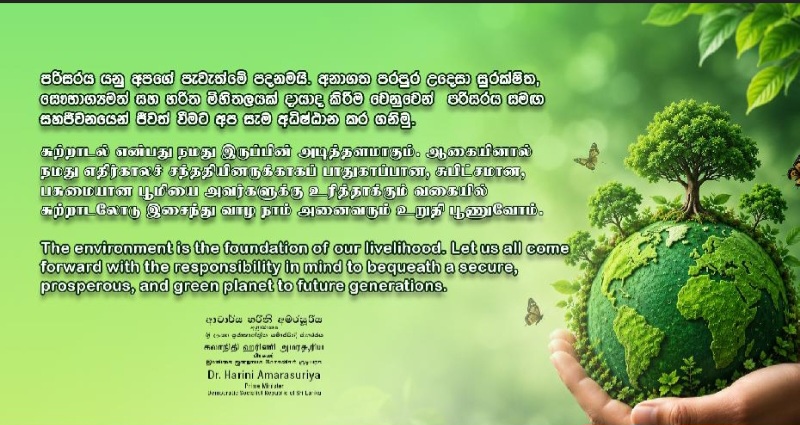
Prime Minister Dr Harini Amarasooriya in her Environment Day message said that the environment is the foundation of our livelihood and called upon all Sri Lankans to come forward with the responsibility in mind to bequeath a secure a secure, prosperous and green planet to future generations.The PM’s Environment Day message:
“The environment is the foundation of our livelihood. It is the responsibility of the government to bequeath a secure, prosperous, and green planet to future generations.
In line with the global theme, “Urgent Climate Action,” and guided by the vision of “A Sustainable Biosphere – An Evergreen Life,” Sri Lanka commemorates World Environment Day this year at a critical moment. Drawing lessons from the climate-related challenges we have recently experienced, special attention has been directed toward protecting the water catchment areas of the central highlands and restoring ecosystems.
Under the theme “Dalulanna Idadenna” ( Let it Bloom), the Ministry of Environment has organized a series of programmes across the island to mark World Environment Day. These initiatives include environmental conservation inspired by religious values, awareness programmes on climate change, the protection of the Diyawanna Oya, the development of infrastructure in the wildlife sector, the conservation of water resources, and the promotion of medicinal plant cultivation, and through these efforts, it is evident that environmental conservation has evolved beyond a mere concept and become a practical and active commitment.
At this significant moment in our nation’s history, as more than 63,000 hectares of forest land have been gazetted as protected reserves through the “Wanaspathi” National Programme, which was launched last year, every citizen must resolve to live in harmony with the environment.