
News
WNPS partners LOLC to establish multi-regional monitoring system for conservation of Sri Lankan leopard


February 21st 2022 (COLOMBO) The Sri Lankan leopard (Panthera pardus kotiya) is the largest of the four wild cat species found in Sri Lanka, and the apex mammalian predator on the island. The sub-species of this charismatic animal is endemic to Sri Lanka and widely distributed across the island’s dry zones and low country wet zones with habitats ranging to the cloud forests of the highest elevations in the hill country.
It is believed that there are less than 1,000 leopards roaming in the wild within the island. Further, the leopard is threatened globally by habitat loss and illegal wildlife trade, while in the human-dominated land-use areas in Sri Lanka, the impacts of habitat loss prevail critically. To initiate and sustain a science-based conservation strategy it is imperative to further understand the distribution and the ecology of the Sri Lankan leopard, specially, in under-studied areas nationwide.
In addressing this knowledge gap, the Wildlife and Nature Protection Society (WNPS) will partner with LOLC Holdings PLC, Sri Lanka’s leading and largest diversified conglomerate to establish a network of specialized leopard conservation locations and research centers across identified geographically important areas, within Sri Lanka. These Research Centres will focus on understanding the species function in populations or meta-populations that exist at much larger scales than individual management units, at a regional level.
Through this initiative, the WNPS hopes to create a common knowledge and data-sharing platform to drive a research-based island-wide leopard monitoring programme. Through the establishment of these Research Centres nationwide, smaller monitoring efforts will be easily integrated into larger programs and databases. It will enable scientists and conservationists access to deeper and wider sets of data to understand local leopard populations, regionally and countrywide
In the initial phase, six research stations will be set up in identified locations across Okanda or Panama, Morningside, Killinochchi, Belihuloya, Maskeliya or Nallathaniya, Sigiriya or Ritigala. The Project will monitor the presence of leopards in selected geographical areas, using camera traps and surveys.
The Research Centres will liaise with local wildlife and forest officers, and also serve as educational hubs to generate awareness amongst the local communities, including knowledge dissemination and generating research-based human-leopard conflict mitigation measures. This is timely and critical, in addressing the increasing number of leopard deaths in Sri Lanka, predominantly through snares set up in a human-dominated landscape.
The Project will provide a critical context for the management and conservation of the Sri Lankan leopard, currently listed as Vulnerable on the IUCN Red List. Recent research has shown that leopard habitat suitability in Sri Lanka is heavily influenced by forest cover, patch size, connectivity, and the level of protection of the landscape, a critical requirement to conserve the island’s biodiversity.
“As the Sri Lankan leopard is the largest predator in our ecosystem, it is important that we know the current position related to its habitat, the threats faced by it etc. Hence, it is vital to do a more coordinated island-wide data collection effort to mitigate any conflicts or issues faced by this predator” said Mr. Kapila Jayawardena, Group Managing Director/CEO of the LOLC Group. “To this end, we are pleased to step forward and join hands with the WNPS to support them in this endeavour, which will enable them to make informed decisions to protect this endemic species” he went on to state.
“Multi-stakeholder partnerships play a key role in influencing the course of conservation. For lasting impacts, a range of extraordinary partners, including governments, local communities, businesses, scientists, academics, and individuals must collaborate. We are happy that Sri Lanka’s largest Business and most diversified Business Group has partnered with us for a 5-year project. The WNPS will bring the wild cat research community to work together and share the findings for a collective conservation effort” said Spencer Manuelpillai, the President of the WNPS.
Speaking further Prof Enoka Kudavidanage said, “The Sri Lankan Leopard is threatened by our unplanned land use, intentional wildlife crimes, lack of awareness, economic intentions especially in the tourism sector with minimum respect for wildlife, obstacles for enforcing adequate penalties for wildlife crimes, limited understanding of its ecology and resource requirements, and finally the delay in translating knowledge into action.
“I am hoping that this initiative by the WNPS and LOLC Holdings will assist to combine findings of the past and the ongoing research and conservation measures, identify the data gaps, addressing them through collaborative pathways, facilitate data sharing, and fueling a collective and science-driven long-termed leopard conservation strategy for Sri Lanka with the participation of multiple stakeholders. The project will benefit from the knowledge, of all researchers studying leopards in Sri Lanka, of those who are actively working for the conservation of this charismatic animal, and of those who are willing to initiate new research in data deficient areas, as our ultimate objective is to ensure the existence of healthy populations of leopards in Sri Lanka”.



The commissioning ceremony of the deep-sea patrol vessel as Samudravijaya, gifted to the Sri Lanka Navy by the United States Coast Guard to enhance the Navy’s operational capabilities, was held under the patronage of Commander-in-Chief of the Armed Forces, President Anura Kumara Dissanayake, on Thursday afternoon (04) at the Eastern Terminal premises of the Port of Colombo.
The vessel was officially handed over to Sri Lanka by the United States Coast Guard on 2 December 2025. Following modifications to meet the operational requirements of the Sri Lanka Navy, the vessel commenced its voyage to Colombo on 20 February 2026 from the United States Coast Guard Yard in Baltimore, Maryland.
The induction of the vessel marks a significant step towards further strengthening the operational capabilities of the Sri Lanka Navy and enhancing the country’s maritime and national security. The vessel is expected to make an important contribution to maritime surveillance, search and rescue operations, protection of fisheries resources, environmental monitoring and the enforcement of international maritime laws and conventions. In particular, it will serve as a vital asset in combating narcotics trafficking and other transnational maritime crimes, which remain major challenges for both Sri Lanka and the wider region.
During the ceremony, President Dissanayake presented the official commissioning warrant to the vessel’s Commanding Officer, Captain Gayan Wickramasuriya. The President subsequently unveiled the vessel’s name board and official insignia before undertaking an inspection tour of the ship. The Commander of the Navy briefed those present on the vessel’s operational readiness, systems and capabilities.
President Dissanayake also signed the vessel’s Distinguished Visitors’ Book and was presented with a commemorative plaque featuring a replica of the vessel.
Among those present were Minister of Ports and Civil Aviation Anura Karunatilaka. Deputy Minister of Defence, Major General Aruna Jayasekara (Retd.), Secretary to the Ministry of Defence, Air Vice Marshal Sampath Thuyacontha (Retd.), Admiral of the Fleet Wasantha Karannagoda, Commander of the Army, Lieutenant General Lasantha Rodrigo, Commander of the Air Force, Air Vice Marshal Vasu Bandu Edirisinghe. Commander of the Navy, Vice Admiral Kanchana Banagoda, Inspector General of Police, Attorney-at-Law Priyantha Weerasooriya, Charge d’affaires to the U.S. Embassy Ms. Jayne Howell, Senior Defence Official and Defence Attache with Spouse Lieutenant Colonel Matthew House, representatives of the Embassy and senior officers of the Sri Lanka Navy.
(PMD)

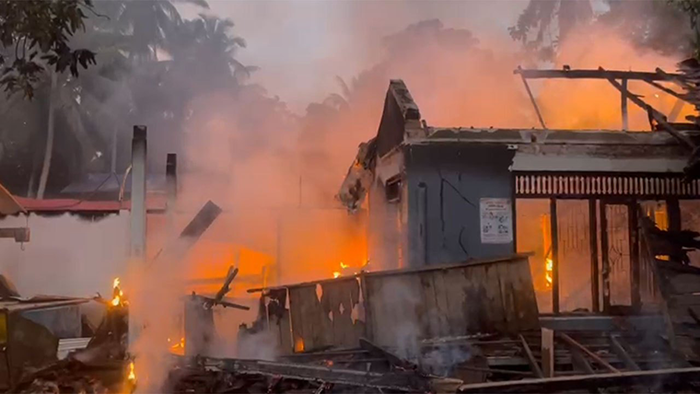
Death toll rises to 12: Director remanded
Some residents were allegedly chained
Police have come under public pressure to investigate allegations of inhumane treatmenf the residents at an elders’ home in Batagoda, which was also reportedly used as a care centre for persons with special needs, following a devastating fire that has so far claimed 12 lives.
Eyewitnesses who were among the first responders told the media that several residents had been chained inside rooms at the Senehase Kedella Elders’ Home when the fire broke out on Wednesday. They claimed that rescue efforts were hindered as iron chains could not be removed, and that some residents died while being restrained.
Authorities have not yet verified these claims, and Police said investigations are continuing.
Police spokesman ASP F.U. Wootler, contacted for comment, said there were rumours to that effect, but the Police were not in a position to verify the claims until a report from the Government Analyst was received. He said eight survivors with burn injuries were being treated in hospital.
Meanwhile, the Director of the facility had been arrested and was due to be produced before the Horana Magistrate’s Court, Police said adding that he was remanded till June 11.
The death toll from the fire has risen to 12 as of Thursday morning following the recovery of additional charred remains during ongoing forensic examinations at the site. Six others sustained serious injuries and are being treated at the Horana Base Hospital.
Police said 72 residents were inside the facility at the time of the blaze. Of them, 10 died inside the building, seven were injured and hospitalised, while 51 were rescued and relocated.
Survivors were initially housed at Batagoda Junior School before being transferred with Army assistance to another branch of the same care network in Galpatha.
A magisterial inquiry was conducted on Thursday morning. Horana Magistrate Lakmini Vidanagamage visited the scene. The burnt remains were examined and removed under judicial supervision.
Separately, allegations have emerged that residents were required to pay an admission fee of Rs. 75,000, along with a monthly charge of Rs. 35,000 to the centre. Police have not commented on these claims.
The director was taken to the scene as part of ongoing investigations, while forensic experts continue examinations to determine the cause of the fire, which remains undetermined.Anguruwatota Police are conducting investigations.
By Norman Palihawadane and Nishan S Priyantha

Sri Lanka CERT has issued a public warning over the circulation of artificial intelligence (AI)-generated videos falsely depicting President Anura Kumara Dissanayake, Prime Minister Harini Amarasuriya and several other prominent personalities to promote fraudulent investment schemes online.
According to complaints received by the national cyber security agency, the videos have been created using deepfake technology and are being used as part of attempts to defraud members of the public through financial scams.
The images of famous sports personalities and other public figures have also been misused in the deceptive content.
The agency has warned that similar AI-generated material has been used to spread false information relating to investment opportunities, employment offers, as well as matters concerning the country’s economy and tax policies.
According to Sri Lanka CERT, the videos are being widely shared across online platforms and frequently contain links urging viewers to make investments in return for purported profits.The agency has cautioned that these links may redirect users to fraudulent websites designed to steal personal information, financial data and money from unsuspecting victims.
Sri Lanka CERT has urged the public to exercise extreme caution when encountering such content online and advised against clicking on suspicious links or sharing personal information through unverified websites.
“The public should remain vigilant and avoid becoming victims of false information and online fraud schemes,” the agency said.
Sri Lanka CERT has also encouraged internet users to verify information through official sources before acting on any investment, employment or financial offers circulated via social media or other online platforms.

Qualifier Chwalinska sets up final against Andreeva

Zelensky proposes face-to-face talks in open letter to Putin

President Commissions Offshore Patrol Vessel ‘Samudra Vijaya’ into Sri Lanka Navy

Shreyas Iyer to replace Suryakumar Yadav as India’s T20I captain

Pakistan hold their nerve to take series in low-scoring scrap

Robinson routs New Zealand top-order as England hit back on 16-wicket day

‘Dates have the highest sugar content to fight Coronavirus’

Sunday Island 27 December – Headlines

#SundayIsland 17th December – Headlines

Sunday Island – 28th March

Sunday Island Headlines – 21 March

Sunday Island – 21st February – Headlines
-

 News3 days ago
Lankan duo emerge winners in Latin dance championship held in Blackpool, UK
-
 News6 days ago
IMF urges Lanka not to meddle with exchange rate
-

 Business4 days ago
IMF’s unstated rate:Sri Lanka’s $695m loan costs about 5.33% per annum
-
 News6 days ago
State of emergency extended
-

 Features5 days ago
Are threats to Buddha Sasana external or from within?
-

 Business4 days ago
Sri Lankan scientist-innovator Milinda Edirisinghe introduces AI-integrated gem testing system to gemological world
-

 News4 days ago
UNP challenges NPP move to amend Vihara – Devalagam Act
-

 Latest News1 day ago
Kusal Mendis, Pathum Nissanka, bowlers put Sri Lanka 1-0 up