
Latest News
Teacher recruitment examinations will be conducted in accordance with the relevant court decisions – PM


Prime Minister Dr. Harini Amarasuriya stated that the forthcoming two teacher recruitment examinations will be conducted in accordance with the relevant court decisions pertaining to the ongoing legal proceedings and further noted that, taking into consideration the requests received, steps have been taken to make a request to Court’s approval to revise the conditions of the effective date of degree completion.
The Prime Minister made these remarks while addressing a meeting held at Monaragala Royal College to brief education authorities of the Monaragala District on the new education reforms.
Under the new education reforms, Smart Boards will be provided to 132 schools in the Monaragala District as part of the program to equip secondary schools with modern technology. As a symbolic step under this initiative, Smart Boards were presented to 10 secondary schools under the Prime Minister’s patronage. This program is being implemented with the intervention of the Digital Task Force operating under the Prime Minister’s Office. It was also emphasized that a new digital policy, formulated with special attention to child protection, will be introduced in April.
As part of her visit to the Monaragala District on the 13 th of February, the Prime Minister observed the implementation of the new learning methodologies introduced for Grade One under the new education reforms. She visited Kumbukkana Sri Shanmugam Tamil Maha Vidyalaya and Maduruketiya Maha Vidyalaya in Monaragala to observe the educational activities of Grade One students.
Considering the increase of student numbers and the development of infrastructure facilities, the Prime Minister also approved a proposal submitted by the School Development Society to rename Maduruketiya Maha Vidyalaya as Monaragala Dharmaraja Maha Vidyalaya.
Teachers briefed the Prime Minister that the new education system, supported by revised workbooks and activity-based learning methods, has proven to be effective, with students participating enthusiastically.
Addressing education officials further at the meeting held at Monaragala Royal College, the Prime Minister stated:
“Although this will not provide a complete solution to the existing teacher vacancies, these examinations can offer considerable relief. According to the Court’s previous determination, the effective date of degree completion had been set as 30.06.2025. However, considering numerous requests and following the cabinet approval we have sought Court’s consent to revise this date. We will act in accordance with the decision granted.
Funds allocated for school infrastructure must be utilized transparently and in line with proper planning, and progress must be reported accordingly. We cannot move forward by dividing ourselves along national, provincial, rural, or urban lines. As education authorities, you must make swift and accurate decisions based on correct data.
Further, discussions are already underway within the Piriven Committee of the Ministry of Education to develop Piriven education and to address the issues faced by Piriven teachers.”
The event was attended by the members of the Maha Sangha, Uva Province Governor Attorney-at-Law Kapila Jayasekara, Deputy Minister of Trade and Commerce R.M. Jayawardhana, Member of Parliament Ajith Agalakada, Uva Provincial Education Secretary Nihal Gunarathne, and several officials from the education sector.



[Prime Minister’s Media Division]


After a 16-wicket opening day of the English Test summer, a further 17 fell on the second on an up-and-down Lord’s surface that left batters guessing. Despite a mid-afternoon wobble when they lost four wickets in 11 balls, England ended it firmly on top by striking three early blows to New Zealand’s attempts to chase 254 in the fourth innings.
A wicket has fallen every 25 balls across the first two days – with 11 batters out bowled and nine lbw – and neither captain has seen fit to use a spinner on a pitch defined by its variable bounce. Emilio Gay’s 57 on Test debut is the highest score on either side so far, and he would have been out lbw to Matt Henry for 24 if Tom Latham had reviewed the on-field decision.
Henry was limited to four overs on the opening day by back spasms and New Zealand’s three other quicks shouldered a heavy workload as a result. But his only wicket summed up the challenge for batters: the ball shot low from a good length, sneaking under the toe-end of Jacob Bethell’s bat to knock back his off stump.
Oliie Robinson the protagonist of the opening day in reducing New Zealand to 29 for 6 with a superb new-ball burst on his comeback to Test cricket, led England off after just under an hour on the second morning after completing his first five-wicket haul in four years. Their first-innings lead stood at 29 after Kyle Jamieson’s three sixes put a small dent in the deficit.
Glenn Phillips had counterattacked on the first evening but lost his off stump to Josh Tongue’s first ball of the morning. Tongue struck again in his second over when Nathan Smith left one that jagged back sharply, Atkinson bluffed Will O’Rourke with a full ball that he edged to slip, and Robinson roared in celebration after knocking back Henry’s middle stump.
Gay’s maiden Test innings had lasted only 14 balls as Jamieson worked him over, but he played tightly and patiently in his second in adding 52 with Ben Duckett. He slowly went through the gears after a cautious start, reaching an 84-ball half-century – the first by an England opener on debut since Keaton Jennings in 2016 – when taking 16 runs off a Smith over.
But New Zealand will rue a series of missed opportunities. Rachin Ravindra and Devon Conway both dropped catches for the second day in a row – Ravindra shelled Duckett at short midwicket, and Conway gave Bethell a life at gully – while Daryl Mitchell and Tom Latham left a slip catch for one another when Henry found Gay’s outside edge.
Duckett made 33 before slicing O’Rourke to gully while camped on the back foot expecting a short ball before Henry’s daisy-cutter did for Bethell, but it was Gay’s dismissal – fiddling Smith’s outswinger behind – that prompted England’s collapse: Harry Brook and Joe Root were pinned lbw, while Ben Stokes lost his off stump to Smith as 126 for 2 became 127 for 6 in 11 balls.
It took a 57-run stand between Jamie Smith and Atkinson – the highest partnership of the match – to drag England’s lead past 200. Smith, promoted above Stokes to No. 6, was bowled shouldering arms in the first innings but played with far more conviction in the second, driving Henry to both the cover and mid-off boundaries in the over before tea.
Atkinson miscued a flat-batted swat straight up to be caught-and-bowled by Jamieson but Robinson took over from him by swiping at New Zealand’s short balls. Nathan Smith was rewarded when he went fuller, bowling both his namesake Jamie and Tongue before Robinson’s heave to midwicket gave him a second successive six-wicket haul.
It left New Zealand needing the highest score of the match to secure only their second win at Lord’s and while higher targets than 253 have been hauled in across the previous 149 Tests at this ground, few of those can have been on surfaces offering fast bowlers as much encouragement as this one.
Latham decided to chance his arm, chasing Atkinson’s third ball with a hard-handed drive which he steered straight to Brook at second slip. Unsurprisingly, Robinson’s first over was less eventful in the second innings than his three-wicket effort in the first, but he very nearly had Kane Williamson bowled shouldering arms in his second.
Robinson was chuntering when Stokes brought the keeper up to force Williamson to stay in his crease, and his attempts to send Jamie Smith back were ignored. But the argument came to a natural end between overs as Williamson was pinned lbw by Tongue, reviewing only in desperation as his fifth and likely final Test at Lord’s ended with scores of 0 and 18.
O’Rourke was given the unenviable task of walking out as nightwatcher, and lasted six balls before he was castled by Atkinson. Devon Conway, who reached the close unbeaten on 12, will need substantial support from New Zealand’s middle order to reel in the remaining 218 runs.
Brief scores:
New Zealand 113 in 29.5 overs (Kyle Jamieson 38; Gus Atkinsonn2-09,Ollie Robinson 5-39, Josh Tongue 3-40) and 36 for 3 in 11.5 overs (Devon Conway 12*; Gus Atkinson 2-10) need 218 more runs to beat England 140 in 39.4 overs (Harry Brook 56; Kyle Jamieson 5-62, Nathan Smith 3-38, Will O’Rouke 2-25) and 226 in 5 overs (Emillo Gay 57, Jamie Smith 39; Nathan Smith 6-70, Will O’Rourke 2-46)
[Cricinfo]
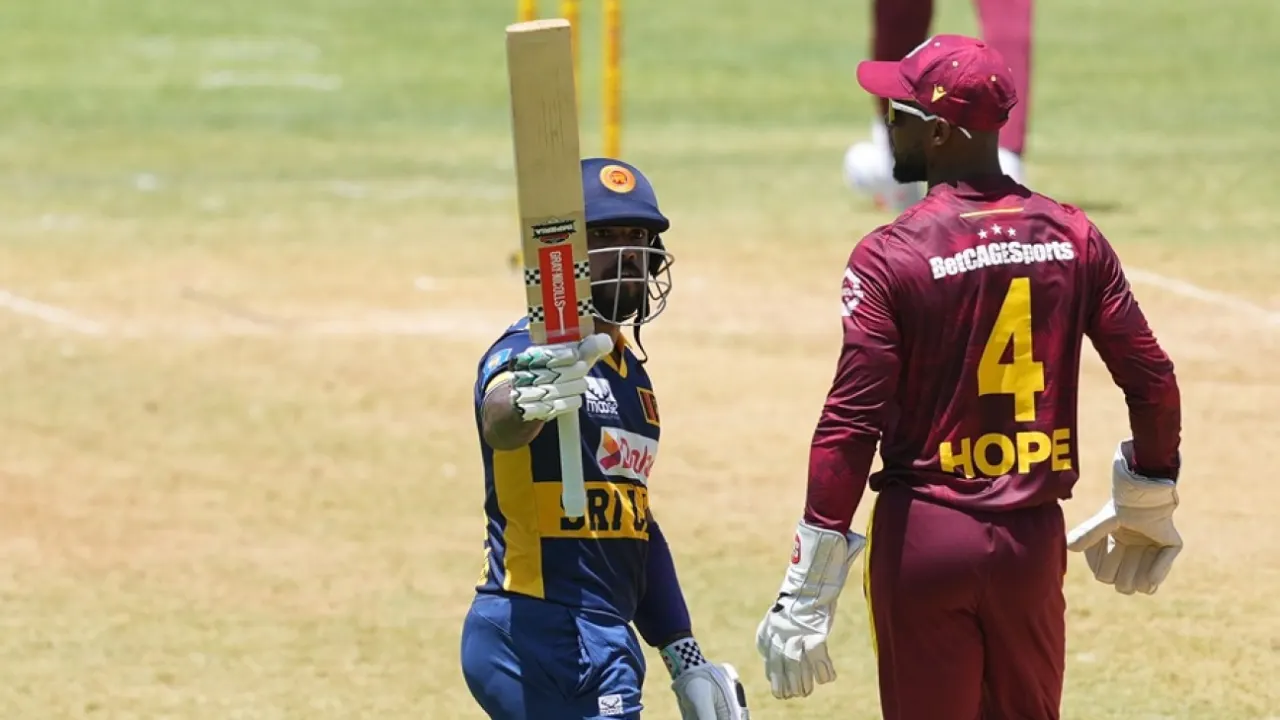
A first ODI win in the West Indies since 2013 and more importantly, a winning start to Gary Kirsten’s tenure as head coach. The action now returns to the same venue for the second of three games, as the hosts seek to keep the series alive and both sides look to implement any learning from the first game.
For Kirsten and Sri Lanka, there were elements of the veteran coach seeking to come to terms with the talents at his disposal and identifying their best fit. The promotion of Kamindu Mendis to the top of the order – while not coming off on Wednesday – is one such example, while Kusal Mendis’ aggression through the middle overs showed that captaincy has not dulled his attacking instincts.
But there were concerns too. Pavan Rathnayake had a breakout 2026 T20 World Cup, but having been positioned in a pivotal No. 4 role, his 24 off 38 only served to snuff the momentum Kusal had created. Kirsten will no doubt have taken note, as he would have of Janith Liyanage’s pivotal contributions at the death. Perhaps trialing Liyanage at four instead?
For West Indies, the problems certainly outweighed the positives. Despite the quick start provided by their openers – something that in most scenarios ought to have helped break the spine of a 300-plus chase – the middle order struggled to contend with Sri Lanka’s spinners.
There also seemed to be a distinct lack of clarity in their batting approach; unlike in T20s where they are a side renowned for their ability to clear the boundary with regularity, in the 50-over format – perhaps owing to the fact this was their first such assignment in six months – there seemed to be some rustiness and even unease around the need to build at pace through the middle.
Nevertheless, there will be strands to cling to heading into Saturday’s second ODI, particularly the execution of their plans in shackling Pathum Nissanka. At the same time, it will have been impressed on the top-order the importance of capitalising on their starts.
In the opening game, Roston Chase showcased his utility, delivering a tidy ten-over spell of 2 for 47 before chipping in with a steady 33 off 46 balls during the chase. Those numbers kept the home side competitive, but in a must-win second game, West Indies will be hoping he ramps things up, particularly with the bat. Chase’s technical expertise against spin will likely prove pivotal in combating the pair of Wanindu Hasaranga and Maheesh Theekshana, and that anchor role will ideally allow the team’s designated boundary-hitters to play with freedom around him.
Dushmantha Chameera proved that absolute pace remains lethal, regardless of the type of surface on offer. The quick turned up once more with his now customary consistent displays of hit-the-deck bowling, as he ran through the West Indies middle-and-lower order to finish with match-winning figures of 4 for 67. His capacity to extract sharp bounce from a good length will also once more prove a challenge for the West Indian openers.
West Indies will most probably go in with an unchanged XI.
West Indies (probable): John Campbell, Justin Greaves, Keacy Carty, Shai Hope (capt & wk), Sherfane Rutherford, Roston Chase, Matthew Forde, Gudakesh Motie, Alzarri Joseph, Shamar Joseph, Jayden Seales
Sri Lanka will likely field an unchanged lineup. Though considering Sri Lanka’s stacked seam-bowling department, and the reverse swing on offer in the first game, it wouldn’t be surprising to see Eshan Malinga brought into the XI.
Sri Lanka (probable): Pathum Nissanka, Kamindu Mendis, Kusal Mendis (capt & wk), Pavan Rathnayake, Charith Asalanka, Janith Liyanage, Wanindu Hasaranga, Milan Rathnayake, Maheesh Theekshana, Dushmantha Chameera, Asitha Fernando/Eshan Malinga
[Cricinfo]

Anthropic is proposing that the world’s top artificial intelligence companies come up with a coordinated way to pause development of advanced AI systems, warning that the technology is improving so quickly that there’s a risk humans would lose control.
The company behind the Claude chatbot said in a blog post on Thursday that, as cutting-edge AI gets increasingly faster at carrying out tasks, “it would be good for the world to have the option to slow or temporarily pause” its development.
Anthropic said its internal research institute plans to explore the issue in collaboration with others and “take actions” to help build the systems for a credible slowdown or pause, without being more specific.
Anthropic rival OpenAI argued for a different approach in a report published on Wednesday, saying that “democratic governments — not private companies acting alone — must ultimately determine the rules, safeguards, and accountability mechanisms”.
“Our view is that decisions about the pace of AI innovation should not be left to any one lab, company, or special interest group,” it said.
AI models are getting faster, with rapid increases in how quickly they can carry out software tasks like coding on their own, Anthropic said in its post. Based on current trends and given enough computing power, an AI system could be able to design and develop its own successor, in what is known as “recursive self-improvement”.
Self-building AI would be a major technological milestone that would bring benefits in science, healthcare and other areas, Anthropic said, but it “also might increase the risks of humans losing control over AI systems”.
Some tech industry figures have long warned of such a scenario.
Anthropic’s post comes after a different warning this week from a team of researchers at the University of Toronto who showed how AI tools could be used to create a new kind of AI “worm” that adapts its hacking strategy as it spreads from device to device and takes over a vast computing network.
“I think it’s really important that people understand that it’s not just the biggest, most powerful language models that pose the security concerns,” lead researcher Nicolas Papernot said in an interview.
The authors of the Anthropic post, company cofounder Jack Clark and Marina Favaro, head of its research institute, said the pause would be used to enable “societal structures and alignment research” to keep up with AI advances. Alignment is industry shorthand for making sure the technology matches human values and intentions.
The proposed coordination would let advanced AI labs verify that global rivals have actually stopped or slowed their work, “and that a bad actor could not use the auspices of a coordinated slowdown to jump ahead in secret”.
The company said a coordinated global mechanism is needed because, without it, a slowdown in AI development could let the “least cautious” players catch up and add to pressure on companies and governments as they make tough choices about AI safety.
Fears that advanced AI systems may get out of human control and cause societal harm have risen as the technology becomes increasingly capable. Anthropic’s own Mythos model sent shockwaves through industries, including banking and software, earlier this year with its ability to find vulnerabilities in existing code.
But regulation has been slow, especially in the US, where most leading AI labs are based. A Trump administration executive order earlier this week put the onus on the labs themselves, asking them to voluntarily submit their most capable models for government cybersecurity testing before public release.
Safety focus
AI researchers have also urged a pause before, but have had little success. Elon Musk, who owns AI lab xAI, was among the backers of a 2023 push by the non-profit Future of Life Institute to halt AI development for six months to allow time for safety guardrails.
Anthropic has long positioned itself as a safety-focused AI lab. Earlier this year, it refused to let the US military use its models for domestic surveillance and fully autonomous weapons, prompting backlash from the government, which put it on a national security blacklist, set to take effect later in 2026.
Anthropic’s post comes as the company and ChatGPT-maker OpenAI race to sell shares on the stock market, in an IPO that could value Anthropic at nearly a trillion dollars.
Papernot notified Canadian cybersecurity authorities prior to releasing his report, which shows how researchers developed the worm in a laboratory by using an “open-source” AI tool that is easy for software developers to cheaply access and modify.
“In the past, cyber attackers would focus on targets that are very high value,” he said. “Banking systems, hospitals, electricity grids, water treatment systems, schools.”
Papernot agreed that there should be more collaboration between companies, government agencies and academic researchers to develop countermeasures as AI-powered hacking tools supercharge the search for computer vulnerabilities.
“That old laptop you have in your basement that you don’t check on regularly doesn’t seem like a very high-value target, but it can be used as a launch pad to attack these higher-value targets,” he said. “Anything connected to the internet is now at risk because of how low the cost has become to mount these cyberattacks.”
[Aljazeera]

England make inroads after New Zealand set 254 to win

Rusty West Indies face upbeat Sri Lanka with series on the line

Pakistan naval trio leaves Colombo after goodwill visit

PEOTV secures media rights for FIFA World Cup

Anthropic urges AI labs to pause, warns humans risk losing control

Iran footballers issued US visas for World Cup, says White House

‘Dates have the highest sugar content to fight Coronavirus’

Sunday Island 27 December – Headlines

#SundayIsland 17th December – Headlines

Sunday Island – 28th March

Sunday Island Headlines – 21 March

Sunday Island – 21st February – Headlines
-

 News5 days ago
Lankan duo emerge winners in Latin dance championship held in Blackpool, UK
-

 Business6 days ago
IMF’s unstated rate:Sri Lanka’s $695m loan costs about 5.33% per annum
-
 Latest News2 days ago
Kusal Mendis, Pathum Nissanka, bowlers put Sri Lanka 1-0 up
-

 News3 days ago
New US tariffs proposed on 60 countries, including Sri Lanka
-

 Business6 days ago
Sri Lankan scientist-innovator Milinda Edirisinghe introduces AI-integrated gem testing system to gemological world
-

 Features7 days ago
Are threats to Buddha Sasana external or from within?
-

 News6 days ago
UNP challenges NPP move to amend Vihara – Devalagam Act
-

 Features2 days ago
Power crept into the Sangha and is now tearing it apart