
Sports
Dasuni’s triumph a massive victory for underdogs

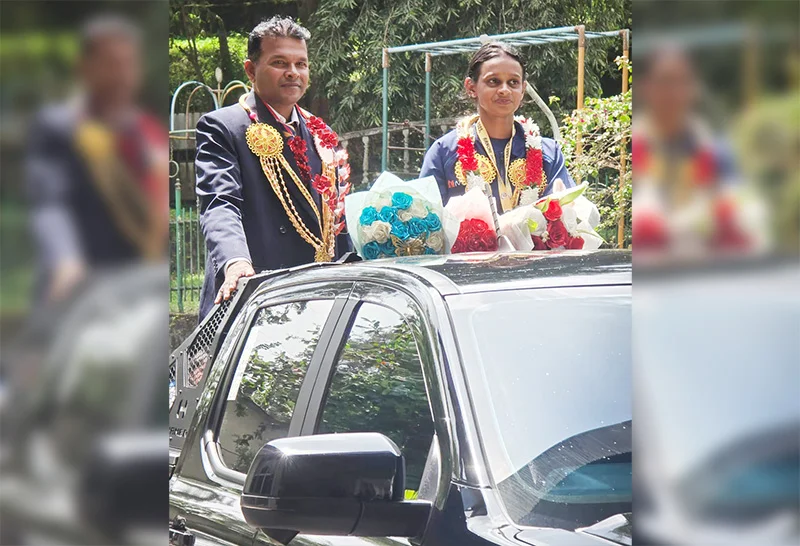
There were many outstanding performances by Sri Lankan athletes at the just concluded South Asian Athletics Championship in Ranchi India. Many consider Shafiya Yamick’s hattrick of golds on top of every other accomplishment. Undoubtedly, it was a remarkable achievement.
There were also other feats that went unnoticed as the spotlight fell mainly on multiple medal winners. Dasuni Kaushalya’s gold winning feat in the women’s 400 metres hurdles was one such.
More than the gold, it is the outstanding personal best of 58.66 seconds that delights analysts. It is an average performance compared to top world performances of the likes of Famke Bol or Sydney Mclaughen but looking back at the little progress the discipline has made during the past decade, Kaushalya merits accolades for a job well done.
Except Olympian Christine Merrill and former champion Madushani Kaushalya, no other Sri Lankan athlete had run that fast over the ten hurdles in history.
As highlighted in these columns in the run up to the championship, Kaushalya was slowly establishing herself as an emerging contender to challenge the US based hurdler Christine Merrill’s national record one day.
The Sri Lanka Air Force athlete and her coach Asanka Rathnayake had to beat many odds to prove this fact. And they are the happiest of all now as their hard work paid off in Ranchi.
Rathnayake belives that his charge could be trained to achieve sub 58 or 57 seconds within a year provided that she gets fast tracks to train.
”I believe that she could be trained to clock 57.5 or 57.3 or probably sub 57 if she could train on fast tracks,” Rathnayake told ‘The Island’ after attending a felicitation ceremony organised by Kaushalya’s school St. Andrew’s Balika, Nawalapitiya and the Urban Council of Nawalapitiya.
”This is a technical event. You need to train and compete on fast synthetic tracks to produce fast feats,” said Rathnayake.
As the table displays all fast performances by national record holder Christine Merrill were achieved on venues in the US or elsewhere. Even former champion Madushani had achieved her best feat overseas.
”I firmly believe that she could feature in an Asian Games final at least if she could train on proper tracks,” said Rathnayake.
The coach and athlete have done their part now it is incumbent upon authorities to do the rest.
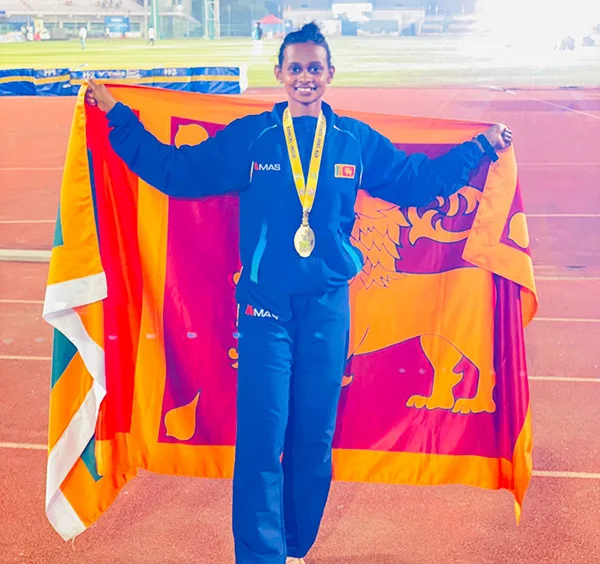
Dasuni Kaushalya with her medal.
Best Performances of Woman’s 400m hurdles by year from 2008
2008 Christine Merrill LA USA 59.62
2009 Christine Merrill San Angelo USA 58.59
2010 Christine Merrill USA 58.04
2011 Christine Merrill Kobe July 56.83
2012 Christine Merrill London Aug 57.15
2013 Christine Merrill USA VA June 56.45
2014 Christine Merrill US 58.25
2015 Christine Merrill Tex US 58.36
2016 Kaushalya Madushani Guwahati 59.87
2017 DGND Wickramasinghe 60.33
2018 Kaushalya Madushani 59.68
2019 Kaushalya Madushani 58.16
2020 GAS Dulani 62.90
2021 Kaushalya Madushani 59.47
2022 Kaushalya Madushani 58.73
2022 Dasuni Kaushalya 62.95
2023 Dasuni Kaushalya 60.98
2024 Dasuni Kaushalya 59.53
2025 Dasuni Kaushalya 59.15
2025 Dasuni Kauahalya 58.66
by Reemus Fernando


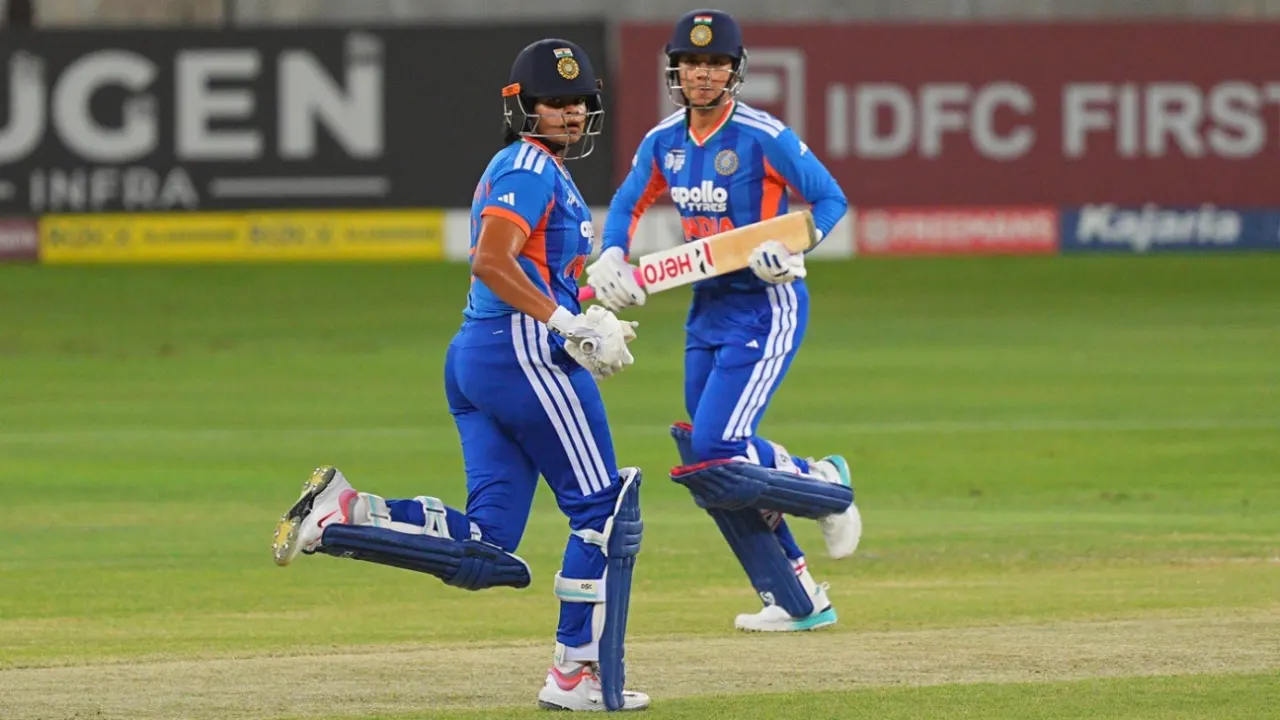
A commanding opening stand between Shafali Verma and Smriti Mandhana, followed by an excellent overall bowling effort, gave India their eighth Asia Cup title, fourth in T20 format, as they beat previous champions Sri Lanka by 72 runs in Dubai.
Shafali and Mandhana put up 129 for the first wicket, the highest partnership for any wicket in the Women’s T20 Asia Cup, to power India to 183 for 5. Sri Lanka’s chase never got going, despite India dropping as many as five catches, as the spin unit led by Deepti Sharmaand N Shree Charani kept them under control throughout. Chamari Athapaththu top-scored with 36, but Sri Lanka were eventually bowled out for 111. India now lead Sri Lanka 6-1 in Asia Cup final meetings.
Shafali set the tone after captain Harmanpreet Kaur opted to bat after winning the toss. When Sri Lanka introduced spin in the second over, both openers immediately attacked, picking up two boundaries. But Shafali combined power with placement in the third over, first using the pace on a short ball from outside off to guide it past short third, before clipping a length delivery through midwicket to make it back-to-back fours.
Athapaththu brought herself on in the fifth over but that brought little respite. Shafali got underneath a tossed-up delivery and launched it straight back over the bowler’s head before sending another ball in the slot over long-on. India raced to 57 without loss at the end of the powerplay.
The boundary-hitting continued after the powerplay too, with Shafali finding the ropes regularly on her way to a 24-ball fifty, the fastest half-century in Women’s T20 Asia Cup history. Mandhana, who had initially scored at around a run a ball, then joined in on the fun as she lofted a flighted delivery from Chamudi Praboda over long-on before bringing up her own half-century, off 36 balls, with a cut through the offside. India reached 98 without loss at the end of ten overs.
With India looking well on track for a 200-plus total, Sri Lanka finally made inroads in the 13th over when Praboda broke through, having Shafali mistime a shot to cover. India suffered another setback in the following over when Mandhana was run out for the third time in the tournament. Harmanpreet, coming in at No. 3, struck Athapaththu’s delivery straight to point and immediately set off for a single, but she hesitated midway before continuing, leaving Mandhana stranded as the throw came in. The mix-up ended Mandhana’s innings on 59, with Sri Lanka sending back both well-set openers in a space of six balls.
Sri Lanka could have had Richa Ghosh soon after but Kavisha Dilhari could not hold on to a difficult running catch. Ghosh had mistimed a slog sweep towards deep backward square leg, with Dilhari racing in and diving forward, only for the ball to slip from her hands as she hit the ground. Ghosh could not make the most of the reprieve as she scored 15 off 13 before picking out cover.
Sri Lanka did a better job at the death, restricting India and picking up the wickets of Harmanpreet and Deepti in successive deliveries in the 19th over. That brought G Kamalini, playing her first match in this Asia Cup and just her second T20I, to the crease and she managed a four and a six off the last two balls to take India to 183 for 5.
A chase of 184 was never going to be easy, but Imesha Dulani started the proceedings positively, shuffling across to a full delivery from Kranti Gaud and paddling it past short fine leg for four. But a similar attempt brought an end to her innings in the fourth ball of the over, with Dulani attempting a scoop only to miss the ball completely and watch it crash into the top of leg stump.
Earlier, Sri Lanka had suffered a setback when Vishmi Gunaratne appeared to roll her ankle while returning the ball and was carried off the field on a stretcher. She, however, came out to bat at No. 3, attempting to rebuild alongside Athapaththu. But fast bowlers Gaud and Nandani Sharma left the duo frustrated, with Athapaththu enduring a testing over from Gaud, getting off the mark only on the eighth delivery she faced.
She then showed off some of her big hitting, taking on Shafali for a six and a four, but despite the boundaries, she was only going at a run-a-ball at the end of the powerplay. Any hopes of Sri Lanka coming close to chasing the total ended with her dismissal in the tenth over.
Anticipating Athapaththu would look to attack, Deepti shortened her length, making her charge down the pitch. But the ball turned away sharply, beating Athapaththu’s attempted shot, and Ghosh completed a straightforward stumping, dismissing the Sri Lanka captain for 36. Deepti struck once more in the over, having Gunaratne bowled, leaving Sri Lanka needing 121 off the last ten.
As has been the case throughout the tournament, India’s spinners showed their prowess, never letting Sri Lanka even have a sniff at the game thereon. Wickets fell regularly, with Charani removing Harshitha Samarawickrama, the hero of the 2024 Asia Cup with a sharp return catch for 9.
Charani then picked up two wickets in the over. Kavisha Dilhari fell first, slicing a thick outside edge towards short third, following which Nilakshika Silva, who was playing with a broken finger, top-edged a shot towards deep square leg.
India were sloppy in the field, dropping five catches but it was too late for Sri Lanka to capitalise on the chances. Deepti finished with three wickets and Charani with four, finishing as the tournament’s top two wicket-takers, as India bowled Sri Lanka out for 111 on the last ball of the innings.
Scores:
India Women 183 for 5 in 20 overs (Smriti Mandhana 59, Shafali Verma 68, Harmanpreet Kaur 14, Richa Ghosh 17, Gunalan Kamalini 15*; Mithalia Ayodhya 1-33, Chamari Athapaththu 1-34, Chamudi Prabodha 1-40) beat Sri Lanka Women 111 all out in 20 overs (Chamari Athapaththu 36, Vishmi Gunarathne 20, Nilakshika Silva 22; Kranti Gaud 1-08, Shafali Verma 1-23, Shree Charani 4-20, Deepti Sharma 3-19, Prema Rawat 1-22) by 72 runs
[Cricinfo]

Rumesh Tharanga outsmarted a strong field including his closest rivals this season, Anderson Peters and Julian Webber to clinch the men’s javelin title of the inaugural Ultimate Championship in Budapest.
The Diamond League champion overtook Webber and Peters with his third round throw which was measured at 87.11 metres before further improving the distance to a colossal 91.01metres, the third time the 23 year old has exceeded the 90 meters mark this season.
The two-time world champion Peters finished second with 86.18m.
European champion Weber, who led in the first round, finished third with 85.89m. (RF)
Sports
Maris Stella Thimbirigaskatuwa, Lyceum Wattala clinch Western Province Schools Games athletics titles


Maris Stella College, Thimbirigaskatuwa and Lyceum International School, Wattala emerged as the boys’ and girls’ overall champions respectively at the Western Province Schools Games athletics championship, which concluded at Diyagama on Friday.
Maris Stella produced a strong all-round performance to secure the boys’ title, with St. Benedict’s College, Kotahena finishing runners-up and Maris Stella College, Negombo taking third place.
The Thimbirigaskatuwa school’s success was highlighted by an outstanding performance from Deesara Herath, who was adjudged the boys’ Best Athlete after producing a 7.49m effort in the Under-20 long jump.
Maris Stella also produced another Best Athlete through Akash Peiris, who claimed the Under-14 boys’ award with a 12.91m performance in the shot put.
The school further underlined its strength in sprinting by establishing a new meet record in the Under-18 boys’ 4x100m relay. The Maris Stella quartet clocked 42.4 seconds to take the gold.
Their depth was also evident in the relay events, where Maris Stella finished as the overall runners-up.
In the girls’ competition, Lyceum International School, Wattala secured the overall championship, with the school’s success spearheaded by Risansa Nirupama. She was named the girls’ Best Athlete following her impressive 24.49-second performance in the Under-20 200m.
The performances of Herath and Nirupama were among the standout individual displays of the championship, while Maris Stella’s meet record in the Under-18 4x100m added further gloss to their successful campaign.

Fast Attack Craft P 4447 recovered in successful salvage operation

Showers above 100 mm are likely at some places in the Western, Central, Sabaragamuwa, Southern, North-central and North-western provinces

Shafali, Mandhana power India to eighth Asia Cup title

Tharanga wins Ultimate Javelin title

CIABOC member’s appointment: Controversy over Speaker under probe heading selection process

GMOA: Countrywide cadre revision not done since 2015

‘Dates have the highest sugar content to fight Coronavirus’

Sunday Island 27 December – Headlines

#SundayIsland 17th December – Headlines

Sunday Island – 28th March

Sunday Island Headlines – 21 March

Sunday Island – 21st February – Headlines
-

 Sports3 days ago
DDS set to lose Test captaincy
-
 News6 days ago
Thailand shuts door on undesirables from Sri Lanka
-

 News3 days ago
Sri Lanka faces new grid challenge as rooftop solar surges: former CEB GM
-

 Business6 days ago
CEB successor company breaks into top three in competitive BESS tender
-

 Latest News3 days ago
Shafali, Deepti power India into sixth T20 Asia Cup final
-

 Opinion5 days ago
Navigating Sri Lanka’s Israeli Dilemma
-

 Latest News2 days ago
Sri Lanka thwart Fatima Sana challenge to secure Asia Cup final spot
-

 Features4 days ago
Lost for 90 years: Rare Goby resurfaces in Jaffna