
Business
Free rice for 2.7 million needy families

By Ifham Nizam
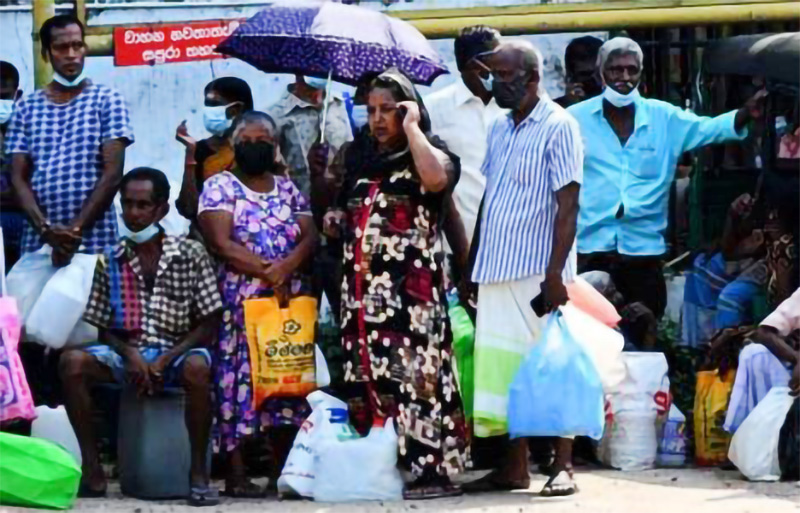
The Finance Ministry has allocated Rs. 20 billion to supply rice free to nearly 2.7 million needy families across the country. This commitment follows President Ranil Wickremesinghe’s pledge to provide 20kg of rice to low-income families in May and June.
According to a senior official at the Agriculture Ministry, concerted efforts were made in collaboration with small and medium-scale rice mill owners to ensure the necessary stock of rice. Initially, Rs. 10 billion was distributed among rice mill owners nationwide.
“The allocation of Rs. 10 billion was disbursed in portions ranging from Rs. 25 million to 50 million to facilitate the supply of paddy stocks,” the ministry official elaborated. However, it was emphasized that the Finance Ministry is directly managing this initiative under the directives of the Presidential Secretariat.
President Wickremesinghe inaugurated the National Rice Distribution for low-income families at Ambagasdowa Stadium, Uva Paranagama, on Sunday.
Wickremesinghe said that 2.74 million low-income families would receive a monthly allocation of 10 kilograms of rice for two months. Specifically, 191,548 eligible families in 15 Divisional Secretariat Divisions within the Badulla district were identified to receive this subsidy. The President symbolically distributed bags of rice to 25 beneficiaries, marking the commencement of the rice allocation.
The distribution of rice to selected beneficiaries is ongoing under the supervision of Divisional Secretaries nationwide. Wickremesinghe underscored the importance of equitable economic development and collaboration among political parties, emphasizing the diverse initiatives of the current government.
Furthermore, he instructed that paddy should be purchased, milled, and the rice distributed among low-income earners through a transparent mechanism.
A senior official disclosed that initially, it was planned to allocate Rs. 10,000 million to purchase 61,600 metric tons of paddy under the program, providing 2 million low-income families with 10 kg of rice each per month over two months, free of charge.
However, it was revealed during discussions that 2.85 million families are identified as needing this assistance.
Wickremesinghe reiterated: “The government is committed to purchasing rice worth Rs. 20 billion to distribute to 2,850,000 low-income families as part of its food security program.” He assured that the government would safeguard rice prices by providing a guaranteed price and delegated the task of purchasing paddy stocks to District and Divisional Secretaries. Additionally, he emphasized that rice would not be sold, and a dedicated team would oversee the program’s implementation.

By Ifham Nizam
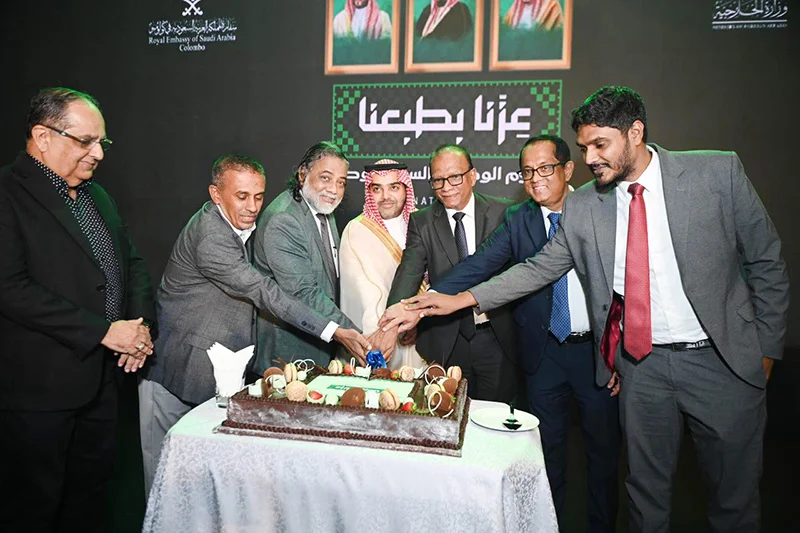
Sri Lanka is pitching Saudi Arabia for greater investment and deeper trade ties, seeking to attract Saudi capital into new development opportunities while aligning bilateral economic cooperation with the Kingdom’s ambitious Vision 2030 agenda, Ports and Civil Aviation Minister Anura Karunathilaka, chief guest at Saudi Arabia’s 96th National Day celebrations in Colombo, said.
Addressing the National Day reception at ITC Ratnadipa, Karunathilaka said Sri Lanka was keen to identify new areas of economic cooperation with the Kingdom and create fresh opportunities for Saudi investors and businesses.
‘We look forward to creating new opportunities for the people of both countries by working in cooperation with Saudi Arabia’s Vision 2030 and its broader development initiatives, he said.
The minister said Sri Lanka wanted to move beyond its existing development cooperation with Saudi Arabia and build a broader economic partnership encompassing investment, trade and new development projects.
He noted that Saudi Arabia had already made a substantial contribution to Sri Lanka’s development. Since 1981, the Kingdom has provided concessional financing amounting to around Saudi Riyals 1.5 billion for 13 projects in Sri Lanka, supporting key sectors including energy, healthcare, education, drinking water and infrastructure.
Karunathilaka said Sri Lanka appreciated this support and was keen to build on the foundation created by those projects by opening further avenues for Saudi investment.
The minister’s investment pitch comes as Saudi Arabia advances its Vision 2030 programme, with the Kingdom seeking to diversify its economy and develop new international partnerships. Sri Lanka, meanwhile, is seeking to attract investment and expand economic opportunities through closer engagement with international partners.
Karunathilaka also highlighted the strong people-to-people links between the two countries, noting that nearly 250,000 Sri Lankans currently work and reside in Saudi Arabia.
‘They serve as an important bridge between our two countries and contribute significantly to strengthening the people-to-people ties between Sri Lanka and Saudi Arabia, he said.
He expressed appreciation for Saudi Arabia’s continued assistance to Sri Lanka and thanked the Saudi government for the facilities extended to Sri Lankan Muslims undertaking Hajj and Umrah pilgrimages.
Karunathilaka said Sri Lanka looked forward to working more closely with Saudi Arabia to strengthen political relations, broaden investment opportunities and enhance development cooperation.
Yaser Abdulrahman Al-Hazme, Chargé d’Affaires of the Royal Embassy of Saudi Arabia to Sri Lanka, said the embassy remained committed to strengthening bilateral relations by promoting political, economic and cultural communication between the two countries.
‘The embassy of the Kingdom of Saudi Arabia in Colombo has been keen during the past period to strengthen bilateral relations between the two countries by playing its role in supporting political, economic, and cultural communication, Al-Hazme said.
Al-Hazme also highlighted the embassy’s role in strengthening communication between Saudi and Sri Lankan institutions and following up on the interests of Saudi citizens in Sri Lanka.
‘On this precious national occasion, I extend my sincere thanks and appreciation to the government and people of the Democratic Socialist Republic of Sri Lanka for the attention and care given to relations between our two countries, and for the constructive cooperation that has contributed to strengthening the bonds of friendship and partnership between the Kingdom and Sri Lanka, he said.
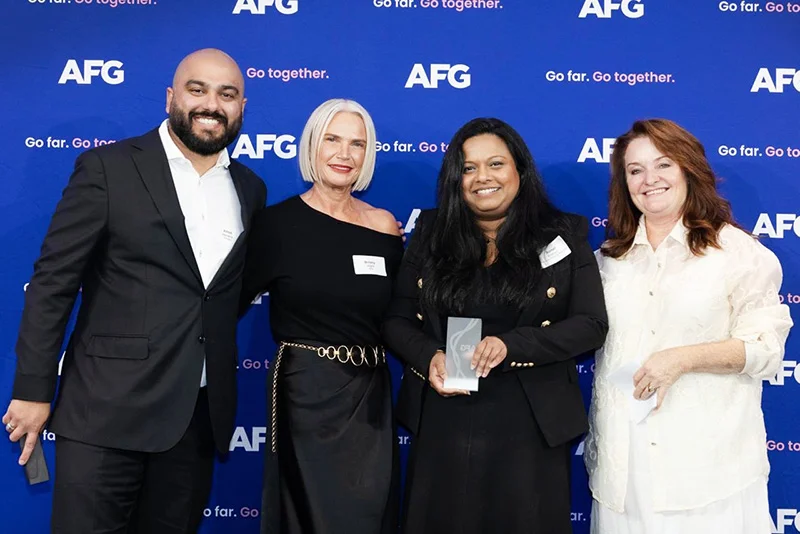
Australian finance professional Sonali Rodrigo has been recognised with the prestigious AFG Women on the Move Scholarship, presented by Australian Finance Group (AFG), in recognition of her leadership, industry contribution and impact spanning more than two decades in Australia’s finance industry.
The AFG Women on the Move program is dedicated to supporting and advancing women in the finance and mortgage broking industry, recognising individuals who demonstrate leadership, professional contribution, growth, impact and a commitment to empowering other women. The scholarship is supported by leading industry partners, including HSBC and Thinktank.
Sonali’s career spans more than 20 years in Australia’s finance industry, encompassing senior leadership, financial advisory and governance roles. Alongside her professional responsibilities, she has actively mentored and supported women in their career development, contributed to financial literacy, and helped individuals make more informed financial decisions. Her recognition reflects both her professional achievements and the broader impact of her leadership, particularly in creating opportunities and empowering the next generation of women in finance.
Institute of Policy Studies of Sri Lanka (IPS)
Continued From last Friday
Regional infrastructure improvements beyond the Western Province are essential to close market-access gaps and improve efficiency. The Western Province alone generates 42% of Sri Lanka’s GDP, but the dynamics of such agglomeration may also be highly underestimated. Officially, barely a fifth is deemed ‘urban’ in the province, but IPS re-estimates from the 2024 census using population density and infrastructure access, place the true figure at nearly 61%. The absence of strong secondary cities and industrial clusters outside the province reduces the potential gains from this agglomeration, thereby weakening incentives for firms to locate elsewhere or decentralise operations.
Fiscal incentives can promote decentralised corporate operations by offering tax rebates, lower property taxes, and land access in secondary cities like Kalutara and Gampaha, leveraging the connectivity of Southern and Colombo-Katunayake Expressways. The Hambantota seaport and airport, along with Koggala and Mirijjawela Export Processing Zones, can help develop the Southern Province through geography-based tax concessions.
Immediate measures, such as pricing vehicle entry into Colombo city will support regional agglomeration while tackling the acute problem of city congestion. Adopting a low-cost, technology-anchored free-flow method, similar to the Automated Number Plate Recognition (ANPR) currently used in commercial parking facilities for vehicles entering the city, is one such means. Installing high-mounted overhead ANPR gantries at key arterial entry points can operationalise congestion pricing without disrupting traffic speed. Fee collection can use a system like E-Tags electronic toll collection on expressways, integrated with digital payment gateways like GovPay and LankaQR for dynamic, time-of-day variable pricing.
The renewable energy transition is vital to drive competitiveness, external shock resilience, and green growth. Sri Lanka’s transition to renewable energy (RE) has advanced from a mere aspiration to tangible progress. Yet, the evidence suggests the transition is advancing faster on the generation side than the system built to absorb it. Transmission capacity, market design, financing channels, and digital infrastructure have not kept pace with capacity additions, and this gap is what will determine the pace of the transition through 2030.
Capital spending on transmission must be ring-fenced by legally, operationally, and financially separating the electricity grid (the transmission network) from the rest of the energy sector or by the broader government budget as a protected public investment within the medium-term budget framework. Funding should shift from general budget support to dedicated multilateral facilities, reinforced by sovereign guarantees for eligible borrowing. To safeguard public funds, this must be paired with a clear tariff pass-through mechanism that effectively limits open-ended Treasury exposure.
To build market trust, domestic budget funding should be earmarked for market-design technical assistance, signalling strong policy ownership rather than relying on external donors. Transparency too should be strengthened by publishing a firm implementation timeline in the Budget statement and fully disclosing long-term fiscal commitments from Power Purchase Agreements, capacity arrangements, and ancillary services.
(Concluded)

Iran’s Araghchi meets Qatari mediators as US calls for nuclear talks

Showers above 50 mm expected in Uva, Eastern and Central provinces and in Polonnaruwa and Mullaittivu districts after 2.00 p.m.

PAFFREL raises concerns over Anti-Corruption (Amendment) Bill

First cases taken up by SC after enactment of 22A dismissed

Now NR named 4th suspect in Krrish case

Sri Lanka Red Cross Society honoured with Friend of Singapore Red Cross Award

‘Dates have the highest sugar content to fight Coronavirus’

Sunday Island 27 December – Headlines

#SundayIsland 17th December – Headlines

Sunday Island – 28th March

Sunday Island Headlines – 21 March

Sunday Island – 21st February – Headlines
-

 News6 days ago
Mastermind Naufer Moulavi among 15 found guilty
-

 Midweek Review6 days ago
Thileepan’s fast unto death: An authentic narrative that many missed
-
 Latest News5 days ago
Showers above 100 mm are likely at some places in the Western, Sabaragamuwa, Central and North-western provinces and in Galle and Matara Districts
-

 Editorial6 days ago
Big Bad Bills
-
Editorial5 days ago
Crimes punished and unpunished
-

 Features4 days ago
Beyond traditional jobs: Why Sri Lanka needs to facilitate the gig economy
-

 News6 days ago
No referendum needed for passage of 22 A: SC
-
 Latest News6 days ago
Ms. P. M. Jayadeera (Engineer) appointed Director General of Irrigation