
News
Inland Revenue releases list of goods and services exempt from enhanced VAT


The Inland Revenue Department yesterday (21) issued the list of goods and services that would be exempted from the enhanced Value Added Tax (VAT) regime that comes into effect from 01 January 2024.
The list of items included Wheat and wheat flour; infant milk powder; Pharmaceutical Products and Drugs (other than cosmetics) whose end use are confined to therapeutic or prophylactic effect and purchased on a prescription of a physician and raw materials for the production or manufacture of such products or drugs; Ayurvedic Preparations that belong to the Ayurveda Pharmacopoeia or Ayurvedic Preparations (other than cosmetic preparations) or Unani, Siddha or Homeopathic Preparations (other than cosmetic preparations); Crude Petroleum Oil, Kerosene, Aviation Fuel, Oil for Ships or Fuel Oil; Artificial Limbs, Crutches, Wheel Chairs, Hearing Aids, Accessories for such aids or Appliances, White Canes for the blind, Braille Typewriters and Parts, Braille Writing Papers, Braille Writing Boards, etc.; Bio Fertilizer, Artemia Eggs and Peat Moss; Agricultural Seeds, Agricultural Plants, Shrimp Feed inclusive of Prawn Feed and Animal Feed but excluding Poultry Feed; Yarn used for textile industry; and Dyes used for the handloom industry.
Among the services exempted from VAT are: Educational Services provided by any person or partnership; Public passengers transport services (other than air transport, water transport or transport of tourists, excursion tours and taxi services); Electricity including distribution; Services in relation to burials and cremations; Services at a restaurant situated beyond the immigration counter at the
Bandaranaike International Air Port; Goods and services to the mission of any state or any organisation to which the provisions of the Diplomatic Privileges Act; Goods or services funded directly by foreign organisations for the relief of sudden distress caused by natural or human disasters or to any activity having regard to the interest of the national economy, as approved by the Minister; a number of Financial Services:
the operation of any current, deposit or savings account; the exchange of currency; the provision of any loan, advance or credit, etc.; the life insurance, Agrahara insurance and crop and livestock insurance; the transfer of non-performing loans of a licensed commercial bank by way of transfer of such loans to any other person in terms of a restructuring scheme or other scheme of such bank as approved by the Central Bank of Sri Lanka with the concurrence of the Minister; All healthcare services provided by medical institutions or professionally qualified persons providing such care other than hospital room charges; Locally Manufactured Handloom Textiles;
Rice, Rice Flour and Bread so far as such products are manufactured locally; Unprocessed Agricultural, Horticultural or fishing products produced in Sri Lanka; Locally manufactured Surgical Gauze used for surgery; Fabric which are subject to a cess at a specific rate; Services by the Department of Commerce, the Board of Investment of Sri Lanka or the Sri Lanka Ports Authority; Services by a person in Sri Lanka to any other person outside Sri Lanka to be consumed or utilised by such other person outside Sri Lanka for which the payment is made in Sri Lanka rupees; Geriatric Services and Child Care Services; Goods or services to any specified project identified by the Minister, taking into consideration the economic benefit to the country, on which the tax is borne by the Government; or (b) Goods and services to any infrastructure development project funded through foreign loans or donations directly to the Government Ministries, approved by the Minster on the recommendation of secretary of the respective Government Ministry; Goods or services by the Central Bank of Sri Lanka.
Meanwhile, Goods to be used as exhibition material or as material in any technical demonstration and which are re-exported after the completion of such project, exhibition or demonstration; Aircraft Engines or Aircraft Spare Parts identified under specified Harmonised Commodity Description and Coding System Numbers for Custom purposes; Chemical Naphtha by the Ceylon Petroleum Corporation to be supplied to the Ceylon Electricity Board for the generation of electricity; and The import and supply of goods at Duty Free Shops for payment in foreign currency.







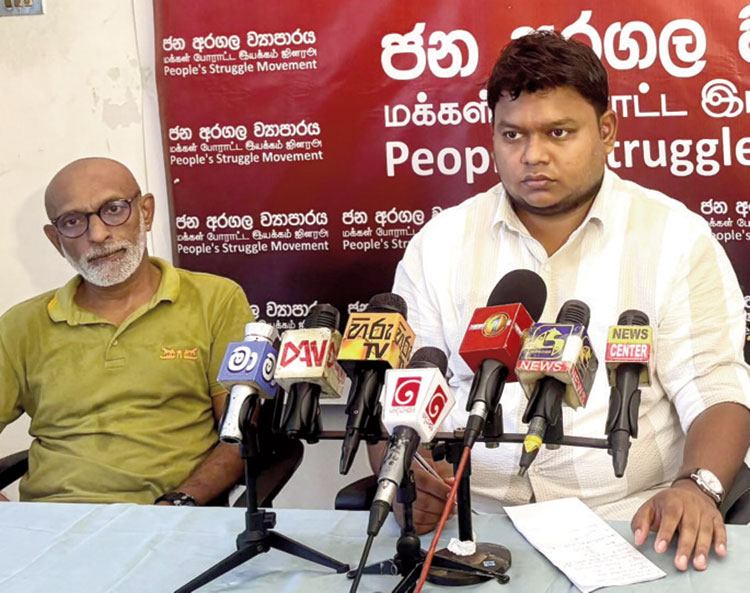
The Frontline Socialist Party-backed People’s Struggle Movement is set to stage a protest march in Colombo today (03) against what it describes as the growing tax burden on the public and the rising cost of living.
The organisers are due to commence the “Colombo March Against Unjust Taxes” at noon from Campbell Park, Borella. The FSP has also been mobilising support for the protest in Colombo and its suburbs in the run-up to the event.
People’s Struggle Movement National Executive Council member Wasantha Mudalige, speaking at a media briefing in Nugegoda yesterday (02), called on the public to join the protest, saying the movement intended to bring the tax burden faced by ordinary people to the forefront.
Mudalige alleged that successive tax measures had placed an excessive burden on households, particularly through taxes on food and educational items. He also criticised the Government over what he described as the high cost of basic food items and the difficulties faced by parents in meeting their children’s educational expenses.
He accused the Opposition of failing to adequately address the issue, claiming that opposition parties raised such concerns, mainly during election periods.
Mudalige also criticised the Government for what he described as a departure from promises made before the 2024 presidential election regarding taxes on educational equipment.
He questioned the tax burden on food items, citing figures of Rs. 100 per kilogramme on dried sprats, Rs. 310 per kilogramme on chicken and Rs. 11 per egg.
He further alleged that while ordinary people were bearing a heavy tax burden, wealthy groups were receiving tax concessions. He also criticised the Government’s economic programme and its implementation of measures associated with the International Monetary Fund (IMF).
The movement has framed today’s protest as part of a broader campaign over the cost of living and taxation. The People’s Struggle Alliance has separately announced that the Campbell Park demonstration will be the first in a series of public actions, with further protests planned in November.
Mudalige said the movement would continue to take the issue to the streets and urged the public to participate in today’s demonstration.
People’s Struggle Movement National Executive Council member Jayantha Amarasinghe also addressed the press.

The Colombo High Court yesterday postponed the trial in the case filed under the Prevention of Money Laundering Act against Yoshitha Rajapaksa, son of former President Mahinda Rajapaksa.
The case was taken up before Colombo High Court Judge Udesh Ranatunga, with Yoshitha Rajapaksa, who is currently out on bail, appearing in court.
The trial was postponed as the President’s Counsel appearing for the defence was indisposed.
The Attorney General has filed the case against Rajapaksa, alleging that he committed an offence under the Prevention of Money Laundering Act by purchasing five plots of land in Dehiwala and Ratmalana, worth more than Rs. 73 million.
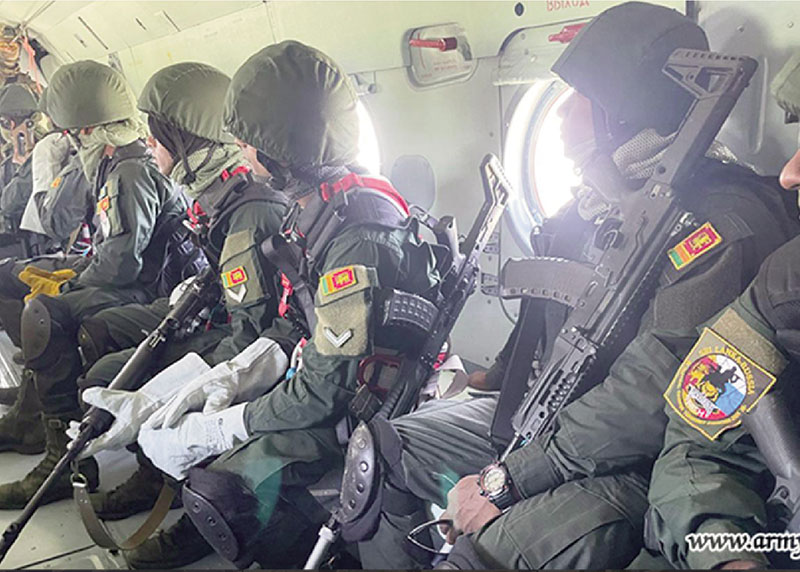
A contingent of the Sri Lanka Army, comprising 20 officers and 55 other ranks, participated in the combined military exercise ‘Wolverine Path II–2026’, conducted with the Armed Forces of the Russian Federation in Vladivostok, Russia, from September 18 to 25.
According to the Ministry of Defence, the exercise primarily focused on counter-terrorism operations and provided participating troops with training in a challenging combined operational environment.
The exercise included a range of tactical activities, including heli-rappelling, close-quarters battle (CQB), ambush operations, sniper firing, drone operations, buggy training and combat medical support.
The Ministry said the training enabled Sri Lankan troops to further develop their combat skills, tactical coordination and operational readiness.
It also provided an opportunity for the two militaries to exchange professional knowledge, operational experience and tactical expertise. Sri Lankan personnel gained exposure to training methodologies, tactical approaches and operational practices adopted by the Russian Armed Forces, the Ministry said.
The participation also enabled the Sri Lankan contingent to identify lessons from the joint training and share its own experiences with the Russian military.
The Sri Lankan contingent returned to the country following the exercise and arrived at Mattala Rajapaksa International Airport on September 28.
The Ministry said participation in the exercise contributed to enhancing the professional knowledge, tactical awareness and operational preparedness of Army personnel while promoting military-to-military cooperation, mutual understanding and professional relations between Sri Lanka and Russia.

G7 to release 100 million barrels of oil and diesel after Trump export ban threat

Showers above 75 mm are likely at some places in the Central, Sabaragamuwa, Western, Uva, North-western, Southern and North-central provinces and in Mannar district.

All set for Colombo rally against govt.’s tax policies

Yoshitha R money laundering trial postponed

Lankan troops test mettle in Russian war games

Tax burden drives thousands of doctors out of country: GMOA

‘Dates have the highest sugar content to fight Coronavirus’

Sunday Island 27 December – Headlines

#SundayIsland 17th December – Headlines

Sunday Island – 28th March

Sunday Island Headlines – 21 March

Sunday Island – 21st February – Headlines
-

 News5 days ago
Police remove Thileepan statue in Jaffna
-

 Features5 days ago
The 22nd Amendment, constitutional recovery and illiberal slippage
-

 Features5 days ago
Of foreigners as CEOs of Lankan ventures
-

 Latest News3 days ago
Gold winner Tharanga gets brand-new Honda Vezel from SLAAJ
-

 News5 days ago
Sajith rejects Jt. Opp. protest sabotage claim; SJB TU chief demands remedial action
-

 Features4 days ago
Thailand’s biggest new global star …
-

 Features3 days ago
Why Sri Lanka needs an Inclusive Civic Nationalism – urgently
-

 News4 days ago
First cases taken up by SC after enactment of 22A dismissed