
Sports
Col. Henry Steel Olcott Memorial Cricket tournament from December 8 at Asgiriya

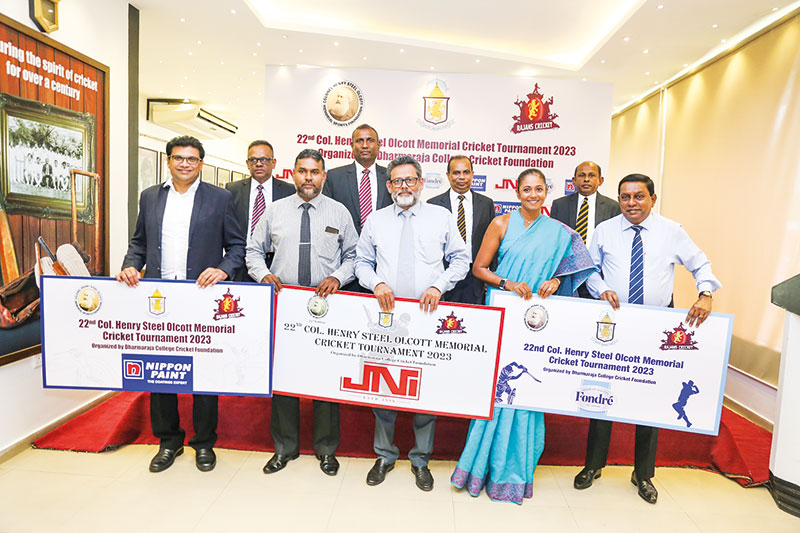
The Col Henry Steele Olcott Memorial Cricket Tournament organized by Dharmaraja College Cricket Foundation will be held from December 8 to 10 at the iconic Asgiriya International Stadium in Kandy. The eight-team competition features leading schools established by Col Olcott in Sri Lanka, namely Ananda, Nalanda, Mahinda, Dharmapala, Maliyadeva, Dharmasoka, Rahula and this year’s hosts Dharmaraja.
Played among cricket teams formed by the eight premier Buddhist schools, the three-day event is expected to feature former top class national players and former first-class players who played cricket at the highest level, representing their respective schools, top domestic clubs and the country. The tournament has two segments involving present players and past players of the eight schools during the three days. A 6-a-side tournament between schoolboy teams including the finals will be played on the first day while an eight overs per side tournament for past cricketers of the eight schools will be played on the second day.
The semi-finals and finals of the Old Boys tournament, will be played on the final day, which is expected to dish out exciting games. All eight schools have confirmed their respective list of players, which includes well-known names. Ananda College includes former national stars such as Arjuna Ranatunga, Thilina Kandamby, Muthumudalige Pushpakumara and Sanjeewa Ranatunga. Former national all-rounder Upul Chandana turns out for his alma mater Mahinda College. Maliyadeva College has included former national caps Ranjith Madurasinghe and Jeewantha Kulatunga in their list of players. Former fast bowler and present national chief selector Pramodya Wickramasinghe is among the list of players released by Rahula College, Matara. All eight teams have selected their cream of former players who have played the game at the highest level at school and domestic levels.
The Henry Steel Olcott Memorial Cricket Tournament is conducted in honour of Colonel Henry Steele Olcott, the founder of Buddhist educational institutions in Sri Lanka. The inaugural tournament was played in 1999 hosted by Nalanda College and pioneered by Late Bandula Warnapura, the first Test cricket captain of Sri Lanka.
This year the tournament is organised and conducted by the Dharmaraja College Cricket Foundation as the tournament is set to be featured for the 22nd occasion since its inception. From the editions that have played so far, Mahinda, Galle boast of most number of titles won outright, which is seven. Dharmasoka, Ambalangoda have won it five times. They have also emerged as joint champions on three other occasions. Ananda and Maliyadeva have won it on three occasions each. Dharmapala, Pannipitiya have two titles against their name, while Dharmaraja and Nalanda have won it on a single occasion each.
The 22nd Col Henry Steel Olcott Cricket Tournament is sponsored by Fondre Fat spread by Pyramid Wilmar(Pvt) Ltd, Nippon Paint and JN Interiors (Pvt) Ltd.


The Cabinet of Ministers approved the resolution furnished by the Minister of Youth Affairs and Sports to establish the proposed National Higher Performance Centre for atletes.

India opener Shafali Verma has received an official reprimand and a demerit point for breaching Level 1 of the ICC Code of Conduct during the second T20I against Zimbabwe on Sunday.
Shafali, an ICC release said, breached Article 2.2 of the ICC Code of Conduct for Players and Player Support Personnel, which relates to “abuse of cricket equipment or clothing, ground equipment or fixtures and fittings during an International Match.”
It was Shafali’s first offence in a 24-month period.
The incident occurred in the 12th over of Zimbabwe’s innings when Shafali threw the ball into the ground in frustration after dropping a chance at mid-off offered by Chipo Mugeri-Tiripano off Sree Charani.
Shafali admitted the offence and accepted the sanction proposed by match referee GS Lakshmi, which meant there was no need for a formal hearing.
Level 1 breaches carry a minimum penalty of an official reprimand, a maximum penalty of 50% of a player’s match fee, and one or two demerit points.
India currently lead the three-match series 2-0 with the third game to be played on Tuesday evening. The T20Is will be followed by three ODIs in Vadodara from October 23.
(Cricinfo)

A total of 146 players will be competing for 27 available slots in the WPL 2027 mini auction on October 28 in Kochi. Of these, England batter Sophia Dunkley and Australia captain Sophie Molineux are the only two players who have listed themselves at the maximum base price of INR 50 lakh.
The auction pool has 119 Indian players, including 22 capped and 97 uncapped players, with 20 slots available for Indian players. The overseas pool has 27 players – 14 capped and 13 uncapped – including six from Associate teams, with seven slots available.
G Kamalini (released by Mumbai Indians), Kiran Navigre (released by U P Warriorz), Heather Graham and Jess Jonassen have registered at the second-highest base price of INR 40 lakh, while a total of 30 players have registered at INR 30 lakh.
Among the notable absentees are West Indies allrounder Deandra Dottin, who was released by UPW, and Australia legspinner Alana King, who was released by Delhi Capitals. Lizelle Lee, who was DC’s highest run-scorer last season, has also not listed herself after being released by the franchise.
What the teams look like going into the auction
Only two English players – Dunkley and Kira Chathli (INR 10 lakh) – have registered for the auction, with several others, including Danni Wyatt-Hodge, Alice Capsey, Dani Gibson, Lauren Filer and Linsey Smith opting to skip the WPL next year.
Cricinfo has learned that England are likely to play three T20Is in Sri Lanka in early February, which will clash with the final week of the WPL. While the ECB is likely to allow players to stay in India to complete the tournament, most players have instead chosen to prioritise their international commitments ahead of the Champions Trophy later that month.
The relatively low salaries on offer at the WPL are also understood to be a factor in many English players deciding not to register, with most internationals earning significantly more to play in the Hundred (up to £190,000 last year) than the highest permitted base price in the WPL of INR 50 lakh (£40,000 approx).
Molineux was part of the Royal Challengers Bengaluru [RCB] title-winning squad in 2024, and had bagged 12 wickets in ten games at an economy rate of 7.31. She was retained by RCB for the 2025 season but a knee injury ruled her out of the season. Dunkley, meanwhile, played for Gujarat Giants [GT] in 2023 before opting not to register for the 2024 season. She went unsold in the 2025 auction.
Among the premier internationals who have listed themselves for INR 30 lakh are Australia allrounder Grace Harris (released by RCB), Sri Lanka captain Chamari Athapaththu, South Africa left-arm spinner Nonkululeko Mlaba and South Africa allrounder Chloe Tryon.
UPW, who released nine players, will go into the auction with the biggest purse of INR 3.75 crore.
[Cricinfo]

Import and Export (Control) Regulations No. 08 of 2026
Draft Bill of the Public Private Partnership Enterprises Act to be gazzetted
Amendment of the Ayurvedha Act No. 31 of 1961

Cabinet nod to amend the Sri Lanka Development Administration Institute Act No. 9 of 1982
Establishment of the National Higher Performance Centre
State patronage for the cremation ceremony of the late deputy prelate (Anu Nayaka Thero) of the Sri Laka Ramangya Maha Nikaya, Gatambe Rajopawanramadhipatha, Siri Chandawimala Wanshalankara, Chandrakeerthi Sri Amarawansha, Sadhdharmawageeshwara, Shasanashobhanna Most Venerable Keppetiyagoda Siriwimalabhidhana Thero

‘Dates have the highest sugar content to fight Coronavirus’

Sunday Island 27 December – Headlines

#SundayIsland 17th December – Headlines

Sunday Island – 28th March

Sunday Island Headlines – 21 March

Sunday Island – 21st February – Headlines
-

 Features3 days ago
Kotahena:A Small Enclave, An Extraordinary Legacy
-

 News7 days ago
Sri Lanka, India caught in US-Iran ship crisis
-

 News4 days ago
Asgiri Mahanayake calls for immediate release of Gnanasara Thera
-

 Latest News7 days ago
Missiles intercepted near Riyadh after Saudi coalition hits Yemen fuel depot
-

 Latest News7 days ago
Kusal Mendis’ unbeaten 87 hands Sri Lanka consolation win
-

 News2 days ago
Record 1,600 students take Russian Classical Ballet examination in Sri Lanka
-
 News6 days ago
AC President recuses himself from hearing prison attire case pertaining to Gnanasara Thera
-
 News5 days ago
Naval officer testifies Yoshitha received Rs. 5.15 mn in salaries during SLN service