
Features
Traveling in Russia for UNESCO and more of life in Paris


(Excerpted from volume ii of the Sarath Amunugama autobiography)
In the final years of the gerontocracy that ruled the Communist Party and the USSR we received the green light to have the annual general meeting of the Internatioal Programme for the Development of Communications (IPDC) in the Soviet Union. This was a special plus for the IPDC because till now its main backers were the Third World countries and the Nordic group. The Soviet delegation which included the general manager of Tass News Agency as well as Zassousky of Moscow University and several top brass from the Foreign Ministry managed to convince the old men in the Kremlin that it was in their interest to ally with the many Third World countries associated with UNESCO and IPDC.
As if to reinforce their Third world connections it was suggested that the meeting be held in Tashkent – the capital of Socialist Uzbekistan. The USSR had already built up Tashkent as their window to Asia. For instance, the Tashkent Film Festival was well known in Asia and Africa. The city had the infrastructure to mount a global conference. Preparatory work for the meeting was assigned to me and my office. My counterpart was Sasha, an official in the USSR Embassy in Paris, who was charged with UNESCO relations.
We struck up an instant friendship as we had to travel many times to Moscow together to finalize arrangements for the meeting. Since it was a high level UN conference M’Bow himself would attend it. Having received a battering from the western press the DG looked forward to the choreographed welcome he was bound to receive in the USSR. This was a difficult time for him since the spat with the USA had led to him being demonized in the Western media.
He discovered too late that it was not possible to win over the western media if you take on the Jewish lobby. Once the press begins to demonize you, it becomes difficult even for political leaders to help you. M’Bow was beginning to go down the slippery slope and he found that the popularity of the IPDC among all political camps gave him a chance to mend fences. But the Reagan administration did not approve of him on the Israeli issue.
The US left UNESCO, which created a gaping hole in our budget. Japan came to the rescue by increasing its contribution. But there was a price tag to the rescue act. It began to suggest changes at the top and very soon M’Bow was replaced by a Japanese Secretary General.
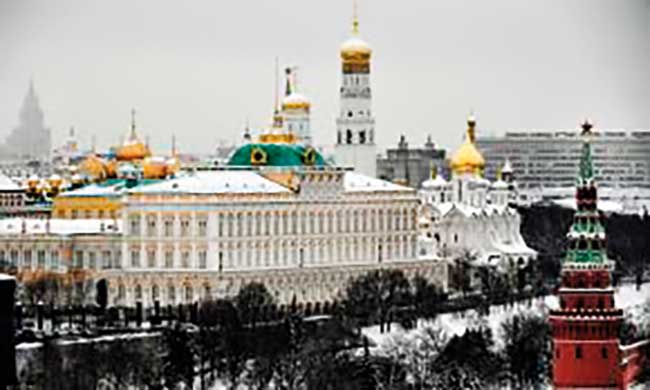
Kremlin
While preparations for the Tashkent meeting brought me to Moscow many times, I also had to negotiate some tricky points with the Communist Party bureaucrats. One such issue was regarding visas. Any UN meeting presupposes the issuing of visas to all participants recommended by it. The host country cannot impose any conditions regarding the travel and security of the participants once they are within its borders.
All arrangements for board and lodging of participants must be approved by us. All this had to be handled sensitively as the US had added several anti-Communist hardliners to their observer delegation perhaps hoping to sow confusion. In all probability these delegates would not have been issued visas if they had applied directly to Moscow. Among these hardliners or ‘cold war warriors’ was Alan Weinstein, a University Professor who had published a lengthy volume presenting evidence to prove his thesis that the killing of John F Kennedy was the act of a ‘lone assassin’ and was not a conspiracy.
Weinstein was considered to be a USSR watcher for Reagan. He was joined in the journey to Tashkent by an alcoholic Californian journalist Nossiter who was a favourite of the US President. It looked very much as though the US delegation was expecting some mishap which could be highlighted at home in their ongoing effort to vilify the United Nations. So we had to be extra careful in our preliminary arrangements.
While in Moscow I took time off for sightseeing. The city was full of old dynastic buildings. The multi-coloured churches with their onion like domes were an architectural wonder. The massive Red Square in the Kremlin with a lit up lone red star looking down from the highest building was an inspiring sight to me, who as an undergraduate at Peradeniya, had pored over books written about the historic Red revolution of the Bolsheviks led by Lenin.
To my pleasant surprise my guide to the historic sites of the city was Ordzhonikidze – the great grandson of a fellow Georgian revolutionary and comrade of Stalin. The original Sergo Ordzhonikidze was one of the heroes of the revolution. He was rare among the early leaders to die unscathed by the terror launched by Stalin. Stalin named one of his battle ships after him. However the latest research has thrown doubt about the manner of his death.
My guide was a young man well versed in the history of the revolution. He took me to the Museum of the Revolution which narrates the history of that epochal event. Communists have no hesitation in rewriting history to fit their current preoccupations. For example in all the old photos of revolutionary leaders, Trotsky had been air brushed out. Since I was familiar with the original photos from Isaac Deutscher’s books I asked my guide about it.
His answer shocked me. He told me that he had not even heard of such a name. He added that none in his generation knew of Trotsky. We then visited the Lenin Mausoleum to view Lenin’s embalmed body which a writer has described as a ‘communist relic’. By this time Khrushchev had ensured that Stalin’s sarcophagus which had lain side by side with Lenin’s was removed from the viewing hall. The Russians are obsessed with sarcophagi.
In the basements of the old churches with onion domes – of the Russian Orthodox Church – in ancient boxes lie the remains of church leaders of the past years. The communists have buried the remains of ancient kings but have left the churchmen alone in the crypts. I remembered that Moscow is only a part of the story. The revolution took place in St Petersburg with its Winter Palace.
Much later, on an official visit there with President Mahinda Rajapaksa I was able to imagine the drama at the beginning of the Russian Revolution. The ship ‘Aurora’ which figures largely in history because the sailors mutinied and threatened to bombard Petersburg in support of the revolutionaries was, we saw, moored in Petersburg harbour. But Moscow became the new capital. Ordinokidze and I motored to the outskirts of Moscow to see last ditch defences Stalin had set up to prevent Hitler’s tanks rolling down to take the beleaguered capital which housed Stalin and the Central Committees.
Soviet Tanks and soldiers had made a heroic stand there and driven back the Nazis. After the guided tour we lunched at Moscow’s famous five star restaurant `Matryoshka’ on Katuzovsky Avenue, which was a popular meeting place of the Moscow elite. I went back to my Hotel Moskva and got ready for the highlight of my tour, the visit to the Bolshoi Theatre to see ‘Swan Lake’ danced by the world famous Bolshoi Ballet. I had seen ‘Swan Lake’ in Paris, Berlin [called ‘Schwansee’ in German] and London but the Bolshoi version was the most breathtaking, both for the dancing and Tchaikovsky’s music.
After this encounter I was ready to fly back to Paris. My friend Sasha of the Paris embassy then introduced me to a touching traditional Russian gesture. He brought a home cooked loaf of bread wrapped in a bandana. His wife, who was a teacher of English in a University, had baked the bread. In the past in Russia when a family member or friend undertook a long journey his loved ones would cook him a loaf of bread, wrap it and hand it over so that he would not go hungry. I too was given that touching honour and was greatly moved.
Promising to come back, I took the Air France flight back to Paris and home after a wonderful experience in Soviet Russia. By a coincidence seated next to me on the flight was Bala Tampoe who was one of my heroes from University days. We talked and on the following day I took him out to lunch in a posh hotel close to the ‘Le Monde’ office where Bala had an interview with a French journalist.
Tashkent
The Tashkent meeting was quite a victory for the newly formed IPDC. The international situation was moving towards dialogue and nations were looking for signals, however small they may appear at first, of a thaw in the Cold War. The USSR was in a state of paralysis after a period of rule by geriatric leaders. Gorbachev was in the wings and soon ‘Perestroika’ and ‘Glasnost’ was to emerge to shake up the Communist world.
As mentioned earlier Ronald Reagan sent a delegation of right wing hardliners to Tashkent. They were carefully handled by the State Department officials who came along with them from Washington. They came expecting a frosty reception but the USSR and our staff made sure that they felt comfortable as they were invited to many meals, and especially drinking sessions, in the best Tashkent restaurants. According to American Foreign service officers, their report to Reagan was conciliatory.
Sensing the value of this meeting M’Bow himself attended the conference. He was treated with great respect by the USSR authorities, which was a contrast to the way in which he had been treated by a visiting US under-secretary. At the meeting, defying expectations of a boycott, western delegates who provided most of the funds, were happy that IPDC was short on rhetoric but had successfully collected funds and launched many projects to improve communications facilities in the poorer nations.
The USSR also by selecting Tashkent had signaled that they were on the side of the developing nations. Tashkent was their gateway to Asia and the “third world” countries. They had invested heavily in providing hotels and conference centres in the city. Though we were put up in the best hotel we got a shock when an earthquake hit Tashkent and we had to run out to the open in the night till the tremors subsided. It was a comic sight to see the distinguished delegates congregating on the lawn in their night clothes. Later we were assured that such tremors were not exceptional and the hotel was built to be earthquake proof I doubt whether our seasoned diplomats bought that story in its entirety.
Samarkand
After the grand finale of the meeting USSR authorities had arranged an excursion to Samarkand for the participants. Samarkand has been described by a poet as “a rose red city half as old as time”. It had been the cradle of the Mughal, which later became a famous centre of Islamic learning. We saw one of the oldest Universities of the world with its warren like rooms for the young scholars who then traversed Asia and the Middle East propagating the Islamic faith.
They were also the early scientists and astronomers who advanced learning in mathematics and tracking of changes in the sky and stars. The world’s oldest telescope to observe the skies was located in Samarkand. The Tashkent meeting brought me even closer to the Asian delegates to UNESCO and IPDC. Among them was G. Parthasarathy, the head of the Indian delegation. GP was close to the Nehru family having been the PMs roving ambassador. He was India’s Ambassador to Vietnam at a crucial time when Nehru was called upon to be a mediator in the growing political crisis in that country. We became close friends with consequences that I will describe later in this chapter.
The UNESCO top brass was pleased with our management of the conference. M’Bow held a reception for the staff and thanked them. When the inevitable cuts foIlowing the US withdrawal came, IPDC was not touched. We were encouraged to keep up our ties with the State Department Officials in Paris who were themselves unhappy about the withdrawal but could do nothing about it. They assured us that eventually the US will return and that is what really happened later. In the meanwhile, USAID with whom we had excellent relations continued several of our projects bilaterally with those countries concerned.
Rue Jean Daudin
As stated earlier with the arrival of my family in Paris I moved to a spacious flat in Rue Jean Daudin which was close to UNESCO headquarters and my office in Rue Miollis. This was a posh quartier in Paris being close to the Eiffel Tower, Trocadero, the Ecole Militaire and Champ de Mars – the most famous park in Paris. The shift of residence from a ‘Red’ working class district to the heart of upper class Paris gave me an opportunity of experiencing different historical cultures of that ancient city.
The topography of Paris is highly segmented on the basis of social class. As a jogger in my new locality I could run past the military school which had produced a Napoleon as well as all the military leaders of World wars including De Gaulle. In fact paratroop commanders led by Generals Salan and Massu, who opposed De Gaulle’s change of policy on Algeria, attempted to assassinate him in front of the Ecole Militaire. This real event forms the backdrop of the famous thriller ‘Day of the Jackal’ which became a bestseller.
I ran past the Invalides – a hospital for war veterans established by Napoleon, which is now a war museum. From there I would reach the Champs de Mars and the Tour Eiffel. Then I would go past the Trocadero, down the steps near the Musee de Homme and back to my home in Rue Jean Daudin. It was a daily chore which not many people would have had the privilege of enjoying. But it was also saddening because my route was dotted with plaques commemorating the resistance fighters who had been put against the wall in those locations and summarily executed by the Gestapo during the Nazi occupation. From time to time old ladies – relatives, girlfriends and surviving comrades-would hobble up to those monuments to lay a bunch of flowers as remembrance of those sad times past.
I then got down to the task of finding schools for my two daughters who were delighted to be in Paris at the best time of their young lives. Ramanika who was 18 enrolled in the American University of Paris while Varuni who was 15 joined the British school of Paris which was located out of the city in idyllic surroundings. The British school bus was parked at the Trocadero and the students, who were mostly from the posh quartiers, had to come there by car or metro.
Varuni would take the Segur Metro to Trocadero first with her mother but soon on her own, and catch the school bus to the suburbs with her mischievous schoolmates who were mostly drawn from UNESCO and embassy families. Occasionally my wife and I visited the school to inquire about Varuni’s progress. We were accompanied by Navaz as an interpreter and two other Sri Lankans. The school management would have been horrified to see a delegation of Asians descending on their school, all intent on following the early baby steps in education of their new entrant Varuni Amunugama.
But both children adapted themselves well and would merge easily with their new friends who were up to their usual pranks in class and on school tours to England, Ireland and parts of Europe. They were both on great demand as ‘baby sitters’ to small children of the super-rich like Bank Directors, Ambassadors and Supermodels who paid them handsomely. With the money so collected the two girls traveled through Europe by train on their own.
In Geneva they were looked after by Jayantha and Maureen Dhanapala. In Rome they stayed with Mahinda Ranaweera and his wife who were UNESCO functionaries there. In Germany they were guests of my wife’s cousin who was married to an embassy official in Bad Godesberg. They were popular ‘baby sitters’ because they spent part of their allowance buying chocolates for their wards.
We also had many Sri Lankan friends staying with us. Namel and Malini Weeramuni, our friends from way back, toured France with some companions in a caravan and I arranged a flat nearby for them to stay while visiting Paris. Lester and Sumitra Peries were regular visitors to Paris. Earlier their good friend Vernon Mendis, who was our Ambassador, had entertained them. They also had friends in the French film industry, some of whom were associated with the Cannes Film Festival.
Sumitra’s film `Loku Duwa’ produced and acted by Geetha Kumarasinghe was selected under a special section in Cannes called ‘Un Certain Regard’ which was a considerable achievement for both Sumitra and Geetha. A lot of work went into making a shorter version of the Sinhala film, subtitling, striking extra prints and launching of a publicity drive in the French media. All this was done and `Loku Duwa’ was screened to an enthusiastic audience.
On another occasion Sumitra visited Paris and stayed with us when one of her films was presented at the Nantes Film Festival. Richard Ross and his wife Jane who were our close friends when they were in Colombo as attaches to the US Embassy, were in Paris serving in the US embassy. They were living on a houseboat moored on the river Seine. Dick and Jane invited us for dinner on their boat. It was a fun party with plenty of drinks and as the music increased in tempo, we were scared that an inebriated guest would jump into the river.










by Dinesha Samararatne
Professor, Dept. of Public & International Law, Faculty of Law of the University of Colombo
and was an independent member of Sri Lanka’s Constitutional Council (Jan. 2023 to Jan. 2026).
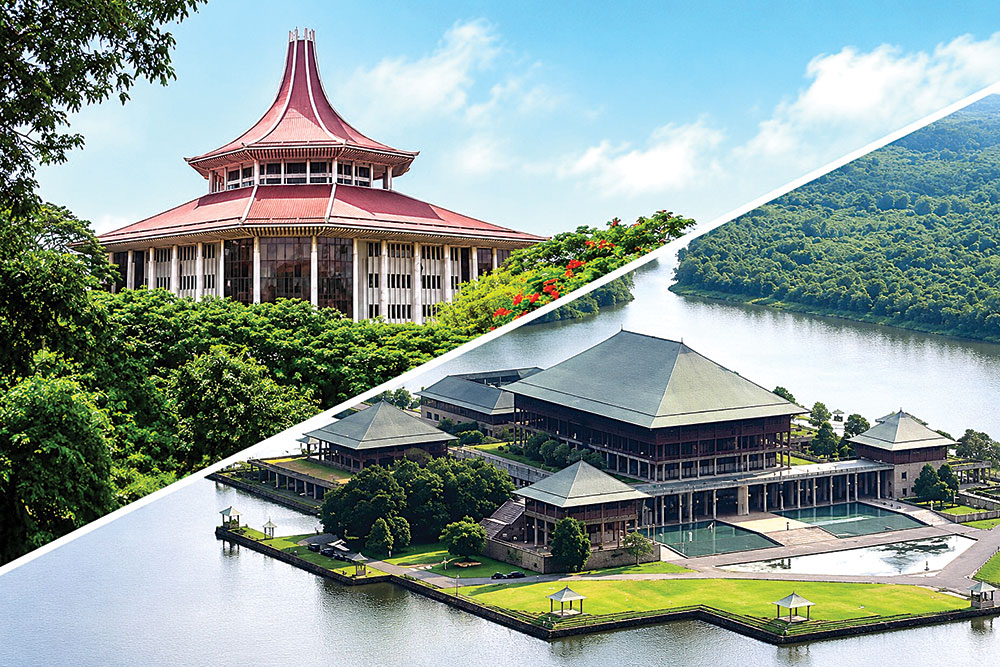
Sri Lanka’s political transition in 2024 was widely regarded as restoration of democracy, a reversal of authoritarian rule and an opportunity for constitutional recovery. The 22nd Amendment is the first constitutional amendment since this turning point. It 1) extends the age of retirement of the judges of the superior courts by two years, 2) expands the number of judges in the Court of Appeal by 4, and 3) introduces a cap of 6 years on the term of a Chief Justice. The expansion of the Court of Appeal is meant to facilitate the Court sitting outside of Colombo.
This Amendment is a stress-test on Sri Lanka’s democratic restoration as well as constitutional recovery. This Bill was published in the Gazette along with a proposed amendment to the Judicature Act of 1978, which sought to extend the age of retirement for the lower judiciary and to increase the number of judges of the High Court by 10. The enactment of the Amendment coincides with the completion of two years of this Government. Here, I offer a brief assessment of some of the key policy and constitutional issues involved.
Democratic Transition and Constitutional Recovery
There were many signs of a new lease of political life in Sri Lanka following the presidential election in 2024. Many politicians (of a certain kind) who sensed the change chose to not even contest the parliamentary elections. An Inspector General of Police (whose appointment itself was, at the time, under challenge) was impeached, and the political discourse seems to shift towards more democracy, transparency and accountability. The vigilance of the engaged citizen (as opposed to the mere voter) was evident in the pushback which led to the resignation of a Speaker as well as a Minister.
Some may say that these changes were too little and too late. After all, the Online Safety Act and the Prevention of Terrorism Act remain on our law books and we are still governed by an Executive President. Some others may argue that these are signs of a significant paradigm shift that is underway. Since 2025, the number of investigations, prosecutions and convictions related to bribery and corruption has been unprecedented, the President’s Fund is being accessed by people on the basis of financial need and there seems to be a change in the political culture. Whether these changes may be consolidated, it is too early to tell.
Policy and the 22nd Amendment
The 22nd Amendment to our Constitution suggests that political tactics familiar to the old order of things (to the extent that that order is in our past), are re-emerging. A proposal for a constitutional amendment which is piece-meal (with no convincing explanation for its selectivity), is published in the gazette without public consultation – not even consultations with relevant professional bodies – and is enacted without bi-partisan consensus. A recent example of a similar approach is the expansion of the number of judges in the Supreme Court and Court of Appeal by way of amendments at the Committee Stage of the 20th Amendment in 2020, with no transparency or consultation and with political justification post-Amendment. Many questions arise and remain unanswered. Among the many issues that plague our courts, on what basis were these issues prioritised for reform? As in the past, the process has been opaque and rushed. In turn this has led to polarised debates which carry the risk of compromising the confidence in the Government.
Laws delays, one of the stated concerns that the 22nd Amendment seeks to address, is at crisis levels in Sri Lanka. It is certainly a concern for citizens but it is a concern along with the extremely weak mechanism for legal aid, the lack of accessibility of court procedures and the difficulties we face for instance at a police station. We have a right to know why amidst all these serious and ubiquitous issues, the government prioritised constitutional reform in this selective manner. Constitutional reform must demonstrate a compelling link between the aspirations of the people for democracy, for human dignity and the flourishing of life. If the plight or aspirations of people are weaponised by political forces or elected representatives, we carry the burden of calling that out.
My own view is that a review of the age of retirement of judges is long overdue, but whether and how it ought to apply to sitting judges, carries the real or perceived risk of undermining the independence of the judiciary. Moreover, that is certainly not the only reform that is long overdue. The minimum criteria for the appointment of a judge to our superior courts is governed by convention (sometimes in the breach), not by law. In fact, the law does not lay down any criteria for appointment to our superior courts despite the Court’s assertion in its Determination on the 22nd Amendment bill that judges are appointed on merit, ‘competence and ability to work hard’ (p 87). While procedures and mechanisms are in place for disciplinary measures for the judiciary of lower courts, there is no such mechanism for the superior courts. The rules of the Constitutional Council (a matter that has been disputed in litigation) do not provide guidance on the process to be adopted for approval /disapproval of nominations made by the President to these courts. There is no judicial review of legislation in Sri Lanka. In fact, we are governed under a constitution that provides for the enactment of constitutional amendments or law reform that are inconsistent with the Constitution (with approval at a referendum). These are some aspects that require review and discussion in relation to the further improvement of the judicial branch of the state in Sri Lanka. Many of us consider these reforms not just important but also urgent.
Special Determinations and their Scope
Generally, after a Bill is placed in the Order Paper of Parliament, any citizen may challenge it before the Supreme Court and the Court communicates its determination to the President and to the Speaker within three weeks (Article 121). When a Bill proposes to amend the Constitution, it requires approval by 2/3 absolute majority in Parliament. Therefore, if a Bill is challenged, the Court has to determine whether it also requires approval by the people at a referendum. The approval of the people is required if the Court determines that the Bill or any of its clauses is inconsistent with the entrenched clauses of our Constitution listed in Article 83. There are 10 entrenched clauses in our Constitution including the clause on Buddhism and freedom from torture. These clauses may only be amended with 2/3 in Parliament and approval by the People.
The presentation of the Bill and proceedings before Court is a reminder, yet again, of the sheer inadequacy of the manner in which the Constitution is amended or how we engage in law reform. Within a matter of three weeks, the Supreme Court is required to exercise its ‘pre-enactment’ judicial review. In this case, 65 petitioners rushed to Court to challenge the 22A bill and eight others the amendment to the Judicature Act. The hearings are conducted under severe time-pressure, including, in this instance, without a right of reply for the petitioners to the submissions by the Attorney-General. In the proceedings related to pre-enactment review, I cannot help but notice the irony of the process. At least in theory, the Attorney-General is the guardian of the Constitution and, therefore, is required to act in trust, for the benefit of the People. In these hearings, however, the Attorney-General, by and large, presents and defends the policies of the government. In theory, the government represents the people. The petitioners, too, bring to Court the concerns of the people (to the extent that they are presented by the petitioners) through counsel who often appear pro-bono for them. One possible way out of this dilemma is to consider a possibility for the Attorney-General to participate in these proceedings on the basis of the Constitution and for the government to retain its own counsel to make submissions defending its policies.
Two Constitutional Issues
The Court was faced with two constitutional questions in hearing these petitions. First, whether the petitions required the full court to hear and determine the matter since the Bill involved the retirement age of the sitting judges as well. Second, the Court had to determine whether the proposed amendment had a negative impact on judicial independence, whether judicial independence was an aspect of the entrenched clauses of our Constitution and if both those questions were answered in the affirmative, whether the Bill required approval at a referendum. Previously, the Court has determined that in reviewing a Bill, Court will not inquire into the desirability of the proposed reform but limit itself to determining whether any clauses of a Bill are inconsistent with the entrenched clauses of Constitution and would therefore require approval by the people at a referendum.
Constituting the Bench
In the Supreme Court, benches ordinarily comprise three judges, and the Chief Justice is vested with discretion to constitute larger benches of five or more judges (Article 132). In ‘the opinion of the Chief Justice’ the question involved must be one of ‘general and public importance’. The decision to constitute a larger bench may be the Chief Justice’s decision, or on the request of at least two of the judges hearing the matter or at the request of a petitioner. In the Dissolution case (2018) the Chief Justice himself constituted a Bench of seven judges.
The Chief Justice had constituted a Bench of five judges to hear this matter, of different years of seniority in the Court. Court rejected the request for a full bench on the basis that the Bench did not have a conflict of interest and that a five-judge Bench was the appropriate use of the resources of the Court, particularly in light of the fact that the Court was due to hear petitions regarding another bill at the same time. For the first time, the Court comments on the administrative functions of the Chief Justice, the difficulties in case management under resource constraints and the internal procedures of a bench when dealing with a Special Determination. Ironically, this reminds us that for several months, the vacancies in the Supreme Court and the Court of Appeal have remained while the President and the Government claim that they are committed to addressing laws delays.
Even if the Court had taken the view that there was a conflict of interest, as a matter of necessity, the Court had to make a determination on this Bill. The Court, in its wisdom, determined that a five-judge bench was constitutionally adequate. Yet, it could be argued, that in this context, a full bench or a fuller bench, would have satisfied all concerned that the Court had taken the maximum measures it could, to avoid any perceptions of a conflict of interest. That interest of the Court and of our constitutional system, arguably is constitutionally more important than ensuring efficiency in case-management.
The Bill and Independence of the Judiciary
The independence of the judiciary includes the following dimensions: personal and institutional; negative and positive; the actual and the perceived; and procedural and substantive. These dimensions require a principled assessment as well as a situated or contextual assessment.
‘Independence of the Judiciary’ is explicitly mentioned only twice in our Constitution: in the preamble, as part of our ‘intangible heritage’ which ‘guarantees’ our dignity and well-being and as the sub-heading for chapter XV of the Constitution. The independence of the judiciary, as part of our intangible heritage, has to be understood as a foundational constitutional concept and as a constitutional principle. In its operationalisation, the concept and the principle have to be interpreted and applied in context. This is where the contestations on the 22nd Amendment come alive. None of the entrenched clauses directly refers to the independence of the judiciary. However, in its recent jurisprudence, the Court has held that the independence of the judiciary has to be read into Article 3 of our Constitution, which is entrenched. Article 3 states that ‘sovereignty is in the People and is inalienable’ and further that our sovereignty includes ‘powers of government, fundamental rights and the franchise.’ In this Determination, Court endorses this interpretation.
The Court rightly notes that matters of policy are not reviewable by court except if such policies are vague or manifestly unreasonable. The Court determines that petitioners were wrong to argue that the extension of the age of retirement of the judiciary was an encroachment on the independence of the judiciary. Notably, the Court does not explain the independence of the judiciary as a constitutional concept except to note that the Constitution ‘guarantees that Judges will be able to make decisions free of influence and based only on relevant facts and law.’ (p 74). The Court further notes that while a reduction of the term or a reduction in the salaries of judges would undermine judicial independence, the increase of salaries of judges could hardly be considered as impacting judicial independence.
The Court considered several comparative examples in considering whether or not the extension of the age of retirement has been determined to have undermined the independence of the judiciary elsewhere. However, in each of those examples the broader constitutional context has a material bearing on the conclusions reached. In India, the selection of judges for appointment is through the Collegium System which comprises the judiciary. In the UK, the age of retirement was raised after extensive consultation between July – October 2020. As reported by the UK government, 1004 responses were received from the judiciary, the legal profession and other stakeholders. It is thereafter that the decision was implemented. It is relevant to note here that despite the lack of consultation, the lower judiciary and the Bar went on record opposing this Amendment.
In its wisdom, the Court agreed with the submissions made by the Attorney-General that since the extension of the age of retirement applied to all the judges, it was non-discriminatory and non-discretionary and therefore was ‘not at the whim and fancy of the Executive.’ (p 83) The Court reproduces a Note to the Cabinet (3 July 2026) which sets out the reasons for the Government’s policy decision. Notably, in a sector where no constitutional reforms have been made, except to require approval for appointments by the Constitutional Council, the Note provides no justification for selectively focusing on the age of retirement. The excerpts of the Note reproduced in the Determination make no reference to the other two reforms proposed.
The Social Justice Questions and Constitutionalism
For us, the constitutional questions have to be answered within the broader political context. From the citizen’s perspective, even the increase of the salaries of judges, if implemented under questionable, selective or opaque circumstances, can give rise to questions, concerns and a weakening of public confidence. Facts take colour from their context. This reminds me of another question on which there has been some debate in Sri Lanka, which is, whether Sri Lanka should establish a separate Constitutional Court which will adjudicate on constitutional matters thereby permitting a broader jurisdiction and mandate.
Some others have even described law as a colonial tool that has oppressed most in society. Some have argued that social justice requires that we marginalise or even dispense with commitments to liberal values such as rules of procedure and values of democracy such as diversity of opinion. That Sri Lankans have experienced exploitation, that democracy has been abused for state capture, through its Constitution and law, is true. As much as the law has been a tool for exploitation and abuse, it has also been a tool for liberation and social justice. Victims of human rights violations and abuse of law, often the vulnerable in our society, often have no recourse but the law. They seek it, even if to fail. Justice, too, is heavily contested and should remain so. Its meaning cannot be the monopoly of one social class, a political party or a ruling elite. At the same time, there ought to be commitments we can make as a polity to values, procedures and substantive outcomes that bring liberal commitments to rights and procedure with those of social justice. Furthermore, we must avoid the trap of romanticising ‘the people.’ We, the people, have actively sought and cultivated political patronage and participated in practices that undermine our common good, such as daily acts of violence, racism, patriarchy, corruption, abuse whether at home, at work or in the public domain.
Returning to the question of law, constitutions and justice, we should be vary of a ‘them vs us’ approach, particularly when they are propagated by those with political, cultural or economic power. The Constitution allows the Cabinet to place a bill before the People for their approval through a referendum (Article 120). Perhaps, taking this path, even if it carries a significant financial cost, may have allowed the government to put to rest the opposition to the 22nd Amendment. It is ironic that under a Constitution that declares the people to be sovereign, the only time a bill has been put to the people, was to postpone the exercise of their franchise (4th Amendment to the Constitution 1982).
Illiberal Slippage and/or Democratic Backsliding?
Serious issues of constitutional politics of this nature require that a strong government (which is what we have, with a charismatic leader and 2/3 in Parliament) is matched by a strong Opposition. What we have, instead, for the most part, are some politicians and political parties that have no credibility on matters related to the judiciary, mobilising against the government and claiming to defend the independence of the judiciary. While that tragi-comedy writes itself, we the citizens ought to be concerned about the lack of healthy political competition, an essential feature of a sustainable democracy and the disregard by the government of the reasonable voices within the Opposition.
Illiberal slippage or democratic backsliding has been identified as a risk for regimes that have led a transition to democracy. In a system headed by an Executive President, such a risk is all too real, as we know all too well. Ad hoc, piece-meal constitutional amendments of this nature place us on that path. In this political moment, many truths compete with each other. It is true that Sri Lanka made a distinct transition to democracy. It was made in stages starting from 2022. No single political party or social movement can claim that transition as their own. We cannot deny the organic dynamics of that transition. It is true that this transition has a class dimension to it. For certain, the political elite of the past enjoy diminished political capital and mileage, at least for now. The professional elite, depending on one’s perspective, too, arguably enjoy diminished traction. The ground beneath us is shifting. It is also true that within the limited electoral cycle, limited political capital, and in a context where former authoritarian forces remain electorally relevant, institutional reform is difficult. Situated in this broader context, there is cause for concern about the 22nd Amendment. It has weakened our transition to democracy and placed our constitutional recovery at risk.
(I write as an engaged citizen who studies constitutional law. The views expressed here are my own.)

by R N A de Silva
rnades@gmail.com
“I was good with numbers and liked mathematics, but it changed when letters started to replace numbers”- such sentiments are common expressions that we hear. Perhaps the challenges that the students face in mathematics as a school subject are mainly due to the fear of algebra. For many students the transition into secondary education brings this profound sense of academic dread – algebra. This anxiety is more a structural byproduct of human minds adapt to radical shifts in thinking than a personal failure of the individual student. Many students who have been dealing only with numbers suddenly feel that they are in unfamiliar territory as they have to combine numbers with letters, symbols and rules. Dismantling this fear has to be done by the educators through reshaping how it is introduced and contextualised so that it becomes an accessible gateway of logical reasoning.
Let us look at the reasons for the development of the fear of algebra.
The Challenge of the ‘unknown’
In the first few years of formal schooling, mathematics becomes a tangible experience. They can count with their fingers or tools like counters and beads. They can measure lengths of tables or rooms or divide boxes or fruits into fractions. The operations are predictable and visible. There is stability in numbers as three is always a three. Algebra disrupts this stability. Letters such as x and y are introduced which do not possess fixed values. Suddenly, they are asked to manipulate symbols which they cannot physically see. This demand for abstract thinking can leave students bewildered. When a student enters this stage prematurely or without adequate background, the brain struggles to attach meaning to symbols.
Foundational gaps
As mathematics is uniquely sequential and cumulative, a weak grasp of basic skills may hinder progress in algebra. If a student leaves primary school with a shaky understanding of mathematical operations, it will be a disruption to their ability to follow algebraic steps. Solving an algebraic equation such as 3x – 2 = 10 consists of two levels of cognitive processing. Determining the properties applicable to isolate the variable requires higher order strategic thinking while executing the basic arithmetic operations requires lower order execution. If difficulties arise with lower order execution, they lose track of the broader algebraic strategy. Building confidence starts with consistent practice of foundational skills.
Fear of making mistakes
In general, a problem in algebra may involve a multi-step process unlike in a standard arithmetic problem. This increases the chances of making mistakes thus resulting in an incorrect final answer although the process is correct. Unfortunately, the traditional grading systems often rely heavily on the final result than the logical process. This can lead to an intense fear of failure. Subsequently, this threat of failure may turn into a highly stressful experience.
Now, let us consider strategies to eliminate or minimise the growth of the fear of algebra.
Using concrete examples to clarify abstract ideas
It is essential for teachers to use concrete examples to bridge the gap between simple mathematics and symbolic reasoning, rather than forcing students to jump to abstractness unassisted. A few examples are given below.
Solving an equation such as 3x + 10 = 100 can be introduced in the form of a story. ‘I went to a shop and gave the shopkeeper Rs 100 asking for three candies. He gave me three candies and also Rs 10 as balance. What is the price that I have paid for a candy?’ The gradual introduction of a variable will be made easier with such narratives.
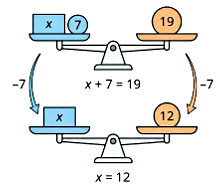
Figure 1
Equations can also be framed as games of balancing on a scale to understand what you do to one side of the scale need to be done on the other side too to maintain balance. (See figure 1)
Factorisation is an area that many students struggle with. The need for a quadratic expression to be converted to a product can be shown through tiles that need to be fully covered in a rectangular area. Factors of X^2 + 5x + 6 can be manipulated with tiles as shown below to obtain the answer as (x + 3)(x + 2). (See figure 2)

Figure 2
With such demonstration, symbols lose their mystical quality.
Embrace mistakes as stepping stones
Errors should be treated as valuable diagnostic data by the teachers where the students are able to dissect where a problem went wrong. Creating a supportive learning environment that normalises mistakes as learning opportunities helps reduce anxiety and encourages persistence.
Assessment should also be done to reward logical reasoning and correct algebraic procedures without giving too much weight to minor arithmetical errors. Formative assessments need to be conducted regularly as algebra is introduced, before the students become overwhelmed by the complexities of cumulative assessments.
Connect with real life applications
Many students fail to see how algebra connects to everyday life, making it harder for them to stay motivated. Wherever possible, teachers can demonstrate practical uses of algebra such as tracking expenses to find the balance remaining after expenditure, estimating travel time or fuel consumption, use of recipes dealing with proportion, tiling the floor of a room and finding measurements for a scaled model of a building. Showing how algebra helps in designing games or solving real-world problems enhances interest and comprehension.
Algebra may feel intimidating at first, but it is an opportunity for students to sharpen their reasoning, resilience and problem-solving skills. When the anxiety is eliminated, algebra reveals itself as an extremely useful and elegant toolkit for problem solving. Using appropriate teaching methods algebra can be transformed from an intimidating barrier into a powerful bridge to intellectual exercise. “An ounce of algebra is worth a ton of verbal argument.” said John Haldane.
(The writer is a senior mathematics examiner of the International Baccalaureate Organisation)
By Ifham Nizam
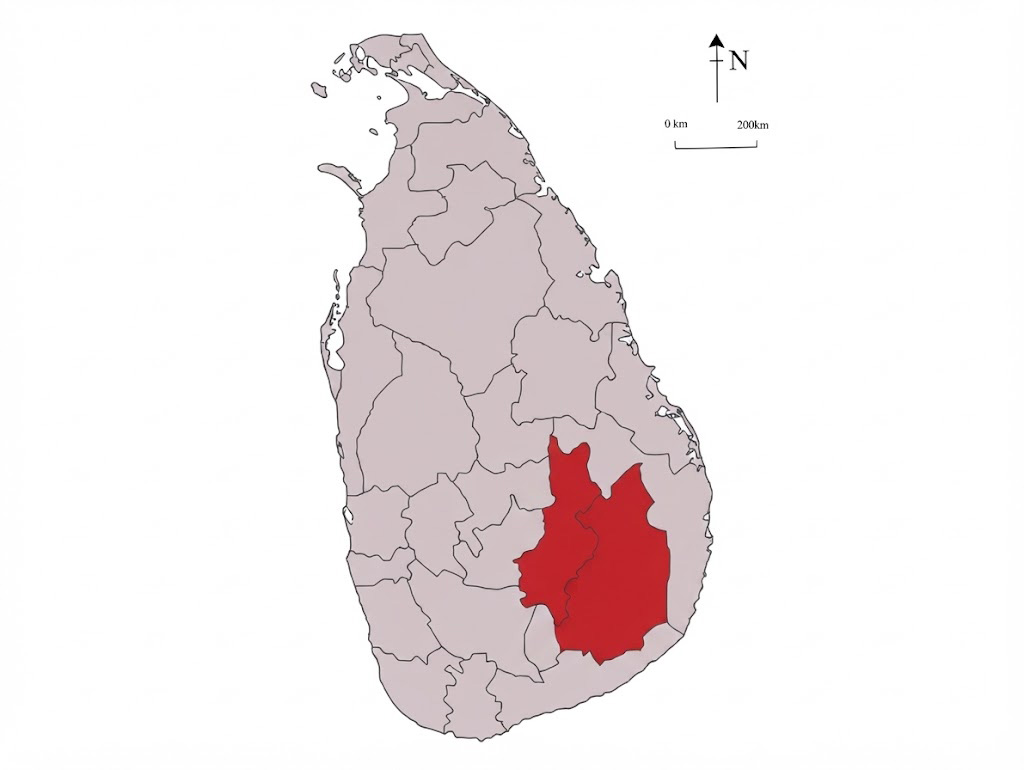
Two forest areas in the Badulla District — Mahiyanganaya Moopalana, covering 29.79 hectares, and Mahiyanganaya Heerussagala, covering 168.09 hectares — have been officially gazetted as forest reserves, bringing a combined 197.88 hectares of ecologically important land under formal protection.
The two forests, located in the Riddimaliyadda Divisional Secretariat Division within the Mahiyanganaya forest range, are dry-monsoon forests that provide habitats for a variety of native plant and animal species.
The declarations form part of the Government’s Vanaspathi forest conservation programme, under which 20 forests, covering a total of 9,538.68 hectares, across six districts, were granted protected status. The latest additions have taken the forest area, protected under the programme, to nearly 65,000 hectares, according to reports.
Environment Minister Dr. Dammika Patabendi and Deputy Minister Anton Jayakody were associated with the conservation programme.
Commenting on the significance of the declarations, Dr. Patabendi said the reserves are intended to deliver long-term environmental, ecological and social benefits.
“Through the declaration of these reserves, we aim to protect Sri Lanka’s biodiversity, safeguard water sources and watershed areas, create opportunities for eco-tourism, and preserve areas of archaeological importance found within these forests,” the Minister said.
Moopalana Forest
The 29.79-hectare Moopalana Forest is a dry-monsoon forest containing a range of natural resources and providing habitat for native species.
The forest is also linked to the livelihoods of surrounding rural communities. Local people obtain forest-based products such as rattan, veniwel and kitul, making the area significant, not only for biodiversity conservation, but also for traditional livelihood activities.
Several small waterways that become active during the rainy season are also found within the forest.
Heerussagala Forest
The larger 168.09-hectare Heerussagala Forest is likewise a dry-monsoon forest with important ecological resources and habitats for native flora and fauna.
The forest also has a direct connection with the local water system, with Nagadeepa Wewa being fed by the forest area.
Adding to its significance is the nearby Nagadeepa Temple, an area associated with archaeological value.
The protection of the forest, therefore, encompasses ecological, water-resource and cultural considerations.
The Ministry of Environment states that its broader approach to environmental management is based on sustainable natural-resource management, with government agencies, communities and other stakeholders participating in conservation efforts.
The gazetting of Moopalana and Heerussagala consequently places nearly 200 hectares of Badulla’s dry-monsoon forest under formal protection, strengthening the legal framework for conserving their biodiversity, water resources and associated cultural values.
The two forests are among 20 forest areas officially declared reserves in the latest phase of the Vanaspathi programme, which covers forests in Badulla, Anuradhapura, Ampara, Kegalle, Nuwara Eliya and Vavuniya.
For the communities surrounding these forests, their protection also represents the preservation of natural resources that support local livelihoods and water systems — while ensuring that these forest ecosystems remain part of Sri Lanka’s natural heritage for future generations, says Environment Ministry Consultant Dr. Ravindra Kariyawasam.

Rain threat looms over lopsided India vs Afghanistan quarter-final

Out, not-out, out: England secure bizarre run-out in Oval victory

Strait of Hormuz tensions linger as Iran and US move further from a deal

Showers will occur in the Western, Eastern, Uva and Sabaragamuwa provinces and in Galle, Matara, Kandy, Nuwara-Eliya, Polonnaruwa and Mullativu districts

Sajith rejects Jt. Opp. protest sabotage claim; SJB TU chief demands remedial action

Police remove Thileepan statue in Jaffna

‘Dates have the highest sugar content to fight Coronavirus’

Sunday Island 27 December – Headlines

#SundayIsland 17th December – Headlines

Sunday Island – 28th March

Sunday Island Headlines – 21 March

Sunday Island – 21st February – Headlines
-

 News5 days ago
Mastermind Naufer Moulavi among 15 found guilty
-
 News6 days ago
Protest against setting up of cement factory in highly populated area near BIA
-

 Midweek Review5 days ago
Thileepan’s fast unto death: An authentic narrative that many missed
-
 Latest News4 days ago
Showers above 100 mm are likely at some places in the Western, Sabaragamuwa, Central and North-western provinces and in Galle and Matara Districts
-

 Editorial6 days ago
Trouble beginning in earnest
-
Editorial5 days ago
Big Bad Bills
-
 News6 days ago
Police may seek clarification from US
-
 News6 days ago
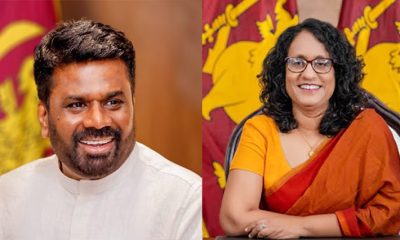
Govt. confident of 2/3 majority despite NPP split speculation