
Features
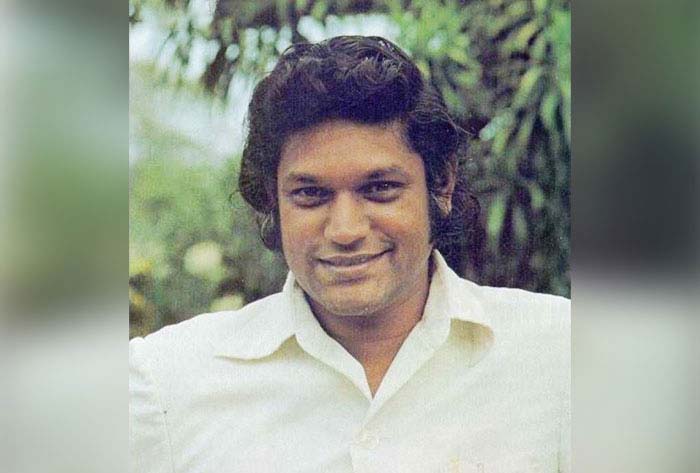
Upali Wijewardene – an enigma and a legend

by Ajith Samaranayake
Between Sri Lanka’s 35th independence anniversary and his birthday Upali Wijewardene boarded his executive Lear Jet at Kuala Lumpur and in a single fateful flash became solidified into an enigma and a legend. The flamboyant tycoon who had left with five others never arrived in Colombo. Somewhere over the Straits of Malacca the plane disappeared with not a clue or a trace.
The drama held the nation in its grip for months. Newspapers reported little else except the mystery of the disappearance. Speculation spread like a bush fire and as the days passed with no news the most fantastic cloak and dagger theories were spun. People gathered by the roadside to listen to the radio news bulletins and strangers become friends as they speculated about the fate of a man who was one of Sri Lanka’s most beloved sons.
Destined
For Philip Upali Wijewardene it was a strangely fitting apotheosis. It was as if his whole colourful career was destined for this final peak, this sudden and dramatic exit just as he was in the very centre of the public eye, a glorious accession to the heights of myth and legend.
For Upali’s life was of the kind which dreams are made of. Though born to one of the most distinguished families in Colombo and into a charmed circle which constituted Sri Lanka’s ruling elite, Upali had carved out a career in an area totally out of synch with that class. He did not take to law or medicine or pursue an academic career as the more favoured sons of this affluent, anglicised and genteel elite were wont to do. Neither did he take to politics.
On the contrary with nothing much except the most rudimentary capital and confidence in his own abilities he began a confectionery industry and business in a part of his ancestral home where such brushes with crude commerce had never before taken place. Down the years this fledgling business he was able to build and expand into a mighty conglomerate, Sri Lanka’s only multinational, until he acquired a worldwide reputation as Sri Lanka’s leading entrepreneur, an enterprising and shrewd businessman who could hold his own with the best of them in New York, London or Bonn.
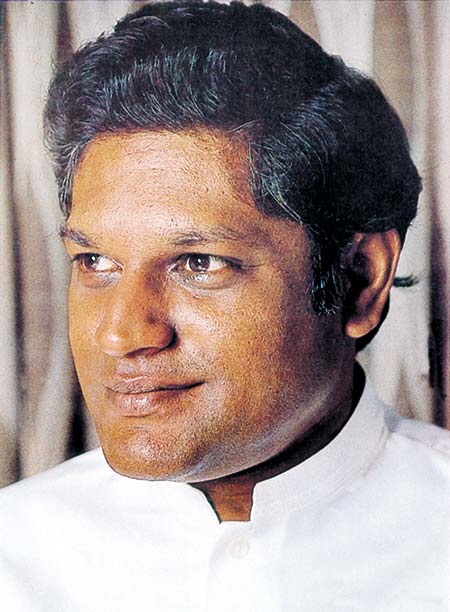
But by February 13, that fateful day which again confirmed the hold of superstition, Upali’s mind was not preoccupied with his businesses alone. For about two years politics had replaced business as his central passion. The man who had conquered the commanding heights of commerce now wanted to conquer the commanding heights of politics. And like everything else he did, he wanted to do it soon.
In 1981 he had founded The Island and the Divaina which had immediately become the eye of the political storm. Their vigorous reporting and comments which did not spare even some of the most powerful politicians of the ruling UNP came as a stirring antidote to the flabby, tame-cat Lake House press which was then dominating journalism.
Readers lapped up the new offerings avidly. Upali Wijewardene’s name was bandied about freely in Parliament. He made no secret of the fact that he wanted to enter Parliament and become finance minister which raised the hackles of the Finance Minister, the fiercely combative Mr. Ronnie de Mel. It became quite commonplace for the bespectacled and owlish Minister to hurl fearsome thunderbolts at the absent Upali in Parliament while we parliamentary reporters of The Island in the absence of our owner became surrogates for the ministerial fury and the embarrassed focus of the eyes of our colleagues in the crowded press gallery of the old Parliament by the sea.
Following year
The following year was to be one of the most crucial in Sri Lanka’s politics. President Jayewardene, Upali’s cousin and mentor, called an early Presidential Election, and in the absence of his normal rival Mrs. Sirima Bandaranaike, incapacitated by her loss of civic rights, easily beat former Minister Hector Kobbekoduwa fielded by an SLFP in tatters.
Then claiming that there was a Naxalite conspiracy to assassinate him if he had lost and claiming further that if General Elections were held on schedule a sizeable number of these horrendous Naxalites would enter Parliament he held a Referendum which the UNP won amidst widespread claims of thuggery, ballot-rigging, etc.
Anyway Upali was loyally by Jayewardene’s side during both campaigns, campaigning vigorously for the UNP at Kamburupitiya, his mother’s ancestral village, for which he had done much through his Ruhunu Udanaya programme for improving the conditions of villages in the South. The south he considered his heartland and it was from the South that he sought to enter Parliament for which there were vacancies even as he boarded his Lear Jet that day in the Malaysian capital.
Elections
For what had happened was that Jayewardene had asked for and received the resignations of 17 members of Parliament who had lost their electorates at the Referendum. Parliament had just been convened for the new session of the Second Jayewardene Presidency and the guns had boomed and the Jayamangala Gathas had been chanted. As that irrepressible Communist MP, the much lamented late Sarath Muttettuwegama quipped, “There was a 21-gun salute only the other day. And now 17 of you are gone.” Among the vacancies were Kamburupitiya and Devinuwara either of which Upali was planning to contest.
This was the backdrop to Upali’s destiny which during the next few weeks would hold the nation in its grip and virtually bring the country to a standstill. Among those on board with Upali in the plane which had left Malaysia’s Subang Airport at 8.41 p.m. on February 13 were Mr. Ananda Pelimuhandiram, the whiz kid Financial Director of the Upali Group and one of his most trusted lieutenants, a Malaysian lawyer Mr. S. M. Ratnam and Steward Mr. A. Senanayake. The jet was piloted by Capt. Noel Anandappa with Mr. Sidney de Zoysa as co-pilot.
They were to have reached Colombo by 9.45 p.m. that night but they did not come. Neither did they come the next day. By the morning of Monday February 14 Colombo was agog with the news. Soon it spread everywhere and the people paused in awe and wonderment as the enormity of the event sank into the public consciousness. Upali Wijewardene had mysteriously vanished with his three companions and two navigators leaving not a clue behind somewhere in that vast and empty night sky over Malaysia.
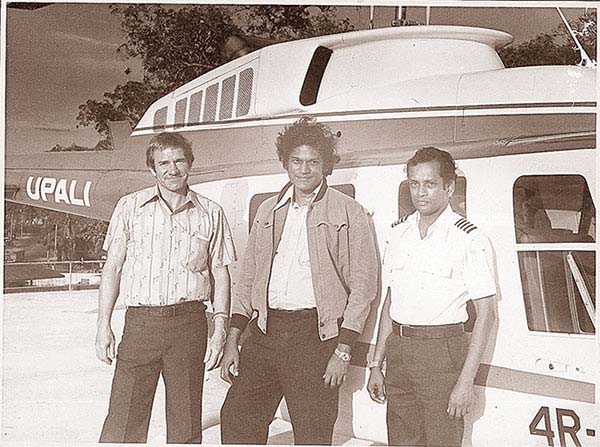
On Tuesday February 15 The Island, ‘Upali’s beloved flagship, broke the news soberly. Over a banner headline “Plane carrying Upali Wijewardene feared lost”. it told its readers that the jet had lost radio contact with the airport just 15 minutes after take off. The last message had said that the aircraft was at an altitude of 27,000 feet. Indonesia and Malaysia had launched a joint air and sea search operation but had failed to find any debris of an aircraft.
At The Island that Monday it was like something out of a novel by Kafka. We were in a daze. Was it possible that six people on board an aircraft in this miraculous age of technology could disappear without a trace? People huddled about the corridors talking, absorbing the news only slowly while the telephones rang incessantly as the other newspapers were getting in touch with us for the latest. But we could do little to shed light on the mystery. The most intensive search by several governments could not yield a single clue. These headlines from the papers which followed convey the flavour of those bizarre days.
February 16 —Air, sea search for Upali Wijewardene continues. Aussie plane may have seen missing jet
February 17— Three planes with sophisticated equipment comb the ocean. No results yet from seven-notion search
A flare and a weak signal but search proves negative. Search for missing plane in Andaman Island.
February 18 – Search for missing jet narrows to coastal area round Sumatra. Lear Jet reps suspect sabotage.
Wreckage
On the same day something happened which could well have been the tragic denouement of the whole drama but which was aborted at the last moment. On the afternoon of that Friday a Reuter report was received that the wreckage of the private jet and several bodies had been found off the Indonesian island of Sumatra.
I was in Fort at the time having taken a brief respite from the bleak house at Bloemendhal Road. With me at one of Fort’s many hospitable hostelries where we were drinking more than usual was Joe Segera, the Daymon Runyonesque Lake House story teller and chronicler of Canal Row and Chandra S. Perera, the always nattily-dressed NBC reporter and man about town.
Slowly the story spread through Canal Row, Hospital Street and Baillie Street and people reacted with shock and grief. More pints were drunk and our senses numbed somewhat by what we had taken Chandra who had known Upali in London and had common friends with him and I repaired to Bloemendhal Road.
There we were told by Editor Vijitha Yapa who had worked frenziedly during those days to bring out the paper in the midst of the tension that Reuter had denied the story within the hour. The next day The Island reported that it had been besieged with telephone calls following the story breaking. Reuters, Hong Kong had been contacted and The Island told ‘The story will be held back’, it reported.
And so the days passed. More headlines.
February 19 — Divers too join search near Sumatra. Another frustrating day of search
February 21 — Top Sri Lanka cops arrive in KL for investigation
Sabotage not ruled out
February 22 — Wheel found by fishermen did come from Lear Jet. Oil slick found near Kumana not from Lear Jet. February 23 —Minesweepers deployed in Indonesia today to find Jet Identification of Lear Jet wheel narrows search area. February 24 — If Lear Jet wheel was spare explosion may have occurred
February 25 —Fishermen cleared: Minesweeper move into find jet. There was no black box on missing Lear Jet. February 26 — PM answers questions on Upali
Unsolved
And so that unusually short month petered out sadly with the riddle unsolved. On the last day of February The Island headline was ‘Lalith thinks sabotage is likely cause of crash’. Under the by line of Lasantha Wickremetunge it said that the then Minister of Trade and Shipping Lalith Athulathmudali who had returned from Indonesia on February 26 as President Jayewardene’s special envoy had said that there were three possibilities for the disappearance of which the most likely was sabotage. Of the other possibilities, pilot error and a defect in the aircraft were most unlikely.
Mr. Athulathmudali also stressed that his investigations had shown that Mr. Wijewardene had no commercial enemies. In a box in the same story the paper reported ‘Temporary halt to search’ saying that since the area searched by the minesweeper had yielded no clues the search; was being abandoned and would resume if fresh evidence is uncovered. Only a single wheel — the right outbourne wheel — of the whole aircraft was found.
And so ended a drama which had electrified the country that cruel month of February and still continues to bemuse the people. What happened to Upali? is still the most popular question asked by friends and acquaintances from anybody connected with the Upali Group. Upali fascinated the people in life and now that he is no longer to be found, lost somewhere in the vast ethereal emptiness, he has become a legend and a cult which continues to enthral the people.
What would have happened if he had arrived in Colombo that February night with politics entering a fresh phase and plunged into what would have undoubtedly been a stormy political career will remain one of the most fascinating “Ifs”, of our contemporary political history.
Enigmatic fate
But what is clear is that the enigmatic fate of the man who built a commercial empire from nothing and captured a nation’s heart will always be looked upon with wonderment by them. Whether Upali could have stormed the commanding heights of politics by using the methods of advertising and self-promotion which he so successfully used in his business enterprises we will never know. Yet, like Icarus who flew but went too close to the sun so that his wings melted, the strange and fascinating destiny of Upali Wijewardene, Sri Lanka’s first tycoon who also chose the sun as his symbol, will always be a glorious legend of our times.
Newspaper
Looking back across ten more eventful years several memories crowd the mind. The memory which stands out most prominently is that of the collective effort to bring out the paper in the midst of the most terrible tension which could have pervaded any newspaper office. Editor Vijitha Yapa who was a loyal friend of Upali had to battle his feelings while he held the fort in the news room keeping in constant touch with the latest developments and answering the questions of local and foreign journalists.
For him and Deputy Editor and News Editor Gamini Weerakoon it was a trial of endurance which they magnificently stood up to. Looking at the paper to which thousands turned during that fateful month for news of its proprietor there is no sign of the almost unbearable tension with which we were working.
Upali Mahattaya
Several days on end we did not go home and the bleak reaches of the night were spent on the bare office tables with the late K. C. Kulasinghe as my companion. Or some nights would be spent in the grimy digs of D. B. S. Jeyaraj located quite close to the Premil Sports Club which was often the hub of our social life where the owner, the late Rajendra Mudalali, would approach us sombrely, always dressed in spotless white sarong and shirt and inquire ‘Any news of Upali Mahattaya?’ And in the morning the sun would rise over the splendid dome of St. Lucia’s Cathedral and we would search the vast sky for an answer.
(This article first appeared in a supplement to mark the 10th anniversary of the disappearance of Upali Wijewardene and party on Feb 13, 1993)











Sri Lanka needs a fairer and more transparent approach to renewable energy
by K R Pushparanjan
Sri Lanka has spent several decades encouraging private investment in renewable energy. Small hydropower was among the earliest successes of this policy while rooftop solar has more recently enabled thousands of ordinary households and businesses to become electricity producers. These developments have reduced the country’s dependence on imported fuel, mobilised private capital for electricity generation and contributed towards a cleaner and more diversified energy system.
It is therefore difficult to reconcile these objectives with reports that renewable generators are increasingly being required to curtail production during periods of low electricity demand, particularly on Sundays, Poya days and other holidays. The question is especially relevant to run-of-river mini-hydropower, where naturally available water may simply pass downstream when generation is stopped, and to rooftop solar, where abundant midday sunshine cannot be postponed until the evening peak.
There are, of course, legitimate technical reasons why the Ceylon Electricity Board (CEB), as system operator, may occasionally have to curtail renewable generation. An electricity system must maintain a continuous balance between generation and consumption. On Sundays and holidays, industrial and commercial demand can fall considerably while solar, hydro and wind generation remain available. Certain conventional generating units may sometimes have to remain connected to provide frequency control, voltage support, operating reserves and other services essential for grid stability. Transmission constraints can also make it impossible to substitute generation in one part of the country directly for generation elsewhere.
No responsible renewable-energy producer would suggest that grid security should be compromised merely to accept every available unit of renewable electricity. However, legitimate engineering considerations should not become a blanket explanation that places curtailment decisions beyond public scrutiny.
The CEB itself describes the economic principle underlying electricity dispatch as merit-order dispatch, under which lower-cost generation is normally utilised before progressively more expensive generation. Consequently, whenever inexpensive renewable electricity is deliberately curtailed while substantially more expensive oil-fired generation continues, electricity consumers and renewable producers are entitled to ask why. If a particular thermal generating unit must remain online for frequency stability, voltage support, network security or some other technical requirement, that can be explained. If transmission congestion requires renewable generation in a particular area to be reduced, that too can be demonstrated. Transparency should strengthen technically sound decisions, not threaten them.
Mini-hydro and an unequal contractual relationship
Run-of-river mini-hydropower deserves particular consideration. Unlike reservoir hydro, most such plants have limited ability to store water. When sufficient water is available, but the plant is instructed not to generate, that water may simply bypass the turbines and continue downstream. The opportunity to produce that electricity is then lost. No imported diesel, furnace oil or coal is required to allow that water to turn a turbine, and there is no corresponding fuel-related foreign-exchange expenditure.
Sri Lanka’s mini-hydropower industry was developed largely through private investment. The CEB currently records 219 commissioned mini-hydro projects with an aggregate capacity of approximately 430 MW and acknowledges the role of government policy in encouraging private-sector development of this indigenous renewable resource.
Yet, there has always been a fundamental imbalance in the commercial relationship between the small power producer and the national purchaser. Mini-hydro projects have historically sold their electricity through the Standardised Power Purchase Agreement (SPPA). The very nature of a standardised agreement substantially limits the individual developer’s negotiating position. Published material concerning Sri Lanka’s small-power-producer framework has described the SPPA as standardized and non-negotiable.
This is hardly a negotiation between parties of equal bargaining strength. A mini-hydro developer cannot realistically reject an unfavorable provision and offer the electricity to another national grid. For much of the industry’s history there has effectively been one purchaser, leaving the developer with little practical alternative but to accept the terms offered.
The weakness of that position becomes particularly evident when curtailment occurs. A PUCSL-commissioned study has recorded that under the original SPPA there was no penalty on the CEB for not purchasing energy. The developer may have invested the capital, borrowed the money, undertaken the construction and hydrological risks, maintained the machinery and had both water and generating equipment available, yet still carry the financial loss when electricity cannot be accepted for reasons originating within the national system.
If curtailment is genuinely necessary for grid security, the plant operator may have to accept the technical instruction. It does not logically follow, however, that the entire financial consequence should automatically be imposed upon the weaker contracting party.
Germany curtails renewables too – but differently
Germany provides a useful comparison precisely because it demonstrates that renewable curtailment is sometimes unavoidable even in an advanced electricity system. With very large quantities of wind and solar generation, Germany regularly experiences transmission congestion and occasions when all available renewable electricity cannot immediately be transported to consumers.
The important difference lies in how the problem is managed. Germany operates a regulated redispatch system. European electricity-market rules require redispatch to be undertaken according to objective, transparent and non-discriminatory criteria. Conventional generation, renewable generation and storage can all form part of the process, with interventions determined by what is required to relieve network constraints safely and economically.
Equally important is the recognition that curtailment has financial consequences. Germany’s Federal Network Agency explains that affected generators and storage operators have statutory entitlements to appropriate financial compensation within the redispatch framework. Depending upon the circumstances, relevant arrangements can take account of generation expenditure, lost revenue opportunities, readiness costs, maintenance implications and costs avoided because generation was reduced. The German framework also provides balancing mechanisms intended to address the commercial position of installations affected by redispatch, including renewable generators.
The principle is worth considering in Sri Lanka. When a privately financed generator is required to sacrifice otherwise available production for the security and benefit of the national electricity system, why should that cost automatically and entirely be borne by the generator?
Germany offers another lesson that may be even more important: transparency. Through the Federal Network Agency and its SMARD electricity-market information platform, information on congestion management, renewable curtailment and conventional redispatch is publicly available. Official German figures show that renewable curtailment amounted to approximately 3.5 percent of renewable generation in 2025, meaning that more than 96 percent of renewable electricity generated reached the system and consumers.
Sri Lanka cannot simply copy Germany. The two electricity systems differ enormously in size, resources, interconnections and market structure. What can be adopted, however, are the principles of transparency, non-discrimination, accountability and fair treatment of generators affected by decisions taken for the benefit of the wider system.
What generation remained online?
Whenever significant renewable curtailment occurs in Sri Lanka, sufficient information should therefore be made publicly available to answer some straightforward questions. How many megawatts were curtailed, for how many hours, and how many megawatt-hours of renewable electricity were consequently lost? Which thermal generating units remained operational during those hours? What fuel were they using and what was their approximate generation cost? Why was each of those units technically required to remain online? Was the curtailment caused by system-wide oversupply, a local transmission constraint, frequency considerations or some other identifiable requirement? These are not unreasonable questions. If the decisions are technically and economically sound, the answers should vindicate the system operator.
The issue assumes particular importance because Sri Lanka has historically spent enormous sums purchasing thermal electricity. An Auditor General’s special audit concerning ACE Power Embilipitiya reported expenditure of approximately Rs. 59.454 billion on electricity purchased from that plant between 2016 and 2021. The audit also drew attention to transmission-system problems and the consequences of permanent solutions not being implemented in a timely manner.
This does not establish that thermal generation is unnecessary or that private thermal producers have acted improperly. Nor should allegations of corruption be made against particular parties without evidence. Nevertheless, Sri Lanka’s long history of public concern regarding procurement, governance and major public expenditure makes transparency particularly important. Large thermal power contracts, fuel purchases and capacity arrangements involve substantial sums of money. The best protection against suspicion is not secrecy but disclosure.
If expensive thermal generation genuinely has to remain online while inexpensive renewable generation is curtailed, publish the technical reason. Publish the quantities. Publish the relevant costs. Allow engineers, economists, regulators, investors and electricity consumers to examine the decision for themselves.
Rooftop solar must not become the next casualty
The same argument now applies to rooftop solar. Sri Lanka successfully encouraged households and businesses to invest their own money in solar installations. Net Metering, Net Accounting and related arrangements helped transform consumers into small-scale electricity producers and contributed substantially to the growth of distributed renewable energy. PUCSL continues to recognise Net Metering, Net Accounting and Net Plus within Sri Lanka’s rooftop-solar framework.
The rapid expansion of rooftop solar undoubtedly creates genuine technical difficulties. Solar production is concentrated around daytime hours, while Sri Lanka’s major electricity demand peak occurs later. On a sunny Sunday or holiday, solar production can therefore be substantial precisely when commercial and industrial demand is low. Distribution networks designed for one-way electricity flows may also encounter voltage and hosting-capacity limitations as increasing quantities of electricity flow back from consumers towards the grid.
But it would be fundamentally unfair to encourage citizens to invest their savings in solar energy and subsequently treat their electricity as a problem simply because the national grid has not developed quickly enough to accommodate it.
Battery energy storage offers an important part of the eventual solution. A household battery can capture surplus solar energy around midday and release it during the evening, when both the household and the national system need electricity most. PUCSL has already recognized the value of combining rooftop solar with battery storage in its evolving regulatory arrangements.
However, domestic battery storage still represents a considerable additional investment for an ordinary household. Public policy should therefore be careful not to make battery ownership an economic prerequisite for participating in rooftop solar before such systems become reasonably affordable.
Until domestic battery storage becomes economically accessible to the average household, Net Metering and Net Accounting should be preserved, strengthened and made genuinely accessible. They provide a practical bridge between today’s rapidly growing distributed solar generation and tomorrow’s electricity system in which affordable batteries, utility-scale storage, pumped hydro and sophisticated demand management can shift much more renewable energy from periods of surplus to periods of high demand.
The national grid should, during this transition, continue to perform an important balancing function. Meanwhile, policy should encourage rather than compel household batteries through appropriate time-of-use tariffs and incentives. As battery prices decline, consumers will increasingly adopt them voluntarily because the economics make sense.
The grid must evolve with renewable energy
The longer-term answer is therefore not to choose between renewable energy and grid stability. Sri Lanka needs both.
Investment is required in battery storage, pumped-storage hydro, stronger transmission and distribution networks, better renewable forecasting, modern inverter technology, sophisticated system-control facilities and demand-response programmes. Electricity tariffs can also be designed to encourage industries, commercial establishments, water pumping, electric-vehicle charging and other flexible loads to consume more electricity during periods of abundant solar production.
The electricity system must gradually become capable of moving energy not merely geographically but also across time—storing electricity when nature provides more than consumers require and releasing it when demand rises.
This is also essential for maintaining investor confidence. Private investors make renewable-energy decisions according to expected annual generation, financing costs and anticipated revenue. If a developer can spend substantial capital constructing a renewable project only to face unpredictable curtailment outside his control and without adequate compensation or contractual recourse, the investment risk increases. Eventually that risk translates into higher financing costs, higher required returns and fewer projects.
A country cannot credibly invite private investors to finance renewable energy infrastructure while retaining an overwhelmingly one-sided contractual ability to discard their output and transfer the resulting financial loss back to them.
Transparency should not frighten the CEB
Nobody should expect the CEB to compromise national grid security merely to accommodate a mini-hydro plant or rooftop-solar producer. Where curtailment is technically unavoidable, it should occur.
But “system stability” should never become a phrase that ends the discussion.
Where synchronous generation must remain operating, explain why. Where transmission congestion requires renewable curtailment, identify the constraint. Where renewable producers sacrifice available generation for the benefit of the national system, develop a fair compensation mechanism. Where expensive thermal generation remains operational while naturally available water bypasses turbines, disclose why that was the technically necessary and economically preferable decision.
Germany demonstrates that renewable curtailment and renewable-energy development are not contradictory. Even sophisticated electricity systems sometimes have to discard renewable electricity. The difference is that a mature system attempts to minimize curtailment, operates under transparent rules, publishes relevant information and recognizes the financial consequences imposed upon generators.
Sri Lanka should aspire to the same principles.
We should not encourage private investors to build mini-hydropower plants and then place them against the wall through contracts over which they have little negotiating power. We should not encourage households to spend their savings installing solar panels and later make them bear the cost of deficiencies in the electricity network. And we should certainly not discard economically usable indigenous renewable energy without a convincing explanation while scarce foreign exchange is being spent importing fuel.
Sri Lanka should not spill usable water, reject available sunlight and then burn imported fuel to produce electricity that nature was prepared to provide without a fuel bill.
The issue is not whether every unit of renewable electricity can always be accepted. Clearly it cannot. The real test is whether every unit curtailed was genuinely necessary, whether the least-cost and least-wasteful solution was chosen, whether affected producers were treated fairly, and whether the public is permitted to see the evidence.
That is not an unreasonable demand from renewable-energy producers. It is the standard of transparency, accountability and economic discipline that Sri Lanka’s electricity consumers should expect from a modern national power system.

Tales of Mystery and Suspense 22
by Prof. Rajiva Wijesinha
I return now to J K Rowling of Harry Potter fame, writing under the pseudonym Robert Galbraith about Cormoran Strike. There are several books in this series of off-beat detective stories, featuring a private investigator who lost a leg while serving in the army, and his assistant Robin Ellacott, who had been raped when a student, with lasting psychological effects. Strike himself was the child of a rock band groupie, who had lived a sordid life, her last attachment being to a failed rock star of relatively aristocratic provenance and brutal habits.
Career of Evil is the third in the Strike series, and markedly different from the two books I read previously, the first and the fifth. Those were relatively speaking classic whodunnits, with a range of possible murderers, the solution in the end being quite unexpected but also convincing. The murderers in both cases are unhinged, but this does not become obvious until Strike has put two and two together and revealed a history of aberrant behaviour.
This novel has just a few suspects, all of them bizarre, as is made clear from the moment they are introduced. The case begins with Robin being sent a severed leg from a dead body, or rather it begins with the thoughts of the murderer who seeks revenge from Strike, which it seems he intends to achieve by first terrifying and then killing the woman he calls Strike’s Secretary. He also evinces a horrid desire to mutilate women after abusing them.
The first person Strike thinks of as a possible suspect is a member of a crime syndicate known to have sent body parts through the post, but Strike soon decides that he cannot be the perpetrator, in part because he is not likely to have known that Strike was responsible for his conviction earlier. Rather Strike is convinced it is one of three people who hate him, two of them individuals he helped to prosecute when he was in the investigating unit of the army, the third his step-father whom he suspected had killed his mother.
Unfortunately, Wardle, the policeman assigned to the case, who gets on well with Strike, is convinced it is the first person Strike had suggested, and does not seem interested in the rest, so Strike sets about trying to find out what they are up to.
They are not easy to trace, but Strike eventually tracks them down. He finds Laing’s mother in Scotland, although she is no longer able to provide any useful information. He then tracks down the mother of Laing’s first wife, Rona, whom Strike had found tied up and tortured. It was this incident that led to Laing’s conviction and imprisonment, and ultimately fuelled his hatred of Strike.
He finds the sister of the second suspect, Noel Brockbank, and learns that she and her brother were both abused as children by their stepfather. Brockbank later went on to abuse young girls himself. When Strike went to arrest him over the abuse of his stepdaughter, Brockbank attacked him with a broken bottle, and Strike knocked him out. Brockbank subsequently suffered seizures and was found to have a serious brain injury. Although Strike was initially blamed for the injury, it was later established that Brockbank had fractured his skull in a rugby match before the confrontation. Brockbank was therefore never convicted of the abuse allegations, while Strike was cleared of responsibility for his brain injury.
Strike’s third suspect is his former stepfather, Jeff Whittaker, whom he describes as unutterably filthy and abusive, yet strangely attractive to women. When Strike tracks him down, he finds Whittaker living with Stephanie, a woman who supports him with what she earns as a sex worker. Despite being abused by Whittaker, she remains devoted to him.
In his musings, the killer refers to the woman he lives with as “It”, suggesting that he could be Whittaker, who lives off Stephanie’s earnings. But when Robin is attacked by a man dressed differently from Whittaker, whom she had seen shortly before, it becomes clear that Whittaker is not the killer. Laing, the first of Strike’s three suspects, is also apparently ruled out when Robin sees him on crutches and learns that he is claiming disability benefits. Strike and Robin therefore concentrate on the third suspect, Noel Brockbank, whom they eventually trace to a home he shares with his girlfriend, Alyssa, and her two young daughters. Robin has seen the younger girl and becomes increasingly worried about what Brockbank might do to her. Although Strike has ordered her to leave Brockbank alone, Robin continues investigating because of her concern for the child. She eventually discovers that Brockbank has been sexually abusing the older of the two girls.
Meanwhile, Strike and Robin manage to identify the girl whose leg was sent to the agency. Among the bizarre letters Strike had received in the past was one from a young woman who fantasizes about having her healthy leg amputated and believed that Strike had deliberately had his own leg removed. Robin realises that the girl was suffering from a condition known as body integrity identity disorder, or BIID, in which a person has a persistent desire to have a healthy limb or other body part removed. Strike simply ignored the letter, unaware that the girl was suffering from a recognised condition and that her request was serious. The girl, Kelsey Platt, is subsequently found to have been murdered, and the police discover forged letters apparently written by Strike in response to her.
Wardle has his suspicions of the man married to the girl’s sister, with whom she had lived. Strike thinks this absurd, and it turns out that the man has an alibi for the time of the murder, but Strike does go along when the sister asks to see him and is overwhelmed by the sense of grief she and her husband evince.
The girl is evidently a godsend to the murderer, whose desire to remove body parts could not be controlled. He chops fingers off a girl he almost kills, and then removes the nose and ears of a girl he kills soon afterwards. And previously he had sent Robin the toe of the girl whose leg had been sent earlier.
All this horror can seem over the top, and one may wonder how Rowling could bring herself to wallow in such grim material. But perhaps she felt very strongly about the abuse women were subject to, and though her depiction of the way women played into the hands of abusive men seems excessive, she feels that awareness of that increases the need for support groups and other mechanisms to provide safety nets.
But there is also another side to the novel, namely the relationship between Strike and his partner Robin, which verges on the romantic though neither wishes to move on the matter. Strike feels diffident about taking advantage of his position as her employer, while Robin is engaged to a young man she has known for years, and whom she was virtually engaged to while at university. He has stood by her after the rape, when she could barely face society, and she finally decides to accept him and they are planning their wedding at the beginning of this book. But she finds that he is jealous of Strike, and hence his resentment of her commitment to her work, she breaks off the relationship when they are staying with her parents to finalize arrangements for the wedding.
But they still share a flat, and given the threat looming over her she cannot really move to live by herself. And gradually his misery wears her determination down, and she agrees again to marry him. The novel ends with their wedding, which Strike just manages to get to, causing her to beam, though she ‘had not once smiled in the entire service’.
But they still share a flat, and with the threat hanging over her, Robin cannot really move out and live by herself. Gradually, Matthew’s misery wears down her determination, and she agrees to marry him after all. The novel ends with their wedding. Strike arrives just in time, battered and bloodied after his confrontation with the killer. Robin has not smiled once during the ceremony, but when she sees Strike, she suddenly beams.
Before that, in the kerfuffle caused by Robin’s attempt to rescue the children of the woman Brockbank was living with, Strike sacks her. This turns out to be useful to him, because he subsequently enlists the children’s mother, Alyssa, to help trap the killer, whom he has by then identified as Donald Laing. With Shanker’s help, Strike arranges for Alyssa to pose as his new secretary and lure Laing into the open while he gains access to the flat Laing has been using as a hideout. There he discovers the evidence of the murders, including the severed body parts kept in a refrigerator.
This leads to a dramatic climax in which the murderer turns up. Strike has difficulty subduing him, partly because of his missing leg, but he is helped by Shanker, a man whom his mother, Leda, had taken in as a neglected and badly beaten boy and who has remained deeply grateful to the family. With the murderer captured and the case effectively wrapped up, Strike asks Shanker to drive him to Yorkshire, where Robin’s wedding is taking place. They arrive while the ceremony is still in progress, and Strike manages to get into the church just as Robin is making her vows. When she sees him, she beams and says “I do” while looking at him rather than at Matthew.
Clearly, this suggests that the relationship between Strike and Robin is far from settled. Indeed, as I discovered when I read the fifth book in the series, the story certainly does run and run.

by Dr Upul Wijayawardhana
It was with a great sense of sadness that I received the news about the death of Ananda Ganegoda at the age of 80 years; the last of the famous industrialist Ganegoda brothers to depart. Ananada was a businessman par excellence but he ought to be remembered specially for his outstanding contribution to popularising Sinhala music by founding the music label Singlanka in 1980. Unfortunately, I lost touch with him, having seen him only once since I left Sri Lanka in May 1988. As I mentioned in my article on statins (Cholesterol lowering statins: Scope for use widens – The Island; 18 September) I have met some remarkable people in my practice of medicine and Ananda was certainly one of them.
The Ganegoda brothers were actually two sets of first cousins though they worked as a single family. Nandajeewa, Sumanalatha, Wimalajeeva, Karunajeewa and Ratnajeeva were the children of Jineris Ganegoda whilst Chandrasiri, Jinadri and Ananda were the children of Jineris’ younger brother Johanis. Sadly, it seems to have been forgotten by many that the Ganegoda brothers were instrumental in changing our export economy by starting garment factories in 1954, one of the first groups of non-traditional exports. According to a family post on Facebook, the visionary leader was Wimalajeewa, who started Noortex, Mayura, GIL and Eurolanka garment factories. Others followed suit and they presided over a vast business empire.
My first contact was not with Ananda but Karunajeeva, if my memory serves me right. After a consultation and a friendly chat, he invited me to a factory visit, which I readily agreed to. He took me to one of the factories in Ratmalana and I was very pleasantly surprised with the high standards maintained in the factory including workers’ welfare. I was able to taste the delicious food served to the workers. The icing on the cake was his measuring me out for shirts and trousers which I wore for a very long time!
Maybe around late 1983 or early ‘84, Ananda ‘channelled’ me for a consultation in the Central Hospital for chest pain and was accompanied by his wife, Nandani. I noted that, in addition to the cigarette smell, he had heavy nicotine staining of fingers. After having ensured that his pain was not cardiac, I tore into him stating, “What is wrong with you? You are among the Sri Lankan businessman doing well and you seem determined to commit suicide with chain smoking,” Then I started wondering whether I had been too blunt, but Ananda said “Dr, Thank you very much. I will stop smoking” and his calm response took me by surprise. On a subsequent social occasion, Nandani whispered in my ear that he had an occasional ‘secret smoke’ and when I encountered, Ananda said “Dr, hari amarui” but promised he would give up completely. I do not know whether he did so but the significant reduction of consumption, hopefully, contributed to his longevity.
I met him last in 1995, in the role of a peacemaker when he was in open conflict with a close relative of mine. I pleaded with him to stop the battle, pointing out that one of his nieces was being courted by the son of my relative. Though shocked, he promised to make peace.
Ananda’s crowning achievement was the founding of Singlanka which made Sinhala songs accessible to the masses. Those of us, old enough to remember, know how difficult it was to listen to music. As a child, I had to go to the village Community Centre to listen to the radio, which is in utter contrast to what is happening today. With just a click on the smartphone anyone can listen to music of any choice, anytime, anywhere as long as you are connected to the internet! Recording with the ability to playback, started with the Phonograph invented by Thomas Edison in 1877, Vinyl records being available from the early twentieth century. They came in various speeds and sizes but needed cumbersome players.
The real breakthrough came in 1963, when the Dutch company Philips introduced the Compact Cassette with more convenient players. Singlanka gave everyone the opportunity to listen to their favourite artists on Compact Cassettes. When the Compact Disc format, developed jointly by Philips and Sony, released in 1983, gathered momentum, Singlanka too moved to this format but most of us are still in possession of Singlanka cassettes. I still occasionally listen to Nanda Malini’s “Pavana”, which has become relevant because of the recent death of Nanda Malini and the ascent of JVP to power, but that is another story.
Most of our famous singers, including the greats like Amaradeva and Nanda Malini, owe at least a significant part of their fame and fortune to Singlanka, which was Ananda’s brainchild. Looking at the discography of Singlanka is like looking at a list of all favourite singers. In addition, Ananda gave the opportunity to the less known in the field of music also to showcase their talent, the best example being Carlo Fonseka’s Calochita Gee, which was a compilation of songs sung by various artists to the lyrics and melodies of Carlo. Who would have imagined multi-talented Carlo having musical creativity as well!
As for me, one event illustrated his generosity and his sense of gratitude. When Dr N J Wallooppillai retired, and I succeeded him as Cardiologist, I arranged for an international conference “Cardiology Update”, which was held on 6th and 7th of June 1985 at Galadari Meridien Hotel, culminating in a banquet. When I rang Ananda about this, he immediately offered to sponsor music for the evening and arranged for Patrick Denipitiya Combo to play and Ivor Dennis, Indrani and Sisira Senaratna to sing. It was a memorable evening, with plaudits from attendees, though we did not have an opportunity to rehearse. I compeered and we selected the songs as we went on. When Indrani wanted to sing Gaya Geethayan I had to stop as it was a Hindi tune and Indians were in the audience! My wife Primrose joined Ivor Dennis to duet “Olu Pipila Wela Lela Denawa”. We ended the banquet with Ivor Dennis singing, and the audience joining, the patriotic song Dakuna, Negenahira, Batahira, Uturada, Eka Kodiye Sevene thanks to Ananda. I am eternally grateful to him.
May Ananda attain the Supreme Bliss of Nibbana!

Showers or thundershowers will occur in most parts of the island after 1.00 p.m.

Unions resist tripartite EPF management plan

Two arrest warrants issued for Gnanasara thera

CA dismisses GR’s writ petition against arrest

ADB-backed virtual net metering project faces policy contradiction

Media action group flays NPP over new anti-terrorism law

‘Dates have the highest sugar content to fight Coronavirus’

Sunday Island 27 December – Headlines

#SundayIsland 17th December – Headlines

Sunday Island – 28th March

Sunday Island Headlines – 21 March

Sunday Island – 21st February – Headlines
-

 Editorial6 days ago
Birth of a bad law
-

 News4 days ago
Police remove Thileepan statue in Jaffna
-

 News6 days ago
TIN mandatory for key transactions from Nov. 1
-

 Features4 days ago
The 22nd Amendment, constitutional recovery and illiberal slippage
-

 Features4 days ago
Of foreigners as CEOs of Lankan ventures
-

 News4 days ago
Sajith rejects Jt. Opp. protest sabotage claim; SJB TU chief demands remedial action
-

 Latest News2 days ago
Gold winner Tharanga gets brand-new Honda Vezel from SLAAJ
-

 Features3 days ago
Thailand’s biggest new global star …