
Features
UNESCO and ‘Trilingual inscription’


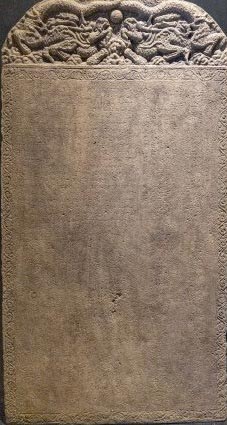
UNESCO has accepted for its Memory of the World Register 2025, the “Trilingual inscription” found in Sri Lanka. The tablet containing the inscription was brought to Sri Lanka from China by Chinese Admiral Cheng Ho [also Zheng He]. The item was therefore submitted to UNESCO jointly by Sri Lanka and China.
UNESCO described the Trilingual Inscription as a stone tablet with Chinese, Persian and Tamil inscriptions, praising the Buddha, Vishnu and Allah.[1] It is the only trilingual inscription having texts in Chinese, Tamil and Persian, UNESCO has said.
UNESCO has uncritically parroted the popular account attached to this tablet, regardless of the fact that it is partially incorrect. This shows that UNESCO has not done any independent examination of this trilingual tablet; neither, it appears, has China.
UNESCO’s recognition of this trilingual tablet has aroused fresh interest in the artefact. This tablet is seen as a unique one specially prepared for Sri Lanka. Observers want to know, therefore, why did the tablet not contain a statement in Sinhala if it was intended for Sri Lanka.
“Can someone enlighten me on why the Sinhala language was not used in this plaque?” This question was asked by retired Navy Admiral Ravindra C Wijegunaratne, when the UNESCO recognition was announced.[2]
From 1405 to 1433 Chinese admiral Cheng Ho directed seven ocean expeditions for the Ming emperor Zhu Di. They are considered to be unmatched in world history. The first expedition was to Champa (central Vietnam), Siam (Thailand), Java to Cochin and the kingdom of Calicut in Kerala. The second expedition (1407-1409) took 68 ships to the court of Calicut to attend the inauguration of a new king.
The third voyage (1409-1411) with 48 large ships and 30,000 troops, visited many of the same places as on the first voyage but also went to Malacca. The fourth voyage (1413-15) in addition to visiting many of the earlier sites, Zheng Ho went onto Hormuz on the Persian Gulf. The fifth voyage (1417-1419) went to Aden, and then on to the east coast of Africa, stopping at the city states of Mogadishu and Brawa (in today’s Somalia), and Malindi (in present day Kenya).
In the sixth expedition (1421-1422) 41 ships sailed to many of the previously visited Southeast Asian and Indian courts and stopped in the Persian Gulf, the Red Sea, and the coast of Africa; the fleet was then sent on to pursue several separate itineraries, with some ships going perhaps as far south as Sofala in present-day Mozambique.
The seventh and final voyage (1431-33) had more than one hundred large ships and over 27,000 men, and it visited all the important ports in the South China Sea and Indian Ocean as well as Aden and Hormuz. One auxiliary voyage travelled up the Red Sea to Jidda, only a few hundred miles from the holy cities of Mecca and Medina.
Records show that on this journey, the ships left for Sri Lanka from Banda Aceh, in Indonesia, reached Sri Lanka on October 10, 1432 and arrived at Calicut in Kerala on December 10.
Zheng He’s voyages would have required many independent fleets to be simultaneously at sea, said one analyst. Dates for outbound and returning voyages make it clear that different fleets departed and returned under different commanders, often years apart. [3] Chinese records indicate that more than 2,700 ships were built during this time.
The distances travelled and places reached in these seven voyages are not disputed. Historians agree that Zheng sailed the Indian Ocean as far as East Africa and the Red Sea.[4] They also agree that China had the capacity to undertake such voyages.

Admiral Cheng Ho
The Chinese fleet visited Sri Lanka on the first voyage and probably on all subsequent voyages too, as Sri Lanka was a useful port of call. On the third voyage, Zheng Ho brought a tablet to be erected in Sri Lanka. The tablet was prepared in Nanking, dated 15th February 1409. It was set up in Galle in 1411.
The slab says, “We (i.e. China) have dispatched missions to announce our mandates to foreign nations”. It spoke of the Buddhist temples in the mountainous isle of Sri Lanka, and listed the generous gifts the group had made to a Buddhist temple in the mountain of Ceylon, presumably Sri Pada. This inscription appears to be intended for Sri Lanka alone.
The other two inscriptions in the Trilingual slab made similar statements. One gave praise to Allah and the other praised the god Tenavarai-Nayanar. To each god the Chinese offered similar lavish tributes. However, there is no definitive translation of the full text, and it is not possible to say anything more about the text.
The local researchers easily identified two of the three scripts as Chinese and Persian. The choice of Persian for Islam probably indicates that Persian would have been the common language in Islamic countries at the time.
Paranavitana thought the third script was Tamil. However, Tamil historians in Sri Lanka had great difficulty in reading this so-called Tamil inscription. ‘This inscription is of a unique kind. There is no similar record in the whole range of Tamil inscriptions,’ they said. The language and orthography show characteristics which are not found in any other Tamil inscription. The word ‘Manittar’ found in the inscription is not found in Tamil, they added. (Tamil inscriptions in the Colombo National Museum p 53, 56)
Gavin Menzies in his book “1421: The Year China Discovered the World”, gives the third language in the inscription as Malayalam, the language of Kerala. It appears that the Galle tablet is not the only one with Malayalam. Menzies says Matadi Falls inscription was also in Malayalam. Presumably, the two slabs in Kerala were in Malayalam too, and that makes a total of four slab inscriptions using Malayalam. (Menzies p 120, 134-136).
Menzies views on the Cheng Ho voyages have been heavily disputed, but as far as I know, the identification of Malayalam as the third language in the stele (slab) has not been contested.
The choice of Malayalam for the Hindu inscription suggests that the one location Cheng Ho visited regularly in the Indian peninsula was Kerala, the other Indian stops would have been brief ones. Cheng Ho’s voyages included regular visits to Kerala. It was the next stop after Galle.
The first and second voyages ended at Kerala. The second voyage was to attend a coronation there. The sixth expedition saw three units of the fleet go to Kerala and separate at Kerala. The Chinese fleet probably touched Kerala during the other three visits too.
Gavin Menzies, in his book “1421: The Year China Discovered the World”, suggests that the Galle slab inscription is one of a series of trilingual slabs prepared in China, and deposited in various foreign ports visited by the Chinese fleet of Cheng He. Similar tablets have been found elsewhere.
Slab inscription
Menzies says that slab inscriptions were found in Cochin and Calicut in Kerala, at Ribeira de Janela in Cape Verde and Matadi Falls in Congo. The Janela one is rejected by critics. There is no such tablet at Janela, they have said. The other inscriptions were not rejected but critics point out that Menzies has not supported his statement with photos of the other tablets.[5]
The argument that the Galle Trilingual tablet proves that Sri Lanka had three religions which ranked equally, cannot be accepted. It is also difficult to believe that China specifically sent to Sri Lanka a tablet written in Persian and Malayalam.
One possible explanation is that these tablets were designed to suit several countries in one go. Three inscriptions in three languages for three religions all carved on one tablet ensured that each country would find an inscription that would suit them. This eliminated the need to carve different tablets for different countries, also the problem of getting the right ship into the right port to deliver the right tablet to the right country.
Sri Lanka ‘s Trilingual slab was discovered in 1911 by the British engineer H.F. Tomalin, who was told of a carved stone covering a culvert near Cripps Road in Galle. There is no record of any other inscription in Sri Lanka getting tossed about in this manner. This shows that the Sinhala king was not interested in this tablet, otherwise it would have been carefully preserved.
One possible reason for this indifference is that Cheng Ho meddled in the internal politics of the host country. On his first voyage, he put down a pirate uprising in Sumatra, bringing the pirate chief, an overseas Chinese, back to Nanjing for punishment. On his third visit he clashed with the authorities in Sri Lanka and took some people to China. They were treated well and were returned to Sri Lanka.
Amateur historians have woven a story around this event. But professional historians, such as W. I Siriweera have told me that the available information is insufficient to form any opinion about the event. It is agreed, however, that the Sinhala king was not captured and taken to China and that Sri Lanka did not pay tribute to China. There is no evidence of either.
It is argued that Cheng Ho’s visits to Sri Lanka were a great honour for Sri Lanka. That is the attitude displayed in the museum in Galle Fort when I visited some years ago. There was a huge picture of Cheng Ho and an emphasis on every possible foreign ruler and visitor who had come to Galle, little or nothing on indigenous culture.
Cheng Ho was engaged in ocean exploration and was using Sri Lanka as a stopover. Sri Lanka was a much-patronised port of call for foreign ships. In addition to its strategic location, it had bays and harbours that could accommodate visiting ship and foreign ships had been making use of this facility for centuries.
Sri Lanka ports were more than a mere stopover. Sri Lanka provided ship repair services as well. Sri Lanka coir rope was much valued for ships. Sri Lanka would have provided good service to Cheng Ho, and that may be why Sri Lanka was gifted one of the trilingual tablets with special reference to its Buddhist temples.
It has been claimed that ‘Tamil inscription’ in the Trilingual slab, (which, local Tamil scholars have said, is not Tamil) shows the importance of the Tamil language in international relations and international trade.
Nirmala Chandrahasan says, “We have seen from the Galle Inscription that China gave the Tamil language pride of place in Sri Lanka at a certain point of time, and similar inscriptions have also been left by them in other south Asian countries. We learn that the Tamil community in Sri Lanka was a powerful and respected one, hence the inscriptions in Mandarin along with Tamil and Persian. She adds that at that time Tamil was a language of commerce and trade in the Indian Ocean region. Tamil Buddhist monks from Kancheepuram brought Buddhism to China. [6]
This is incorrect. Buddhism would have gone to China directly from North India via the land route, not from Kancheepuram in faraway south India. Tamil Nadu was never a strong, Buddhist state. In the 7th century the Bhakthi school of Hinduism replaced Buddhism in Tamil Nadu.
Tamil merchants could not have led international trade, as Nirmala says, because the Tamil kingdom was not even on the international trade route, to start with. The main East-west international trade route went along the north-west and south-west of the Indian peninsula. Tamil Nadu is in the south-east, far away from the international trade route. It lost its proximity to the east-west trade route when Kerala broke away and became independent.
Further, the Tamil kingdom had lost its sovereignty before the Cheng Ho voyages even started. The Tamil kingdom was conquered by the Vijayanagara kingdom of Karnataka in 1378. The kingdom was thereafter administered in Telugu. The Tamil language was suppressed. Therefore, the Tamil language could not have been a language of commerce and trade in the Indian Ocean region in the time of Cheng He.
Tamil language lost vitality thereafter and did not recover for a long time. The following account bears this out. In 1816, Rasmus Rask left Denmark to collect Asian manuscripts for the University of Copenhagen library. Rask returned to Copenhagen in May 1823, bringing manuscripts in Persian, Middle Persian (Zend), Pali and Sinhala languages. He had travelled through Madras and Jaffna, to get to Colombo, but showed no interest in acquiring Tamil manuscripts. (Concluded)
[1] https://www.unesco.org/en/memory-world/register2025
[2] https://island.lk/why-sinhala-omitted-in-famous-stone-inscription-by-ancient-chinese-admiral/
[3]https://archive.org/stream/1434theyearamagnificentchinesefleetsailedtoitalyandignitedtherenaissancebymenziesgavin/.
[4]https://www.historynewsnetwork.org/article/is-gavin-menzies-right-or-wrong
[5]https://nabataea.net/explore/travel_and_trade/book-review-1421-the-year-china-discovered-the-world/
[6] https://www.lankaweb.com/news/items/2021/06/13/chinese-admiral-zheng-he-and-the-tamils-of-sri-lanka/
BY KAMALIKA PIERIS

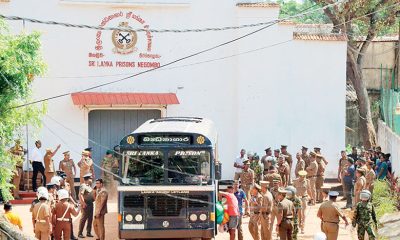
The prison violence in Negombo has become the first major crisis to confront the government since it came to power. The government may or may not be responsible for creating the conditions that have accumulated over decades and made the prison system a powder keg. The fact is the government’s Ratama Ekata anti-drug crackdown boosted the countrywide prison population from 28,000, in late 2024, to 41,000, in 2026. The conditions of imprisonment include chronic overcrowding, poor infrastructure, inadequate staffing, the penetration of organised crime and drug networks into prisons, and the long neglect of prison reform by successive governments. The Negombo Prison was housing approximately 2,600 inmates at the time of the clashes although it was built for only about 650. By the time order was restored, 29 people, including seven prison officers, had lost their lives and more than 100 others had been injured.
Justice Minister Harshana Nanayakkara accepted responsibility before Parliament, visited the Prison and announced immediate measures, including legislative changes to facilitate bail and alternatives to remanding prisoners. The NPP government needs to accept responsibility for its failure to anticipate the danger, to respond with sufficient speed and competence once the problem had erupted. A dangerous situation can be observed countrywide with more than 42,000 prisoners being held in prisons designed to accommodate about 10,000 inmates. The magnitude of the Negombo Prison tragedy needs to be understood not merely as an isolated incident but as a warning that the government cannot postpone structural reforms indefinitely. A government elected on the promise of changing the system cannot justify repeating the failures of its predecessors on the basis that it is sincere and uncorrupt unlike them.
The failure to move beyond promises has become evident in several other sectors as well. Farmers continue to agitate over unresolved problems. Plantation workers continue to seek meaningful integration into national life. Many of them, who were victims of Cyclone Ditwah, continue to live in miserable conditions due to the government’s slowness in dealing with their problems of their lack of ownership of lands and homes. The Mylathamadu cattle farmers of Batticaloa have issues once again even after two presidents, President Ranil Wickremesinghe and now President Anura Kumara Dissanayake ordered evacuation of intruders in terms of court orders. But the local police and the Mahaweli Authority officials seem slow to take any actions, even to the extent of not complying with judicial decisions. Victims of past human rights violations and thousands of families of missing persons are still waiting for justice. The promised repeal of the Prevention of Terrorism Act has yet to materialise. Prison reform has now joined this growing list of deferred commitments.
NPP Pledges
The National People’s Power election manifesto promised not merely honest government but systemic transformation. Under the section dealing with prisons, it pledged to restructure the prison system, reduce overcrowding, expand open prison facilities, strengthen rehabilitation through education, vocational training and psychological support, establish a formal parole system and transform prisons from places of punishment into centres of rehabilitation and reintegration. Those promises reflected international best practice and recognised that a humane prison system is essential to a democratic society. Yet nearly two years into its term little visible progress has been made in implementing these reforms.
Sri Lanka has witnessed different types of prison violence. Some have erupted spontaneously because of intolerable prison conditions, overcrowding and frustration. Others have occurred under circumstances that raised alarming questions about state complicity. The massacre of 53 Tamil political prisoners inside Welikada Prison during the anti-Tamil violence of July 1983 remains one of the darkest chapters in the country’s history. Those prisoners were not protected despite being under state custody. The Mahara Prison violence of November 2020, in which 11 inmates were killed after protests over Covid conditions, similarly generated serious allegations regarding the targeted use of weapons and led to widespread calls for an independent investigation.
Following the deadly violence at Mahara Prison during the Covid pandemic, then Opposition party leader Anura Kumara Dissanayake declared in Parliament that “those who are remanded and imprisoned are under the custody of the state. Therefore, the primary responsibility for the safety of the lives of the prisoners and detainees who are in state custody lies with the government.” He further said that “it is entirely unacceptable in a democratic nation that upholds human rights for prisoners, who are under the protection of the state, to be gunned down while in government custody.” But in the Negombo tragedy once again the state, with President Dissanayake at the helm, was unable to protect the inmates though there is no evidence that the government orchestrated the violence. Being in power for two years there is a rightful expectation that it could have taken better preventive action.
Urgency Needed
There are two special conditions, however, that make the Negombo Prison tragedy a possible turning point rather than merely another episode in Sri Lanka’s long history of prison violence. The first is that until these events the country had enjoyed an extended period without major organised political or communal violence. This improvement was recognised internationally when Sri Lanka rose 30 places in the 2025 Global Peace Index to rank 67 among 163 countries. The Index measures countries on three broad indicators, namely the level of societal safety and security, the extent of ongoing domestic and international conflict, and the degree of militarisation. The improvement reflects the country’s recovery from the years of political upheaval and economic collapse and suggests that Sri Lanka is moving towards a more peaceful future.
The second distinguishing feature is that the present government has no known links to organised crime or the underworld that has so often been associated with sections of the political establishment in the past. This is one of its greatest strengths. President Anura Kumara Dissanayake has spoken publicly about the nexus between organised crime, drug trafficking, money laundering and politics, and has challenged political parties to take action against members who maintain links with criminal networks. That willingness to confront organised crime gives the government a credibility that previous governments lacked. But integrity by itself is not enough. Honest intentions must be matched by administrative competence and political will. A government that seeks to change the system must demonstrate that it can reform and manage the institutions of the state more effectively than those who came before it. The Negombo tragedy suggests that this remains a major challenge.
The government’s greatest asset remains the trust that the public has placed in its sincerity. Unlike many previous governments, it is not burdened by allegations of protecting organised crime or profiting from corruption. That gives it a unique opportunity to undertake reforms that others could not credibly pursue. But it must not rest on its laurels in the belief it is superior to the rest. The Negombo Prison tragedy should become the catalyst for implementing the wider programme of reform promised in the election manifesto. Prison reform cannot be viewed in isolation. It is part of the broader commitment to change the system, strengthen public institutions and ensure that the state serves the people with competence as well as integrity. The reforms promised to rice farmers, cattle herders, plantation communities, victims of past human rights violations and all those who looked to the government for a new beginning deserve the same sense of urgency. Other priorities cannot justify postponing the structural changes that the NPP promised and the country has waited for decades.
by Jehan Perera
Features
Chandi: The one-tusked rebel who defied captivity and became a symbol of Sri Lanka’s wild spirit

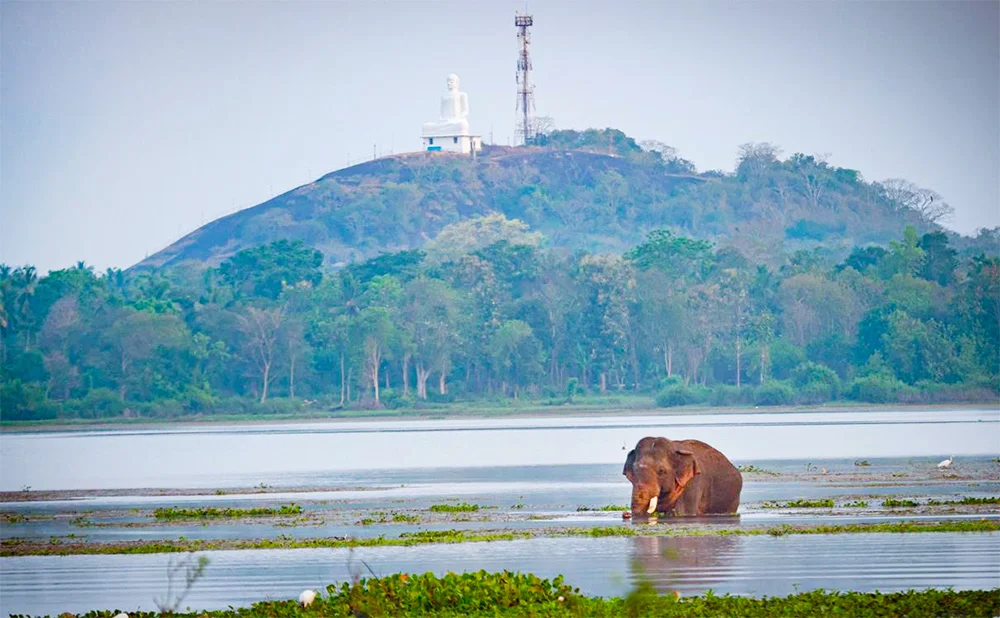
The story of Chandi (T081), the legendary one-tusked elephant of Galgamuwa, is not merely the tale of a wild tusker. It is the remarkable chronicle of an animal whose lifelong struggle for freedom challenged conventional wildlife management, captivated conservationists and villagers alike, and ultimately became one of the most inspiring chapters in Sri Lanka’s wildlife history.
Known affectionately as “Chandi”—a Sinhala name signifying courage, toughness and fearlessness—the iconic tusker earned his place among the country’s most celebrated wild elephants through sheer determination rather than physical grandeur. Born with only one tusk, he repeatedly demonstrated that true strength lies not in appearance but in resilience.
Wildlife photographer and conservationist Chandika Lakmal, founder of Wild Tuskers of Sri Lanka, believes Chandi’s life offers valuable lessons for wildlife conservation and the management of human-elephant conflict.
“Chandi was much more than an elephant.
He became the embodiment of freedom. Every chapter of his life reflected an extraordinary determination to return to the forests where he was born. He showed us that elephants possess deep memories and emotional connections to their homeland that cannot simply be erased through translocation.”
Lakmal said Chandi’s story deserves to be preserved not only as wildlife history but also as a reminder that conservation strategies must be guided by science and compassion.
Unlike most Sri Lankan tuskers, Chandi possessed only his right tusk after being born without the other. Yet that single tusk became an extraordinary tool in his battle against electric fences and other barriers erected across his traditional range.
For decades, Chandi roamed the forests and agricultural landscapes surrounding Galgamuwa, including Mudiyannegama, Ehatuwewa, Kaduru Wewa and Siyambalangamuwa. As cultivation expanded and natural habitats became increasingly fragmented, his encounters with people became more frequent.
Authorities first captured him around 2009 and transported him nearly 200 kilometres away to the Somawathiya National Park in an attempt to reduce conflict between villagers and wildlife.
Many believed the relocation marked the end of Chandi’s association with Galgamuwa.
They were mistaken.
Displaying one of the most extraordinary examples of elephant navigation recorded in Sri Lanka, Chandi travelled through unfamiliar forests and settlements before eventually finding his way back to his birthplace.
“His return astonished everyone,” Lakmal recalled. “Very few animals could accomplish such a journey. Chandi demonstrated the incredible navigational abilities of elephants and their unwavering attachment to familiar landscapes.”
Years later, renewed crop-raiding incidents resulted in another decision to remove him from his home.
This time, he was sent to the Horowpathana Elephant Holding Ground, where elephants considered troublesome are kept under confinement.
For many wildlife observers, Horowpathana represented a final destination.
Numerous elephants transferred there had struggled to adapt to restricted movement and limited access to natural feeding grounds.
Few expected Chandi ever to return.
Yet the fearless tusker once again surprised the nation.
He escaped.
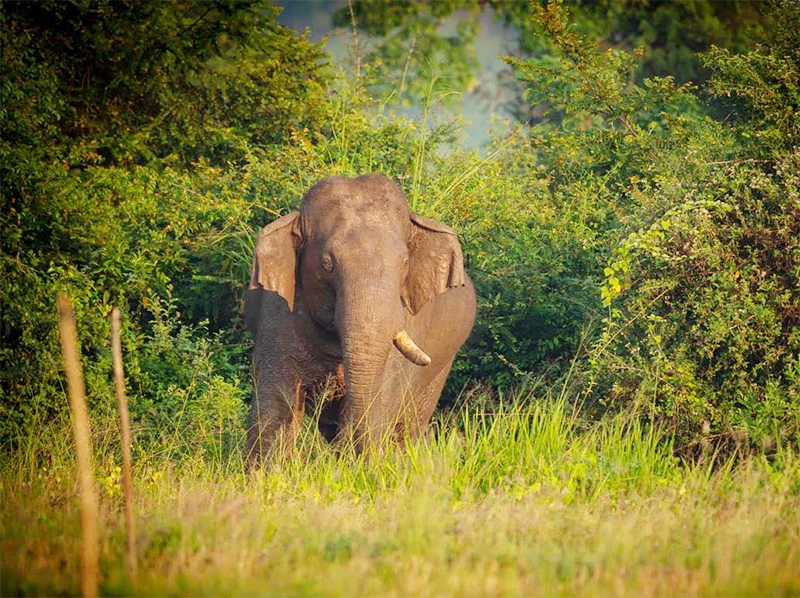
Breaking through barriers that were believed to be secure, Chandi returned to Galgamuwa, reclaiming the forests that had shaped his life.
His remarkable escape became one of the most talked-about wildlife stories in Sri Lanka.
As Chandi aged, deteriorating eyesight increasingly drove him towards cultivated lands in search of food.
Concerned about renewed conflict, authorities captured him once more around 2018 and transferred him back to Horowpathana.
This time, however, every conceivable measure had been taken to prevent another escape.
Massive reinforced concrete pillars were embedded deep underground. Heavy steel cables linked the posts while multiple rows of electric fencing surrounded the enclosure. Steel spikes were fixed atop the pillars.
It was considered escape-proof.
Nevertheless, within months Chandi once again appeared in Galgamuwa.
To this day, nobody knows exactly how he managed to escape.
“That second escape has become one of the greatest mysteries in Sri Lanka’s wildlife history,” Lakmal said. “Despite all the engineering, Chandi proved once again that the desire for freedom can never be underestimated.”
Lakmal believes Chandi’s repeated returns challenged long-held assumptions about elephant translocation.
“His life clearly demonstrated that moving elephants away from their traditional home ranges is not always an effective long-term solution. Many elephants attempt to return, sometimes travelling hundreds of kilometres and creating even greater risks for themselves and people.”
In his twilight years, Chandi became noticeably calmer.
Poor eyesight reduced his movements, and instead of covering extensive distances he remained within a relatively small range around Galgamuwa.
Villagers frequently encountered him standing quietly in reservoirs, resting beneath trees or walking peacefully along rural roads.
Despite his formidable reputation from earlier years, he rarely displayed aggression toward people.
His calm demeanour transformed him into one of Sri Lanka’s favourite photographic subjects.
Wildlife enthusiasts travelled long distances simply to witness the legendary one-tusked giant.
According to Lakmal, Chandi developed an almost mythical status among elephant lovers.
“People admired him because he represented resilience.
He survived repeated captures, difficult relocations and confinement, yet never surrendered. His determination inspired thousands who followed his story.”

Local folklore added another colourful chapter to Chandi’s reputation.
Villagers often joked that the giant tusker occasionally developed a taste for “goda”, the illicit liquor brewed near remote village tanks.
Whether fact or folklore, the tale only strengthened his legendary status among local communities.
Towards the end of 2023, proposals surfaced once again to relocate Chandi, this time to Maduru Oya.
The proposal was met with strong opposition from conservationists, wildlife photographers and local residents.
Many argued that after spending a lifetime defending his homeland, Chandi deserved the dignity of living out his final years where he belonged.
Fortunately, the relocation never took place.
Instead, Chandi remained in Galgamuwa until the end.
His final battle came not against humans but against nature itself.
In late 2024, he suffered fatal injuries during a confrontation with another dominant tusker, Ratta (T079), near Kaduru Wewa.
He was believed to have been approximately 55 years old.
His death marked the end of an extraordinary life that had captured the imagination of wildlife lovers across Sri Lanka.
Lakmal says Chandi’s greatest legacy extends far beyond his individual story.
“Future generations should remember Chandi as the elephant who repeatedly chose freedom over captivity. His life teaches us that conservation is not simply about fencing animals or relocating them.
It is about understanding their behaviour, respecting their natural movements and protecting the landscapes that sustain them.”
He added that Sri Lanka’s escalating human-elephant conflict requires more scientific planning, habitat restoration and landscape-level conservation rather than relying solely on translocation.
For many conservationists, Chandi will forever remain one of the greatest symbols of the island’s wild heritage—a fearless survivor whose determination inspired a nation.
His story is ultimately one of resilience, belonging and freedom.
Long after his footprints have faded from the dusty roads of Galgamuwa, the legend of Chandi—the one-tusked rebel who refused to surrender his homeland—will continue to echo through Sri Lanka’s forests, reminding future generations that the spirit of the wild cannot easily be confined.
By Ifham Nizam

The current debate on increasing the retirement age of judges has attracted considerable public attention. While some people support the proposal as a means of retaining experienced members of the judiciary, others argue that extending the tenure of senior judges would unfairly delay promotional opportunities for younger judges.
This argument, though frequently repeated, overlooks a far more important question. The issue is not whether promotions will be delayed. The real question is whether Sri Lanka should deprive itself of the services of highly experienced professionals simply because they have reached a predetermined age.
The judiciary exists to serve the people, not to provide a career ladder for judges. Every decision relating to judicial appointments and retirement must therefore be guided by one overriding principle – the public interest.
Sri Lanka currently requires Supreme Court judges to retire at the age of sixty-five, Court of Appeal judges at sixty-three, High Court judges at sixty-one and Magistrates and District Judges at sixty. These retirement ages are considerably lower than those found in many developed countries.
Canada requires federally appointed judges to retire at seventy-five. Australia, New Zealand, Belgium, Denmark, Ireland, Japan, the Netherlands, Norway and Spain generally prescribe retirement at seventy, while Germany and France have retirement ages around sixty-seven. The United States goes even further by granting life tenure to federal judges, including Supreme Court Justices, subject to good behaviour.
These countries have adopted such policies because they recognise a simple reality. The value of a judge lies not in physical strength but in wisdom, maturity, independence, integrity and decades of accumulated legal knowledge.
Unlike many occupations where physical ability may decline with age, judicial competence often improves through experience. Every constitutional interpretation, every commercial dispute and every criminal appeal benefits from the judgment of individuals who have spent decades applying the law under diverse and often difficult circumstances.
Life expectancy has increased significantly throughout the world. Advances in healthcare have enabled many professionals to remain mentally alert and physically active well into their seventies. Society has readily accepted this reality. Distinguished surgeons continue to perform complex operations. University professors continue to teach and conduct research. Engineers continue to supervise major infrastructure projects. Senior accountants, architects and consultants continue to advise governments and multinational corporations. There is no convincing reason why judges, whose principal contribution is intellectual rather than physical, should be treated differently.
Opponents of extending judicial retirement often argue that doing so would reduce promotional opportunities for younger judges. While understandable from an individual career perspective, this argument should not determine national policy.
Promotions are not an end in themselves. Nor should vacancies be artificially created merely to accelerate career advancement.
No successful private corporation dismisses its most capable Chief Executive Officer simply because younger executives are waiting for promotion. Universities do not ask distinguished professors to retire to create vacancies for lecturers. Hospitals do not remove highly respected consultants because junior doctors are ready to advance. International engineering firms do not compel their most experienced engineers to leave office solely to facilitate promotions.
The objective of every successful institution is to retain capable people for as long as they continue to perform effectively. The judiciary should be no exception.
Indeed, experienced judges provide an invaluable service beyond deciding cases. They mentor younger judges, preserve institutional memory, maintain consistency in judicial standards and uphold the traditions and independence of the courts. Their guidance helps shape the next generation of judges and contributes directly to the quality of justice delivered to the public.
Another important consideration is Sri Lanka’s substantial backlog of litigation. Delays in the disposal of cases continue to frustrate litigants and undermine public confidence in the justice system. Retaining experienced judges for a few additional years could contribute significantly to reducing these delays while ensuring continuity and stability within the courts.
Naturally, extending the retirement age should not mean automatic continuation in office. Every extension should be subject to periodic medical examinations, continued professional competence, impeccable ethical standards and satisfactory performance. Those who are no longer able to discharge their responsibilities effectively should retire regardless of age.
More importantly, this discussion should not be confined to the judiciary.
Sri Lanka should undertake a comprehensive review of retirement policies throughout the public sector.
Our country has invested enormous public resources in educating and training doctors, engineers, university academics, scientists, accountants, administrators and numerous other specialists. Many of these professionals remain exceptionally capable long after reaching the current retirement age. Yet the nation often loses their services at precisely the stage when their knowledge, judgment and experience are at their highest.
This represents not merely a loss to the individual concerned but a significant loss to the country.
The argument that senior officers should retire simply to create promotional opportunities for juniors is equally unconvincing in every sector.
Promotions should be based on merit, competence, leadership and organisational need, not merely on vacancies created by compulsory retirement.
A well-managed institution should be capable of retaining outstanding senior professionals while simultaneously identifying, training and promoting younger officers on merit. Effective succession planning, mentoring and professional development are the proper solutions, not the premature loss of experience.
Public institutions exist to serve the people. Their primary responsibility is to deliver efficient, impartial and professional services. Every policy decision relating to retirement should therefore be assessed according to one simple question: Will this improve the quality of public service?
If the answer is yes, reform should be seriously considered.
If Sri Lanka wishes to strengthen its institutions and improve governance, it must make better use of one of its greatest national assets—the experience of its senior professionals.
Retirement should no longer be viewed simply as a matter of chronological age. It should increasingly be based on continued competence, medical fitness, integrity and the ability to contribute meaningfully to national development.
Such a policy would strengthen the judiciary, improve public administration, preserve invaluable institutional knowledge and ensure that Sri Lanka benefits fully from the wisdom and experience of those who have dedicated their lives to public service.
The objective should never be to retain people because they are senior.
The objective should be to retain the best people for as long as they remain capable of serving the nation with distinction.
by K. R. Pushparanjan

Oil prices hit 1-month high as US-Iran attacks dim Strait of Hormuz outlook

A few showers may occur in the Western, Sabaragamuwa and North-western provinces and in Kandy, Nuwara-Eliya, Galle and Matara districts

‘Sarasavi Diriya Abhiman’ programme launched under PM’s patronage

England to make late call on Declan Rice for World Cup semi-final

GEF-UNDP backs USD 38 mn drive to curb mercury, hazardous waste

Govt. bans import of goods made with forced labour

‘Dates have the highest sugar content to fight Coronavirus’

Sunday Island 27 December – Headlines

#SundayIsland 17th December – Headlines

Sunday Island – 28th March

Sunday Island Headlines – 21 March

Sunday Island – 21st February – Headlines
-
 News5 days ago
Herath warns prospective migrant workers not to get fleeced by racketeers
-

 Midweek Review7 days ago
Unexpected focus on ‘pieces of tin’ worn by military men
-
 Features3 days ago
Prison riots and politics: NPP’s biggest challenge and Sri Lanka’s biggest opportunity
-

 Editorial4 days ago
What’s the world coming to?
-
 Foreign News4 days ago
Tensions erupt in Indian state after 11-year-old raped and murdered
-
 Features5 days ago
Devanesan Annan – in Memoriam
-

 News6 days ago
Negombo Prison riot: Ensuring protection of prisoners fundamental responsibility of the state – UN
-

 Editorial7 days ago
Prison riots and political battles