
Opinion
The Presidential Youth Commission and current social challenges


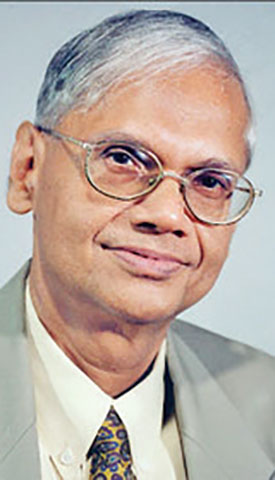 By Professor G. L. Peiris
D. Phil. (Oxford), Ph. D.
(Sri Lanka);
Rhodes Scholar, Quondam Visiting Fellow of the Universities of Oxford, Cambridge and London;
Former Vice-Chancellor and Emeritus Professor of Law of the University of Colombo.
I. The Youth Commission in Retrospect
My tenure of office as Vice Chancellor of the University of Colombo coincided with the most turbulent period in the history of the university system in our country. There was a near total collapse of all systems, and the cost in terms of the loss of life, destruction of public and private property and disruption of all sectors of national life, was exorbitant.
As this time of upheaval drew to a close, the Government, in October 1989, appointed a Presidential Commission to examine, inter alia, “the causes of disquiet, unrest and discontent manifesting itself in the rejection of existing institutions and in acts of violence”.
As one of 7 Commissioners I played an active role in the work of the Commission and in the preparation of its Report. Revisiting its content recently, I was struck by the immediate relevance of its major themes and recommendations, and the thinking underpinning them, to dominant challenges in our society today.
II. Politicisation a Central Malady
“The oral and written representations to the Commission indicated virtual unanimity that politicisation and perceptions about the abuse of political power are some of the main causes of youth unrest in contemporary Sri Lanka”. This was the first sentence in the Report of the Commission which identified, as the main issue, “the abuse of political power in the undermining of democratic institutions”.
Pre-eminent among the recommendations of the Commission was the setting up of a Nominations Commission “which will recommend to the President the names of persons who will constitute the membership of (a) important Commissions responsible for recruitment, promotion,transfer and dismissal in certain vital areas; and (b) Commissions responsible for policy making in selected areas”. The composition of the Nominations Commission was to reflect the balance of political parties in Parliament.
Disenchanted youth, giving evidence before the Commission throughout the length and breadth of the Island, insisted that, although they were not averse to acceptance of adversity – inevitable at times in a nation’s history – what they would vehemently reject and rebel against was deprivation accompanied by palpable injustice.
III. An Institutional Response: The Constitutional Council
This concept of a Nominations Commission was the origin and inspiration of the Constitutional Council introduced into our Constitution by the Seventeenth Amendment in 2001.
Militating against the “winner takes all” mindset and seeking to establish merit and fairplay as the cornerstones of a rules-based system of public administration, the Constitutional Council mechanism dominated political events for a quarter of a century.
Dramatic swings of the pendulum from progress to backlash characterised developments during the whole of this period. The Seventeenth Amendment envisaged a Constitutional Council consisting of 3 Members of Parliament (Speaker, Prime Minister and Leader of the Opposition) and 7 representatives of civil society nominated by political parties in Parliament. The Eighteenth Amendment, in 2010, replaced the Constitutional Council with a Parliamentary Council which departed in crucial respects from the role of its predecessor, in that the Parliamentary Council consisting of 5 members – 3 from the Legislature and 2 from outside – could only make recommendations to the appointing authority, the President, but their concurrence was not required as a condition for validity of appointments. It was, therefore, a relatively weak instrument.
The Nineteenth Amendment of 2015, which brought back into being a Constitutional Council of 10 members – 7 Parliamentarians and 3 from outside – represented movement in the opposite direction by investing the Council with real authority. A further twist in the skein was signified by the retrogressive Twentieth Amendment, in 2020, which restored the largely impotent Parliamentary Council functioning as a mere advisory body.
The wheel came full circle with the Twenty First Amendment in 2022 which embodies the current law. This precludes the President from appointing personnel of vital Commissions – dealing with elections, the public service, the national police, audit, human rights, bribery and corruption, finance, delimitation, and national procurement – without an explicit recommendation by the Council.
Moreover, a whole range of important officials – the Attorney-General, the Governor of the Central Bank, the Auditor General, the Inspector General of Police, the Ombudsman and the Secretary General of Parliament – could not be validly appointed unless the appointment had been approved by the Council on a recommendation made by the President.
IV. Vigilance the Key
These are landmark achievements, in restricting the scope for partisan political influence in the higher echelons of governance; they serve to reinforce public confidence in the integrity of institutions.
There is no room for complacency, however. The nation was witness to the unedifying spectacle of an incumbent President upbraiding the Constitutional Council, on the floor of Parliament, for purported interference with the performance of executive functions. The current controversy between the National Police Commission and the Acting Inspector General of Police has the potential to thwart the former in the exercise of its constitutional responsibilities. Institutional norms of independence and objectivity can hardly be swept away by exigencies of operational control.
V. Legislative Sovereignty and Judicial Oversight
My distinguished predecessor in the Office of Minister of Constitutional Affairs, the late Dr. Colvin R. de Silva, was a protean figure in constitution making. Unyielding in his insistence on sovereignty of the Legislature, he fiercely resisted, on grounds of principle, judicial surveillance of any kind over the legislative functions of Parliament.
The rationale for this view was set out by him pithily in an address to the United Nations Association of Ceylon in 1968: “Do we want a legislature that is sovereign, or do we not? That is the true question. If you say that the validity of a law has to be determined by anybody outside the law making body, then you are to that extent saying that your law making body is not completely the law making body”.
So unflinching was the architect of the Constitution of 1972 in his adherence to this conviction that, even when a Constitutional Court with limited functions had to be provided for, he insisted that the Secretary- General of Parliament must serve as the Registrar of the Court, and that its sittings had to be held not in Hulftsdorp but within the precincts of Parliament.
It is a matter for satisfaction that this view has not taken root in the constitutional traditions of our country. Instead,we have opted for adoption of justiciable fundamental rights as a restraint on the competence of Parliament, in the interest of protection of the citizenry. This is a measure of acknowledgement of the dangers of untrammelled power and the lure of temptation. Contemporary experience demonstrates the wisdom of this choice.
The idea itself is not unfamiliar to our legal culture. Although the Constitution Order-in-Council of 1948 made no explicit provision for judicial review, our courts showed no disinclination to embark on substantive judicial review of important legislation including the Citizenship Act of 1948, the Sinhala Only Act of 1956, and the Criminal Law (Special Provisions) Act of 1962. The latter statute was struck down in its entirety by the Judicial Committee of the Privy Council on the ground of repugnance to the basic scheme of the Constitution.
Judicial oversight of legislation, then, is a defining principle of our legal system. However, the manner of its application is exposed to legitimate criticism in two ways.
(a) The Content of Fundamental Rights
It is disappointing that only civil and political rights have been deemed worthy of entrenchment in our Constitution, to the rigid exclusion of economic,social and cultural rights.This approach, which continues to receive expression in Chapter III of the present Constitution, runs counter to current international recognition that the latter category of rights is of overriding importance,especially in the context of the developing world.
(b) Exclusion of Post-enactment Review
Judicial scrutiny of legislation is confined in our system to pre-enactment review. There is provision for gazetting of bills and for challenge by the public on the basis of conflict with constitutional provisions. The proposed legislation cannot be debated or passed in Parliament until the Determination of the Supreme Court is received by the Speaker. The Court is required to decide, within a stipulated period, whether the legislation, or any portion of it, contravenes the Constitution and, if so, whether a special majority (two-thirds of the total membership of the House) is sufficient to secure its enactment or whether endorsement by the People at a Referendum is needed, as well. Amendments required by the Court must be compulsorily included at the Committee Stage, as a condition of validity (Articles 78 and 121).
A serious lacuna has been laid bare by recent events. In an egregious affront to the mandatory constitutional scheme, the Government, during passage of the Online Safety Bill, secured enactment of the legislation at the Third Reading, without moving all of the Amendments insisted upon by the Court. This resulted in a Vote of No Confidence being moved by the Opposition against the Speaker for intentional violation of the Constitution.
There have been other instances of flagrant abuse of the legislative process. A Bill which, as presented to Parliament and adjudicated upon by the Supreme Court, dealt with representation of women in Provincial Councils, was fundamentally altered in content AFTER judicial scrutiny through extensive Amendments at the Committee stage, making it virtually impossible to hold Provincial Council elections at all.
Deliberate manipulation of this kind, enabling subversion of constitutional procedures, goes without remedy because of the unqualified exclusion of post-enactment review. This derives from the conclusive bar imposed by Article 80 (3) of the Constitution: “When a Bill becomes law upon the certificate of the Speaker, no court or tribunal shall inquire into, pronounce upon or in any manner call in question the validity of such Act on any ground whatsoever”.
In the overall reform envisaged in the near future, this anomaly calls for urgent attention as a key issue.
VI The Public Service: Neutrality or Control?
Provision for an enabling environment for public officials to fulfil their responsibilities in a spirit of independence, without fear or favour, is generally considered an essential feature of a robust democracy.
However, this has not been looked upon as elf-evident at every stage of our constitutional history. On the contrary, political control of the public service has been sanctified as a cardinal virtue, and its cultivation assiduously promoted.
Root and branch opposition to the idea of a public service beyond the reach of political authority is exemplified by the Constitution of 1972, the sheet anchor of which was the principle that “The National State Assembly is the supreme instrument of State power of the Republic” (Article 5). Political control of the public service was held to be a necessary corollary.
This found expression in the emphatic statement that “The Cabinet of Ministers shall have the power of appointment, transfer, dismissal and disciplinary control of all State officers” (Article 106 (2)). For the exercise of this power, it was declared that the Cabinet “shall be answerable to the National State Assembly” (Article 106 (1)).
The State Services Advisory Board consisting of 3 persons appointed by the President, as its designation made clear, was no more than an advisory body. This, indeed, was true even of the Judicial Services Advisory Board set up under the Constitution of 1972: “The appointment of judges shall be made by the Cabinet of Ministers after receiving the recommendation of the Judicial Services Advisory Board” (Article 126). This Board was required to send a list, but the Cabinet had full power to appoint persons not on the list, with the reasons applicable tabled in the National State Assembly.
The Legislature, then, with the Cabinet as its delegate, became under the Constitution of 1972 the clearly identified source of authority over all State officers including judicial officers. The seed had been sown; and an abundant harvest was reaped in succeeding years.
Happily, our constitutional values took a different trajectory, leaving this tradition behind. The aborted Constitution Bill, which I presented to Parliament as Minister of Constitutional Affairs on behalf of President Chandrika Kumaratunga in August 2000, sought to reverse this trend frontally.
Making a radical departure from the policy stance of political control over the public service, the present Constitution provides unequivocally that this authority “shall be vested in the Public Service Commission” (article 55 (3)). An exception is made in the case of Heads of Department, in relation to whom the corresponding power is vested in the Cabinet of Ministers (Article 55 (2)). The power of appointment of Heads of the Army, Navy and Air Force is placed in the hands of the President (Article 61E). These are reasonable exceptions.
VII Precept vs. Example
Laws, skilfully crafted, do not furnish cast-iron guarantees. They simply provide a conducive environment for persons of goodwill and competence to fulfil their public duties, unencumbered by pressure: the rest is up to individual conscience. Constitutional provisions confer security of tenure on judges, prevent reduction of salary and other benefits during their tenure of office and protect them against attacks harmful to the dignity of their office.
The Lawyers’ Collective, comprising public-spirited members of the legal profession, pointed out last week the danger of judges, upon retirement, accepting lucrative appointments within the gift of the government in power. Public perception is the overriding factor in this field. To be remiss is to invite debilitating weakness and to risk erosion of confidence in the foundations of a functioning democracy.


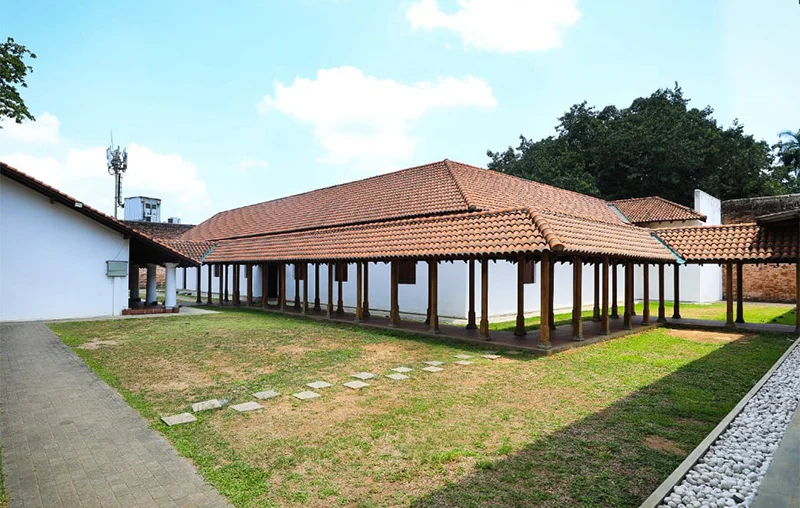
Preamble and the Accused
Ehelepola tragedy has twists and turns; I start with the African proverb, “Until lions have their own historians, the history of the hunt will always glorify the hunter.” In this story, hunters are the Kandy king, his first Adigar Ehelepola, and the British colonial government.
Within a few years of becoming king of Kandy in 1798, Sri Wickrama Rajasingha began to feel his unpopularity spread across the country and right under his nose among the Kandyan elites. He murdered captured British soldiers receiving hospital treatment in Kandy and let Major Davie die in captivity. He executed his Prime Minister, Pilima Talawa Sr., in 1812 for suspicion of colluding with the British, and, as John D’oyly revealed, was envious of the former’s alleged schemes to get his son married to the granddaughter of the late King Kirthi Sri Rajasingha (1747-1782) to establish a blood relationship to royalty.
The king then appointed Ehelepola, nephew of Pilima Talawe as the First Adigar. Continuing his wanton execution regime, he touched a nerve in Kandyans with the sacrilegious act of killing Buddhist monk Moratota Paranatala Unnanse, accused of spying for John Doyly, whom Gananath Obeyesekere called “Master Spy.” The King’s reign was an oppressive, oligarchical system consisting of himself, his family, the Chiefs, and some in the Buddhist sacerdotal fraternity in the Kandyan country.
Sri Wickrama Rajasingha was an illegitimate king, with a dubious claim to a direct royal bloodline, which weakened him as a ruler. As we know now, he was ruling the kingdom with borrowed time. Six months after the Ehelepola killings, he was deposed by the British, the empire-builder with its full power, passion, and double dealings.
The King had an irritable and short-tempered demeanour. In 1816, even as a prisoner of the British being conducted on board HMS Cornwallis, in the morning of the 26th day at sea, William Granville, the British Civil Servant heard him screaming with dreadful passion, hacking and hewing into pieces with a hatchet an extra bedstead in front of his cabin kept for him to sit occasionally. The reason for his fury was that one of his attendants had slept on it the previous night, disgracing his honour!
The Murders
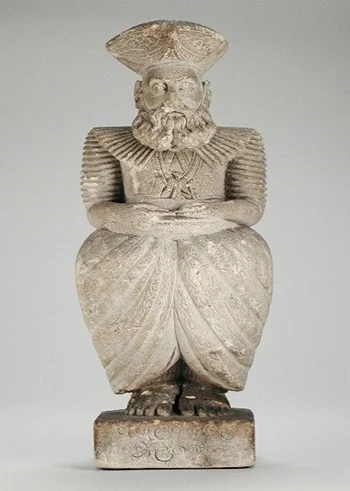
Ehelepola Nilame. Los Angeles
County Museum of Art.
The king was accused of Ehelepola murders, and Ehelepola Adigar stands as an accessory by failing to prevent the crime and willfully refusing to help the victims by abandoning the scene.
Headwinds of the crime started when Ehelepola Adigar, Dissave of Sabaragamuwa, was accused of the stabbing deaths of two koralas, under him. When the king ordered him back to Kandy for questioning, he refused. In May of 1814, the Adigar, fully aware of what the king, with his sinister bearing, would do to his family, sealed their fate by throwing away any chance of saving them, and escaped to Colombo seeking British protection.
The enraged king took hostage Adigar’s wife, Kumarihamy, and her four children, along with a few relatives, until the patriarch’s return. After hearing a rumour that the Adigar was planning to spirit away the family from the prison, the king, breaking principles of elemental justice, decided to put his family to death at a public event.
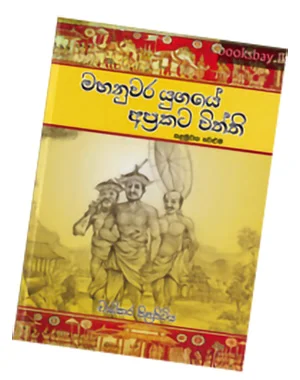
Ehelepola’s misogynist disposition is evident in an old Ola book, recently found in Padiyapelella. In his Mahanuwara Yugaye Aprakata Withthi by historian Chamikara Pilapitiya includes a statement Ehelepola made right before he returned to Kandy with the British army. He bemoaned the loss of his two children, probably the two sons. He added that they were like his two eyes, and, without them, he asked what the use of titles and a good life, referring to rumors that he was planning to get the kingship with British support. He said no word of sorrow for his wife and two daughters, who perished together with the two sons!
In Interior of Ceylon (1821), John Davy, the British Army Doctor (1816–1820), provided the most accurate description with firsthand information of the beheading of the children and the drowning of their mother. The vengeful king summoned Kumarihamy, her four children – two sons, 11 and 9 years old, a daughter, and a nursing baby, and the son of Adigar’s brother and three women to the execution stage near the Natha and Maha Vishnu devale by the palace.
After analyzing contemporary writings, including D’oyly’s Diary, Gananath Obeyesekere has determined the execution date as May 21, 1814. On this day, executioners brought implements of the crime – a wangediya (rice mortar) and a pestle. King then ordered them to decapitate the children first and place the severed heads in the wangediya. When the elder son Lokubanda dithered, his nine-year-old brother Maddumabanda stepped forward and uttered the now legendary words: “Brother, fear not. Let me show you how to die.”
The wadakayo decapitated the children and put their heads into the wangediya and handed the pestle to the agonizing mother. The king ordered her to pound the heads. If she did not, he threatened with an ultimatum – banishment in marriage to Rodiyas, the untouchables in the country, an unfathomable humiliation to her clan. Trusting it would benefit her husband, Kumarihamy declared she would do the unthinkable. With surprising courage, she began to pound the lifeless heads of her children. Some watching this catastrophe wailed, in silence, like driftwood on a deserted shore. A Chief fainted.
Henry Marshall, Surgeon of the British Forces (1808–1821), tells of the perfidious role of one Kandyan Chief who was present that day. When the king ordered the mother to pound the heads in the mortar, Kumarihamy first wavered. The Chief, who was a relative of her husband and supervised the execution, asked her to accept the king’s terms and save the family from the disgrace of living with a Rodiya clan. She did not require such encouragement. With her children slaughtered, soon to face the same fate herself, the only thing left to save was her self-serving husband and his malicious treachery for abandoning them, which she was probably not aware of at the time.
After listening to an eyewitness account, Major Forbes (1840) described the “fortitude and propriety of her conduct” by going through the “most awful scene to which any mother was ever subjected.”
Afterward, the wadakayo and slave women in the palace, carrying the remains of the children, led Kumarihamy and three women to the Bogambara Wewa, which the king could see from the palace.
Six months later, Governor Robert Brownrigg would write what happened next. The “woman herself and three more females, whose limbs being bound, and a heavy stone tied round the neck of each, they were thrown into a lake and drowned.”
King’s retributive justice regime crossed the boundaries of the 32-punishment realm under the murky and ancient Laws of Manu and Kandyan Code of Honor. Pounding heads of decapitated children in wangediya was not in those codes. For the king, it was a theater of death to warn anyone who dared to cross his path. In Discipline and Punishment: Birth of Prisons (1977, 1995), Michel Foucault wrote that such exhibitionist punishments as “the theatrical representation of pain.” But the deposed king, while aboard HMS Cornwallis, placed the blame on Kandyan laws in general, asking William Granville, “Did I make those Laws?”
Interestingly, in The Doomed King: A Requiem for Sri Wickrama Rajasingha (2017), Gananath Obeyesekere, with flimsy evidence, rules out Bogambara Wewa as the site of the drowning. He calls it a myth developed in popular stories like Purana Ehelepola Hatana, invented in the low country. He calls some informants of early writers of the Ehelepola story as “inventive mills, overloaded with falsities,” and no British account exists of Bogambara as the lake where the tragedy took place! But two decades before Purana Ehelepola Hatana, L. De Bussche wrote in Letters on Ceylon (1817) that the dead family was cast into the lower lake of Kandy. Davy was more specific. He wrote in 1821 that the women were “led to the little tank in the immediate neighborhood of Kandy called Bogambarawave [sic] and drowned.”
The alternative location Obeyesekere provides is another smaller tank north end of the city, Borawewa, near the present-day Katugastota railway tunnel. It was also closer to the Asgiriya Temple and the Royal Burial grounds, making it unlikely the king would execute prisoners and dump the bodies close to such sacred places. Obeyesekere seems to disregard Adigar himself, and Dissave of Wellassa, other Chiefs and eyewitnesses still living in Kandy who provided firsthand information to Davy and Henry Marshall.
Bogambara Wewa – The Place
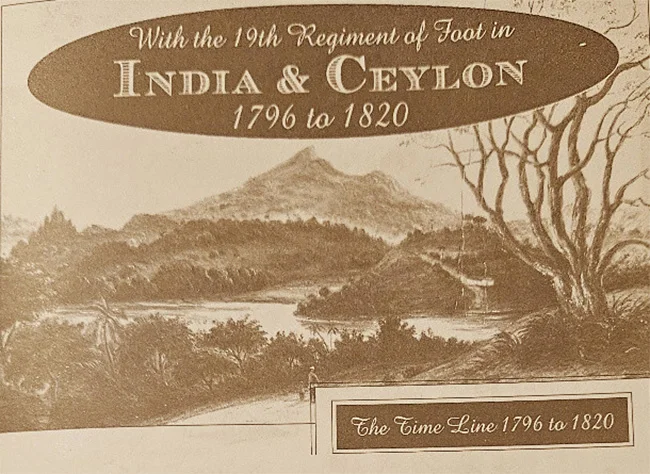
Bogambara Wewa (1796–1820). Green Howards Regimental Museum, London, reproduced in Mahanuwara Yugaye Aprakata Vitti (II) by Chamikara Pilapitiya (2018).
This Wewa, also known as Palledeniya Wewa, is believed to have been built by Rajasingha II (1635–1687). Robert Knox wrote in 1681 that the king made a bank of earth across a valley, far above a cable’s length (200m) and four fathoms high. To prevent erosion, builders made a ralapanawa (revetement) along the inner slope of the bund. He had a “banquetting house about a musket-shot from his palace” [sic] on a little hill by this pond.
In the stylish praise poem Parangi Hatana (c.1642), Bogambara Wewa is likened to the Buddhist cosmic lake Anotatta. Although Kandy Lake looks dandy, the former, with a storied past and the memory of its sepulchral encounter with the Ehelepola heartbreak, was entrenched in the public pantheon of city’s aesthetics.
When measured against the Kandy maps of Lt. Col. Henry Evatt (1768–1851) of Royal Engineers in 1816 reproduced in Nihal Karunaratna’s From Governor’s Pavilion to President’s Pavilion, and in Davy’s in 1821, this bund appears to cross the narrow valley separating Bahirawakanda range between the Police Station and a projection of the Hantana range behind the Education Office near the Railway station. Furthermore, the painting Bogambara Wewa (c. 1796–1820) shown in the image clearly shows a man and a boy walking on the bund of the wewa running in the direction where, in the distance, the distinctive summit of Hantana range is visible. The artist drew it looking towards the hospital, standing on the Pushpadana College slope of Bahirawakanda, behind the police station.
In 1817, De Bussche wrote that this Wewa covered about 6 or 8 acres. Contemporary maps show it occupied the general area bordered by sections of present-day streets named Colombo, Dalada, Yatinuwara, and the Police Station, and the elevated land where the now-decommissioned Prison Complex stands, and the Bund of the Kandy Lake. Except for a few ephemeral ponds scattered along the foot of the hills in the west of the valley, this Wewa remained the main source of water for the city until the Kandy Lake came on board in 1812.
Both lakes were fed by streams originating from Dunumadalawa forest on hills bordering the south side of the city and from Udawattakele in the North. It was unlikely the palace used water from the Bogambara Wewa since it was located uphill from the Wewa. However, as Knox wrote 135 years earlier, the king had water brought to the palace in ditches cut on mountain sides in the North and East and stored in “little ponds made with lime and stone and full of fish,” probably a well and a pond near the palace. One such pond is seen east of the Kundasale road, current Malabar Street, east of Maligawa, on the Dutch Map of 1766, reproduced in Aprakata Vitti. The 1816 map signed by Henry Evatt of the Royal Engineers shows a ditch originating from Kandy Lake to the moat in front of the palace. It then curves West, and goes North parallel to Trincomalee Street. On this map, Bogambara Wewa turns to the south and tapers off as a thin strip parallel to Old Colombo Road, the present-day Peradeniya Road.
Kandy was topographically too compact, surrounded by hills and two lakes in the middle. The area occupied by the Bogambara Wewa and fields below was the only direction the city could expand. Thus, after the British occupied it in 1815, one of their first tasks was to drain it to create more land.
The ensuing building boom in the city began soon. When Davy came to Kandy in 1817, Bogambara Wewa had already been drained. So, he wrote the city “standing on the border of an artificial lake made by the last king,” unquestionably referring to Kandy Lake (Kiri Muhuda). A few years later, Governor Edward Barnes (1824–1831) rode with Rev. Reginald Heber in 1825, proudly showing off another construction project a kilometer from the Kandy Lake – the 500-foot-long tunnel through the Aniwatta hills, a shortcut to the ferry at Halloluwa on the Mahaweli River. Building of the Pavilion (Governor’s Mansion) started around 1826 during Governor Barnes’ tenure.
Last Tango of the King and Adigar
 On January 10, 1815, Brownrigg declared war on the Kandyan kingdom. On February 11, eight months after the Ehelepola executions, the king fled Kandy. On the 12th, Major Willerman entered the city, followed by Governor Brownrigg on the 14th. Unlike later in 1819, when the Governor, as the new Lord of the land, returned to Kandy with Davy, on this inaugural day of entry, there was no pomp and pageantry with arches of white olas (gokkola) to receive him along the road from Gannoruwa. Immediately after, Ehelepola entered Kandy with Major Hook and joined Lieutenant Mylius and Ekneligoda pursuing the killer of his family. On February 18, they arrested the king and his family in a house near Medamahanuwara. The British escorted the king to Colombo, and 11 months later, banished him and his entourage to Vellore. He died there in 1832, aged 52.
To mollify the feared tempest of emotions in Kandyan people after deposing the king and ending Sinhala sovereignty, Governor Robert Brownrigg wrote in the official declaration to the Chiefs, reminding them of the king’s “bold contempt of every principle of justice, setting at nought all known grounds of punishment, dispensing with the necessity of accusation, and choosing for its victims helpless females uncharged with any offence, and infants incapable of crime.”
Two weeks after signing the Kandyan Convention, even before formal religious services for his family, Ehelepola informed the Governor that he planned to marry Pilima Talawe Jr.’s sister (widow of Migastenna Adigar) and asked for financial assistance for the wedding. Then, in April 1815, with wounded pride after being sidelined by the British, Adigar gave a mataka dana to 20 monks in memory of his family. His fantasy of becoming the “Deveni Rajjuruwo” did not materialize. Instead, the British gave him the feel-good title of “Friend of the British Government.” In 1818, the “friends” took him into custody. He was never charged but kept in confinement in Colombo. In 1825, he was banished to Mauritius and died in 1829.
Gananath Obeyesekere wrote that when Ehelepola was banished to Mauritius, Sinhala power was lost. Six decades after Adigar’s death, Lawrie wrote that the Ehelepola family line was extinct.
But the Adigar left it to history to judge what a cowardly and callous patriarch he was, having intentionally allowed his wife and children to perish at the hands of a roguish king’s executioners.
Sightings of Wangediya
After the bodies and implements used in the executions disappeared in the watery grave, the mood of the thickly knitted social, cultural, and superstition pathologies of Kandyans undoubtedly prevented any chance of naturalizing the wangediya, by saving it as a household item, or relic of the Ehelepola saga. It was a heartbreak and a cultural shock, painful, grisly, to give this object of murder a place within a residential confine.
But nine decades later, the first written account of the rice mortar used in the killings appears in A.C. Lawrie’s 1896 Gazetteer of the Central Province (Vol. I). He refers to the Kandy DC case number 30962, where a Malay named Sadim Kumba had stated to the Temple Land Commissioner that, in 1843, on land close to the new police station, he saw the stone trough used in the Ehelepola killings, and, in 1858, it was in the Kandy Pavilion.
This episode seems to have continued later with the alleged involvement in it of a T.B. Paranathala. In 1895, he was a Clerk in the Kandy District Court and was appointed as an English-speaking Special Juror (Gov. Gazette of 1895, Part II, p. 43). He probably had come across Kumba’s evidence, and, knowing its historical value, could have related it to Lawrie, who was a judge in Kandy at the time and working on the Gazetteer, which came out a year later.
When the construction of the police station began around 1843, workers moved a lot of earth in and out of the adjoining empty lake bed and its shoreline, and that it is possible to expect the chance of stumbling upon items buried in the former lake floor reappearing.
Sadim Kumba may have been privy to this information for two reasons. He was probably either part of the construction crew on the police station project or, as a boy growing up in the city, may have joined the crowd that followed the Ehelepola ladies on their last journey and saw the spot where wangediya was rolled down the bund.
If what Kumba saw is true, after the way the city cried seeing the executions, and as Brownrigg wrote then that Sinhalese are a “Superstitious Race,” it is incomprehensible that any sane person would take home a bloodied wangediya.
Thus, all physical evidence of the bloody Ehelepola episode, too, remained buried in the watery grave. Therefore, it was not until three decades after the wewa was drained that the British had any contact with what was buried in the lake floor, when wangediya surfaced perforce during grading work on the new police station site.
The British also feared that if remains of his family were to resurface, Ehelepola Adigar, remarried and living comfortably in retirement, but still a formidable character in Kandyan affairs with the title of Maha Nilame, though under a cloud of suspicion, would be upset, and create political instability by regrouping friends to take retribution against the chiefs who sided with the king.
With the scars of the 1818 revolt still in mind, following the 1843 discovery, the British would strategically remove the wangediya to the Pavilion, away from the public eye to prevent rekindling of sentiments among the Kandyans until after 1858, when it disappeared from the pavilion.
However, Chamika Pilapitiya, who inspected ola manuscripts and listened to oral histories in Kandyan country, had shared new insights into the wangediya saga with me. According to him it was found in an Ala Kola Landa (shrub land). A Muhandiram in a Malay soldier phalanx then took possession of it, washed, and used it at his home. His son Cader, who inherited it, sold it to a T. B. Paranathala Nilame. In 1929, it changed hands again, this time to Dr. J. W. Artigala, as stated by M. Malius de Silva.
If this story holds true, in three instances starting from 1843, three generations of Malay families – Kumba, Malay Muhandiram, and his son Cader in Kandy – were in contact with the wangediya in some form or another until early 20th Century, when it changed hands with Paranathala.
In conclusion, I implore scholars at the National Museum, Kandy Museum, and Ehelepola Museum to follow up on this lost trail. Because this wangediya is the only object now existing out here to have had contact with, and heard cries of, the eponymous family 211 years ago at Deva Sanhide, a stone’s throw from Ehelepola residence. If the museum can secure it, it is a solemn and endearing gesture to this family, now only admired as wax figures, standing in silence, unable to tell their story.
Only then can we write the last coda for the Ehelepola Requiem.
Lokubanda Tillakaratne writes about the Ethnography of Nuwarakalaviya.
by Lokubanda
Tillakaratne
Reform of the Anti-Corruption Act – Part III
by A Special Correspondent
(Continued from yesterday)
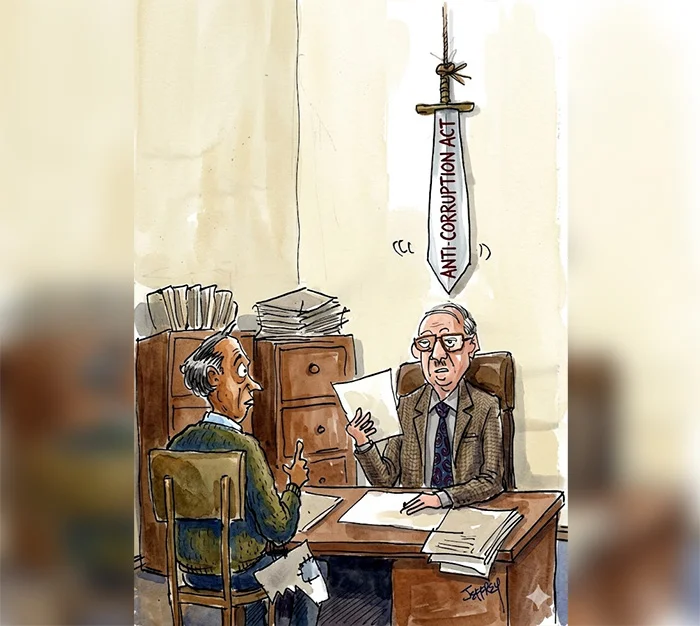
The most dangerous job in Sri Lanka today is that of a public servant. Even those who have never taken a bribe or enriched themselves unlawfully, can still be accused of corruption by ‘causing a loss to the government’ and all public servants now live with the constant possibility of arrest and prosecution while holding office or even after retirement. This is a developmenthat has taken place in the past several years due to misguided policies and bad politics.
When the Central Bank was set up in 1949 under the guidance of John Exeter of the US Federal Reserve, the following provision was included in the Monetary Law Act of 1949.
“47.(1) No member of the Monetary Board or officer or servant of the Central Bank shall be liable for any damage or loss suffered by the bank unless such damage or loss was caused by his misconduct or wilful default. (2) Every member of the Monetary Board and every officer or servant of the Central Bank shall be indemnified by the bank from all losses and expenses incurred by him in or about the discharge of his duties, other than such losses and expenses as the board may deem to have been occasioned by his misconduct or wilful default.”
Until 1994, Section 47 provided all the protection that Central Bank officials needed. But after Section 70 was introduced to the Bribery Act in 1994, and ‘causing a loss to the government’ became an offence amounting to corruption, even Central Bank officers technically lost their immunity. Acts that cause a loss to the government are very much a part of the Central Bank’s functions. If the Central Bank allowed the Rupee to depreciate, the cost of servicing foreign debt goes up and causes a loss to the government. A slight increase in the interest rate increases the cost of servicing government debt and causes a loss to the government.
The only reason that officers of the Central Bank were not prosecuted under Section 70 after 1994 was because nobody got the bright idea of making a complaint against them. As pointed out earlier, Section 70 remained dormant for many years after 1994. However, the dogs were let out after 2015 and today, no public servant is safe. In the post-2015 era, petitioners have gone to courts arguing that an economic crisis was precipitated because a government reduced taxes, did not allow the Rupee to depreciate, and delayed seeking IMF assistance. Now, there is nothing to stop another set of petitioners from going to courts arguing that yet another economic crisis has been precipitated because of high taxes, a depreciating Rupee, and strict IMF conditions!
So, public servants including Central Bank officials who play a major role in economic decision making are exposed and vulnerable. The Monetary Law Act of 1949 was replaced by the Central Bank Act of 2023 and Section 47 of the old Monetary Law Act still continues to exist in a way in the Central Bank Act of 2023 in the form of Sub-section (1) of Section 121.
Jail time for public servants
However, there is a crucial difference between Section 47 of the old Monetary Law Act and Section 121 of the 2023 Central Bank Act because the new provision has been promulgated to suit the new era of criminal charges and jail time even for public servants who have not taken bribes or enriched themselves unlawfully.
While Sub-section (1) of Section 121 of the new Central Bank Act encapsulates the essence of the old Section 47, the Central Bank Act of 2023 has a new Subsection (2) of Section 121 which basically states that if an officer of the Central Bank is faced with an investigation or court proceedings, the Central Bank will meet the legal costs of that officer. This legal aid comes with the proviso that if any wrongdoing is proven, the offender will have to reimburse the money spent to the Central Bank.
It should be borne in mind that under the present law, the wrongdoing that needs to be proven under is not that the said Central Bank officer took bribes or enriched himself, but of having caused a loss to the government. So in reality, there is no protection for Central Bank officers who have no option but to cause losses to the government as a part of their day to day duties especially when it comes to exchange rate and interest rate management.
While Section 121(2) of the 2023 Central Bank Act thoughtfully provides for the legal costs of Central Bank officers under investigation or prosecution, it has not provided for the time that officer will have to spend in remand prison. For the sake of completeness, there should have been a Sub-section (3) to Section 121 stipulating that if an officer of the Central Bank under investigation or prosecution ends up in remand prison, a peon of the Central Bank will be assigned to take food and other essentials to the remand prison on a daily basis!
At least the Central Bank Act of 2023 has explicit provisions to help their employees with legal support if the need arises. But other public servants in less well-paid, less powerful branches of the public service or state institutions have no such safeguards. What is necessary is to prevent bribe-taking and unlawful enrichment by public servants but this has to be done without undermining the decision-making and problem-solving powers of public servants and thereby paralysing the entire system of governance.
As we saw in the previous article, the Indian system allows those who bear actual responsibility for running the country to decide whether a prosecution or an investigation into the conduct of an official is warranted in the circumstances if there is no evidence of bribe taking or unlawful enrichment. That enables those running the country to act on irregularities without undermining the system of governance.
However, in Sri Lanka, governments led by short-sighted and small-minded people have a tendency to come into power with their garments hitched up high, and perform various ill-advised antics to please the gallery. Hence, what works as a safeguard in India may actually be turned into an instrument of political persecution in Sri Lanka with every succeeding government mindlessly sanctioning investigations and prosecutions against holders of high office in the previous government.
In Sri Lanka, when power changes hands, the winner-takes-all and commonsense, far-sightedness and even the medium to long term self-interest of the winners themselves, go out of the window resulting in a ‘monkey with a razor blade’ situation. The Sri Lankan public service is too weak to be able to hold things steady and they too tend to get carried away by whatever political wind may happen to be blowing at a given time.
The elusive sense of balance and proportion
However, all is not lost. From the time of independence until Section 70 of the Bribery Act was introduced in 1994, public servants could be prosecuted only for actually taking bribes or possessing unexplained wealth. Even after Section 70 was introduced in 1994 to prosecute a public servant for corruption by causing a loss to the government even if there was no bribe taking or unlawful enrichment, prosecutions under this provision were not instituted for many years. So, there is a history of rational behaviour in Sri Lanka as well. What is necessary is to find some balance and a sense of proportion when it comes to public servants who take bona fide decisions that are open to interpretation as ‘causing a loss to the government’ even though that person has not taken bribes or enriched himself unlawfully in the process.
In some instances, a decision taken by a public servant may benefit some individual and it may cause a loss of revenue, loss of property or a need to make a payout on the part of the government. A given set of circumstances would require remedies within a certain range. In making such a decision, the rationale therefor and any precedents would obviously be recorded by the public servant. If a complaint is received, an internal board of inquiry should be able to ascertain whether there was anything unusual in the decision taken.
If redacted versions of such internal inquiry reports are made publicly available, anyone who is not satisfied with the conclusion should be able to challenge it with the board of inquiry, the CIABOC, the police the courts or even in the media. When an allegation relates to a loss incurred by the government and there is no evidence of bribe taking or undue enrichment, there should be some sort of a halfway house without an all-powerful external inquisitor rushing into the matter with arrests, imprisonment, investigations and prosecutions. Unless something is done to address this issue, what we are staring at, is creeping governmental paralysis over a period of time.
(Concluded)

The terrorist war, which was launched in the 1970s to create a separate state, was ruthless and created political and economic instability. Sri Lankan governments, during this period, were pushed, and sometimes forced, by internal and external forces to talk ‘peace’ with the terrorist faction. The terrorists made use of the peace initiatives and strengthened their forces by procuring arms, recruiting personnel and exploding bombs in the city centres and massacring civilians
But Sri Lankan forces, who were determined to defeat the terrorist group, continued to exert pressure on the enemy with unparalleled heroism. President Mahinda Rajapaksa, too, was determined to get rid of the ferocious enemy and with the then Secretary of Defence, Gotabaya Rajapaksa, senior officers of the Army, the Navy and the Airforce, planned a full-scale operation to wipe out the enemy.
The LTTE killed many Tamil political leaders and also took with them more than 25,000 Tamil civilians, by force, as a human shield, when they retreated to the East. The civilians were finally liberated by the Sri Lankan armed forces. Many thousands of Tamil children were recruited as child soldiers, depriving them of their innocent childhood. Some were trained as suicide bombers. Many of them were killed in the battles while the remaining ones were rehabilitated by the Sri Lanka government.
When the situation changed for the better, after 18th May, 2009, one of the darkest chapters of Sri Lankan history was ended by the war heroes, assisted by the Police, and the members of the civil defence force.
Finally, around 7,000 members of the armed forces sacrificed their lives, while nearly 30.000 members were injured. The nation should be ever grateful to these war heroes who survived and liberated the land and others who were killed and also injured fighting for the land.
RANJITH SOYSA

PM meets academic experts from the British Council

Gaby Lewis to lead Ireland at T20 World Cup

PM meets Sri Lankan community living in London

Kapila Wijegunawardena to head SLC’s new selection committee

Afghanistan refugee women’s team set for England tour under ECB initiative

DR Congo cancels World Cup training camp over Ebola outbreak

‘Dates have the highest sugar content to fight Coronavirus’

Sunday Island 27 December – Headlines

#SundayIsland 17th December – Headlines

Sunday Island – 28th March

Sunday Island Headlines – 21 March

Sunday Island – 21st February – Headlines
-

 Features5 days ago
Sri Lankan Airlines Airbus Scandal and the Death of Kapila Chandrasena and my Brother Rajeewa
-

 News6 days ago
Lanka’s eligibility to draw next IMF tranche of USD 700 mn hinges on ‘restoration of cost-recovery pricing for electricity and fuel’
-

 News5 days ago
Kapila Chandrasena case: GN phone records under court scrutiny
-

 News5 days ago
Rupee slide rekindles 2022 crisis fears as inflation risks mount
-
 Features2 days ago
Octopus, Leech, and Snake: How Sri Lanka’s banks feast while the nation starves
-

 Business5 days ago
Expansion of PayPal services in Sri Lanka officially announced
-
 Features7 days ago
Mysterious Death of United Nations Secretary General Hammarskjöld
-

 News5 days ago
Court orders further arrests in alleged USD 42 Mn NDB fraud case