
Features
The Election-Economy Nexus and the Politics of JVP Apology

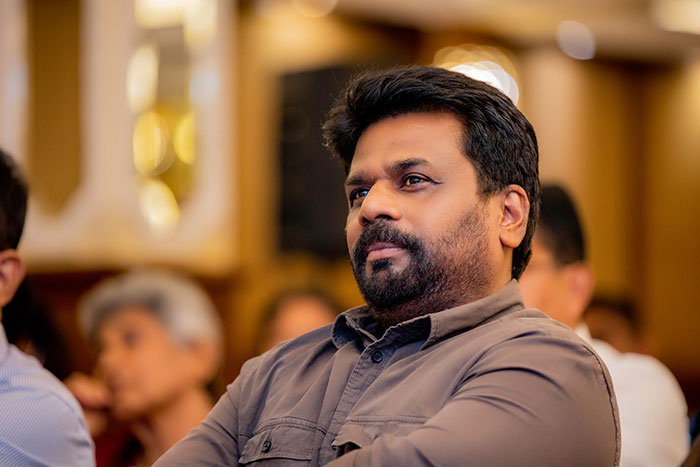
by Rajan Philips
The economy is the base; everything else is superstructure. That is the old Marxian concept, simply put. The base ultimately determines what goes on in the superstructure, which includes among other things the state and its institutions, as well as their processes and functions. Included are the legislature, the executive and the judiciary, and their elections and appointments. Over time, there have been modifications to the old concept.
Borrowing from Freud’s psychoanalysis, Louis Althusser, the French Marxist, used the concept of over-determination to suggest that there are multiple causes producing an effect, i.e., political outcomes are ‘over determined’ by many causes besides the economy, although the economy could be singularly significant. Neo-Marxists have provided another angle in that just as the base could determine the goings on in the superstructure, what goes on in the superstructure also have implications for the base.
I believe it was in his political obituary of JR Jayewardene (in the Lanka Guardian) that Dayan Jayatilleke quite remarkably described the outcome of JRJ’s open economy project was to drag the Sri Lankan economic base into alignment with the superstructure that had already drifted into alignment with global changes. This is not to absolve the architects of the open economy of their untoward intentions, unintended results and ill-gotten gains, but to use that experience as a backdrop as we come to view the emerging dialectic between the economy of Sri Lanka and the politics of the JVP/NPP. And in this election year, all politics is electoral. Hence the election-economy nexus.
Yet the JVP’s project is quite different from that of JRJ. The task is now to salvage the economy and not to embark on any realignment. For the electorate it would be a question of JVP’s competence as much it would be of its attractiveness as a new alternative. So, it is fair, reasonable and necessary to question the JVP/NPP on its approach to and experience in matters economic.
But it is a worthless red herring to demand the present leader of the JVP/NPP to apologize for the doings and misdoings of the pre-NPP JVP under the leadership of his predecessors. Put another way, if the JVP/NPP were to win the next pair of national elections, it should be because it is able to persuade a majority of voters on what it can do in the future as government, especially for providing economic stewardship; and not because it says sorry for what the JVP did in its insurrectionary past under a different leadership.
Schoolmasterly Politics
It is also school masterly politics to ask Anura Kumara Dissanayake to say sorry for the ways of his predecessors before he can be admitted in class. Not to mention the preferential school masterly treatment in allowing convicted murders to sit in parliament because they belong to the right parties and perhaps the same ‘class.’ It is not my purpose to prescribe what Mr. Dissanayake should or should not do or to predict what he may or may not do, but to critique, if not poke fun at, the moral hypocrisy and the political idiocy of the current crop of apology seekers.
Globally, there is a body of literature on political apologies following the so called “age of apologies” – the two decades of 1990s and 2000s, when 186 political apologies were rendered in comparison to 16 apologies over the previous four decades from 1947 to 1989. Decolonization obviously provided the primary site for rendering political apologies. Other instances include oppressive states and regimes using apologies as a framework for reconciliation and restorative justice between state oppressors and the oppressed populations. The most celebrated example of the latter is the truth and reconciliation experience of post-apartheid South Africa.
The offering of apologies is still continuing and in significant numbers, but a number of apology academics are becoming weary of dispensing apology by state actors who cynically use apologies to rhetorically accept responsibility without institutional commitment to change. The ethos of apology is now credited for the American response to the 9/11 Al Qaeda attacks that targeted the perpetrators of the attack while rejecting Islamophobia and without infringing the rights and freedoms of Muslim and Arab American citizens. Bundling Al Qaeda and Islam is the handiwork of Donald Trump, but that is an altogether different phenomenon.
Germany has perpetually placed itself in apology mode for the horrors of the holocaust. But where continuing restitution for even such an epochal tragedy as the holocaust can easily morph into a new and subjectively no less horrific tragedy is what the world is now watching in Gaza. The political fallouts from the Gaza tragedy are manifesting themselves in every Western country. To wit, the historic trouncing of all the major political parties in the recent Rochdale bye-election in Britain. Not to mention the domestic pressure on the Biden Administration in the US and its desperate efforts to effect an immediate ceasefire in Gaza while insisting on the two-state solution for the long term. Be that as it may.
Sri Lanka is not an automatic site for political apologies. Some Western academics have noted that Sri Lanka is not the typical authoritarian state that is transitioning to democracy, with political apologies becoming part of the transitionary phase. Sri Lanka, if at all, has been moving in the opposite direction. A reasonably functioning democratic state that has been more than occasionally careening into authoritarian spells. One significant shortcoming that academics have noted is the absence of judicial review of legislation that have prolonged the life of draconian laws without checks and challenges. There is homework to be done in putting these checks and balances in place through constitutional reform. But nothing is going to come out of asking for and accepting apologies.
Historically, the oppressive instruments of the state have been used against working class organizations and minority groups. No apology was given, and nothing was asked for. The 1971 JVP insurrection was the first instance when the state was systematically challenged and forced into an authoritarian mode. The insurrection was defeated, and its leaders were tried under new laws, convicted and jailed. No one asked for apologies. There were of course significant political fallout. The whole program of the United Front government was irreparably set back. The brutal put down of the insurrection by the UF government became an electoral weapon for the opposition UNP in the 1977 elections. The UNP’s payback was the freeing of imprisoned JVP leaders, not all of whom were ready to grow out of their insurrectionist proclivities.
1983 came and went without any apology, and in an aside President Jayewardene declared the JVP Naxalites, and ordered their arrests. The JVP went underground to launch its second coming, and it came with worse brutalities and matching putdowns. The JVP was again defeated to a point that its third coming could only be non-violent and even democratic. Should President Jayewardene be asked for a posthumous apology – for triggering the cycle of JVP violence – now that there is a kinsman of his in office as President?
At the other side of the ethno-spectrum, the Tamil militants engaged the state in bouts of war that went on for over 25 years. Even the Indian army got in the act, and the whole island became a killing field. People perished in their random tens of thousands. There have also been hundreds of targeted killings, including a dozen or so emblematic ones using state resources for political reasons as well as for personal reasons. None of them have been solved and the perpetrators are perpetually at large. In the scheme of things, who is one to ask for apologies and who is to give?
What might be more concerning is the reported mobilization of ‘retired tri-forces’ by the JVP/NPP apparently as an electoral phalanx. The SJB is reportedly going after officer-level retirees, while Ranil Wickremesinghe has staked his ground from top, as usual, by taking care of the current tri-forces with state bounties. The tri-forces, whether on the job or in retirement, have become an important part of the Sinhalese social formation, as well as a numerically critical voting bloc.
The socialization of the tri-forces has served the positive purpose of keeping them away from temptations to overthrow democratically elected governments. But the ever lurking danger is in the ethno-politicization of the tri-forces that pits them against non-Sinhala members of the Sri Lankan society. The Rajapaksas were often accused of ethno-politicization of not just the tri-forces, but of all forces. Even that did not help them in the end, a lesson that the JVP/NPP can ignore only at their ultimate peril.
The Election-Economy Nexus
Turning to the elections and the economy, Sri Lanka is among quite a few countries that are facing rather consequential elections this year. But there is no consistent picture of the election-economy nexus that one might see in the countries with upcoming elections. Understandably so, because beneath the over arch of the global economy, the world’s societies are seething with their socio political specificities. The two big ones are India and the US. The Indian economy is strong. It is the economic engine that is propelling South Asia to be the leading growth region in a somewhat sluggish world economy. The world economy is “neither sick nor strong” is the assessment of a political economist, John Rapley. He even compares it to long Covid – the lasting aftereffects of Covid-19 that selectively impairs some but not others.
India struggled during the pandemic, but now it is surging. India’s growth has been upwards of 7% and 8% in recent quarters and is projected keep going for now. In comparison to others, India’s manufacturing sector is sustainably strong. Modi inspired government spending on infrastructure and incentives to boost the production of electrical and electronic goods have been positively catalytic. He is poised to win a ‘threepeat’ election victory, which he could have done on the strength of performance of the economic base alone without monkeying with India’s secular superstructure.
China, on the other hand, is literally on a downward trajectory. The country does not suffer elections, but it is currently suffering the drastic reversal of its once runaway economic growth. So much bad news, that the government canceled Premier Li Qiang’s news conference that traditionally accompanies the annual sessions of the National People’s Congress.
At the other end, the US economy is going strong; in fact, the only western economy that is positively growing in every sector. Britain and Japan are officially in recession, and Germany is reportedly at economic ‘standstill.’ President Biden delivered his election year State of the Union address on Thursday. He ripped into Trump; chided the Justices of the Supreme Court who were in attendance for rescinding women’s right to abortion; called upon women to show their power with their vote; and joked that he may not look old, but he has been around for a long time.
It was quite a performance at the pulpit for an 81 year old, with hardly any stumble. It certainly would enthuse his base, but whether it would be enough to stop Trump in his tracks is a different question. The November election will be a repeat of the last one between Biden and Trump with their positions reversed. But Biden is not ahead of Trump in opinion polls, as he should be on account of the economy alone. That base is not helping Biden, at least not yet.
On the other hand, Trump who should be reviled and rejected for orchestrating an insurrection against the Congress on January 6, 2021, among other crimes, has taken over the Republican Party, the party of Abraham Lincoln. No one has asked him to apologize. The state of American superstructure is quite shaky in spite of its strong economic base.
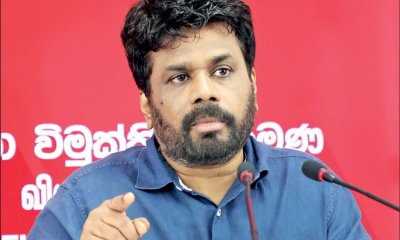
There is not much to say that is not already known about either Sri Lanka’s economy or its politics. The assurances of the two elections happening, starting this year, have given room for some optimism and hope. The arrival of Anura Kumara Dissanayake as a presidential contender has spurred the public mood. But it is still a long way to go. And there will be many questions asked of Mr. Dissanayake, and rightly so. Let them be questions on the economy, on ending crime and corruption, and on constitutional reform. Not about apologies.

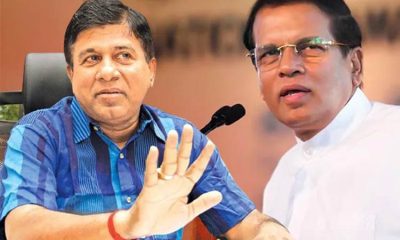







The Trump paradox is easily explained at one level. The US President unleashes American superpower and tariff power abroad with impunity and without contestation. But he cannot exercise unconstitutional executive power including tariff power without checks and challenges within America. No American President after World War II has exercised his authority overseas so brazenly and without any congressional referral as Donald Trump is getting accustomed to doing now. And no American President in history has benefited from a pliant Congress and an equally pliant Supreme Court as has Donald Trump in his second term as president.
Yet he is not having his way in his own country the way he is bullying around the world. People are out on the streets protesting against the wannabe king. This week’s killing of 37 year old Renee Good by immigration agents in Minneapolis has brought the City to its edge five years after the police killing of George Floyd. The lower courts are checking the president relentlessly in spite of the Supreme Court, if not in defiance of it. There are cracks in the Trump’s MAGA world, disillusioned by his neglect of the economy and his costly distractions overseas. His ratings are slowly but surely falling. And in an electoral harbinger, New York has elected as its new mayor, Zoran Mamdani – a wholesale antithesis of Donald Trump you can ever find.
Outside America it is a different picture. The world is too divided and too cautious to stand up to Trump as he recklessly dismantles the very world order that his predecessors have been assiduously imposing on the world for nearly a hundred years. A few recent events dramatically illustrate the Trump paradox – his constraints at home and his freewheeling abroad.
Restive America
Two days before Christmas, the US Supreme Court delivered a rare rebuke to the Trump Administration. After a host of rulings that favoured Trump by putting on hold, without full hearing, lower court strictures against the Administration, the Supreme Court by a 6-3 majority decided to leave in place a Federal Court ruling that barred Trump from deploying National Guard troops in Chicago. Trump quietly raised the white flag and before Christmas withdrew the federal troops he had controversially deployed in Chicago, Portland and Los Angeles – all large cities run by Democrats.
But three days after the New Year, Trump airlifted the might of the US Army to encircle Venezuela’s capital Caracas and spirit away the country’s President Nicolás Maduro, and his wife Celia Flores, all the way to New York to stand trial in an American Court. What is not permissible in any American City was carried out with absolute impunity in a foreign capital. It turns out the Administration has no plan for Venezuela after taking out Maduro, other than Trump’s cavalier assertion, “We’re going to run it, essentially.” Essentially, the Trump Administration has let Maduro’s regime without Maduro to run the country but with the US in total control of Venezuela’s oil.
Next on the brazen list is Greenland, and Secretary of State Marco Rubio who manipulated Maduro’s ouster is off to Copenhagen for discussions with the Danish government over the future of Greenland, a semi-autonomous part of Denmark. Military option is not off the table if a simple real estate purchase or a treaty arrangement were to prove infeasible or too complicated. That is the American position as it is now customarily announced from the White House podium by the Administration’s Press Secretary Karolyn Leavitt, a 28 year old Catholic woman from New Hampshire, who reportedly conducts a team prayer for divine help before appearing at the lectern to lecture.
After the Supreme Court ruling and the Venezuela adventure, the third US development relevant to my argument is the shooting and killing of a 37 year old white American woman by a US Immigration and Customs Enforcement (ICE) officer in Minneapolis, at 9:30 in the morning, Wednesday, January 7th. Immediately, the Administration went into pre-emptive attack mode calling the victim a “deranged leftist” and a “domestic terrorist,” and asserting that the ICE officer was acting in self-defense. That line and the description are contrary to what many people know of the victim, as well as what people saw and captured on their phones and cameras.
The victim, Renee Nicole Good, was a mother of three and a prize-winning poet who self-described herself a “poet, writer, wife and mom.” A newcomer to Minneapolis from Colorado, she was active in the community and was a designated “legal observer of Immigration and Customs Enforcement (ICE) activities,” to monitor interactions between ICE agents and civilian protesters that have become the norm in large immigrant cities in America. Renee Good was at the scene in her vehicle to observe ICE operations and community protesters.
In video postings that last a matter of nine seconds, two ICE officers are seen approaching Good’s vehicle and one of them trying to open her door; a bystander is heard screaming “No” as Good is seen trying to drive away; and a third ICE officer is seen standing in front of her moving vehicle, firing twice in the direction of the driver, moving to a side and firing a third time from the side. Good’s car is seen going out of control, careening and coming to a stop on a snowbank. Yet America is being bombarded with two irreconcilable narratives – one manufactured by Trump’s Administration and the other by those at the scene and everyone opposed to the regime.
It adds to the explosiveness of the situation that Good was shot and killed not far from where George Folyd was killed, also in Minneapolis, on 25th May, 2020, choked under the knee of a heartless policeman. And within 48 hours of Good’s killing, two Americans were shot and injured by two federal immigration agents, in Portland, Oregon, on the Westcoast. Trump’s attack on immigrants and the highhanded methods used by ICE agents have become the biggest flashpoint in the political opposition to the Trump presidency. People are organizing protests in places where ICE agents are apprehending immigrants because those who are being aggressively and violently apprehended have long been neighbours, colleagues, small business owners and students in their communities.
Deportation of illegal immigrants is not something that began under Trump. It has been going on in large numbers under all recent presidents including Obama and Biden. But it has never been so cruel and vicious as it is now under Trump. He has turned it into a television spectacle and hired large number of new ICE agents who are politically prejudiced and deployed them without proper training. They raid private homes and public buildings, including schools, looking for immigrants. When faced with protesters they get into clashes rather than deescalating the situation as professional police are trained to do. There is also the fear that the Administration may want to escalate confrontations with protesters to create a pretext for declaring martial law and disrupt the midterm congressional elections in November this year.
But the momentum that Trump was enjoying when he began his second term and started imposing his executive authority, has all but vanished and all within just one year in office. By the time this piece appears in print, the Supreme Court ruling on Trump’s tariffs (expected on Friday) may be out, and if as expected the ruling goes against Trump that will be a massive body blow to the Administration. Trump will of course use a negative court ruling as the reason for all the economic woes under his presidency, but by then even more Americans would have become tired of his perpetually recycled lies and boasts.
An Obliging World
To get back to my starting argument, it is in this increasingly hostile domestic backdrop that Trump has started looking abroad to assert his power without facing any resistance. And the world is obliging. The western leaders in Europe, Canada and Australia are like the three wise monkeys who will see no evil, hear no evil and speak no evil – of anything that Trump does or fails to do. Their biggest fear is about the Trump tariffs – that if they say anything critical of Trump he will magnify the tariffs against their exports to the US. That is an understandable concern and it would be interesting to see if anything will change if the US Supreme Court were to rule against Trump and reject his tariff powers.
Outside the West, and with the exception of China, there is no other country that can stand up to Trump’s bullying and erratic wielding of power. They are also not in a position to oppose Trump and face increased tariffs on their exports to the US. Putin is in his own space and appears to be assured that Trump will not hurt him for whatever reason – and there are many of them, real and speculative. The case of the Latin American countries is different as they are part of the Western Hemisphere, where Trump believes he is monarch of all he surveys.
After more than a hundred years of despising America, many communities, not just regimes, in the region seem to be warming up to Trump. The timing of Trump’s sequestering of Venezuela is coinciding with a rising right wing wave and regime change in the region. An October opinion poll showed 53% of Latin American respondents reacting positively to a then potential US intervention in Venezuela while only 18% of US respondents were in favour of intervention. While there were condemnations by Latin American left leaders, seven Latin American countries with right wing governments gave full throated support to Trump’s ouster of Maduro.
The reasons are not difficult to see. The spread of crime induced by the commerce of cocaine has become the number one concern for most Latin Americans. The socio-religious backdrop to this is the evangelisation of Christianity at the expense of the traditional Catholic Church throughout Latin America. And taking a leaf from Trump, Latin Americans have also embraced the bogey of immigration, mainly influenced by the influx of Venezuelans fleeing in large numbers to escape the horrors of the Maduro regime.
But the current changes in Latin America are not necessarily indicative of a durable ideological shift. The traditional left’s base in the subcontinent is still robust and the recent regime changes are perhaps more due to incumbency fatigue than shifts in political orientations. The left has been in power for the greater part of this century and has not been able to provide answers to the real questions that preoccupied the people – economic affordability, crime and cocaine. It has not been electorally smart for the left to ignore the basic questions of the people and focus on grand projects for the intelligentsia. Exhibit #1 is the grand constitutional project in Chile under outgoing President Gabriel Borich, but it is not the only one. More romantic than realistic, Boric’s project titillated liberal constitutionalists the world over, but was roundly rejected by Chileans.
More importantly, and sooner than later, Trump’s intervention in Venezuela and his intended takeover of the country’s oil business will produce lasting backlashes, once the initial right wing euphoria starts subsiding. Apart from the bully force of Trump’s personality, the mastermind behind the intervention in Venezuela and policy approach towards Latin America in general, is Secretary of State Marco Rubio, the former Cuban American Senator from Florida and the principal leader of the group of Cuban neocons in the US. His ultimate objective is said to be achieving regime change in Cuba – apparently a psychological settling of scores on behalf Cuban Americans who have been dead set against Castro’s Cuba after the overthrow of their beloved Batista.
Mr. Rubio is American born and his parents had left Cuba years before Fidel Castro displaced Fulgencio Batista, but the family stories he apparently grew up hearing in Florida have been a large part of his self-acknowledged political makeup. Even so, Secretary Rubio could never have foreseen a situation such as an externally uncontested Trump presidency in which he would be able to play an exceptionally influential role in shaping American policy for Latin America. But as the old Burns’ poem rhymes, “The best-laid plans of men and mice often go awry.”
by Rajan Philips ✍️
The Presidential election campaign was drawing to a close. We had campaigned hard but everyone knew that it would be a keenly contested election. A final meeting was scheduled for Saturday December 18, 1999. It was to be held near the Town Hall in Colombo and CBK was to be the chief speaker. I was accommodated in the front row of the stage together with other party leaders.
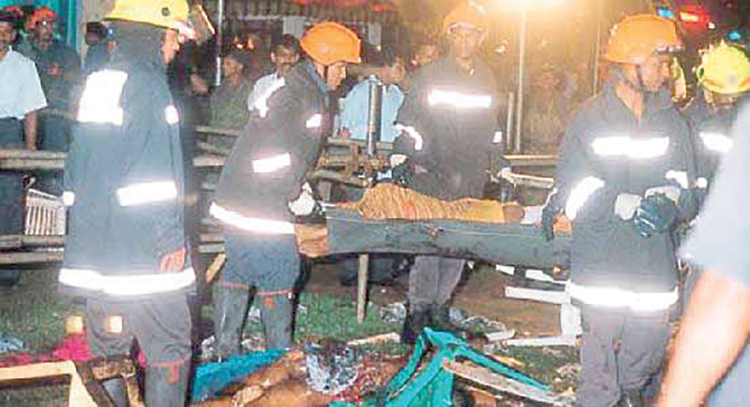
Ratnasiri Wickremanayake, the Prime Minister, had invited me to be a speaker at his final meeting in Horana. I waited till CBK arrived, spoke briefly to her and left for Horana. I had barely reached Havelock Town when I heard the sound of a blast from near the Town Hall. It was a well planned attempt on the life of CBK by the LTTE. Suicide bombers had come into the well packed grounds with a group of supporters of a Colombo district SLFP MP. Fortunately they had been prevented from coming close to the stage by the barriers set up by the Police.
CBK had finished her speech to a packed audience and was going down the gangway from the stage to her car when the bomber had detonated his bomb killing himself, several policemen, CBKs driver and many onlookers. But for the fact that her driver had driven up to the steps, thereby interposing the steel reinforced Mercedes Benz car between the bomb and CBK she would have been torn to shreds.
When we inspected the Benz it was a mass of twisted metal like a futuristic sculpture. I forgot about Horana and immediately rushed to the general hospital where to my relief I was told that the President was alive and out of danger. Since I had experience of the bombing of the UNP group meeting in Parliament during JRJs time, I rushed to Temple Trees to find that Sunethra Bandaranaike had fortunately promptly come there and was with the children upstairs.
The Temple Trees staff congregating downstairs were wandering about in shock till the arrival of President’s Secretary Balapatabendi. I urged that we should immediately get down Anuruddha Ratwatte -the Deputy Defence Minister, who at that time was in Kandy. A problem arose because helicopters could not fly at night. He was asked to come immediately by road and he did arrive in the shortest time.

Town Hall bomb scene CBK’s
In the meanwhile I suggested that Balapatabendi should broadcast the news that CBK was alive and out of danger as we had done with JRJ after the Parliament bombing. Already news about the attack was swirling because international media was using it as “Breaking News”. Bala and I went to the TV station and as he was getting into the studio I noticed that he was dressed in a black shirt which could have given a bad message to the country. I quickly took off my shirt and exchanged it for Balas black shirt. He then spoke on camera trying to calm the country wide audience dressed in an over-sized shirt.
We went back to Temple Trees and found that the PM and other Cabinet Ministers and relatives had arrived there and were taking charge of the situation. I then went to the General Hospital to see GL Peiris and Alavi Moulana who were in a state of shock and awaiting medical attention. Alavi’s shirt was blood stained and his sons were helplessly moving around asking for immediate medical attention.
After that both sides did not campaign in the remaining few days. The whole country was in a state of shock and disbelief. To the credit of Ranil Wickremesinghe he immediately visited CBK to wish her a speedy recovery and virtually called off his campaign. The shock of the Town Hall blast was compounded when almost at the same time a bomb was set off by the LTTE in Wattala where the UNP was holding a propaganda meeting. Major General Lucky Algama who was in charge of security was killed in this blast together with several UNP supporters.
Presidential Election December 2019
The presidential election was held as scheduled. We witnessed a clear shift of the sentiments of voters towards CBK after the bombing. I went to Kandy to cast my vote early as usual at the Nugawela voting centre. Immediately after that I left for Colombo. All along the road women of all ages were gathering in great numbers to cast their votes. It became clear that a sympathy vote was in the offing, especially among women. They could empathize with CBK who had lost a father and husband and now nearly lost her own life in the cause of public service.
The election results when announced proved that our hunch was correct. The declared results were as follows;
CBK
4,312,157 Votes [51.1 Percent]
Ranil
3,602,748 Votes [42.71 Percent]
Nandana Gunatillake
[JVP] 344,173 [4.08 Percent]
CBK then took a courageous decision which unfortunately backfired on her many years on as I will describe in a succeeding chapter. In the light of possible confusion following the bombing she decided to take her oath of office as the new President immediately though she had several months more to serve in terms of her earlier mandate. Though she had a team of brilliant lawyers including H L de Silva and R K W Goonesekere to advice on constitutional matters such details were not analyzed by her political staff. She took oaths before Chief Justice Sarath Nanda Silva and on the following day left for UK for medical treatment.
(Excepted from Vol. 3 of the Sarath Amunugma autobiography) ✍️

LESSONS FROM MY CAREER: SYNTHESISING MANAGEMENT THEORY WITH PRACTICE – PART 29
The last episode covered the final stages of my work as Advisor to the National Productivity Drive at the Ministry of Industrial Development. Soon after, in September 1998, I accepted the position of Managing Director of the Merchant Bank of Sri Lanka (MBSL). This chapter shares key events and lessons from my time there.
First few weeks at MBSL
The Board agreed that, for the first month, I would work only half-days, as I still had obligations I could not abandon. I was organising the International Convention on Quality Circles 1998, which attracted many foreign participants, and although we had appointed an event organiser, numerous arrangements still required my involvement. I will write more about that Convention later in these memoirs.
Those half-days turned out to be useful. They allowed me to quietly observe and understand the situation. MBSL was in worse shape than I had expected. The financial problems were visible to anyone who read the statements. The bigger crisis, however, was the staff’s morale and the rapid loss of staff members.
During the interim management period, many staff benefits had been cut, and several senior executives had already left. In the first few months, farewell gatherings became routine. It felt like rats leaving a sinking ship. And indeed, the organisation was sinking. Yet I had accepted the challenge — largely because I sensed that the Chairperson could secure government support, which she had already begun to do.
The broader environment added to the tension. The LTTE conflict was still active. Our office building, a very tall building located near the Colpetty junction, was a prime target. It had an Air Force unit with anti-aircraft guns on the rooftop one floor above he boardroom.. No one was allowed there without special permission, even though the area had originally been designed as a rooftop function space.
The first board meeting was quite hilarious because, while we were discussing important strategic issues, the upper floor was reverberating with a baila session, with boots tapping the floor keeping time. Apparently, the unit had an assurance that there would be no air strikes, and they could take a break.
My own office was spacious, but the windows were blocked because Temple Trees — the official residence of the Prime Minister — was clearly visible if not. At first, working without any outside view felt quite oppressive. Eventually, I grew accustomed to it.
Once I began full-time work in October, I carefully examined the situation with the help of my capable team. Several senior employees were not leaving for higher-paying opportunities or foreign jobs — they were committed, though uncertain about the future.
Then came investigations by the Central Bank and the Securities and Exchange Commission. Much of my time was spent responding to information requests and ensuring that all releases of information were approved. Many years previously, MBSL had unintentionally become a subsidiary of the Bank of Ceylon (BOC) when BOC’s investment arm purchased shares that pushed ownership above 50 per cent.
Hence although we were not a deposit taking institution and therefore not under the regulatory oversight of the Central Bank, we were under the Central Bank scrutiny because we were a subsidiary of the BOC. Although we were independent in operations, the customary practice was that the BOC Chairman would also chair MBSL, together with other BOC directors serving on our board. Our Chairperson, Mrs Dayani de Silva, was determined to turn MBSL around.
At that time, we operated two main divisions:
· Corporate finance, including advisory and investment banking; and
· Leasing, including trade finance.
In addition, there were the service divisions such as Human Resources, Secretarial and Finance and Accounting
Staff matters and the trade union
Morale was low. staff resisted the benefit cuts and the shift toward rules that resembled those of government departments. Signing an attendance register was particularly disliked.
I reviewed the situation carefully. Some of the removed benefits saved only trivial amounts. I reinstated those. I also installed an electronic time-card system for everyone — including myself. I announced clearly that I would clock in every day, just as they did. Naturally, the first few months were not easy.
I began holding monthly staff meetings to explain what we were doing, why we were doing it, and where we stood financially. Communication had clearly been lacking earlier, and these meetings helped rebuild trust. I also operated an “open door” policy, welcoming any employee who wished to meet me. The performance appraisal system was another issue. Instead of motivating staff, it had become a source of resentment. I suspended it for two years and asked everyone to work together as one team.
Most employees up to the Deputy Manager level were unionised, affiliated with the Ceylon Bank Employees Union (CBEU), headed by Mr M. R. Shah. The collective agreement was due, and the union presented a long list of demands — many of them impossible, given our financial state. Normally, negotiations take place between the Employers’ Federation of Ceylon (EFC) and the CBEU. The Director General of the EFC, Mr Gotabhaya Dassanayake, advised me first to build mutual confidence, especially as I had never met Mr Shah before.
I invited Mr Shah to my office. Over tea, I openly explained the crisis we were facing, our restructuring plan, and the management approach we intended to adopt. He listened carefully and asked sensible questions. We parted on friendly terms, and more importantly, with a shared understanding.
A month later, negotiations began at the EFC. To my surprise, Mr Shah began by saying that, after speaking with the new Managing Director, he understood our difficulties and accepted the direction we were taking. He then withdrew several demands on the spot. I was relieved, not because demands were dropped, but because he had recognised our sincerity and our plan. Later, Mr Dassanayake telephoned to say he had rarely seen such cooperation. In time, as restructuring succeeded, we gradually restored many benefits. That entire episode reinforced a powerful lesson: honest communication and genuine leadership build trust far faster than confrontation.
Expanding leasing
The board was deeply concerned about the leasing division. Non-performing loans were very high, and they urged me to restrict new business and focus solely on recoveries. I informed the board that management was partly to blame because the staff was pressured to meet stretch targets, and all we got were substandard leasing facilities. Targets without safeguards are never beneficial.
My thinking differed. Aggressive recovery efforts often demoralise good customers and overburden staff. In addition, the customers were already in great difficulty because they had no financial means to meet their leasing obligations. Instead, I believed we needed to build a new, healthier portfolio, while also expanding fee-based advisory work with lower risk. I had also abandoned my consultancy business when I joined MBSL, and proposed creating a new subsidiary to bring that kind of business into the bank. The board rejected it – understandably, given past failures with subsidiaries, including one in Nepal.
We decided that if our leasing operations were to grow, they needed to feel more connected to ordinary Sri Lankans. Research revealed that many people viewed us as an “English-speaking bank.” That perception alone discouraged potential customers.
So, we refreshed our leasing brand. The new logo carried the Sinhala word for “leasing,” applications were printed in Sinhala, and signboards carried both languages. Even the telephone operator’s greeting changed. Instead of the polished “Good morning, MBSL,” which sometimes intimidated Sinhala-speaking callers, we switched to “Ayubowan, MBSL.” It was friendly, respectful, and immediately accepted across all segments.
When an SME business owner comes for a lease, they have already selected the vehicle, and the decision is more based on ego than on a business requirement. We would discourage them and enlighten them that the vehicle does not match their requirements, and advise them to select a smaller one. They look unhappy, but they finally agree when presented with the maths of repayment.
We also organised short educational sessions for our customers on how to maintain vehicles, extend tyre life, the importance of the correct lubricants, and improve customer service. These simple initiatives created goodwill, strengthened customer relationships, and soon, the leasing business began to grow. At the same time, we were tough on recoveries, and some unpleasant moments included we seized a vehicle when a couple was on their honeymoon. The board, while pressuring me to recover, also constantly reminded me that no strong-arm tactics should ever be used.
Improving cash availability
Before I joined, two government institutions had agreed to provide debentures, with Treasury comfort letters. However, a condition required us to build a monthly sinking fund for repayment. To me, this made little sense. We were already short of operating cash. Locking more away would only weaken us further.
The head of finance had faithfully followed the rule. I instructed him to stop doing so and to use the funds for business expansion. When the board asked how we planned to repay the debentures, my answer was simple: growing organisations borrow when repayment comes due — that is how business operates.
We also began selling off our minority shareholdings from our share portfolio wherever possible even at a loss. The market was depressed, and those investments in shares contributed nothing to our survival. We retained only the Merchant Credit of Sri Lanka and divested the others. Gradually, liquidity improved, and operations stabilised.
The thorny bonus issue
Before my arrival, the board had approved bonuses despite the 1997 crisis. I was surprised how it happened soon after chalking up a billion rupee loss. However, just three months into my tenure, the board refused the December 1998 bonus. I found myself in a painful position. The EFC warned that withholding payment was risky because bonuses were written into appointment letters. Yet, reality was clear — we simply could not afford it.
I addressed the staff personally, explained the situation frankly, and announced the decision. The disappointment was visible everywhere. But given the circumstances, they accepted it.
There were more challenges and many more lessons still to come. In the next article, I will continue the story of how, step by step, we navigated those difficulties and rebuilt the organisation.
(The writer is a Consultant on Productivity and Japanese Management Techniques
Retired Chairman/Director of several listed and unlisted companies
Recipient of the APO Regional Award for Promoting Productivity in the Asia-Pacific Region
Recipient of the Order of the Rising Sun, Gold and Silver Rays from the Government of Japan
Email: bizex.seminarsandconsulting@gmail.com)
By Sunil G. Wijesinha ✍️

One person dead and 300 buildings destroyed in Australia bushfires

Iran warns it will retaliate if US attacks as protesters defy crackdown

GENERAL WEATHER FORECAST FOR NEXT 36 HOURS

National Communication Programme for Child Health Promotion (SBCC) has been launched. – PM

Level I landslide early warnings issued to the Districts of Badulla, Kandy, Matale and Nuwara-Eliya extended

Rescuers race to find dozens missing in deadly Philippines landfill collapse

‘Dates have the highest sugar content to fight Coronavirus’

Sunday Island 27 December – Headlines

#SundayIsland 17th December – Headlines

Sunday Island – 28th March

Sunday Island Headlines – 21 March

Sunday Island – 21st February – Headlines
-
 News20 hours ago
Sajith: Ashoka Chakra replaces Dharmachakra in Buddhism textbook
-

 News6 days ago
Interception of SL fishing craft by Seychelles: Trawler owners demand international investigation
-

 Features20 hours ago
The Paradox of Trump Power: Contested Authoritarian at Home, Uncontested Bully Abroad
-

 Business20 hours ago
Dialog and UnionPay International Join Forces to Elevate Sri Lanka’s Digital Payment Landscape
-
 News6 days ago
Broad support emerges for Faiszer’s sweeping proposals on long- delayed divorce and personal law reforms
-

 Features20 hours ago
Subject:Whatever happened to (my) three million dollars?
-

 News20 hours ago
65 withdrawn cases re-filed by Govt, PM tells Parliament
-

 Opinion3 days ago
The minstrel monk and Rafiki, the old mandrill in The Lion King – II