
Midweek Review
Some heretical thoughts on educational reforms

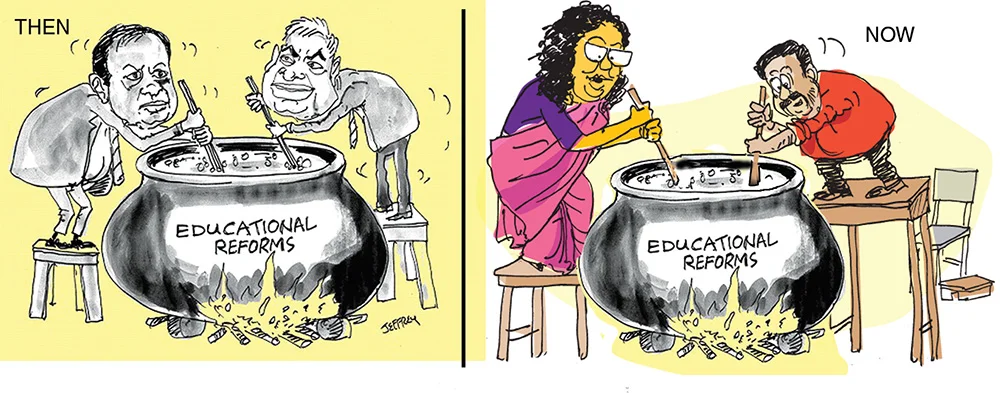
The term education originates from the Latin words ‘educare’, meaning ‘to bring up’, and educere, meaning ‘to bring forth’. The precise definition of education is disputed. But if it is linked with the obvious expected outcome of it – learning, then the definition of education changes to a resultant outcome of ‘a change in behaviour’.
Let me say this at the outset. I am not going to get embroiled in the nitty-gritty pros and cons of the current controversies hogging the headlines today. Except to say this. As every discerning and informed person says, we need educational reforms. There is near unanimity on that. It is the process – a long, and even tedious process – that needs to be carried out that gives rise to disagreements and controversy. A public discussion, stakeholder viewpoints and expert opinion should be given due time and consideration.
Sex education – “the birds and bees” to start with – has to be gradually introduced into school curricular. When? is the critical question that needs specific answers. Do we need to go by Western standards and practices or by a deep understanding of our cultural milieu and civilisational norms? One thing is clear in my mind. Introduction of sex education into school curricular must not be used – or abused – to make it a ‘freeway’ for indiscriminate enforcement of the whole human sexual spectrum before the binary concepts of human sexuality has been clearly understood by children – especially during their pre-pubertal and immediate post-pubertal adolescent years. I have explicitly argued this issue extensively in an academic oration and in an article published in The Island, under the title, “The child is a person”.
Having said that, let me get on to some of my heretical thoughts.
Radical thinkers
Some radical thinkers are of the view that education, particularly collective education in a regulated and organised school system, is systematic streamlined indoctrination rather than fostering critical thinking. These disagreements impact how to identify, measure, and enhance various forms of education. Essentially, what they argue is that education channels children into pliant members of society by instilling existing or dominant socio-cultural values and norms and equipping them with the skills necessary to become ‘productive’ members of that given society. Productive, in the same sense of an efficient factory production line.
This concept was critiqued in detail by one of my favourite thinkers, Ivan Illych. Ivan Illich (1926 – 2002) was an Austrian philosopher known for his radical polemics arguing that the benefits of many modern technologies and social arrangements were illusory and that, still further, such developments undermined humans’ image of self-sufficiency, freedom, and dignity. Mass education and the modern medical establishment were two of his main targets, and he accused both of institutionalising and manipulating basic aspects of life.
One of his books that stormed into the bookshelves that retains particular relevance even today is the monumental heretical thought ‘Deschooling Society’ published in 1971 which became his best-known and most influential book. It was a polemic against what he called the “world-wide cargo cult” of government schooling. Illich articulated his highly radical ideas about schooling and education. Drawing on his historical and philosophical training as well as his years of experience as an educator, he presented schools as places where consumerism and obedience to authority were paramount. Illich had come to observe and experience state education during his time in Puerto Rico, as a form of “structured injustice.”
‘Meaningless credentials’
Ilych said that “genuine learning was replaced by a process of advancement through institutional hierarchies accompanied by the accumulation of largely meaningless credentials”. In place of compulsory mass schooling, Illich suggested, “it would be preferable to adopt a model of learning in which knowledge and skills were transmitted through networks of informal and voluntary relationships”. Talking of ‘meaningless credentials’ it has become the great cash-cow of the education industry the world over today – offering ‘honorary PhDs’ and ‘Dr’ titles almost over the counter. For a fee, of course. I wrote a facebook post titled “Its raining PhDs!”.
Mass education and the modern medical establishment were two of his main targets, and he accused both of institutionalising and manipulating basic aspects of life. I first got to ‘know’ of him through his more radical treatise “Medical Nemesis: The expropriation of Health”, that congealed many a thought that had traversed my mind chaotically without direction. He wrote that “The medical establishment has become a major threat to health. The disabling impact of professional control over medicine has reached the proportions of an iatrogenic epidemic”. But it was too radical a thought, far worse than ‘Deschooling Society’. The critics were many. But that is not our topic for the day.
The other more politically radical views on education comes from Paul Freire. Paul Freire (1921 – 1997) was a Brazilian educator and Marxist philosopher whose work revolutionised global thought on education. He is best known for his 1968 book “Pedagogy of the Oppressed” in which he reimagines teaching as a “collaborative act of liberation rather than transmission”. A founder of critical pedagogy, Freire’s influence spans literary movements, liberation theology, postcolonial education, Marxism, and contemporary theories of social justice and learning. He is widely regarded as one of the most important educational theorists of the twentieth century.
Neutral education process?
Richard Shaull, in his introduction to the 13th edition of ‘Pedagogy of the Oppressed’ wrote: “There is no such thing as a neutral education process. Education either functions as an instrument which is used to facilitate the integration of generations into the logic of the present system and bring about conformity to it, or it becomes the “practice of freedom”, the means by which men and women deal critically with reality and discover how to participate in the transformation of their world”.
Here are a few quotes from Paul Freire before I revert to the topic I began to write on: “Liberating education consists in acts of cognition, not transferals of information.”; he believed that “true liberation comes from the oppressed taking agency and actively participating in the transformation of society”; he viewed “education as a political act for liberation – as the practice of freedom for the oppressed.”; He said that “traditional education is inherently oppressive because it serves the interests of the elite. It helps in the maintenance of the status quo.”
Where does our own ‘educational reforms’ stand? Is it transference, transformative, liberating or an attempt at maintaining the status quo with the help of the ADB? The history of educational reforms in Sri Lanka has been long. A quick check on the internet elicited the following:
Colonial Era (Pre-1940s): Colebrooke-Cameron Commission (1830s): Promoted English and standardised curriculum, laying groundwork for modern systems.
Buddhist Revival: Efforts by Anagarika Dharmapala to establish schools with Buddhist principles and English education.
The Kannangara Reforms (1940s): 1943 – Minister C.W.W. Kannangara introduced free education for all funded by general taxes; 1947 – introduced it from kindergarten to university. Central Schools (Madhya Maha Vidyalayas) established high-quality secondary schools in rural areas to ensure equitable access. Medium of Instruction was mandated to be the national languages (Sinhala and Tamil) for primary education.
Nationalisation and Standardisation
Nationalisation and Standardisation (1960s-1970s): 1961 – Denominational schools were taken over by the government to create a national education system. 1972 – New attempts at reform introduced following the 1971 youth uprising, focusing on democratising education and practical skills through a common curriculum and a national policy, responding to socio-economic needs. Introduction of language-based standardisation that in all likelihood triggered the ‘separatist war’. 1978 – change from language-based standardisation to district-based standardisation on a quota system for university entrance that was first introduced with a promise for only ten years, but persists until today, for nearly 50 years. No government dares to touch it as it is politically explosive.
Focus on quality and access (1980s-1990s): White Paper on Education (1981) – aimed to modernise the system together with components of privatising higher education. It faced severe criticism and public protests for its clear neoliberal leanings. And it never got off the ground. The National Colleges of Education (1986) were established.
1987 – Devolution of education power to provincial councils. 1991 – Establishment of The National Education Commission created to formulate long-term national policies. 1997 – Comprehensive reforms through a Presidential Task Force to overhaul the general education system (Grades 1-13), including early childhood development and special and adult education.
21st Century Reforms (2000s-Present): Mid-1990s-early 2000s – focused on transforming education from rote learning to competency-based, problem-solving skills; emphasising ICT, English, equity, and aligning education with labour market needs; introducing school restructuring (junior/senior schools) and compulsory education for ages 5-14; and aiming for national development through development of human capital.
Modernising education
2019 educational reforms focused on modernising education by shifting towards a modular, credit-based system with career pathways, reducing exam burdens, integrating vocational skills, and making education more equitable, though implementation details and debates around cultural alignment continued. Key changes included introducing soft skills and vocational streams from Grade 9/10; streamlining subjects, and ensuring every child completes 13 years of education; and moving away from an excessive focus on elite schools and competitive examinations.
This government is currently implementing the 2019 reforms in the National Education Policy Framework (2023–2033), which marks a radical departure from traditional methods. Module-Based System and a shift from exam-centric education to a module-based assessment system starting in 2026.
Already we have seen multi-pronged criticisms of these reforms. These mainly hinge on the inclusion – accidentally or intentionally – of a website for adult male friend groups. The CID is investigating whether it was sabotage.
Restricting access to social media
When there is a global concern on the use of smartphones and internet by children, and where Australia has already implemented a new law in December 2025 banning under-16s from major social media platforms to protect children from cyberbullying, grooming, and addiction, requiring tech companies to use age verification.
The U.S. does not have a federal law banning smartphones for under-16s, but a major movement, fuelled by the US Surgeon-General warnings and research on youth mental health, is pushing for restrictions, leading many individual states (like California, Florida, Virginia) to enact laws or guidelines for school-day bans or limits for students, focusing on classroom distraction and social media risks, with some advocates pushing for no smartphones before high school or age 16.
The UK doesn’t currently have a legal ban on smartphones for under-16s, but there’s significant political and public pressure for restrictions, with debates focusing on social media access and potential school bans, with some politicians and experts advocating bans similar to Australia’s, while others push for stronger regulations under the existing Online Safety Act to protect children from addictive algorithms and harm.
Sweden is implementing a nationwide ban on mobile phones in schools for students aged 7 to 16, starting in autumn 2026, requiring devices to be handed in until the school day ends to improve focus, security, and academic performance, as part of a major education reform. This national law, not just a recommendation, aims to reduce distractions and promote traditional learning methods like books and physical activity, addressing concerns about excessive screen time affecting children’s health and development.
Norway doesn’t have a complete smartphone ban for under-16s but is moving to raise the minimum age for social media access to 15 and has implemented strong recommendations, including a ban on phones in schools to protect children from harmful content and digital overexposure, with studies showing positive impacts on focus and well-being. The government aims to shield kids from online harms like abuse and exploitation, working with the EU to develop age verification for platforms like TikTok and Instagram.
Finland implemented a law in August 2025 restricting smartphone use for students aged 7-16 during the school day, empowering teachers to ban devices in classrooms, meals, and breaks, except for educational or health reasons, to combat distractions, improve focus, and support student well-being and social skills. The move aims to create calmer learning environments, reduce cyberbullying, and encourage more in-person interaction, giving teachers control to confiscate disruptive phones, though digital tools remain part of education.
Trend in liberal west
When this is the trend in the ‘liberal West’ on the use of smartphones by children in schools, did not our educational reform initiators, experts and pundits in the NIE not been observing and following these worldwide trends? How could they recommend grade 6 children to go to (even a harmless legitimate) website? Have they been in hibernation when such ‘friend/chat room’ sites have been the haunt of predatory paedophile adults? Where have they been while all this has been developing for the past decade or more? Who suggested the idea of children being initiated into internet friends chat rooms through websites? I think this is not only an irresponsible act, but a criminal one.
Even if children are given guided, supervised access to the internet in a school environment, what about access to rural children? What about equity on this issue? Are nationwide institutional and structural facilities available in all secondary schools before children are initiated into using the internet and websites? What kind of supervision of such activities have been put in place at school (at least) to ensure that children are safe from the evils of chat rooms and becoming innocent victims of paedophiles?
We are told that the new modular systems to be initiated will shift assessments from an exam-centric model to a modular-based, continuous assessment system designed to prioritise skill development, reduce stress, and promote active learning. The new reforms, supposed to begin in 2026, will introduce smaller, self-contained learning modules (covering specific topics or themes) with integrated, ongoing assessments.
Modular assessment and favouritism
I will not go into these modular assessments in schools in any detail. Favouritism in schools is a well-known problem already. 30% of final assessments to be entrusted to the class teacher is a treacherous minefield tempting teachers into corrupt practices. The stories emanating from the best of schools are too many to retell. Having intimate knowledge of what happens to student assignment assessments in universities, what could happen in schools is, to me, unimaginable. Where do the NIE experts live? In Sri Lanka? Or are they living in ideal and isolated ivory towers? Our country is teeming with corruption at every level. Are teachers and principals immune from it? Recently, I saw a news item when a reputed alumnus of “the best school of all” wrote a letter to the President citing rampant financial corruption in the school.
This article is already too long. So, before I wind up, let me get on to a conspiracy theory. Why have the World Bank and the ADB been pumping millions of USD into ‘improving’ our education system?
World Bank
The World Bank is the largest source of external financing for education in developing countries, maintaining an active portfolio of approximately $26 billion in 94 countries reaching an estimated 425 million students— roughly one-third of all students in low- and middle-income countries.
The World Bank funds education globally through loans, grants, and technical assistance to improve access, quality, and equity, focusing on areas like teacher training, digital infrastructure, and learning outcomes, with significant recent investment in Fragile, Conflict, and Violence (FCV) settings and pandemic recovery efforts. Funding supports national education strategies, like modernising systems in Sri Lanka, and tackles specific challenges such as learning loss, with approaches including results-based financing and supporting resilient systems. Note this phrase – ” … with significant recent investment in Fragile, Conflict, and Violence (FCV) settings ….”. The funds are monumental for FCV Settings – $7 billion invested in Fragile, Conflict, and Violence settings, with plans for $1.2 billion more in 2024-25. Now with our Ditwah disaster, it is highly fertile ground for their FCV investments.
Read Naomi Kline’s epic “The Shock Doctrine: The rise of disaster capitalism”. It tells it all. It must be read and digested to understand the psychology of funding for FCV settings.
The 40.3 million USD World Bank’s IRQUE (Improving Relevance and Quality of Undergraduate Education) Project in Sri Lanka (circa 2003-2009) was a key initiative to modernize the country’s higher education by boosting quality, accountability, and relevance to the job market, introducing competitive funding (QEF), establishing Quality Assurance (QA) functions for the first time, and increasing market-oriented skills, significantly reducing graduate unemployment. I was intimately involved in that project as both Dean/Medicine and then VC of University of Ruhuna. Again, the keywords ‘relevance to the job market’ comes to mind.
The Asian Development Bank (ADB) is heavily funding education reform in Sri Lanka, notably with a significant $400 million loan (Secondary Education Sector Improvement Program – SESIP) to transform secondary education, aligning it with global knowledge economy demands, improving curriculum, teacher training, and infrastructure for quality access. ADB also provides ongoing support, emphasising teacher training, digital tech, and infrastructure, viewing Sri Lanka’s youth and education as crucial for development. The keywords are ‘aligning it with global knowledge economy demands’. As of 2019, ADB loans for education totalled approximately $1.1 billion, with cumulative funding for pre-primary, primary, and secondary education exceeding $7.4 billion since 1970 in the Asia-Pacific region.
Radical view of IMF and WB
A radical view of the Bretton Woods twins – the International Monetary Fund (IMF) and the World Bank – and the ADB characterises them not as neutral facilitators of global economic stability and egalitarian economic development in poor countries, but as tools of Western hegemony, neoliberal imposition, and institutionalized inequality. From this perspective, these institutions, created to manage the post-WWII economic order, have evolved into instruments that perpetuate the dominance of the Global North over the Global South.
The World Bank and the ADB (in our part of the world) have been investing heavily on education reform in poor countries in Asia and Africa. Why? Surely, they are not ‘charity organisations’? What returns are they expecting for their investments? Let me make a wild guess. The long-term objective of WB/ADB is to have ‘employable graduates in the global job market’. A pliant skilled workforce for exploitation of their labour. Not for “education as a political act for liberation” as Paul Freire put it.
I need to wind up my heretical thoughts on educational reform. For those of us who wish to believe that the WB and ADB is there to save us from illiteracy, poverty and oppression, I say, dream on.
“Don’t let schooling interfere with your education. Education consists mainly of what we have unlearned.” – Mark Twain
by Susirith Mendis
Susmend2610@gmail.com


Sri Lanka’s disastrous tour of Australia in 2022 (09 Oct. to 13 Nov.) caused widespread anger among the cricket community and the cricket loving public. The Auditor General’s special report that dealt with that tour revealed significant financial irregularities regarding the SLC executive committee’s visit there for the 2022 T20 World Cup. In spite of heavy media focus on the AG’s report in the run-up to the World Cup debacle in India, the government lacked the political will to deal with the developing situation. The then Auditor General W.P. C. Wickramaratne stood by his report. The top official, who retired in April 2025, reiterated the serious revelations but the Parliament conveniently discarded it.
Former parliamentarian Eran Wickramaratne’s unexpected move jolted the Samagi Jana Balawegaya (SJB). In spite of being aware of covert moves to bring in Wickramaratne as chief of the corruption-riddled Sri Lanka Cricket (SLC), in place of Shammi Silva, the SJB never really believed it could succeed as it was considered a literal goldmine. But when President Anura Kumara Dissanayake pushed the deal through on 29 April, a furious SJB General Secretary Ranjith Madduma Bandara, however, tried to save face by merely declaring it as a political appointment. The veteran politician said so when the media sought his reaction to Wickramaratne’s move at the P.D. Sirisena grounds, Maligawatte, the venue of SJB May Day rally.
Earlier, in response to Wickramaratne’s declaration that he quit the SJB’s Working Committee and Management Committee to pave the way for him to accept the top SLC post, Madduma Bandara asked Wickramaratne to give up the party membership, too.
President Dissanayake’s move caught the main Opposition party, as well as the Sri Lanka Podujana Peramuna (SLPP), by surprise. The vast majority of parliamentarians, representing the Janatha Vimukthi Peramuna (JVP)-led ruling National People’s Power (NPP), couldn’t have been aware of the operation executed by President Dissanayake.
There hadn’t been a previous instance of the NPP accommodating an ex-parliamentarian from a rival party in any capacity. The top NPP leadership always indicated that those who represented other political parties in Parliament wouldn’t be welcome. Ex-lawmaker Field Marshal Sarath Fonseka threw his weight behind the JVP/NPP on numerous occasions, during Aragalaya and the post-presidential polls. Although some expected the war-winning Army Commander to receive an invitation from the NPP, it never materialised. Then, what really made the NPP extend an invitation to Wickramaratne, who first entered Parliament on the UNP National List at the 2010 general election. Wickramaratne contested Colombo at the 2015 general election on the UNP ticket and was appointed Deputy Minister of Investment Promotions and Highways. Widely regarded as one of UNP leader Ranil Wickremesinghe’s favourites, Wickramaratne switched his allegiance to Sajith Premadasa in early 2020 and contested the Colombo district on the newly registered SJB and served as a lawmaker till 2024. Wickramaratne failed to regain his seat in the 2024 general election.
Wickramaratne had been one of the leading proponents of Yahapalanaya (2015-2020) that perpetrated Treasury bond scams in February, 2015, and March, 2016, and a key member of the 106 parliamentary group. As a SJBer, he represented a much smaller parliamentary group that consisted of 54 lawmakers.
What made the former banker, Wickramaratne, accept the daunting challenge of restructuring the utterly corrupt SLC, the country’s richest sports body, embroiled in wasteful practices? As a key member of the SJB, during the 2020-2024 period, Wickramaratne knew how SLC manipulated Parliament and proceeded with its agenda during Shammi Silva’s leadership.
The SJB spearheaded a vigorous campaign, targeting SLC, though it never managed to overwhelm the sports body that enjoyed unprecedented backing of the executive. In spite of the Parliament unanimously adopting a joint resolution calling for the removal of the SLC management, including its Chairman Shammi Silva, that board remained. President Dissanayake executed an operation that replaced Shammi Silva with Eran Wickramaratne. That brought Wickramaratne’s affiliation with the SJB to an unceremonious end. Ex-MP Wickramaratne made his move at the expense of the SJB parliamentary group, now down to 40 in the current Parliament.
The NPP secured an extraordinary 159 seats at the last parliamentary election. That tally included 18 National List slots.
The second largest party in Parliament consists of 40 including five NL slots. The remaining seats in the 225-member Parliament were shared by Ilankai Tamil Arasu Kadchi (ITAK/8), New Democratic Front (NDF/5), Sri Lanka Podujana Peramuna (SLPP/3), Sri Lanka Muslim Congress (SLMC/3), Sarvajana Balaya (SB/1), United National Party (UNP/1), Democratic Tamil National Alliance (DTNA/1), All Ceylon Tamil Congress (ACTC/1), All Ceylon Makkal Congress (ACMC/1), Jaffna – Independent Group 17 (IND17-1) and the Sri Lanka Labour Party (SLLP/1).
A surprising move
The NPP brought in Wickramaratne ostensibly to clean up SLC at a time the current dispensation, plagued by various allegations, is under heavy fire. Many eyebrows were raised over the calculated move that eased pressure on the government. Obviously, the former investment banker had no qualms in joining the government, amidst the continuing controversy over (1) release of 323 red-flagged containers from the Colombo port, without mandatory physical checks; (2) resignation of Energy Minister Punykumara aka Kumara Jayakody, after the release of the damning National Audit Office (NAO) report on the coal-scam, in the wake of the unsuccessful SJB No-Confidence Motion (NCM), the first since the 2024 September presidential election; (3) massive Rs 13.2 bn fraud at the National Development Bank in which Eran served as the Chief Executive Officer in 2001 (4) staggering USD 2.5 mn heist at the Treasury that devastated the government.
It would be pertinent to mention that he resigned from the NDB to enter Parliament on the UNP National List at the 2010 parliamentary poll, close on the heels of the re-election of Mahinda Rajapaksa for a second presidential term.
Within 24-hours after Wickramaratne accepted the NPP offer, the Treasury scam took an absolutely unexpected turn when an Assistant Director at the External Resources Department of the Finance Ministry, Ranga Rajapaksa, who had been interdicted over the alleged theft, was found dead, under suspicious circumstances, just outside his residence in Kuliyapitiya.
In spite of a panel of Judicial Medical Consultants, appointed to conduct the post-mortem examination on the body of Ranga Rajapaksa, concluded that all injuries were self-inflicted and that the death was due to suicide, the SJB questioned the circumstances of the death.
The SJB felt betrayed by Eran’s move at a time the Opposition was making headway, though the NPP enjoy an unchallengeable 2/3 majority in Parliament. Confident that corruption allegations, particularly the USD 2.5 mn affair and the suicide of top Finance Ministry official eroded public confidence, the SJB challenged the NPP to hold the long-delayed Provincial Council polls. The challenge was issued at the May Day rally held at P.D. Sirisena grounds, Maligawatta. SJB leader Sajith Premadasa declared if President Dissanayake accepted his challenge the next May Day will be held with SJB Chief Ministers in charge of the PCs.
The man is definitely no saint either as he once got caught campaigning with a group of his supporters in Moratuwa during the moratorium on canvassing just before an election.
Eran Wickramaratne, whatever said and done in his defence, will find it extremely difficult to explain why he switched his allegiance to the NPP, particularly against the backdrop of serious allegations. The ongoing parliamentary probe into the container affair, as well as the growing energy crisis due to the West Asia conflict, and low quality coal supplied to the country’s only coal-fired power plant, Lakvijaya at Norochcholai, and threat to the banking sector, obviously failed to deter Wickramaratne from switching sides. The former Deputy Minister obviously risked his principled stand throughout his political career against corruption.
However, like all other UNP and SJB politicians, Wickramaratne cannot, under any circumstances, absolve himself of the UNP’s culpability in Treasury bond scams, perpetrated under Prime Minister Ranil Wickremesinghe’s watch. Perhaps, over a decade after the first Treasury bond scam, many people still do not know that the Central Bank had been under Wickremesinghe at the time when then Central Bank Governor, Singaporean Arjuna Mahendran, struck. Wickramaratne remained loyal to the party though, unlike Sujeewa Senasinghe (current member of SJB parliamentary group), he didn’t launch a booklet in defence of Mahendran.
In the wake of Sajith Premadasa’s defeat at the 2019 presidential election, the party split, with the majority of members of the UNP group in the Yahapalana parliament switching allegiance to Sajith Premadasa. The SJB never explained its stance on Treasury bond scams that ruined the administration, at the very onset of its much-touted 100-day programme. The SJB needs to at least acknowledge its responsibility for its conduct, during that time, as some of those who shielded the bond thieves represent the party in Parliament now.
Widely referred to as the “footnote gang” the group has been accused of inserting footnotes into a COPE committee report on the Central Bank Treasury bond scams, literally challenging its findings. Key members often highlighted include Harsha de Silva, Sujeewa Senasinghe, Ajith P. Perera, Harshana Rajakaruna, Hector Appuhamy, Ashok Abeysinghe, Abdul Maharoof, Wasantha Aluvihare, and Ravindra Samaraweera.
Shammi vs Roshan
In the wake of Sri Lanka’s humiliating exit from the 2023 ICC Men’s Cricket World Cup following a massive 302 run-defeat inflicted by India at Wankhede Stadium, Mumbai. Australia won the tournament played in India from October 05 to November 19, 2023.
Sports Minister Roshan Ranasinghe, who also held the Youth Affairs and Irrigation portfolios, pounced on the opportunity to oust Shammi Silva’s cricket administration. The Polonnaruwa District MP, as well as those who wanted to see the back of Shammi Silva, who had been at the helm, since February, 2019, felt that they wouldn’t get a better chance. The SJB threw its full weight behind the Sports Minister’s project though he represented the SLPP that reached a consensus with Ranil Wickremesinghe, regarding post-Aragalaya administration. For the SJB, the Sports Minister’s move presented an opportunity to rock the administration struggling to cope up with growing economic woes.
Within days after India thrashed Sri Lanka, Ranasinghe sacked the cricket administration and brought in a committee, headed by Arjuna Ranatunga, the skipper of 1996 World Cup winning team. Inclusion of Jayantha Dharmadasa in the Ranatunga-led interim committee caused controversy though, as a whole, the public approved the move. But, Shammi hit back hard. Within 24 hours, SLC challenged the Minister’s action.
The Court of Appeal quashed the Sports Minister’s decision to sack the country’s crisis-ridden cricket board and restored the expelled officials, pending a full hearing. Shammi had the unconditional backing of the Indian Cricket board and, most importantly, the protection of the executive. Wickremesinghe had no qualms in shielding Shammi and his team, though Sports Minister Roshan was elected to Parliament on the SLPP ticket.
An irate Sports Minister revealed in Parliament how Wickremesinghe demanded that he rescind the decision to sack the cricket administration. Wickremesinghe wanted Shammi back at the helm of the SLC whatever the allegations directed at him. The Sports Minister disclosed in Parliament how he refused to carry out Wickremesinghe dictatorial directive and challenged him to do whatever he desired.
The resolution, unanimously adopted by the Parliament on 09 November, 2023, to get rid of the cricket administration, had no impact on Wickremesinghe. Eran Wickramaratne had been a member of that Parliament though he now quietly contributed to a strategy that enabled the NPP government to replace Shammi without causing any unnecessary issues.
When Roshan declined to reinstate what he repeatedly described as corrupt cricket administration, Wickremesinghe sacked him from the Cabinet of Ministers. Perhaps, the UNP leader had the tacit support of the top SLPP leadership to drop the ‘Pohottuwa’ man from the Cabinet. The SLPP never really took up that issue as Wickremesinghe, in consultation with his Chief of Staff Sagala Ratnayaka, plotted a controversial course.
The sacked Sports Minister hit back hard at Wickremesinghe and Sagala Ratnayaka, in and outside Parliament. Alleging that his life was in danger, Roshan said that in case of any harm caused to him, Wickremesinghe and Ratnayake should be held responsible. The lawmaker urged the Speaker not to expunge his statement from Hansard.
During the war of words, between Roshan and the SLC in November, 2023, the latter lodged a complaint with the Commission to Investigate Allegations of Bribery or Corruption (CIABOC) accusing him of misappropriation of funds made available by them to the National Sports Fund. There had never been a similar case in which the Cricket Board/SLC moved CIABOC against the subject Minister.
Shammi proved again that with right connections challenges could be successfully neutralised. But, his feat remains extraordinary as he thwarted the unanimous resolution adopted against him in Parliament. There had never been an instance where the Parliament took such a stance in respect of an individual or a particular body. Wickremesinghe, in spite of the Parliament, at that time, represented by only one National list MP from the UNP (defeated Galle District candidate Wajira Abeywardena) without hesitation sacked a Cabinet Minister appointed by his predecessor Gotabaya Rajapaksa.
Wickremesinghe’s actions underscored how the executive could undermine Parliament, regardless of consequences. Shammi emerged far stronger and proceeded with his agenda.
A visit to Mandaitivu
Having backed the SJB-led November 2023 move in Parliament against SLC, perhaps the electorate believed the first elected post-Aragalaya government would swiftly move against the powerful cricket administration. However, that issue took a back seat as the NPP confronted other challenges. By then previously mentioned issues, particularly the coal scam that exposed the NPP’s duplicity, grabbed media attention, and SLC was conveniently forgotten.
Then suddenly, on Shammi Silva’s invitation, President Dissanayake visited Mandaitivu island, situated about three kms off Jaffna town and is connected to the peninsula, via a causeway.
On September 1, 2025, Dissanayake laid the foundation stone there for what the SLC called Jaffna international cricket ground, on 48 acres, featuring 10 centre wickets with boundary distance extending up to 80 meters, exceeding international standards. The SLC declared the proposed seventh international stadium would have a spectator capacity of 40,000, positioning it as a premier cricket destination in the region.
The SLC couldn’t complete the work before the end of December, 2025, due to Cyclone Ditwah, and other reasons, including the absence of an Environmental Impact Assessment (EIA) report. The Chairman of the Central Environmental Authority, Professor Tilak Hewawasam, is on record as having said in late February this year that instructions were issued to halt the construction work under way at the Jaffna International Cricket Stadium until SLC secured environmental impact assessments to permit them to grant formal approval.
The launch of the Mandaitivu project was in line with the overall plan to create a 138-acre sports city in the Jaffna district. Those who opposed the project have alleged that it would be an ecological disaster and Mandaitivu should never have been considered for an international cricket stadium. It would be interesting to see how the new SLC chief addressed this issue alone, leaving aside all else.
Some of the criticism directed at the Jaffna sports city project is political. Northern Province-based politicians and other interested parties, not with the NPP, feel the proposed project may further erode their support base. Their concerns have to be addressed, taking into consideration President Dissanayake’s success in winning both the Northern and Eastern electoral districts at the presidential and parliamentary polls in 2024. The NPP created political history when it defeated the Illankai Thamil Arasu Kadchi (ITAK) in predominantly Tamil speaking regions thereby proving that the party could be overwhelmed.
Although the ITAK regained some respectability at the Local Government polls in 2025, the NPP still enjoys overwhelming superiority in the North and East but the actual situation can be ascertained only if President Dissanayake accepted the SJB’s challenge to conduct Provincial Council polls soon.
Wickramaratne now faces an extraordinary challenges, a situation he never experienced during the time as a UNP MP from 2010 to 2020 and then SJB lawmaker from 2020 to 2024. It wouldn’t be easy as many interested parties, including those antagonised by his move whatever the consequences of Mandaitivu environmental issues, would be out to target him. In case Wickramaratne failed in his capacity as the SLC chief to take remedial measures, he would have to face the consequences. The NPP, too, will be at the receiving end for obvious reasons.
While a section of the SJB asserted that Wickramaratne’s actions were treacherous, given his role in the party, some believe that the invitation extended to the former parliamentarian revealed that the NPP lacked suitable persons among them to take such a high profile assignment. The question is whether Wickramaratne can pull it off or himself be overwhelmed by an utterly corrupt system that progressed over the years with the connivance of politicians.
Shammi Silva couldn’t have retained SLC leadership without contest for just over seven years sans heavy political backing. That is the undeniable truth. The latest ‘arrangement’ that compelled him to give up the hot seat about 11 months before the end of his term enabled the controversial figure to avoid investigations into past affairs. Bringing in Wickramaratne, too, seems to have the approval of Shammi Silva who proved his mettle as a shrewd negotiator.
By Shamindra Ferdinando

 As almost the whole country knows by now, a group of 22 Buddhist monks were arrested on 25 April 2026, by the Police Narcotics Bureau at the international airport in Katunayake carrying approximately 112 kilograms of Kush, a high-grade, potent strain of cannabis and Hashish with a street value of over LKR 1,100 million. It is supposed to be the largest drug haul of this kind at the airport and has made global news too.
Locally, and particularly on social media, it has opened a very vocal debate with two main streaks. One has already judged the monks as guilty, purely based on information and stories in free circulation on the internet. The other claims that these are not even monks, but are imposters planted to bring disrepute to Buddhism while some articulations within this streak even go to the extent of claiming government culpability, without offering an iota of evidence. Almost none of these discusses in any serious manner what this means in terms of the law of the land and its applicability to Buddhist monks, and why this level of criminality has occurred from within the clergy in the first place. Such reflection, however, is the only sensible thing that should come out of this unfortunate incident which had considerably dangerous consequences for society if the narcotics went undetected.
The law in our country seems to apply differently or at least very slowly when it comes to Buddhist monks. This suggests that they occupy some kind of undefined but privileged status above citizenship and its constituent responsibilities. People may have noticed that Buddhist monks do not stand when the national anthem is being sung even though it is standard etiquette across the world including in our country to do so. But this exception in practice does not seem to apply to other religious leaders.
When as a schoolboy in the 1980s, I asked one of my teachers, a Buddhist monk, whom I still hold in high esteem, why this was the case, his answer was, this was the tradition since the time of the Buddha. My classmates and I pointed out to him that at the time of the Buddha, there were neither nations nor national anthems, and this question would not have even arisen. But there are stories from Buddhist history and literature that might be interpreted as monks being treated differently and elevated in status even above rulers due to their spiritual attainment. But today, we are not dealing with remnants of a distant history and belief, but the present in vastly transformed social and legal conditions.
Obviously, this is a tradition born out of wrongful and selective interpretation of respect and veneration, and not a formal legal exemption. Partly, that veneration comes from narratives in Buddhist literature, such as the incident involving Emperor Asoka and the seven-year-old novice monk, Venerable Nigrodha, who it is said to have sat on the emperor’s throne, when invited to be seated. Whatever the actual sources of this veneration are, what it does in contemporary times, is to set apart Buddhist monks symbolically from other citizens with the indication that the law of the land applies differently to them and that too, favourably. In practice, unfortunately, this becomes a cover within which errant individuals can hide from the long arm of the law as well as common sense and ethics that apply to all others.
The cultural and political logic behind this practice assumes that Buddhist monks are beyond and above the law, which is meant for the laity, and that such noble individuals will not do anything wrong. But even in the time of the Buddha itself, this was not a fact as Buddhist history explains well. It is precisely this cultural logic that led some commentators to use two interesting words to describe the 22 monks arrested at the airport and another who was arrested later who was to be the recipient of the drugs. One word is chiwaradhaarin,
literally meaning those wearing robes without implying their possible belonging to any local ecclesiastical order. In contemporary usage, it is also a somewhat insulting term. The other word is, bhikshu prathirupakayin, literally meaning people masquerading as monks. The whole point here was to delink these errant monks from monkhood and therefore from Buddhism itself because the alleged crime was too serious.
The Mahanayaka Theras of the Siyam, Amarapura, and Ramanna chapters issued a statement on 26 April 2026, just one day after the arrests, referring to the arrested as bhikshu prathirupakayin (people masquerading as monks) who were misusing the robe and noted these acts were against Buddhism and called for the suspects to be duly punished and prosecuted to the fullest extent of the law. On 28 April, the President met the Mahanayaka Theras and other senior monks to discuss the fallout and possible future action including closer supervision of monks within the order. Ideally however, neither this statement nor the meeting with the President was necessary if monks were treated as a matter of routine like normal citizens when they violate the law of the land. It is precisely based on this principle that the police arrested them in the first place. But there is no doubt they receive special treatment everywhere in the country, including in the airport.
It is this sense of privilege under the law that needs to end. When I say this, I am not talking of individual respect to monks people might have, based on their knowledge of the dhamma, including myself. That is a matter of individual preference. I also do not mean disciplinary supervision, investigation of institutional malpractices and disciplinary or vinaya breaches and punishments which can be carried out by the religious organisations themselves if they have a workable system. But if monks, like any other citizen, violate the law of the land whether it is drug trafficking, rape, child abuse, financial irregularities, instigating violence and so on, then, they cannot be offered special treatment or leniency. They must be held accountable and prosecuted, but fairly, like all of us deserve. No exceptions can be made.
The sheer noise of the local debate also has not posed yet another pertinent question that is important in this context. That is, how has it become possible for monks to engage in such obviously illegal acts with massively negative consequences for the society which they are supposed to serve selflessly? What has gone wrong, where and why?
Ven. Gurugoda Siriwimala made the following observations in a Facebook post in Sinhala on 27 April, which outlines the prevailing situation very rationally and clearly:
“The Bhikkhu Sasana (The Buddhist Monastic Order) in Sri Lanka is part of the country’s own decline. When a nation falls into decay, it is impossible for one specific segment within it to remain unaffected. The most tragic aspect of this is that in a country like Sri Lanka, where the cultural fabric is heavily built upon religion, the clergy—who ought to be the ultimate role models—have descended into such a state of degeneration.
The Monastic Order in Sri Lanka has become mere puppets of political parties and the media. For ordinary monks like us—who travel in public buses and subsist on the alms provided by ordinary people—it has become a matter of such shame that we feel like we must hide our faces. But these are not issues to monks who hardly walk in the streets, who constantly hold press conferences and utter foolhardy things from political stages.
Political parties in Sri Lanka have divided the clergy among themselves, maintaining a group of prominent monks who would act according to party agendas. We see even at this very moment how they are being manipulated like puppets. A group of hollow, senseless fools with no spiritual sensibility whatsoever are making a mockery of themselves in front of the whole country by holding press conferences morning and night. These monks lack education; they possess no understanding—either at a national or international level—of the subjects they speak about …”
Ven. Siriwimala’s articulation is the clearest explanation of what is happening in the Buddhist monastic order that I have read in recent times. What is even more important is that it has come as a self-reflective critique from within. The drug-carrying monks are not an unusual occurrence or an anomaly when it comes to drug trafficking in the country in general or reported malpractices involving some other monks on numerous other occasions. According to publicly available reports, some monks have repeatedly insulted minority religious practices and sentiments. One example of this is the current case in which indictments have been served against one of these monks for a case from 12 years ago. His discourses of violence are matters of public record as are the records of others. Sexual violence and child abuse involving some other monks have also come to the forefront on and off including the case of a monk who was found guilty of multiple counts of sexual assault by the Isleworth Crown Court in London in 202 and placed on the UK Sex Offenders Register for life even though he is running a school close to Colombo. There are many such cases circulating in public discourse, but not all of these have been prosecuted. Much has been silenced by inaction.
As Ven. Siriwimala has rightly pointed out, many monks have become problematic mouthpieces for political parties and political interests. Even the manner of their public articulation and behaviour as well as the nature of political involvement have become shameful, to put it mildly. But almost none have faced consequences within the ecclesiastical order of institutional Buddhism.
What this overall situation has done is to bring the Buddhist ecclesiastical order into needless disrepute. And much of this has happened due to the unfortunate silence of the Mahanayaka Theras and other senior prelates when they should have campaigned for reform within their monastic orders and paved the path towards prosecution in the same way they have done in the context of the recent drug interdiction. Seen in this sense, the present issue is nothing new. It is merely one of the more visible examples of a much deeper malaise.
Whenever I hear of these issues and the relative silence from within the monastic order, I am constantly reminded of the Buddha’s own words in Aṅguttara Nikāya (Numerical Discourses) and particularly in Anāgatabhaya Sutta (Discourse on Future Dangers). The ‘future dangers’ that would lead to the corruption of the Sangha and the disappearance of the Saddhamma (True Dhamma) the Buddha articulated include the following, all of which have to do with monks: 1. Lack of training and discipline among monks and the resultant consequences; 2) consequences of monks stopping paying attention to the profound teachings of the Dhamma; 3) monks focusing on excessive materialism and luxury and distancing themselves from practices such as meditation and seeking liberation; 4) the emergence of conflict and factionalism as a result of which monks becoming argumentative and using the Dhamma as a weapon to attack one another rather than as a means to liberation; 5) all this would finally lead to the corruption of the teachings of the Buddha and monks would end up teaching what is not the Dhamma but present it as the Dhamma and will teach what is not the Vinaya but present it as the Vinaya.
Is it not this that is happening today? Aren’t the kind of examples of malpractices I have outlined above indicative of this situation which the Buddha himself foresaw in his own lifetime? If the April 2026 drug bust is to serve a purpose for the future, it should happen at two levels: 1) the government and the laity should not treat monks as privileged when they engage in wrong-doing and violate the law of the land. The government should make it very clear formally that the law enforcement and judicial systems must fully prosecute violators of the law without any exceptions; 2) Leaders within the Buddhist monastic order including the Mahanayaka Theras and other senior prelates as well as their lay supporters should establish and empower an urgent system of internally addressing issues within their own orders and organisations, which should include the identification of wrong doers on the basis of specific ecclesiastical or legal violations and their expulsion from their monastic orders. There should not be any exceptions.
If this bare minimum can be achieved without delay and that too with honesty, then, we can imagine a more sanguine future where Buddhism can play the role it is supposed to. If it cannot be done, then, the future will be what the Buddha has already predicted.

A Small, cheery wayside bakery,
A sought-after oasis by the needy,
Is now empty, barred and bolted,
Leaving its workers helpless and aghast,
While the eatery is up for grabs it seems,
And townsfolk are given to understand,
That soaring rentals caused its demise,
And all this came to pass just a day after,
The Red-shirted gentry from grandstands,
Pledged timely lifelines to the underclass,
But ground-level facts proclaim otherwise;
The Dignity of Labour is an orphaned cause.
By Lynn Ockersz
-

 News4 days ago
MIT expert warns of catastrophic consequences of USD 2.5 mn Treasury heist
-
 News6 days ago
CJ urged to inquire into AKD’s remarks on May 25 court verdict
-

 News7 days ago
USD 3.7 bn H’tota refinery: China won’t launch project without bigger local market share
-

 Editorial4 days ago
Clean Sri Lanka and dirty politics
-

 Editorial7 days ago
Deliver or perish
-
 Opinion6 days ago
Security, perception, and trust: Sri Lanka’s delicate balancing act
-
 News2 days ago
SLPP expresses concern over death of former SriLankan CEO
-

 Editorial3 days ago
The Vijay factor