
Midweek Review
Some heretical thoughts on educational reforms

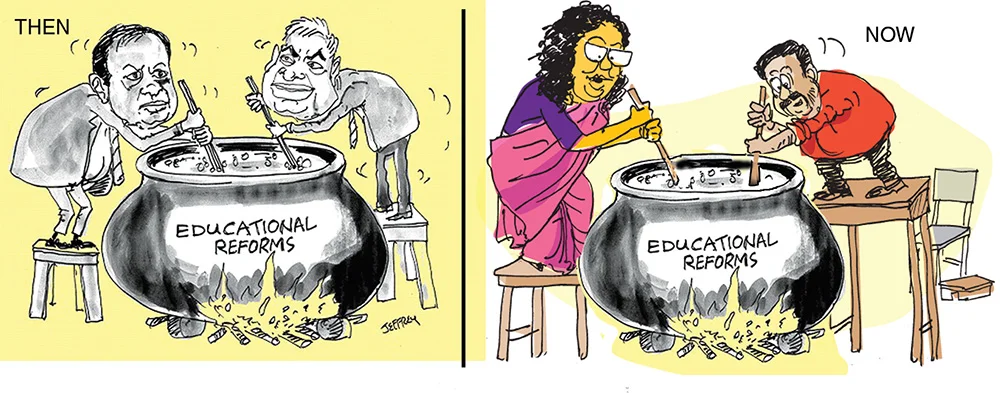
The term education originates from the Latin words ‘educare’, meaning ‘to bring up’, and educere, meaning ‘to bring forth’. The precise definition of education is disputed. But if it is linked with the obvious expected outcome of it – learning, then the definition of education changes to a resultant outcome of ‘a change in behaviour’.
Let me say this at the outset. I am not going to get embroiled in the nitty-gritty pros and cons of the current controversies hogging the headlines today. Except to say this. As every discerning and informed person says, we need educational reforms. There is near unanimity on that. It is the process – a long, and even tedious process – that needs to be carried out that gives rise to disagreements and controversy. A public discussion, stakeholder viewpoints and expert opinion should be given due time and consideration.
Sex education – “the birds and bees” to start with – has to be gradually introduced into school curricular. When? is the critical question that needs specific answers. Do we need to go by Western standards and practices or by a deep understanding of our cultural milieu and civilisational norms? One thing is clear in my mind. Introduction of sex education into school curricular must not be used – or abused – to make it a ‘freeway’ for indiscriminate enforcement of the whole human sexual spectrum before the binary concepts of human sexuality has been clearly understood by children – especially during their pre-pubertal and immediate post-pubertal adolescent years. I have explicitly argued this issue extensively in an academic oration and in an article published in The Island, under the title, “The child is a person”.
Having said that, let me get on to some of my heretical thoughts.
Radical thinkers
Some radical thinkers are of the view that education, particularly collective education in a regulated and organised school system, is systematic streamlined indoctrination rather than fostering critical thinking. These disagreements impact how to identify, measure, and enhance various forms of education. Essentially, what they argue is that education channels children into pliant members of society by instilling existing or dominant socio-cultural values and norms and equipping them with the skills necessary to become ‘productive’ members of that given society. Productive, in the same sense of an efficient factory production line.
This concept was critiqued in detail by one of my favourite thinkers, Ivan Illych. Ivan Illich (1926 – 2002) was an Austrian philosopher known for his radical polemics arguing that the benefits of many modern technologies and social arrangements were illusory and that, still further, such developments undermined humans’ image of self-sufficiency, freedom, and dignity. Mass education and the modern medical establishment were two of his main targets, and he accused both of institutionalising and manipulating basic aspects of life.
One of his books that stormed into the bookshelves that retains particular relevance even today is the monumental heretical thought ‘Deschooling Society’ published in 1971 which became his best-known and most influential book. It was a polemic against what he called the “world-wide cargo cult” of government schooling. Illich articulated his highly radical ideas about schooling and education. Drawing on his historical and philosophical training as well as his years of experience as an educator, he presented schools as places where consumerism and obedience to authority were paramount. Illich had come to observe and experience state education during his time in Puerto Rico, as a form of “structured injustice.”
‘Meaningless credentials’
Ilych said that “genuine learning was replaced by a process of advancement through institutional hierarchies accompanied by the accumulation of largely meaningless credentials”. In place of compulsory mass schooling, Illich suggested, “it would be preferable to adopt a model of learning in which knowledge and skills were transmitted through networks of informal and voluntary relationships”. Talking of ‘meaningless credentials’ it has become the great cash-cow of the education industry the world over today – offering ‘honorary PhDs’ and ‘Dr’ titles almost over the counter. For a fee, of course. I wrote a facebook post titled “Its raining PhDs!”.
Mass education and the modern medical establishment were two of his main targets, and he accused both of institutionalising and manipulating basic aspects of life. I first got to ‘know’ of him through his more radical treatise “Medical Nemesis: The expropriation of Health”, that congealed many a thought that had traversed my mind chaotically without direction. He wrote that “The medical establishment has become a major threat to health. The disabling impact of professional control over medicine has reached the proportions of an iatrogenic epidemic”. But it was too radical a thought, far worse than ‘Deschooling Society’. The critics were many. But that is not our topic for the day.
The other more politically radical views on education comes from Paul Freire. Paul Freire (1921 – 1997) was a Brazilian educator and Marxist philosopher whose work revolutionised global thought on education. He is best known for his 1968 book “Pedagogy of the Oppressed” in which he reimagines teaching as a “collaborative act of liberation rather than transmission”. A founder of critical pedagogy, Freire’s influence spans literary movements, liberation theology, postcolonial education, Marxism, and contemporary theories of social justice and learning. He is widely regarded as one of the most important educational theorists of the twentieth century.
Neutral education process?
Richard Shaull, in his introduction to the 13th edition of ‘Pedagogy of the Oppressed’ wrote: “There is no such thing as a neutral education process. Education either functions as an instrument which is used to facilitate the integration of generations into the logic of the present system and bring about conformity to it, or it becomes the “practice of freedom”, the means by which men and women deal critically with reality and discover how to participate in the transformation of their world”.
Here are a few quotes from Paul Freire before I revert to the topic I began to write on: “Liberating education consists in acts of cognition, not transferals of information.”; he believed that “true liberation comes from the oppressed taking agency and actively participating in the transformation of society”; he viewed “education as a political act for liberation – as the practice of freedom for the oppressed.”; He said that “traditional education is inherently oppressive because it serves the interests of the elite. It helps in the maintenance of the status quo.”
Where does our own ‘educational reforms’ stand? Is it transference, transformative, liberating or an attempt at maintaining the status quo with the help of the ADB? The history of educational reforms in Sri Lanka has been long. A quick check on the internet elicited the following:
Colonial Era (Pre-1940s): Colebrooke-Cameron Commission (1830s): Promoted English and standardised curriculum, laying groundwork for modern systems.
Buddhist Revival: Efforts by Anagarika Dharmapala to establish schools with Buddhist principles and English education.
The Kannangara Reforms (1940s): 1943 – Minister C.W.W. Kannangara introduced free education for all funded by general taxes; 1947 – introduced it from kindergarten to university. Central Schools (Madhya Maha Vidyalayas) established high-quality secondary schools in rural areas to ensure equitable access. Medium of Instruction was mandated to be the national languages (Sinhala and Tamil) for primary education.
Nationalisation and Standardisation
Nationalisation and Standardisation (1960s-1970s): 1961 – Denominational schools were taken over by the government to create a national education system. 1972 – New attempts at reform introduced following the 1971 youth uprising, focusing on democratising education and practical skills through a common curriculum and a national policy, responding to socio-economic needs. Introduction of language-based standardisation that in all likelihood triggered the ‘separatist war’. 1978 – change from language-based standardisation to district-based standardisation on a quota system for university entrance that was first introduced with a promise for only ten years, but persists until today, for nearly 50 years. No government dares to touch it as it is politically explosive.
Focus on quality and access (1980s-1990s): White Paper on Education (1981) – aimed to modernise the system together with components of privatising higher education. It faced severe criticism and public protests for its clear neoliberal leanings. And it never got off the ground. The National Colleges of Education (1986) were established.
1987 – Devolution of education power to provincial councils. 1991 – Establishment of The National Education Commission created to formulate long-term national policies. 1997 – Comprehensive reforms through a Presidential Task Force to overhaul the general education system (Grades 1-13), including early childhood development and special and adult education.
21st Century Reforms (2000s-Present): Mid-1990s-early 2000s – focused on transforming education from rote learning to competency-based, problem-solving skills; emphasising ICT, English, equity, and aligning education with labour market needs; introducing school restructuring (junior/senior schools) and compulsory education for ages 5-14; and aiming for national development through development of human capital.
Modernising education
2019 educational reforms focused on modernising education by shifting towards a modular, credit-based system with career pathways, reducing exam burdens, integrating vocational skills, and making education more equitable, though implementation details and debates around cultural alignment continued. Key changes included introducing soft skills and vocational streams from Grade 9/10; streamlining subjects, and ensuring every child completes 13 years of education; and moving away from an excessive focus on elite schools and competitive examinations.
This government is currently implementing the 2019 reforms in the National Education Policy Framework (2023–2033), which marks a radical departure from traditional methods. Module-Based System and a shift from exam-centric education to a module-based assessment system starting in 2026.
Already we have seen multi-pronged criticisms of these reforms. These mainly hinge on the inclusion – accidentally or intentionally – of a website for adult male friend groups. The CID is investigating whether it was sabotage.
Restricting access to social media
When there is a global concern on the use of smartphones and internet by children, and where Australia has already implemented a new law in December 2025 banning under-16s from major social media platforms to protect children from cyberbullying, grooming, and addiction, requiring tech companies to use age verification.
The U.S. does not have a federal law banning smartphones for under-16s, but a major movement, fuelled by the US Surgeon-General warnings and research on youth mental health, is pushing for restrictions, leading many individual states (like California, Florida, Virginia) to enact laws or guidelines for school-day bans or limits for students, focusing on classroom distraction and social media risks, with some advocates pushing for no smartphones before high school or age 16.
The UK doesn’t currently have a legal ban on smartphones for under-16s, but there’s significant political and public pressure for restrictions, with debates focusing on social media access and potential school bans, with some politicians and experts advocating bans similar to Australia’s, while others push for stronger regulations under the existing Online Safety Act to protect children from addictive algorithms and harm.
Sweden is implementing a nationwide ban on mobile phones in schools for students aged 7 to 16, starting in autumn 2026, requiring devices to be handed in until the school day ends to improve focus, security, and academic performance, as part of a major education reform. This national law, not just a recommendation, aims to reduce distractions and promote traditional learning methods like books and physical activity, addressing concerns about excessive screen time affecting children’s health and development.
Norway doesn’t have a complete smartphone ban for under-16s but is moving to raise the minimum age for social media access to 15 and has implemented strong recommendations, including a ban on phones in schools to protect children from harmful content and digital overexposure, with studies showing positive impacts on focus and well-being. The government aims to shield kids from online harms like abuse and exploitation, working with the EU to develop age verification for platforms like TikTok and Instagram.
Finland implemented a law in August 2025 restricting smartphone use for students aged 7-16 during the school day, empowering teachers to ban devices in classrooms, meals, and breaks, except for educational or health reasons, to combat distractions, improve focus, and support student well-being and social skills. The move aims to create calmer learning environments, reduce cyberbullying, and encourage more in-person interaction, giving teachers control to confiscate disruptive phones, though digital tools remain part of education.
Trend in liberal west
When this is the trend in the ‘liberal West’ on the use of smartphones by children in schools, did not our educational reform initiators, experts and pundits in the NIE not been observing and following these worldwide trends? How could they recommend grade 6 children to go to (even a harmless legitimate) website? Have they been in hibernation when such ‘friend/chat room’ sites have been the haunt of predatory paedophile adults? Where have they been while all this has been developing for the past decade or more? Who suggested the idea of children being initiated into internet friends chat rooms through websites? I think this is not only an irresponsible act, but a criminal one.
Even if children are given guided, supervised access to the internet in a school environment, what about access to rural children? What about equity on this issue? Are nationwide institutional and structural facilities available in all secondary schools before children are initiated into using the internet and websites? What kind of supervision of such activities have been put in place at school (at least) to ensure that children are safe from the evils of chat rooms and becoming innocent victims of paedophiles?
We are told that the new modular systems to be initiated will shift assessments from an exam-centric model to a modular-based, continuous assessment system designed to prioritise skill development, reduce stress, and promote active learning. The new reforms, supposed to begin in 2026, will introduce smaller, self-contained learning modules (covering specific topics or themes) with integrated, ongoing assessments.
Modular assessment and favouritism
I will not go into these modular assessments in schools in any detail. Favouritism in schools is a well-known problem already. 30% of final assessments to be entrusted to the class teacher is a treacherous minefield tempting teachers into corrupt practices. The stories emanating from the best of schools are too many to retell. Having intimate knowledge of what happens to student assignment assessments in universities, what could happen in schools is, to me, unimaginable. Where do the NIE experts live? In Sri Lanka? Or are they living in ideal and isolated ivory towers? Our country is teeming with corruption at every level. Are teachers and principals immune from it? Recently, I saw a news item when a reputed alumnus of “the best school of all” wrote a letter to the President citing rampant financial corruption in the school.
This article is already too long. So, before I wind up, let me get on to a conspiracy theory. Why have the World Bank and the ADB been pumping millions of USD into ‘improving’ our education system?
World Bank
The World Bank is the largest source of external financing for education in developing countries, maintaining an active portfolio of approximately $26 billion in 94 countries reaching an estimated 425 million students— roughly one-third of all students in low- and middle-income countries.
The World Bank funds education globally through loans, grants, and technical assistance to improve access, quality, and equity, focusing on areas like teacher training, digital infrastructure, and learning outcomes, with significant recent investment in Fragile, Conflict, and Violence (FCV) settings and pandemic recovery efforts. Funding supports national education strategies, like modernising systems in Sri Lanka, and tackles specific challenges such as learning loss, with approaches including results-based financing and supporting resilient systems. Note this phrase – ” … with significant recent investment in Fragile, Conflict, and Violence (FCV) settings ….”. The funds are monumental for FCV Settings – $7 billion invested in Fragile, Conflict, and Violence settings, with plans for $1.2 billion more in 2024-25. Now with our Ditwah disaster, it is highly fertile ground for their FCV investments.
Read Naomi Kline’s epic “The Shock Doctrine: The rise of disaster capitalism”. It tells it all. It must be read and digested to understand the psychology of funding for FCV settings.
The 40.3 million USD World Bank’s IRQUE (Improving Relevance and Quality of Undergraduate Education) Project in Sri Lanka (circa 2003-2009) was a key initiative to modernize the country’s higher education by boosting quality, accountability, and relevance to the job market, introducing competitive funding (QEF), establishing Quality Assurance (QA) functions for the first time, and increasing market-oriented skills, significantly reducing graduate unemployment. I was intimately involved in that project as both Dean/Medicine and then VC of University of Ruhuna. Again, the keywords ‘relevance to the job market’ comes to mind.
The Asian Development Bank (ADB) is heavily funding education reform in Sri Lanka, notably with a significant $400 million loan (Secondary Education Sector Improvement Program – SESIP) to transform secondary education, aligning it with global knowledge economy demands, improving curriculum, teacher training, and infrastructure for quality access. ADB also provides ongoing support, emphasising teacher training, digital tech, and infrastructure, viewing Sri Lanka’s youth and education as crucial for development. The keywords are ‘aligning it with global knowledge economy demands’. As of 2019, ADB loans for education totalled approximately $1.1 billion, with cumulative funding for pre-primary, primary, and secondary education exceeding $7.4 billion since 1970 in the Asia-Pacific region.
Radical view of IMF and WB
A radical view of the Bretton Woods twins – the International Monetary Fund (IMF) and the World Bank – and the ADB characterises them not as neutral facilitators of global economic stability and egalitarian economic development in poor countries, but as tools of Western hegemony, neoliberal imposition, and institutionalized inequality. From this perspective, these institutions, created to manage the post-WWII economic order, have evolved into instruments that perpetuate the dominance of the Global North over the Global South.
The World Bank and the ADB (in our part of the world) have been investing heavily on education reform in poor countries in Asia and Africa. Why? Surely, they are not ‘charity organisations’? What returns are they expecting for their investments? Let me make a wild guess. The long-term objective of WB/ADB is to have ‘employable graduates in the global job market’. A pliant skilled workforce for exploitation of their labour. Not for “education as a political act for liberation” as Paul Freire put it.
I need to wind up my heretical thoughts on educational reform. For those of us who wish to believe that the WB and ADB is there to save us from illiteracy, poverty and oppression, I say, dream on.
“Don’t let schooling interfere with your education. Education consists mainly of what we have unlearned.” – Mark Twain
by Susirith Mendis
Susmend2610@gmail.com

Midweek Review
Legacy of enforced disappearances: Vital facts conveniently forgotten to whitewash LTTE and India
Those demanding accountability from Sri Lanka for war crimes allegations are strangely silent on atrocities committed by the LTTE. On the orders of its leader Velupillai Prabhakaran, the LTTE killed hundreds of members belonging to rival terrorist groups. It assassinated President Ranasinghe Premadsasa, almost succeeded in assassinating President Chandrika Bandaranaike Kumaratunga and made attempts on President Mahinda Rajapaksa. But, the indiscriminate use of children as cannon fodder went unnoticed. How many children, forcibly recruited into their ranks, perished in fighting? And, lastly, shouldn’t the Tamil community hold the Illankai Thamil Arasu Kadchi (ITAK)-led now defunct Tamil National Alliance, that recognised the LTTE in 2001 as the sole representative of the Tamil speaking people, responsible for death and destruction caused since 2001?
By Shamindra Ferdinando
Working Group on Enforced or Involuntary Disappearances (WGEID) representative Ana Lorena Delgadillo Pérez, and head of the Association of Relatives of Enforced Disappearances (ARED) Yogarasa Kanagaranjini, on 30 August, opened an exhibition at the Thanthai Selva Auditorium in Jaffna. The exhibition, appropriately named ‘Long Road for Justice,’ coincided with the International Day for Victims of Enforced Disappearances.
Pérez later addressed a conference held therein where the responsibility on the part of Sri Lanka was stressed.
Civil society activist Sunanda Deshapriya, in an article titled ‘Sri Lanka’s Disappeared: Where Do We Go from Here?’ carried in Jaffna Monitor, dealt with missing persons issue. Deshapriya focused on the North-East war (https://www.jaffnamonitor.com/sri-lankas-disappeared-where-do-we-go-from-here/)
The ICRC, Colombo, issued a statement regarding the International Day of the Disappeared. When the writer sought the number of missing persons in the country, Ruwanthi Jayasundare, Head of Communications, said that they had a caseload of 15,000 registered tracing requests (1983-2009) but she asserted that the actual number of missing was far bigger (https://island.lk/icrs-sustained-and-collective-efforts-critical-to-address-issue-of-missing-persons/)
Perhaps, many people wouldn’t know that the ICRC arrived here in 1989 during the second Janatha Vimukthi Peramuna (JVP) terror campaign in the wake of Indian military intervention here. The much discussed issue of disappearances must be appropriately dealt with, taking into consideration the relevant factors. At the time of their deployment here, President Ranasinghe Premadasa had been engaged in direct talks with the Liberation Tigers of Tamil Eelam (LTTE) and the Geneva-headquartered body never expected a gruesome outbreak of violence. It would be pertinent to mention that within weeks after the ICRC’s arrival here, the JVP was crushed with brute force as it, too, resorted to senseless violence. The counter violence unleashed by the state apparatus was such that the then Marxist group’s top leadership was killed, except for Somawansa Amarasinghe, who escaped, with Indian help, in February 1990, and remained in exile till late 2001.
The ICRC deployment took place in mid October, 1989, and JVP leader Rohana Wijeweera was captured in the second week of November, at Ulapone, and shot in custody, and was allegedly cremated alive at the Borella cemetery.
In fact, at the time the ICRC arrived here, the JVP was on its last legs. The UNP government never bothered to hand over the bodies of slain JVP cadres to their families. Those who had been listed missing at that time were no longer in the land of the living, by the time the ICRC brought its operation in the South to an end.
What the country never expected was a fresh flare-up in the northern and eastern regions. The LTTE resumed large-scale hostilities, in June, after the Indian Army pulled out from Sri Lanka in late March 1990. Interestingly, some of those demanding justice for the missing/disappeared are conveniently silent about the disappearances during the Indian Army deployment here (July 1987 to March 1990).
Soon after hostilities erupted in the northern and eastern regions, following a 14-month truce between President Ranasinghe Premadasa and LTTE leader Velupillai Prabhakaran (May 1989 to June 1990), the ICRC was invited to open offices in that region. There had been excesses on the part of the military and law enforcement authorities as the government battled the LTTE, the world’s most ruthless terrorist organisation as assessed by none other than the US Federal Bureau of Investigation.
Yet Sri Lanka must earnestly address accountability issues and take meaningful measures to compensate the families of the innocents.
However, the Tamil community must come to terms with the reality that the vast majority of dead were members of the LTTE. The LTTE enjoyed considerable firepower as it literally wielded a conventional fighting capability, which even included a fledgling air force and directly challenged the government, and the armed forces had no option but to fight back. Obviously, the LTTE, that achieved significant battlefield successes over the years, never expected the almost non-stop three-year-long offensive that brought the war to an end in May 2009. Disappearances became exceptionally an important issue in the overall agenda pursued by the Tamil Diaspora and Tamil speaking political parties here only after the LTTE’s eradication.
Multiple reasons
In September 1990, several months after the Indian Army was literally forced to pull out from Sri Lanka as Tigers fought back the mighty IPKF to a standstill, while President Premadasa, too, made it clear that they were no longer welcome here, Amnesty International (AI) documented 43 cases of disappearances. According to the London headquartered AI, the majority of these disappearances happened in the Jaffna peninsula, following the outbreak of fighting in October 1989. The Indian Army launched ‘Operation Pawan’ meant to disarm the LTTE in line with the Indo-Lanka Accord, signed on 29 July, 1987.
During the Indian Army deployment here (1987 July to 1990 March), the Sri Lankan armed forces were confined to their barracks in the North and East. The AI accused the Indian Army of torture, extrajudicial executions and disappearances. The deaths of nearly 1,500 Indian officers and men, and injuries to approximately 3,000 others during the Indian deployment here, underscored the ferocity of the situation.
The Indian Army carried out reprisals, following LTTE attacks in both provinces. The Indian Army was also accused of sexual violence. Perhaps, the August 1989 Valvettithurai orgy of violence, during which Indian soldiers killed civilians, tortured detainees, committed sexual violence, and systematically destroyed homes and businesses, while the town was under curfew, was the worst case.
In October, 2025, the International Truth and Justice Project (ITJP) presented a detailed reparations claim, in association with the Valvettithurai Citizens’ Committee, to the Sri Lankan Office for Reparations, requesting USD $15 million (LKR 4.5 billion) for victims of a 1989 orgy of violence committed by the IPKF where at least 66 civilians were killed and 34 injured.
There hadn’t been a previous instance of a comprehensive compensation claim for such a wartime crime. Thousands of LTTE cadres, some of them trained in India, and civilians, perished in Indian Army action. The Indian Peace Keeping Force (IPKF) earned such a bad reputation it came to be dubbed the Indian People Killing Force.
The war in Sri Lanka, or whatever one chooses to call it, should be examined in the context of a high profile Indian destabilisation project ordered by Premier Indira Gandhi. Over a year after the Indian Army pullout, the LTTE assassinated Rajiv Gandhi, by then out of power, but he was the person Velupillai Prabhakaran held responsible for the Indian Army deployment in Sri Lanka. Following Gandhi’s assassination, India hunted down the LTTE team, involved in the operation, carried out by a female suicide cadre.
The LTTE forgot the Indian role in the transformation of the Tamil separatist terrorist movement to a deadly conventional threat. If not for the despicable Indian action, Sri Lanka wouldn’t have been hauled up before the Geneva-based United Nations Human Rights Council (UNHRC). That is the unpalatable truth.
How many Sri Lankan Tamils disappeared during weapons training in India? Did India investigate such disappearances as well as deaths caused by fighting among rival Tamil terrorist groups operating in India at that time? Among the groups that had been armed by India were PLOTE (People’s Liberation Organisation of Tamil Eelam), EPRLF (Eelam People’s Revolutionary Liberation Front) and TELO (Tamil Eelam Liberation Organisation) responsible for quite a significant number of killings and human rights violations.
India never accepted responsibility for the PLOTE raid on the Maldives on a contract to topple the then Maldivian PM Gayoom’s government given by a domestic rival in early November, 1988. Shouldn’t New Delhi at least apologise for the sea borne raid on the Maldives that resulted in deaths of Maldivians, as well as raiders? The Indian Navy sank a ship commandeered by the attackers fleeing the Maldives after air borne Indian troops brought the situation under control.
The Indian and global media praised swift Indian intervention but ignored two key factors, namely (i) the operation targeting Maldivian President Maumoon Abdul Gayoom was mounted by one of the groups trained, armed and deployed by India and (ii) two trawlers carrying the raiding party left the northern part of Sri Lanka, at that time held by the Indian Army.
The writer had the opportunity, in November, 2011, to interview the Maldivian businessman, Abdullah Luthufee, who convinced the PLOTE leader Uma Maheswaran to carry out the operation. (Male plot leader speaks out 3 November, 2011, Rajiv saved us from Gayoom-Male coup leader 4 November 2011 and How Luthufee moved SAARC venue from Male to Addu 11 Nov 2011) dealt with the operation that should have drawn international attention to the Indian destabilisation project. Let me stress that some PLOTE cadres perished when the Indian Navy sank the vessel commandeered by the fleeing PLOTE cadres. They were among those who had been listed missing during the conflict.
Australian and US interventions
One-time top JVPer Kumar Gunaratnam secret arrival in Sri Lanka as an Australian Citizen Noel Mudalige, in early September, 2011, emphasised the issuance of foreign passports in assumed names to Sri Lankans under controversial circumstances. The writer exclusively reported how the head of the breakaway JVP faction, known as the Frontline Socialist Party (FSP), arrived here. The Australian High Commission in Sri Lanka acted swiftly and decisively when Gunaratnam disappeared after entering the country, using Australian passport bearing number N 1016123 on September 4, 2011 (https://dbsjeyaraj.com/dbsj/?p=43914). The writer dealt with the same issue again in August 2016 (https://dbsjeyaraj.com/dbsj/?p=47936).
Among thousands of Sri Lankans, now having foreign citizenship, there can be many people listed here as “missing/forcibly” disappeared. Western governments never helped Sri Lanka to establish the real identities of Sri Lankans living abroad, under assumed names. If Gunaratnam never acted in a manner inimical to the JVP, he could have easily lived a comfortable life in Australia as Sinhala Buddhist Noel Mudalige.
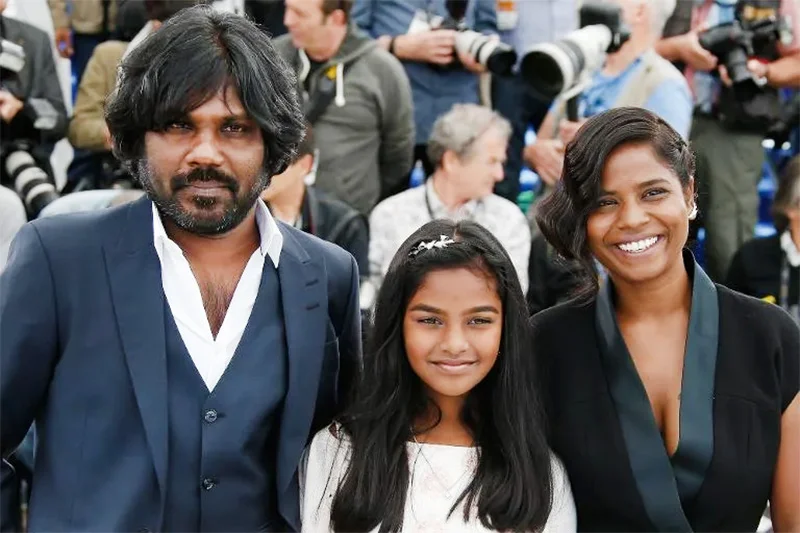
There had been many interesting stories of those categorised as missing/dead turning up in the West, under new identities. One of the most intriguing ones, is about an ex-LTTE terrorist turned Frenchman Antonythasan Jesuthasan, the lead actor in Dheepen that won the prestigious Palme d’Or at the 2015 Cannes Film Festival.
Internationally acclaimed Jacques Audiard directed the movie about three Sri Lankans who formed a fake family to escape the war and to secure asylum in France. Antonythasan Jesuthasan’s performance in Dheepan earned him a Best Actor nomination at the 2016 César Awards (the French equivalent of the Oscars). Jesuthasan is the only ex-LTTE terrorist to receive international acclaim as an actor.
In an interview with Tom Seymour (Dheepan’s Antonythasan Jesuthasan: from Tamil Tiger to star of a Palme d’Or winner in The Guardian) posted online on March 31, 2016, transformed Frenchman Jesuthasan, unwittingly revealed how he deceived the United Nations High Commissioner for Refugees (UNHCR) to secure political asylum. Seymour reported that Jesuthasan, after having shown him a dense lattice of scars on his forearm, declared: “I did those to myself. I was 22, and I had spent years trying to come to the west. I wanted to get a fake French passport, but I had to be accepted as a refugee. I went to the UNHCR [the UN High Commissioner for Refugees], but they wouldn’t believe my story. So I cut myself, and held up my arm, and said to them: ‘Look at my blood. This is my word.”
Jesuthasan is just one among thousands who obtained political asylum on false claims. Jesuthasan ended up as the star of Dheepan, directed by Jacques Audiard, possibly France’s most celebrated modern director. There cannot be a better example than Jesuthasan to highlight the web of deceit pertaining to the vast majority of those who successfully secured political asylum. But, the Sri Lanka Foreign Ministry never bothered to set the record straight. Born in Allaipiddy, on the Velanaitivu islet, Jesuthasan claimed he fought the Sri Lanka Army in August 1990 and subsequently fled the country and managed to reach France.
But, the case of Kathiravel Thayapararajah is one of the most controversial cases. Thayapararajah had been involved in a Tamil Diaspora funded project in Kilinochchi during Eelam war IV. He couldn’t have secured the Diaspora assignment without the approval of the LTTE and remained in the Vanni during the war. He disappeared in September 2009.
His disappearance prompted a section of the media, as well as some international NGOs, to accuse the Directorate of Military Intelligence (DMI) of executing him. No less a person than the then US Assistant Secretary of State for South Asian Affairs and one-time US Ambassador in Colombo, Robert O. Blake, inquired about the missing person.
The University Teachers for Human Rights (Jaffna), the Australian Government Refugee Review Tribunal, Tamilnet and the European Centre for Constitutional and Human Rights among others blamed the Sri Lankan intelligence for the disappearance. However, the Indian media, in May, 2014, revealed Thayapararajah’s arrest though they didn’t know at the time that he was the person who was supposed to have been killed by the Sri Lankan Intelligence. At the time Indian police apprehended Thayapararajah, at Arichamunai off Dhanuskodi, after arriving there in a boat from Sri Lanka, he had been with notorious female human smuggler Uthayakala. She claimed Thayapararajah was her second husband.
That chance detection exposed a blatant lie propagated over the years. The then Head of Missing Persons Commission, retired High Court Judge Maxwell Paranagama, is also on record as having called for international cooperation to trace persons living overseas under new identities. Paranagama told the writer that at that time both the international community, including the ICRC, had declined to help Sri Lanka identify those taking cover behind new identities.
Chemmani mass graves
Sri Lanka needs to investigate war crimes allegations, particularly the high profile Chemmani mass grave. The country cannot ignore the continuing accusations with the international media taking advantage of the situation to tarnish the country, especially the Rajapaksa rule. It must be a way of the West taking revenge from the Rajapaksas for going against their wish to save the bold thirsty Tigers. It is like their logic that Israel can do no wrong!
The CNN dealt with the Chemmani issue while the International Commission of Jurists (ICJ), in July last year, called for what it claimed as victim-centred investigation into the alleged mass graves in compliance with international law and standards.
Tamil political parties, too, repeatedly demanded tangible action against the perpetrators. The Chemmani mass grave site drew national and international attention in 1998 following the confession of a soldier implicated in the rape and murder of schoolgirl Krishanthy Kumaraswamy. Chemmani has become a powerful and painful symbol of the country’s war-torn past.
Krishanthy Kumaraswamy was raped and killed by soldiers on the 7th of September, 1996. The same group of soldiers later killed her mother, her younger brother and a family friend who went out searching for the teenager.
An excavation, in 1999, led to the recovery of 15 sets of remains, and then the matter was allowed to rest for about a quarter of a century. On the orders of the Jaffna Magistrate’s court, a fresh excavation was ordered last year, following the chance recovery of some skeletal remains and so far nearly 600 sets of human remains have been found, among them children and infants. Tamil media have declared Chemmani as the largest mass grave found in Sri Lanka.
It would be pertinent to mention that some time back the Army was accused of the Mannar mass graves but investigations undertaken by the Office of Missing Persons (OMP), with international expertise, proved the claims false. Bone fragment samples were submitted to Beta Analytic, a specialised US radiocarbon-dating laboratory. This happened during the Yahapalana administration (2015-2019) Later, the lab indicated that the tested bone samples dated back to the period between 1499 and 1719 AD (the 15th to 18th century). That brought an end to the Mannar mass graves hoax.
Whatever the circumstances, the government cannot remain silent regarding the Chemmani mass graves. The area that had been under Security Forces Headquarters, Jaffna continues to receive public attention, both here and abroad. The Army will have to address the issue without further delay. Let me stress the importance of investigating the atrocities perpetrated by others, namely the Indian Army for which the responsibility lies with the government of India as well as the LTTE, and over half a dozen other terrorist groups that subsequently entered the political mainstream.
The formation of Tamil National Army (TNA) by India before the Indian Army pullout by March 1990, too, must receive the attention of Sri Lanka as well the concerned international community. Having totally destabilised the smaller neighbouring county by arming scores of terrorist groups, New Delhi went a step further by the formation of the TNA meant to protect Varatharaja Perumal’s North-East provincial administration.
In spite of President Ranasinghe Premadasa drawing strong criticism for arming the LTTE against the Indian Army, in hindsight, if not for his controversial decision, India’s proxy, TNA may have taken root. Whatever various parties say today, the TNA had been formed to ensure the continuation of the deeply unpopular Perumal’s administration that went to the extent of forcible conscription. India can never absolve itself of responsibility for what it did in Sri Lanka. The destabilisation project, largely influenced by the then Premier Indira Gandhi’s concerns over the developing situation in Tamil Nadu, caused massive death and destruction. No less a person than J.N. Dixit, who served as their High Commissioner in Colombo (1985 to 1989), and later appointed National Security Advisor (2004 to 2005) disclosed in his memoirs ‘Makers of India’s Foreign Policy: Raja Ram Mohun to Yashwant Sinha’, Indira’s Gandhi’s intervention. The late Dixit in no uncertain terms blamed her for Indian intervention in Sri Lanka.
By Ifham Nizam
Pictures by Nishan S Priyantha and Kamal Bogoda
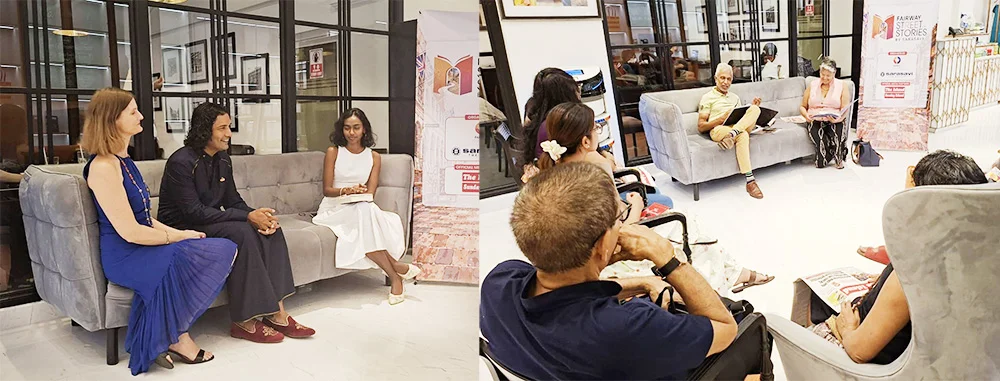
Ashok Ferrey took readers into an older Colombo through Colpetty People. Vivimarie Vanderpoorten opened the door to the personal stories behind her poetry. Andrew Fidel Fernando brought cricket, culture and the distinctive world of Sri Lankan school cricket into the conversation, while Ramya Jirasinghe spoke candidly about the long and often difficult road from writing a manuscript to seeing it published.
Then came Margaret Richardson and Asanka de Mel, whose conversation moved from literature to the question of where Sri Lanka should be by 2048.
These were among the voices that gave life to Fairway Street of Stories, a new initiative that sought to bring Sri Lankan English-language writers closer to their readers.
But behind the gathering of authors, readers, books, children, book clubs and aspiring writers was a bigger idea—the brainchild of Amendra Haputhanthri, Director of Sarasavi Bookshop (Pvt) Ltd.
For Haputhanthri, Fairway Street of Stories is not merely another literary event. It is part of a much larger attempt to create a marketplace for Sri Lankan talent and to persuade readers to discover stories that are unmistakably their own.
“Usually, when we have exhibitions, such as the Colombo Book Fair, we always think about what sells the most. Here, we wanted to create a niche market for people who want to read Sri Lankan writing,” she said.
And the first event demonstrated just how wide that literary world can be.
Stories from a Sri Lanka we know
Haputhanthri believes one of the greatest strengths of Sri Lankan English writing is its sense of place.
A thriller set in an unfamiliar foreign city may be entertaining. But a thriller unfolding at the Galle Face Hotel or Mount Lavinia Hotel carries another kind of intimacy for a Sri Lankan reader.
“You have familiar words and actual real-world places that we have been to. There will be a connection with the book,” she said.
That connection can be even more powerful when the story takes readers into places and experiences that are disappearing.
This is one reason she admires Ferrey’s work.
During his Fairway session, Ferrey, together with Tanya de Mel, offered readers an engaging glimpse into the world behind Colpetty People and the Colombo it captures.
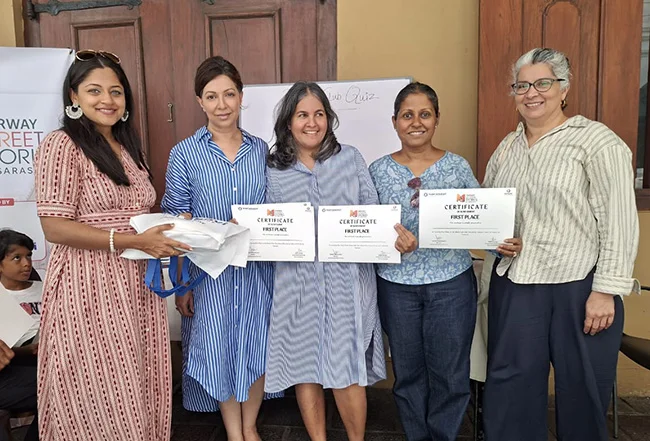
Amendra Haputhanthri (extreme left) with winners
For Haputhanthri, Ferrey’s writing is also a record of a rapidly changing city.
“Even Sri Lanka is changing very rapidly. Within Colombo also, the environment is rapidly changing, and that is being addressed nicely in the books of Ashok Ferrey,” she said.
Literature, in that sense, becomes more than entertainment.
It becomes memory.
The stories behind the poems
Vivimarie Vanderpoorten offered a very different literary experience.
Haputhanthri describes her as one of the country’s outstanding contemporary talents, particularly because of the personal histories embedded in her poetry.
A poem on a page may be only a few lines long. But behind those lines can lie an entire life.
Vanderpoorten spoke about those experiences at Fairway, including deeply disturbing events she had witnessed during her university years.
For Haputhanthri, hearing those stories transformed the poems.
“All her stories, there is a back story. All her poems, there is a back story,” she said.
She believes such conversations are precisely what literary events should create—a space where readers can move beyond the printed page and understand the human experience that produced it.
She also encouraged people to read poetry, even if only one poetry collection a year.
Poetry, she believes, forces readers to think beyond what is immediately presented.
“It gives you the ability to think out of the box,” she said.
Cricket is more than a score
Andrew Fidel Fernando brought yet another dimension to the event.
For someone who writes and comments on international cricket, his work naturally takes readers into the world of the game. But Haputhanthri noted that Fernando’s writing also captures the culture surrounding cricket in different countries.
And Sri Lanka has a particularly richstory to tell.
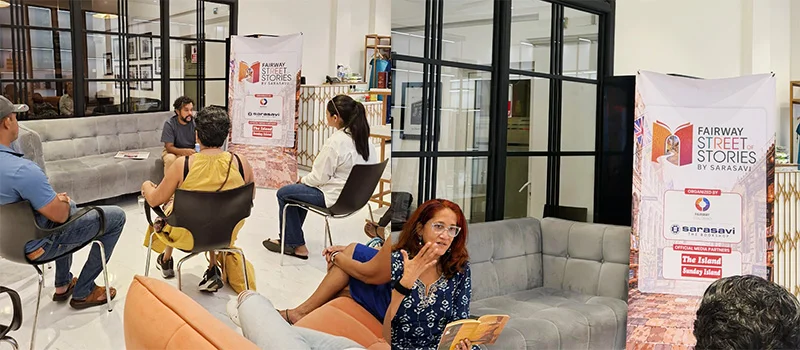
Andrew Fidel Fernando / Dr. Vivimarie Vanderpoorten
For Haputhanthri, the island’s school-cricket culture is something the world should know more about.
“We are the best in the world when it comes to having a culture for school cricket. It is something very unique to our country,” she said.
She even suggested that writers interested in Sri Lankan cricket should explore this largely distinctive phenomenon in greater depth.
Because literature can sometimes reveal what statistics cannot.
A schoolboy walking onto a cricket ground carries with him a school, a city, friendships, rivalries, family expectations and an entire culture.
From manuscript to book
Ramya Jirasinghe’s contribution was particularly relevant to aspiring writers.
She spoke about her own journey and the realities of getting a book published.
Her experience demonstrated that literary success rarely happens overnight.
Winning recognition is one thing. Turning a manuscript into an internationally published book is another.
For emerging writers listening to her, the message was clear: writing requires patience, revision and persistence.
Haputhanthri knows that process well.
Writers, she said, can be rejected repeatedly—even at international level.
And translations create another layer of difficulty.
Sometimes an author reads a translation of his or her work and says: “This doesn’t have my voice.”
That, Haputhanthri acknowledged, illustrates how complex the journey from an original manuscript to another language can be.
A speech from the future
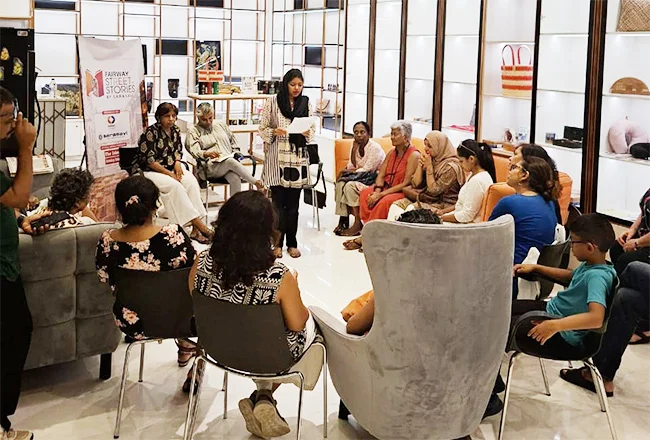
Carmel Miranda
Asanka de Mel and Margaret Richardson brought another perspective to Fairway.
De Mel’s 2048: A Speech from 2048 looks towards the centenary of Sri Lanka’s independence and asks why the country has not yet become a developed nation.
But his message, as Haputhanthri interpreted it, was not one of resignation.
Sri Lanka should not allow its small geographical size to become a psychological limitation.
De Mel’s own journey—from two decades in Silicon Valley to returning to Sri Lanka and embarking on entrepreneurial ventures—was offered as an example of what persistence and confidence can achieve.
For Haputhanthri, it reinforced one of the central lessons of both writing and life.
“There is no shortcut in life,” she said.
Stories that preserve a country
Fairway Street of Stories also reflected Haputhanthri’s belief that literature can preserve aspects of Sri Lankan identity that are increasingly vulnerable.
She spoke about Angampora, Beeralu weaving, traditional culture and historical stories.
Even the country’s royal heritage can become a gateway for a new generation to understand the island’s past.
She recalled seeing foreign visitors browsing books about Sri Lankan kings.
Those books were doing more than recounting history. They were presenting the story of a country with a long and complicated heritage.
Haputhanthri believes Sri Lankan literature can perform a similar role internationally.
“Our stories should also reach people in the same way our food and cultural experiences have reached the world,” she said.
She recalled meeting two foreigners who had visited Sri Lanka around 156 times.
Their extraordinary attachment to the country reminded her that Sri Lanka’s culture has an ability to attract people repeatedly.
The stories of the country, she believes, deserve the same reach.
The problem is not the e-book
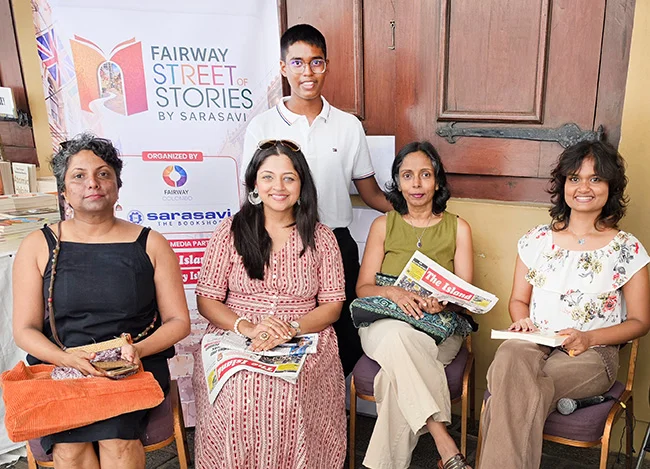
Ramya Jirasinghe (third from left)
Yet while Haputhanthri is passionate about books, she is equally concerned about the future of reading.
She does not believe e-books are necessarily the enemy.
“If people are reading an e-version, as long as they are reading something valuable, that will add something to you,” she said.
The bigger threat, in her view, is the endless scrolling culture of the smartphone.
“Scrolling on the phone reduces your attention span and you can’t do any sort of deep work,” she said.
She has observed this challenge among young people entering the workplace and believes sustained concentration is increasingly difficult.
But her answer is not to blame young people.
It is to begin much earlier—with parents and teachers.
“Whatever the parents read, the children also will read,” she said.
‘Readers Are Not Born, They Are Created’
That belief is now developing into another initiative.
Haputhanthri is working on a programme titled ‘Readers Are Not Born, They Are Created’, which she hopes to take from school to school and community to community.
The target will be parents as much as children.
The message is that reading habits are cultivated. They are demonstrated, encouraged and nurtured.
She also hopes to involve children who have themselves developed through reading, allowing them to share their experiences with others.
For Haputhanthri, the issue is deeply personal.
“I would credit everything that I have today, and everything I am today, because of reading,” she said.
She believes avid readers develop empathy, creativity and critical thinking—qualities that are increasingly valuable in a world dominated by information but often short on attention.
Beyond one literary weekend
Fairway Street of Stories, therefore, is not intended to remain a once-a-year literary celebration.
Haputhanthri wants to see activities connected with reading and books continue throughout the year.
A bargain book sale is among the ideas being considered, making use of books from Sarasavi’s extensive network of branches that may have suffered minor damage or discolouration while remaining on shelves.
The next major event will be the book fair, followed by further initiatives.
But the larger ambition goes beyond sales.
It is about discovery.
A reader discovering a Sri Lankan writer.
A child discovering poetry.
An aspiring author discovering that rejection is not the end.
A foreign visitor discovering that Sri Lanka’s stories are as rich as its food, landscapes and traditions.
And a country discovering itself in its own books.
That is perhaps the most significant contribution of Fairway Street of Stories.
Because the authors who gathered there did more than talk about their books.
They demonstrated the many ways in which Sri Lanka can be written, remembered and imagined.
And behind that gathering was Amendra Haputhanthri’s conviction that these stories deserve not only a place on a bookshelf, but a place in the minds of readers—and eventually, a place in the wider world.

By Lynn Ockersz
Just for a fleeting moment is this sense of relief,
As he eases himself heavily into his airline seat,
Hoping to leave no trace behind of his criminal self,
But he’s dragged down by a guilty conscience,
Which will dog him at heel from now onward,
And this is verily a cast-in-stone life sentence.
-

 News6 days ago
Denied of promotion to SC despite vacancies, justice Gurusinghe retires
-

 Latest News7 days ago
Grade 5 scholarship exam results released
-

 News6 days ago
22A: SC urged to suspend hearing, appoint full bench
-

 News4 days ago
Namal remanded until Sept. 18 over Airbus deal investigation
-

 Latest News3 days ago
Tharanga creates history with Diamond League crown in Brussels
-
 News6 days ago
Govt. seeks NATO assistance
-

 Editorial6 days ago
Strange arithmetic goes unchallenged
-

 News3 days ago
Dispute which triggered listed company director being detained at BIA resolved