
Latest News
Sciver-Brunt, Matthews power Mumbai Indians into second WPL final


Majestic batting from Nat Sciver-Brunt, middle-overs acceleration from Hayley Matthews, and power-hitting from Harmanpreet Kaur helped Mumbai Indians post a daunting total of 213 in the Eliminator. That proved to be too much to chase down, and Mumbai’s 47-run win extended their head-to-head dominance over Gujarat Giants to 7-0 and powered them into their second WPL final in three years. On Saturday, they will face Delhi Capitals in a repeat of the 2023 finale.
Giants were without Deandra Dottin for their first knockout game in three WPLs after the allrounder hurt herself only five minutes before the toss, and was replaced by England’s Danielle Gibson. Giants didn’t do themselves any favours as they misfielded through the innings and put down four catches that cost them heavily. In the run chase, they lost their three top-scorers this season – Beth Mooney, Harleen Deol and Ashleigh Gardner – in the powerplay as Mumbai held on to their catches and effected run-outs.
Phoebe Litchfield scored a quickfire 31 off 20 balls, but once she was stumped off Amelia Kerr, Giants were all but out of the chase at 107 for 5, with the asking rate above 13 an over.
Put in to bat, Mumbai went back to opening with Yastika Bhatia, but it didn’t change her fortunes. After collecting three boundaries in her 14-ball stay during a sedate powerplay in which MI didn’t take too many risks, Bhatia pulled Gibson to midwicket to fall for 14.
The wicket brought out the in-form Sciver-Brunt, who didn’t bat an eyelid to get going alongside Matthews, who started with only 17 runs off her first 22 balls before taking off. Sciver-Brunt took the aerial route straightaway. She ended the seventh over with consecutive boundaries, which Matthews followed up by smacking three of her own off the next three balls from Priya Mishra to power the run rate past eight an over. Three of those five consecutive fours came off short deliveries, a length the Giants bowlers often bowled and got punished for.
Their sloppy fielding didn’t help either, leading to a number of boundaries. The first came in the ninth over when Sciver-Brunt drove to deep cover, where Simran Shaikh let the ball go through her. Soon after, Sciver-Brunt reverse paddled Gardner for her fifth boundary in 12 balls. Kashvee Gautam then let one through at point when Matthews cut one square. By then, Matthews had started to find her A game, and a six off Tanuja Kanwar’s short ball brought her fifty up off 36 balls, and the team’s 100 in 11 overs.
With Mumbai at 111 for 1 after 12 overs, Meghna Singh and Mishra brought some sort of balance back by conceding only 13 runs in two overs. But from the cushion of 124 for 1 with six overs to go, it was time to floor the pedal.
Harmanpreet already had her helmet on in the dugout, and was shadow-practicing her big swings while waiting for her chance. Sciver-Brunt deposited Gibson over deep midwicket and long-on to raise a 29-ball fifty. Giants, meanwhile, continued their wretched run on the field when the reliable Gardner dropped Matthews on 57 straight down the ground.
Matthews made them pay immediately, hitting Mishra for back-to-back sixes over long-on and cover with deft footwork. Such was Mumbai’s luck that even a top-edge off the next ball went for four. But that luck ran out when Matthews edged Gautam behind for 77 off 50 balls, and Mooney took a sharp catch standing up.
Harmanpreet averaged nearly 79 against Giants before this game, and the number could have fallen had Mishra held on to a catch at midwicket when she was on 1. But Mishra didn’t, and Harmanpreet became Harmonster. She went deep in the crease and opened her stance to cart the ball around, whether it was in the slot or not.
Harmanpreet started the 18th over by hammering Kanwar for 6, 4, 4 – even that sequence included a misfield – before ending the over with her trademark slog-sweep for six. That over went for 22 in all. Sciver-Brunt also got a life in the next over – sandwiched between two boundaries off Gibson – when Kanwar made a mess of a skier. Giants were punished yet again next ball, but finally ended the partnership when Litchfield caught one at deep midwicket, leaving Sciver-Brunt seven short of 500 runs this season, and three short of 1000 in the WPL overall.
Harmanpreet was gifted two balls in the slot at the start of the last over, and she happily collected sixes off both. Meghna, however, finished well, giving away just two off the next three balls before nailing a yorker that led to Harmanpreet being run out for 36.
It took only five balls for the hosts to show their superiority in the field on the night, despite the presence of dew. When Shabnim Ismail drew Mooney’s edge, Matthews leapt to her right from first slip to grab the ball with both hands. When Harleen Deol and Gibson got into a mix-up in the fifth over, 20-year-old Sanskriti Gupta put in a dive at point and hurled the ball quickly to the wicketkeeper to find Deol short. And just before the halfway mark, Gibson also fell short when attempting a second run, and her dive wasn’t enough to beat Amanjot Kaur’s flat throw from the deep.
In between, Gardner lost her off stump against Matthews, which meant Giants were 43 for 3 in the powerplay. Litchfield was their only hope and she used her feet regularly against Kerr and struck two boundaries against Ismail that showed her class on either side of the wicket. But when Litchfield ventured out of the crease against Kerr once again and missed, Bhatia did the rest to
leave Giants 107 for 5.
Giants hardly had any steam left in their tank, and their poor running added to their misery. Next to fall short was Gautam, who was sent back when she hurried out for a quick single after drilling the ball to cover, from where Harmanpreet fired the ball back for the sixth wicket.
With another 102 runs to get from the remaining 42 balls, and their top five back in the hut, Giants’ only hope of getting anywhere close to their target was Bharti Fulmali. She started with a straight six off Amanjot, dispatched Kerr to the leg-side boundary, and flayed Matthews for consecutive boundaries behind square. But when Fulmali backed away looking for a third boundary in a row, Matthews beat her attempted cut and knocked the stumps over.
Mumbai continued their stellar fielding display as Harmanpreet took a diving catch to send Shaikh back, and Sciver-Brunt ran to her left at deep midwicket to seal victory in the last over.
Brief scores:
Mumbai Indians Women 213 for 4 in 20 overs (Nat Sciver-Brunt 77, Hayley Matthews 77, Harmanpreet Kaur 36, Yastika Bhatia 15; Kashvee Gautam 1-30, Danielle Gibson 2-40) beat Gujarat Giants Women 166 in 19.2 overs (Danielle Gibson 34, Phoebe Litchfield 31, Bharti Fulmali 30; Simran Shaikh 17, Tanuja Kanwar 16; Shabnim Ismail 1-35, Nat Sciver Brunt 1-31, Hayley Matthews 3-31, Amelia Kerr 2-28) by 47 runs
[Cricinfo]

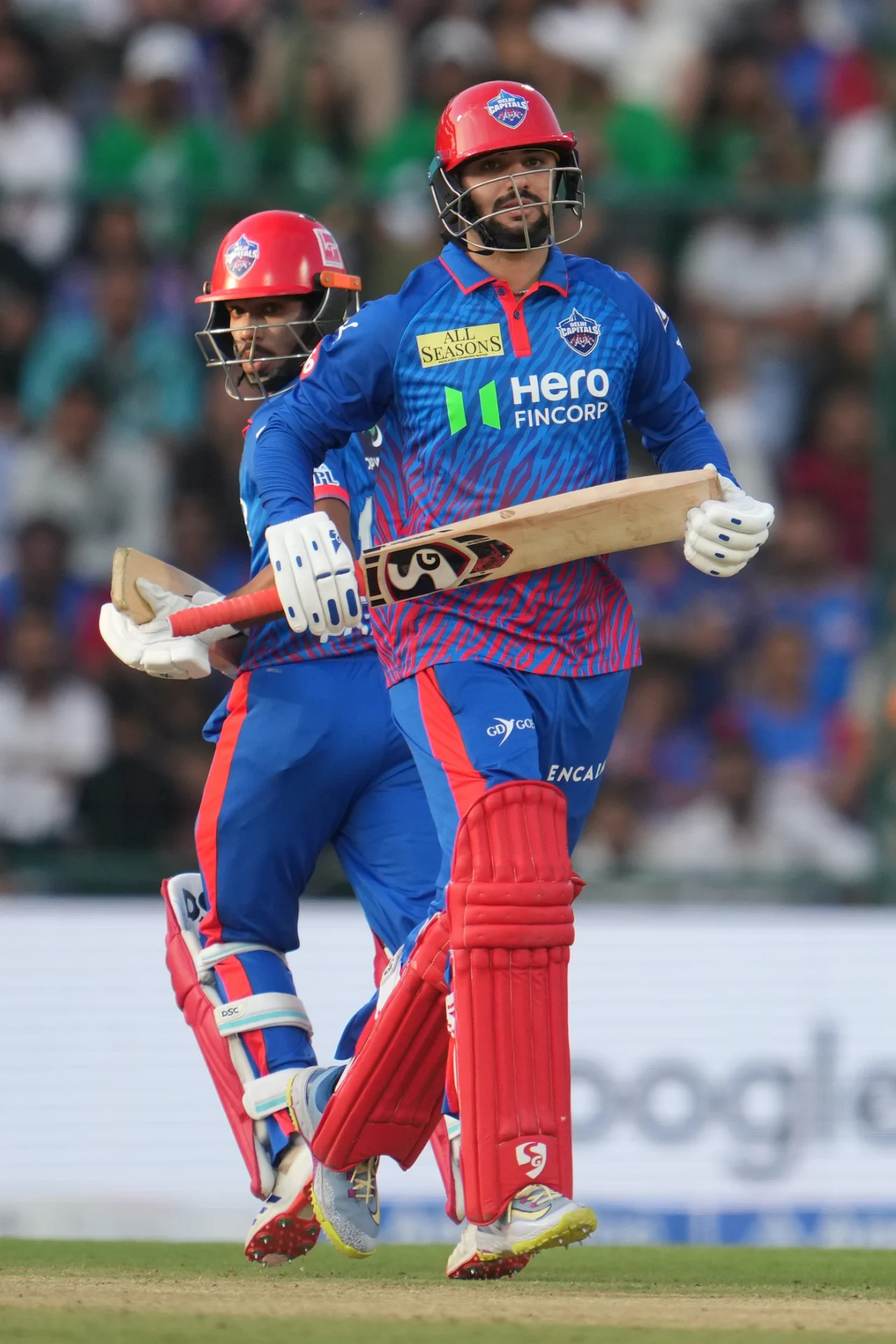
Sameer Rizvi picked up his second Player-of-the-Match award in as many games in IPL 2026, this time scoring 90 off 51 balls to help Delhi Capitals [DC] seal a tricky chase against Mumbai Indians [MI] with six wickets and 11 balls to spare. If you include his Player-of-the-Match award from DC’s last game of the 2025 season, it makes it three in a row. Only seven others have done so, and no one has gone beyond.
Before the Rizvi show, the DC bowlers restricted MI to 162 for 6 on a slow, black-soil pitch at the Arun Jaitley Stadium. With Hardik Pandya unwell, Suryakumar Yadav captained MI and top-scored with 51 off 36 balls. But most other batters struggled to play their shots. In fact, the first six of the MI innings came on the last ball of the seventh over.
DC, too, lost KL Rahul and Nitish Rana early in the chase but Pathum Nissanka’s counterattack kept them going. Nissanka made 44 off 30, after which Rizvi, coming in as DC’s Impact Player once again, ran away with the game.
Mukesh Kumar started waywardly, and Ryan Rickelton made him pay with two leg-side boundaries. From the other end, Rohit Sharma did the same against Lungi Ngidi. But Mukesh bounced back in his second over. He had Rickelton miscuing to mid-off and then caught and bowled Tilak Varma off a knuckleball.
With two right-hand batters, Rohit and Suryakumar, in the middle, Axar immediately brought himself on and sneaked in a three-run over. Rohit did hit two fours off Ngidi’s slower ones in the sixth over, the first a streaky one but the second a caress through covers, to take MI to 41 for 2, but it was a six-less powerplay for them. The last time it happened for MI was in 2023, against Chennai Super Kings in Chepauk.
Axar had a good match-up against Rohit coming into this game and he improved it further by having the batter caught at cover in the tenth over. Rohit made 35 off 26 balls. His match-up against Axar in the IPL now reads 77 balls, 67 runs, four dismissals.
Sherfane Rutherford didn’t last long and holed out to deep square leg against Vipraj Nigam, but Suryakumar kept MI going. He attacked the spinners and hit Kuldeep for two sixes. In the company of Naman Dhir, he brought up his fifty but was lbw to Ngidi off the following delivery. In Hardik’s absence, MI could score only 38 runs in the death overs.
Against Lucknow Super Giants, Rahul was out for a first-ball duck. Here he lasted three balls and made 1 before being caught down the leg side off Deepak Chahar. Rana was run out in the next over when Jasprit Bumrah, after fielding the ball off his own bowling, nailed a direct hit at the non-striker’s end.
At 7 for 2, Nissanka decided to take the attacking route. In the fourth over, he picked up back-to-back fours off Mitchell Santner, the second of which came via a reverse-hit over a leaping Rohit at cover. In the following over, he smashed two fours and a six off Shardul Thakur. Nissanka got a life on 41 when Dhir dropped him off Corbin Bosch but he fell to Santner three runs later.
After ten overs, DC were 73 for 3 – the exact score MI were at the same stage of their innings. The game was in the balance. Rizvi was batting on 25 off 23 but shifted the momentum in just one over. He flayed Bosch over mid-off, ramped him to the deep-third fence, cut him over deep point and launched him down the ground for 20 runs in all.
To ram home the advantage, he used his feet against Mayank Markande in the following over for back-to-back sixes. The first of those took him to his fifty off 31 balls. Such was his dominance that when the fifty stand for the fourth wicket came up, David Miller’s contribution in that was 1 off five balls. He was more of a bystander than a partner.
By the end of the 15th over, the result was a foregone conclusion. The only real interest left was whether Rizvi could reach his hundred. DC needed 25 to win, Rizvi needed 17. On 90, he attempted yet another big hit off Bosch but holed out to long-off.
Brief scores:
Delhi Capitals 164 for 4 in 18.1 overs (Sameer Rizvi 90, Pathum Nissanka 44, David Miller 21*; Deepak Chahar 1-20, Mitchell Santner 1-22, Corbin Bosch 1-39) beat Mumbai Indians 162 for 6 in 20 overs (Rohit Sharma 35, Suryakumar Yadav 51, Naman Dhir 28, Mitchell Santner 18*, Corbin Bosch 11*; Mukesh Kumar 2-26, Lungi Ngidi 1=34, Axar Patel 1-22, Vipraj Nigam 1-24, T Natarajan 1-24) by six wickets
[Cricinfo]
Latest News
Sun directly overhead Dodanduwa, Rathgama, Yakkalamulla, Akuressa, Mulgirigala, Ranna, Kalamatiya and Ussangoda at about 12:13 noon today (05th April)

On the apparent northward relative motion of the sun, it is going to be directly over the latitudes of Sri Lanka during 05th to 15th of April in this year.
The nearest areas of Sri Lanka over which the sun is overhead today (05th) are Dodanduwa, Rathgama, Yakkalamulla, Akuressa, Mulgirigala, Ranna, Kalamatiya and Ussangoda at about 12:13 noon
Latest News
Heat Index at Caution Level in the Western, Sabaragamuwa, Southern, Eastern, North-western, Northern and North-central provinces and in Monaragala district

Warm Weather Advisory
Issued by the Natural Hazards Early Warning Centre
Issued at 3.30 p.m. on 04 April 2026, valid for 05 April 2026
The Heat index, the temperature felt on human body is likely to increase up to ‘Caution level’ at some places in the Western, Sabaragamuwa, Southern, Eastern, North-western, Northern and North-central provinces and in Monaragala district.
The Heat Index Forecast is calculated by using relative humidity and maximum temperature and this is the condition that is felt on your body. This is not the forecast of maximum temperature. It is generated by the Department of Meteorology for the next day period and prepared by using global numerical weather prediction model data.

Effect of the heat index on human body is mentioned in the above table and it is prepared on the advice of the Ministry of Health and Indigenous Medical Services.
ACTION REQUIRED
Job sites: Stay hydrated and takes breaks in the shade as often as possible.
Indoors: Check up on the elderly and the sick.
Vehicles: Never leave children unattended.
Outdoors: Limit strenuous outdoor activities, find shade and stay hydrated.
Dress: Wear lightweight and white or light-colored clothing.
Note:
In addition, please refer to advisories issued by the Disaster Preparedness & Response Division, Ministry of Health in this regard as well. For further clarifications please contact 011-7446491.

Sameer Rizvi aces another tricky chase as Delhi Capitals floor Mumbai Indians

Sun directly overhead Dodanduwa, Rathgama, Yakkalamulla, Akuressa, Mulgirigala, Ranna, Kalamatiya and Ussangoda at about 12:13 noon today (05th April)

Showers expected in the Western, Sabaragamuwa, Central, Southern, Uva, Eastern and Northcentral provinces after 2.00 p.m.

Heat Index at Caution Level in the Western, Sabaragamuwa, Southern, Eastern, North-western, Northern and North-central provinces and in Monaragala district

Global ‘Walk for Peace’ to be held in Lanka

World Bank launches new 5-year partnership framework with Lanka

‘Dates have the highest sugar content to fight Coronavirus’

Sunday Island 27 December – Headlines

#SundayIsland 17th December – Headlines

Sunday Island – 28th March

Sunday Island Headlines – 21 March

Sunday Island – 21st February – Headlines
-

 News3 days ago
2025 GCE AL: 62% qualify for Uni entrance; results of 111 suspended
-

 News5 days ago
Tariff shock from 01 April as power costs climb across the board
-

 News6 days ago
Inquiry into female employee’s complaint: Retired HC Judge’s recommendations ignored
-

 Features6 days ago
New arithmetic of conflict: How the drone revolution is inverting economics of war
-

 Editorial3 days ago
Search for Easter Sunday terror mastermind
-

 Business4 days ago
Hour of reckoning comes for SL’s power sector
-

 Sports6 days ago
Sri Lanka’s 1996 World Cup heroes to play exhibition match in Kuala Lumpur
-

 Features5 days ago
Seychelles … here we come