
Midweek Review
Roadmap for India relations, growing Chinese influence and Quad politics

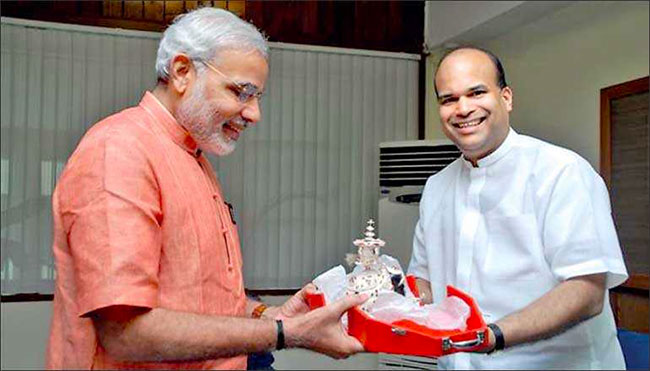
By Shamindra Ferdinando
Naming former lawmaker Milinda Moragoda as Sri Lanka’s High Commissioner in New Delhi had been one of the most controversial decisions taken by President Gotabaya Rajapaksa at the onset of his administration.
The appointment was made in spite of strong objections, even by some of those who had backed Gotabaya Rajapaksa’s candidature at the 2019 presidential election. President Gotabaya Rajapaksa went to the extent of issuing a statement vowing to go ahead with appointments made following careful consideration. However, Moragoda couldn’t take up his new assignment due to the raging Covid-19 epidemic in India. Although the Covid-19 situation remains critical, Moragoda is planning to move to New Delhi soon.
Ahead of taking up his post in Delhi in the coming weeks, Moragoda released a document titled, ‘Integrated Country Strategy for Sri Lanka Diplomatic Missions in India’ that dealt with the 2021-2023 period.
Deputy High Commissioner in New Delhi Niluka Kadurugamuwa, in his introduction to what can be called a road map, asserted that this could provide the required agenda though ideally it should be further fine-tuned and developed in the implementing phase. Sri Lanka needs a long term strategy. Sri Lanka cannot pursue an agenda to suit a particular envoy/government though differences in political approach are understandable.
A meticulous planner, Moragoda having thanked the Deputy HC and members of the Country Team as well as the group of experts who provided invaluable advice and inputs in preparation of the roadmap declared he accepted full responsibility for any omissions or oversights.
Having first entered Parliament through the UNP National List in late 2000, Moragoda successfully contested the 2001 and 2004 general elections on the UNP ticket though in 2007 he switched his allegiance under controversial circumstances to the then President Mahinda Rajapaksa. Moragoda, who had been a key government negotiator in talks with the LTTE during Ranil Wickremesinghe’s tenure as the Premier in 2001-2003 was among those UNPers who received ministerial portfolios after they switched sides in 2007. Moragoda played quite an impressive role during his tenure as the Justice Minister. The writer had an opportunity to cover the rehabilitation process undertaken under Moragoda’s guidance. Perhaps, the involvement of the All Ceylon Hindu Congress in the rehabilitation of LTTE cadres is definitely a high point for the then Minister.
Moragoda remained with the Rajapaksas and was President Gotabaya Rajapaksa’s first choice as the country’s top envoy in New Delhi. Throughout his political career, and post-parliament period, Moragoda pursued a strategy that was alien to many MPs/ex-MPs with the formation of Pathfinder Foundation being a singular achievement. Formation of Pathfinder Foundation (PF) that dealt in foreign relations among a range of other issues with the focus on developing relations and Quad countries, namely the US, Japan, Australia and Japan and US ally South Korea. In the wake of receiving diplomatic assignment, Moragoda gave up the chairmanship of PF to top ex-career diplomat Bernard Goonetilleke, who had been with the outfit for some time.
But what the writer likes to highlight is the recognition of PF by China as one of its top 10 partners here during Mahinda Rajapaksa’s tenure as the President. The recognition was made at a ceremony to mark the Chinese New Year and Sri Lanka’s National Day held at the BMICH. Among those present were President Mahinda Rajapaksa (current Prime Minister), Prime Minister D.M Jayaratne (passed away in Nov 2019), Minister of Health Maithripala Sirisena (former President, SLFP leader, and currently SLPP MP), Minister of External Affairs G.L Peiris (SLPP Chairman and Education Minister), Secretary to the President Dr. P.B. Jayasundera and President Gotabaya Rajapaksa’s Senior Advisor Lalith Weeratunga. The then Chinese Ambassador Wu Jianghao who presented the top 10 partner’s award to Moragoda, Founder of Pathfinder Foundation, is now Assistant Minister of Foreign Affairs.
In his thank you note therein addressed to President Gotabaya Rajapaksa, Moragoda declared the two countries were bound by circumstances of geography, economics, culture, history, and just as importantly, democratic values. Against this backdrop, the former lawmaker asserted any setbacks to Indo-Lanka relationship, however intractable they may appear to be at any given point in time, could only be temporary. Perhaps the proposed road map should be discussed taking into consideration what Moragoda stated in the section headlined ‘Mission Strategic Framework.’ Let me reproduce that vital part verbatim: “In recent years, the Indo-Sri Lanka bilateral relationship has been increasingly dominated by a transactional approach. This is a consequence of the changes in the geo-political equilibrium in the region that have resulted in a growing trust deficit.”
But the Milinda Moragoda saga is not complete, we believe, without going into his background. He is the grandson of late legendary first Sri Lankan Governor of the country’s Central Bank N. U. Jayawardena, but left it under a cloud. The literally self-made, NU then went onto build a financial empire, but that too caved-in in the late’ 80s amidst a public spat with then Governor of the Central Bank Dr. H.N.S Karunatillake.
Indo-Lanka relations and Quad
 Sri Lanka cannot even discuss Indo-Lanka relations without taking into consideration the US-led Quad (Quadrilateral Security Dialogue) the very purpose in its formation has been to gang up against Beijing. The Quad comprising the NATO leader the US, Japan, Australia and India, meant to counter the rapidly growing Chinese military, political and economic power and is also wary about Sri Lanka’s strategic relationship with China. The passage of the Colombo Port City Economic Commission Bill in May this year certainly dismayed Quad. The outgoing US Ambassador Alaina B. Teplitz in April and in July this year sought to subvert the high profile Colombo Port City project. Of course, the CHEC Port City promptly set the record straight. Unfortunately, the government and the Foreign Ministry remained conveniently silent though issues raised by Ambassador Teplitz shouldn’t go unanswered. It would be pertinent to mention that the US statement definitely had the backing of other Quad members, Japan, Australia and India. South Korea though not being part of Quad certainly stands with the US-led grouping.
HC Moragoda’s roadmap that dealt with Indo-Lanka relations cannot be discussed leaving Quad out. In fact, Indo-Lanka relations, regardless of Sri Lanka’s position on bilateral matters, are essentially part of Sri Lanka’s response to Quad concerns relating to China. The forthcoming Malabar exercises off the coast of Guam in the Indo-Pacific are taking place ahead of the much-awaited Quad summit in the US in which Australian, Japanese and Indian leaders are scheduled to meet the US President Joe Biden in October.
Sri Lanka should pay attention to the evolving situation. If decision-makers bother to peruse Chapter 6: ‘An Indocentric Practitioner of Realpolitik’ in ‘Makers of India’s Foreign Policy’ authored by the late Indian Foreign Secretary J.N.Dixit , it wouldn’t be too difficult to understand the complexity of the situation.
The Moragoda roadmap made reference to the loss of about 1,300 Indian soldiers here. The reference is quite questionable and inappropriate. Let me reproduce the relevant section verbatim below: “The intervention in the conflict in Sri Lanka where India lost about 1300 soldiers (emphasis is mine), India’s commitment of billions of dollars as development assistance and grant assistance to Sri Lanka, the Indo-Sri Lanka Free Trade Agreement, cooperation extended through training of Sri Lankan military personnel, undergraduate and postgraduate scholarships to Sri Lankan students, as well as Joint Statements issued on the occasions of state visits of the leaders of the two countries, are but a few examples that amply demonstrate the breadth and depth of the strategic partnership enjoyed by the two countries (emphasis is mine).
It would certainly be a mistake on Sri Lanka’s part to recognise India’s uninvited intervention here as a benevolent example of the strategic partnership between the two countries. Actually, the Indian intervention should have been correctly assessed taking into consideration the late Dixit’s assessment as regards the then Indian Premier, the late Indira Gandhi’s decision vis a vis Sri Lanka.
In his memoirs, Dixit stated: “The two foreign policy decisions on which she could be faulted are: her ambiguous response to the Russian intrusion into Afghanistan and her giving active support to Sri Lankan Tamil militants. Whatever the criticisms about these decisions, it cannot be denied that she took them on the basis of her assessment about India’s national interests. Her logic was that she could not openly alienate the former Soviet Union when India was so dependent on that country for defence supplies and technologies. Similarly, she could not afford the emergence of Tamil separatism in India by refusing to support the aspirations of Sri Lankan Tamils. These aspirations were legitimate in the context of nearly 50 years of Sinhalese discrimination against Sri Lankan Tamils.
In both cases, her decisions were relevant at the point of time they were taken. History will judge her as a political leader who safeguarded Indian national interests with determination and farsightedness.”
Dixit also justified the Indian intervention on the basis of what he described as ‘Sri Lankan government’s evolving security connections with the US, Pakistan and Israel.’
Indian stand in Geneva
Can one envisage the normalisation of Indo-Lanka ties as long as war-winning Sri Lanka remained on the United Nations Human Rights Council (UNHRC) agenda? Can we ever forget Sri Lankan armed forces and political leadership are being hounded for bringing the devastating near three-decades long war to an end whereas those responsible for terrorism here sit in judgment? Sri Lanka needs to set the record straight. India can never absolve itself of the responsibility for causing terrorism here.
The world should acknowledge Sri Lanka would never have to fight a conventional military challenge on its soil if not for the Indian sponsorship of terrorism. Obviously, India wants everyone to conveniently forget its past military misadventure here (July 1987-March 1990) as it seeks a bigger role in the world stage as a US ally. India joined the US project against China long before the formation of Quad in 2007. Whether New Delhi’s policy towards Sri Lanka would be influenced by the overall Quad strategy in Indo-Pacific, Sri Lanka should be wary of India exploiting Geneva as a platform to pursue its objectives here. Clearly Quad countries, as well as South Korea home to nearly 30,000 US military personnel might be swayed to take a common stand in Geneva. Those countries either vote for Geneva resolutions moved by interested parties against Sri Lanka or abstained. Having caused terrorism here in the’ 80s to pave the way for the deployment of the Indian Army in 1987 with catastrophic consequences, India urged Sri Lanka in Geneva March 2021 to address Tamil aspirations. India said that Sri Lanka should take necessary steps through the process of reconciliation and full implementation of the 13th Amendment (shoved down our throat by Delhi) to the Constitution of Sri Lanka. Why should the 13th Amendment to Sri Lanka’s Constitution or the new Constitution making process be an issue at the Geneva-based UNHRC?
The March 2021 Geneva session paved the way for a fresh international investigation into Sri Lanka’s accountability issue. Those who had openly and tacitly backed fresh investigation remained conveniently silent on now-disclosed diplomatic cables from the British High Commission in Colombo (January-May 2009) which contradicted unsubstantiated war crimes accusations directed at Sri Lanka.
It would also be pertinent to mention that Quad countries the Japan and Australia, have to share the expenditure incurred by the US military deployment. South Korea, too, pays for the US military. The US-India relations are now at an extremely high status with the latter being part of the Western powers’ overall thinking. Therefore, Sri Lanka cannot, under any circumstances, ignore the fact its close relationship with China may cause apprehensions among Quad members, particularly India. Such a situation cannot be addressed by improving bilateral relations between Sri Lanka and India. That is the undeniable truth. Against the backdrop of unbearable devastation caused by the raging Covid-19 epidemic, Sri Lanka is easy prey for foreign powers. The epidemic has weakened the country to such an extent that repayment of debt of USD 01 billion International Sovereign Bond Issue received media attention. Have you ever heard of such a fund transfer receiving media attention? Bloomberg quoted State Minister Ajith Nivard Cabraal as having said Sri Lanka has transferred funds to repay the $1 billion bond by Tuesday (July 27) deadline.
Roadmap: Seven primary objectives
As mentioned, the objectives of the Sri Lankan High Commission are (1) Elevate the existing close bilateral relationship to a strategic level through increased interactions at political level (2) Bolster foreign investments as well as earnings from exports. Achieve significant export growth and increase foreign exchange earnings, with the ultimate objective of increasing productivity, employment generation and international competitiveness to uplift the living standards of the people in Sri Lanka, with a view to achieving the macro-economic targets set out for the period 2020- 2025, in the Government Policy framework document, ‘Vistas of Prosperity and Splendour’ (3) Expand collaboration in the fields of strategic cooperation, defence and Indian Ocean security between Sri Lanka and India (4) Further enhance cooperation between Sri Lanka and India, particularly in the fields of culture, education and science and technology, to promote Sri Lanka’s interests (5) Project a more positive image of Sri Lanka in India through public diplomacy initiatives, with a view to reaching out to the people of India and strengthening people-to-people contacts (6) Enhance connectivity between Sri Lanka and India and finally (7) Promote Sri Lanka’s interests in protecting its ocean resources.
Perhaps one of the most important issues (objective number 7) is taking tangible measures to stop ongoing large scale organised poaching in Sri Lankan waters by the Indian fishing fleet. In spite of talks with the Central government, relevant state governments and other stakeholders, poaching continues unabated much to the dismay of local fishermen. India had the wherewithal to comfortably curb the Indian fishing fleet from crossing the Indo-Lanka maritime boundary though New Delhi would never do so for obvious reasons. During the conflict (1980s-2009) terrorists exploited Indian poaching to move men and lethal material between South India and Sri Lanka. The poaching issue can be successfully dealt with only if India is genuinely interested in denying access to her fishermen, who literally invade Sri Lankan waters in thousands of boats to plunder our fish resources. Indo-Lanka relations should be examined against such bilateral issues as well as India being part of Quad ranged against emerging Superpower China. The bottom line Indo-Lanka relations cannot be decided bilaterally. The 99-year-lease of Hambantota port to China, flagship Chinese venture Colombo Port City project, Chinese managed terminal in the Colombo Port and a plethora of other agreements are all part of not only Indo-Lanka relations but relations with other Quad countries as well. Quad nations, the US and Japan recently conducted naval exercises off Trincomalee with the Sri Lanka Navy. The exercise marked a new phase of their strategy as Sri Lanka struggled to maintain a balance and is now forced to walk a diplomatic tightrope.

The Court of Appeal declared on 09 March, 2026: “On the facts currently before us, the application of the exemption contained in Section 5 (1) (b) (i) of the Act is unsustainable. There is a little logical connection between the requested statistics in this information request (that do not pertain to the personal details of individuals) and national security. We see that asserting that national security is at peril, is not a “blanket or unreviewable justification” for withholding information. It should be noted that any restriction must be strictly necessary, proportionate, and supported by a “demonstrable risk of serious harm to the State.” In the case in hand, the Petitioner failed to establish a clear nexus between the disclosure of naval voyage expenditures and any genuine prejudice to national security under Section 5(1)(a) of the Right to Information Act. In the absence of specific evidence, the reliance on security is characterised as a “generalised assertion or mere assertion” cannot be a panacea, we hold it is insufficient to meet the statutory threshold.”
By Shamindra Ferdinando
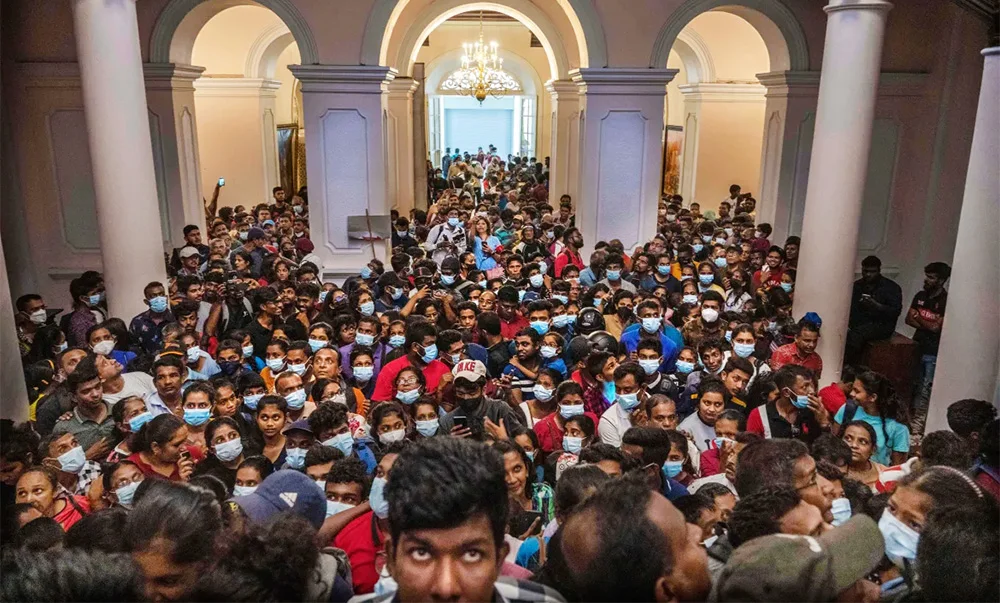
The deployment of SLNS Gajabahu (P 626), an Advanced Offshore Patrol Vessel (AOPV), on the afternoon of 09 July, 2022, to move the then President Gotabaya Rajapaksa, being pursued by a violent aragalaya mob, to safety, from Colombo to Trincomalee, is in the news again.
The issue at hand is how much the deployment of the vessel cost the taxpayer. In response to the Right to Information (RTI) query, the Navy has declined to reveal the cost of the AOPV deployment, or those who were given safe passage to Trincomalee, on the basis of national security.
SLNS Gajabahu, formerly USCGC Sherman (WHEC-720), a United States Coast Guard Hamilton-class high endurance cutter, was transferred to the Sri Lanka Navy on 27 August, 2018, at Honolulu. The vessel was recommissioned 06 June, 2019, as SLNS Gajabahu (P626) during Maithripala Sirisena’s tenure as the President. (Last week, US Special Envoy for South and Central Asia, Sergio Gor, who was here to deliver a message to President Anura Kumara Dissanayake, in the company of Navy Chief of Staff Rear Admiral Damian Fernando, visited SLNS Gajabahu, at the Colombo port.)
What would have happened if the then Navy Chief, Vice Admiral Nishantha Ulugetenne (15 July, 2020, to 18 December, 2022) failed to swiftly respond to the threat on the President? Those who spearheaded the violent campaign may not have expected the President to flee Janadhipathi Mandiraya, as protestors breached its main gates, or believed the Navy would intervene amidst total collapse of the ‘ground defences.’ Ulugetenne accompanied the President to Trincomalee. Among the group were the then Brigadiers Mahinda Ranasinghe and Madura Wickramaratne (incumbent Commanding Officer of the Commando Regiment) as well as the President’s doctor.
The circumstances leading to the President and First Lady Ayoma Rajapaksa boarding SLNS Gajabahu should be examined taking into consideration (1) the killing of SLPP lawmaker Amarakeerthi Atukorale and his police bodyguard Jayantha Gunawardena by an Aragalaya mob, at Nittambuwa, on the afternoon of 09 May, 2022 (2) the Army, deployed to protect Janadhipathi Mandiraya, quite rightly refrained from firing at the violent mob (3) efforts made by the top Aragalaya leadership to compel the then Premier Ranil Wickremesinghe to quit. Subsequently, it emerged that pressure was brought on the President to remove Wickremesinghe to pave the way for Speaker Mahinda Yapa Abeywardena to become the President and lastly (4) arrest of Kegalle SSP K.B. Keerthirathna and three police constables over the killing of a protester at Rambukkana on 19 April, 2022. The police alleged that they opened fire to prevent a violent mob from setting a petrol bowser, barricaded across the railway line there, ablaze.
Now, swift action taken by the Navy, under extraordinary circumstances to prevent possible threat on the lives of the President and the First Lady, had been challenged. The writer felt the need to examine the evacuation of the President against the backdrop of an attempt to compare it with President Wickremesinghe’s visit to the University of Wolverhampton in September, 2023, to attend the awarding of an honorary professorship to his wife Prof. Maithri Wickremesinghe.
The 09 July intervention made by the Navy cannot be, in any way, compared with the public funds spent on any other President. It would be pertinent to mention that the President, fleeing Janadhipathi Mandiraya, and the withdrawal of the armed forces deployed there, happened almost simultaneously. Once a collective decision was made to vacate Janadhipathi Mandiraya, they didn’t have any other option than rushing to the Colombo harbor where SLNS Gajabahu was anchored.
Overall defences in and around Janadhipathi Mandiraya crumbled as crowds surged in the absence of an effective strategy to thwart them. As we recall the law enforcers (both military and police) simply did nothing to halt the advance of the mob right into Janadhipathi Mandiraya, as people, like the then US Ambassador Julie Chung, openly prevailed on the hapless administration not to act against, what she repeatedly termed, ‘peaceful protesters’, even after they, in a pre-planned operation, meticulously burnt down more than hundred properties of government politicos and loyalists, across the country, on 9/10 May, 2022. So they were, on the whole, the proverbial wolves in sheep’s clothing working with the Western regime change project here as was previously done in places like Libya and Iraq and more recently in neighbouring countries like Pakistan, Bangladesh and Nepal to install pliant governments.
After the 9/10 incidents, President Rajapaksa replaced the Commander of the Army, General Shavendra Silva, with Lt. Gen. Vikum Liyanage.
RTI query
M. R. Ali of Kalmuinai, in terms of Section 34 of the Right to Information Act No. 12 of 2016 (read with Article 138), has sought information, in September 2022, regarding the deployment of SLNS Gajabahu. The Navy rejected the request in November 2022, citing Section 5(1)(b)(i) of the RTI Act, which relates to information that could harm national security or defence. Obviously, the release of information, sought by that particular RTI, couldn’t undermine national security. No one can find fault with Ali’s decision to appeal to the RTI Commission against the position taken up by the Navy.
Following hearings in 2023, the Commission issued a split decision on 29 August, 2023. The RTI Commission upheld the Navy’s refusal to disclose items 1 through 5 and item 8, but directed the Navy to release the information for items 6 and 7, specifically, the cost of the travel and who paid for it.
However, the Navy has moved the Court of Appeal against the RTI directive to release the cost of the travel and who paid for it. Having examined the case in its entirety, the Court of Appeal held that the Navy, being the Public Authority responsible for the deployment of the vessel, had failed to prove how they could receive protection under 5(1)(b)(i) of the Right to Information Act. The Court of Appeal affirmed the order dated 29/08/2023 of the Right to Information Commission. The Court dismissed the appeal without costs. The bench consisted of R. Gurusinghe J and Dr. Sumudu Premachandra J.
There hadn’t been a similar case previously. The Navy, for some strange reason, failed to highlight that the failure on their part to act swiftly and decisively during the 09 July, 2022, violence that directly threatened the lives of the President and the First Lady, thwarted a possible catastrophic situation.
The action taken by the Navy should be discussed, taking into consideration the failure on the part of the Army and Police to save the lives of MP Atukorale and his police bodyguard. No less a person than retired Rear Admiral and former Public Security Minister Sarath Weerasekera alleged, both in and outside Parliament, that the Army failed to respond, though troops were present in Nittambuwa at the time of the incident. Had the Navy hesitated to evacuate the President and the First Lady the country may have ended up with another case similar to that of lawmaker Atukorale’s killing.
The Gampaha High Court, on 11 February, 2026, sentenced 12 persons to death for the killing of Atukorale and his security officer Gunawardena.
Let me stress that the costs of presidential travel have been released in terms of the RTI Act. The deployment of SLNS Gajabahu, at that time, has to be examined, taking into account the eruption of Aragalaya outside President Rajapaksa’s private residence at Pangiriwatte, Mirihana, on the night of 31 March, 2022, evacuation of the resigned Prime Minister Mahinda Rajapaksa from Temple Trees, after protesters breached the main gate on 10 May, 2010, and the JVP/JBB-led attempt to storm Parliament on 13 July, 2022. Mahinda Rajapaksa and wife Shiranthi took refuge at the Trincomalee Navy base, chosen by Gotabaya Rajapaksa as sanctuary a few months later.
US Ambassador Julie Chung tweeted that Washington condemned “the violence against peaceful protestors” and called on the Sri Lankan “government to conduct a full investigation, including the arrest and prosecution of anyone who incited violence.”
The US fully backed the violent protest campaign while the direct involvement of India in the regime change project later transpired. As far as the writer is aware, this particular request is the only RTI query pertaining to Aragalaya. Evacuation of Mahinda Rajapaksa took place in the wake of a foolish decision taken at Temple Trees to unleash violence on Galle Face protesters, who were also besieging Temple Trees.
Defence Secretary retired General Kamal Gunaratne told a hastily arranged media conference that the former Prime Minister was at the Naval Dockyard in Trincomalee. The media quoted him as having said: “He will be there for a few more days. We will provide him with whatever security he needs and for as long as he wants.” Mahinda Rajapaksa remained in Trincomalee for over a week before attending Parliament.
Navy’s dilemma
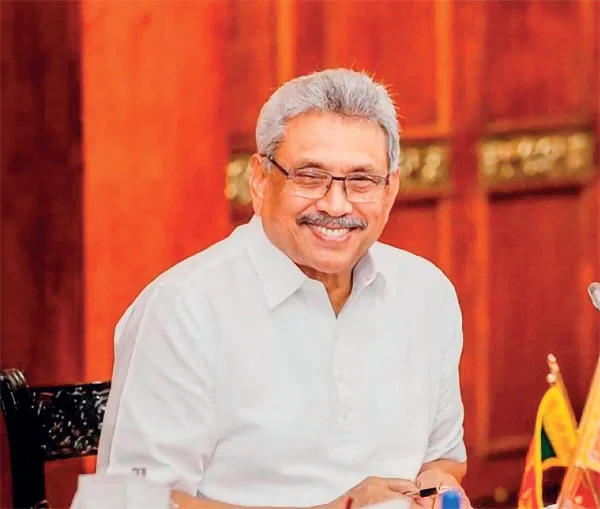
Gotabaya
At the time information was sought under the RTI Act, Ulugetenne served as the Commander of the Navy. Vice Admiral Priyantha Perera succeeded Ulugetenne on 18 December, 2022. Following VA Perera’s retirement on 31 December, 2024, President Anura Kumara Dissanayake brought in the incumbent Kanchana Banagoda, as the 26th Commander of the Navy.
On the basis of the RTI query that dealt with the deployment of SLNS Gajabahu to evacuate President Gotabaya Rajapaksa and First Lady Ayoma, one can seek information regarding the expenditure incurred by Air Force in flying Mahinda Rajapaksa and his wife from Colombo to Trincomalee and back, as well, as Gotabaya Rajapaksa, his wife and two bodyguards leaving the country on Air Force AN 32 on 13 July, 2022. On the following day, they flew to Singapore on a Saudi flight.
Ali, in his representations, stressed that his objective hadn’t been to determine the legality of the Navy’s actions but to exercise his right as a citizen and taxpayer to oversee public spending. He questioned the failure on the part of the Navy to explain as to how revelation of specific information would “directly and reasonably” harm national security. In spite of the RTI Commission directive, the Navy refrained from answering two specific questions as mentioned by justice Dr. Sumudu Premachandra. Question number (6) How much money did the Sri Lanka Navy spent for the travel of former President Gotabhaya Rajapaksha in this ship? And (Question 7) Who paid this money? When did they pay?
Both the RTI Commission and Court of Appeal quite rightly rejected the Navy’s position that the revelation of cost of the deployment of vessels poses a significant threat to national security. That claim was based on the assertion that such financial data could allow third parties to calculate sensitive operational details, such as a ship’s speed, fuel consumption, and operational range. The Navy claimed that the disclosure of sensitive information could reveal supply dependencies, logistics constraints, and fueling locations, making the vessels vulnerable to sabotage or economic warfare.
The Navy sought protection of RTI Act’s section 5(1)(b)(i). Following is the relevant section: “(b) disclosure of such information– (i) would undermine the defence of the State or its territorial integrity or national security;”
The Navy appears to be in a bind over the RTI move for obvious reasons. With the ultimate beneficiary of Aragalaya at the helm, the Navy would find it extremely difficult to explain the circumstances SLNS Gajabahu was deployed against the backdrop of direct threat on the lives of the then incumbent President and the First Lady. The truth is desperate action taken by the Navy saved the life of the President and his wife. That is the undeniable truth. But, the current political environment may not be conducive to say so. What a pathetic situation in which the powers that be lacked the courage to lucidly explain a particular situation. As stressed in the Supreme Court judgment of November 2023, the Rajapaksa brothers – including two ex-Presidents – were guilty of triggering the country’s worst financial crisis by mishandling the economy.
In a majority verdict on petitions filed by academics and civil rights activists, a five-judge bench ruled that the respondents, who all later resigned or were sacked, had violated public trust. The regime change project took advantage of the attack ordered by Temple Trees on 09 May, 2009, on Galle Face protesters, to unleash pre-planned violence on ruling party politicians and loyalists.
If not for the courageous decision taken by Prime Minister Ranil Wickremesinghe, in spite of his private residence, at Kollupitiya, being set ablaze by protesters on the night of 09 July, 2022, to order the military to thwart the JVP/JJB march on Parliament, two days later, and evict protesters from Galle Face soon after Parliament elected him the President on 20 July, 2022, saved the country from anarchy. Although Wickremesinghe, without restraints, encouraged Aragalaya, he quickly became the bulwark against the anti-State project that threatened to overwhelm the political party system.
Obviously, during Wickremesinghe’s tenure as the President, the SLPP, that accommodated the UNP leader as the Head of State, appeared to have turned a blind eye to the RTI query. Had the SLPP done so, it could have captured public attention, thereby making an attempt to influence all involved. In fact, the case never received media attention until journalist and Attorney-at-Law Nayana Tharanga Gamage, in his regular online programme, dealt with the issues at hand.
Before leaving Janadhipathi Mandiraya, the President has warned the military top brass, and the IGP, to prevent the destruction of the historic building. However, no sooner, the President left, the military top brass vacated the building leaving protesters an easy opportunity to take control. They held Janadhipathi Mandiraya until Gotabaya Rajapaksa resigned on 14 July 2022 to pave the way for Ranil Wickremesinghe to become the President.
It would be pertinent to mention that President Gotabaya Rajapaksa only moved into the Presidential Palace (Janadhipathi Mandiraya) after massive protest outside his Pangiriwatte private residence on 31 March, 2022, underscored his vulnerability for an attack.
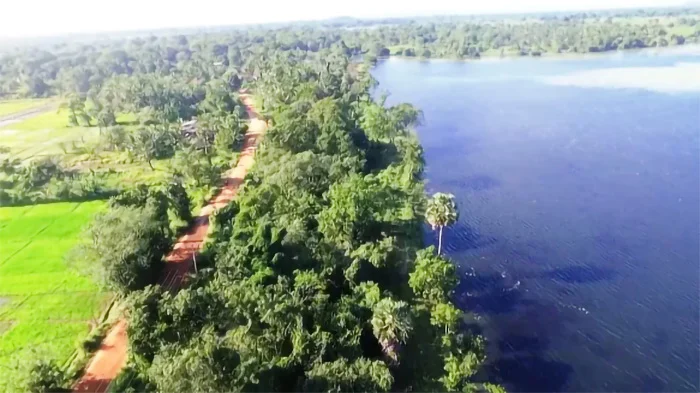
This past November and December Ditwah showed us how dark, eerie and haunting catastrophes cyclones can be. Past generations have suffered as shown in 1911, the Canberra Times reporting the great flood of Ceylon on December 30 of that year. It killed 200 people and left over 300,000 homeless. Half century later, on December 25, 1957, a nameless cyclone brought severe rain to the North Central Province (NCP), and the Nachchaduwa reservoir breached, unloading its full power of volume into Malwatu Oya, a mid-level river flowing through the city of Anuradhapura, nearly washing away its colonial-era bridge near the Lion Tower. A cyclone paid a visit to the Eastern Coast of Sri Lanka on November 17-23, 1978.
Half a century later, Ditwah came with swagger.
Quartet of Rivers
Cyclone Ditwah unleashed disaster and tragedy, terrorising every breath of hundreds of thousands of people. These cyclones come spaced by a generation or two. How the Great River Quartet of Mahaweli, Kelani, Kalu, and Walawe, and their attendant mid-level streams, behaved before Ditwah masks the reality that they are not the loving and smiling beauties poets claim them to be. During the Ditwah visit, our river Quartet showed its true colours in plain sight when wave after wave of chocolate rage pushed uprooted forests creasing islands of floating debris and crashed onto bridges, shattering their potency into pieces. These rivers are nothing more than a bunch of evil reincarnations cloaked in ruinous intentions.
The River Quartet and its mates woke up to the first thunder of Ditwah. They carried away villages, people, property, herds of cattle, and wild elephants to the depths of the Indian Ocean. While we continue to dig out the dead buried in muddy mountainsides, dislodged from their moorings during this flood of biblical proportions, how our rivers, streams, and, particularly, the village tanks handled the pressure on their own will be the core of many future discussions.
The destruction and tragedy caused by this water hurt all of us in many ways. But we all wish they were only a fleeting dream. Sadly, though, the real-life sight of the pulverised railway bridge at Peradeniya is not a dream. This section of the rail line was stripped of its modesty and laid bare. It hung in the air, literally, like strands of an abandoned spider’s web on a wet Kandyan morning. It was a reminder to us that running water is a masked devil and should not be considered inviting. It can unleash the misery with a chilling ending no one wants to experience in a lifetime.
Tank Cascade Systems (TCS)
Although the Ditwah cyclone covered Sri Lanka from top to bottom with equal fury, the mountainous areas and floodplains of our River Quartet surrendered soon. However, the village tanks in the Dry Zone – Northern, North Central, Northeast, and Eastern provinces – weathered that onslaught, sustaining only manageable damage. They collectively mitigated the damage caused by over 200 mm of rain that fell across the catchment areas they represented. Thus, the tank, the precious possession of the village, deserves to be titled as a real beauty.
Let me introduce the village tanks systems our engineering ancestors built with sophistication and ingenuity, a force like Ditwah hardly made a dent in groups of these tanks called Tank Cascade Systems (TDS). Many of the village tanks in the Dry Zone, covering 60% of Sri Lanka’s land area, stand in groups of TDS, separated as individual bodies of water but sharing water from one or more dedicated ephemeral streams. R.W. Ievers, the Government agent for North Central Province in the 1890s, noted that these tanks were the result of “one thousand years of experiment and experience,” and “ancient tank builders took advantage of the flat and undulating topography of the NCP to make chains of tanks in the valleys.” Colonial Irrigation Engineers of the early 20th century also recognised this uniqueness. Still, they could not connect the dots to provide a comprehensive definition for this major appurtenance of the village.
Although these tanks appear to be segregated ecosystems, a closer look at the peneplain topographic map of Sri Lanka shows that each stream feeding them ultimately flows into a larger reservoir or river, jointly or independently influencing the mechanics of regional water use and debouching patterns. This character is the spirit of the dictum of King Parakramabahu centuries earlier: “let not a single drop of water go to waste into the sea without being used by people.” Villagers knew that each tank in their meso-catchment area was related to other tanks on the stream it was in ensuring maximised use of water.
With their embodied wisdom, our ancestors centuries ago configured the placement of individual tanks that shared water from a catchment area. But not until 1985, following a careful autopsy of the pattern of these small tanks in the Dry Zone, Professor Madduma Bandara noticed a distinctive intrinsic relationship within each group of tanks. He called a group of such tanks a Cascade of Tanks. He wrote, “a (tank) cascade is a connected series of tanks organized within a micro-catchment of the Dry Zone landscape, storing, conveying, and utilising water from an ephemeral rivulet.” In short, it is a “series of tanks located in succession one below the other.” Dr. M.U.A. Tennakoon shared the names of the villagers in Nuwarakalaviya used for this configuration of tanks: Ellangawa. On a map, these tanks appear as hanging on a string. Thus, Ellangawa can be a portmanteau, a blend, of these two words.
There are over 475 such cascading tank groups in the Dry Zone. On average, each cascade typically supports four tanks. One cascade, Toruwewa, near Kekirawa, has 12 tanks. According to Professor Madduma Bandara, a cascade of tanks held about 20-30% of the water falling on its catchment area. As I will show later in this essay, the tank cascades behave like buddies in good times and bad times. By undertaking to build a vascular structure to collect, conserve, and share water with communities along the stream path, our ancestors forewarned of the consequences of failing to undertake such micro-projects where they chose to live. The following are a villager’s thoughts on how to retool this concept to mitigate the potential for damage from excess water flow in a larger river system.
To villagers, their tank is royalty. Its water is their lapis lazuli. Therefore, they often embroidered the title of the village with the suffix wewa (tank) or kulam (tank, in Tamil), indicating the close connection between the two. It is the village’s foremost provider and is interdependent. That is why we have the saying, “the village is the tank, and the tank is the village.”
A study in 1954/55 found that there were 16,000 tanks in Sri Lanka, of which over 12,500 were operational. Out-of-commission tanks were those that fell into disuse after the original settlers abandoned them for a host of reasons, such as a breach in the bund, fear of plague or disease, or superstition. Collectively, they supply water to an area larger than the combined area of the fields served by the major irrigation reservoirs in the country at the time.
In some villages, an additional tank called olagama, with its own acreage of fields, receives water from the same stream or from another feeder stream which joins the principal stream above or below the main tank. In the event the main tank is disabled, often the olagama tank can serve as the alternate water source for their fields.
Cultural and Engineering
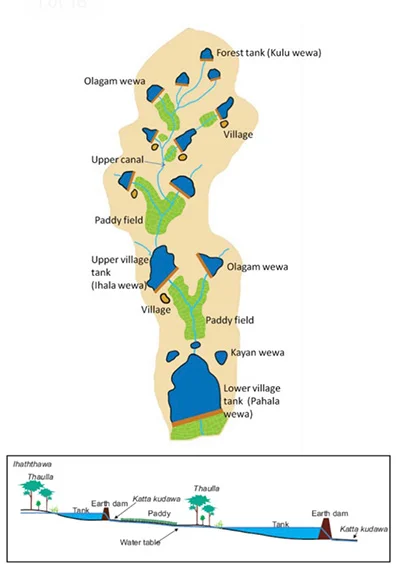
A graphical representation of the tank cascade system. Image courtesy of IUCN Sri Lanka.
A tank cascade is also an engineering undertaking. But village tank builders were not engineers with gold-trimmed diplomas. They were ordinary folks, endowed with generations of collective wisdom, including titbits on the physics of water, its speed, and its cruelty. Village pioneers responsible for starting the construction of the tank bund, gam bendeema, placed the first lump of earth after marking off home sites, not immediately below the future bund, but slightly towards one end of it, in the area called gammedda, or the elevated area the bund links to, gamgoda.
Engineering of a tank cascade has a cultural underpinning. It is founded on the feeling of solidarity among the villages along an ephemeral stream. In practice, it was a wholesome area with small communities of kin below each tank sorting out their own affairs without much intervention of the ruling class. For example, during heavy rains, each village in the chain communicated with the villages below the volume in its tank and the projected flow of the stream. When the tank reached its capacity and water began to spill over the spillway, the village below must take measures to protect its tank bund. If it breached, villagers up and down the cascade helped each other repair it.
They were aware that an earthen dam was susceptible to failure, so they used their own town-planning ideas. They avoided building residential zones directly under the stream’s path, generally at the midpoint of the dam. Instead, they built their triumvirate of life – tank, field, and dagoba (stupa) – keeping safety and practicality in mind. Dagoba was always on a higher ground, never supported by beams on a stream bank like what Ditwah revealed recently. We now know what happens to dagobas built on sagging beams by deceptively serenading riverbanks when thunder waters and unworldly debris came down hand in hand.
From top to bottom, the Tank Cascade showed the engineering instinct of the builders and accessory parts that helped its smooth functioning. There was the Olagama and Kulu Wewa associated with a system. Tank builders had an idea of the volume of water a given stream would bring in a year. In conjunction with this, the bunds of the Olagama and Kulu Wewa are built small. In contrast, the bunds of the tanks that formed the lower rung of the cascade are relatively larger. The idea behind this was that, in the event of a breach in an upstream tank, the downstream tanks could withstand an unexpected influx of water.
During the Ditwah’s death dance, the Mahaweli River did not have this luxury as it marched downstream from Kotmale dam. There were not enough dams to tame this river, and its beastly nature was allowed to run wild until it was too late for many.
The embodied imprints of experience inherited from their ancestors’ helped villagers design the tank’s physical attributes. In general, a tank supplied by this stream had a dam of a size proportional to the amount of water it could store for the fields. Later, as the village added families and field acreage increased, villagers raised the bund and the spillway to meet increased storage capacity. This simple practice guarded against eventualities like uncontrollable floods between villages. Excess water was allowed to flow through the sluice gate and the spillway, reducing the pressure on the bund. Had we applied this fundamental practice on a proportional scale to a large stream, i.e., oya or river, it would have lessened the destruction during a major rainstorm, ilk of which Ditwah brought.
With my experience living in a village with its tank, part of a TCS of five tanks, I wish large rivers like the Mahaweli had a few small-scale dams or partial diversions mimicking a rudimentary TCS so that the Railway Bridge at Peradeniya could have avoided the wrath of hell and high-water bringing muck and debris along its 46 km descent from Kotmale, where its lone dam is. I am glad I have company here. Professor Madduma Bandara noted 40 years ago, “much water flows through drainage lines due mainly to the absence of a village tank-type storage system.” Mahaweli turned out to be that drainage line this past November, holding hands, sadly, though, jubilantly, with the designs of Ditwah. Recently, former Head of Geo-Engineering at Peradeniya University, Udeni Bandara Amarasinghe, highlighted the importance of building reservoirs on other rivers to control floods like those we experienced recently.
Check Dams & Macroscopic Control
Within the TCS, the check dams, Kulu Wewa or Kele Wewa – forest tanks above a working tank held back sediments generated by upstream denudation. They controlled the volume and water entering the main tank. Kulu Wewa provided water for wild animals and checked their tendency to raid crops below the main tank. The difference between Kulu Wewa and Olagama was that, because of its topographical location, Kulu Wewa was occasionally used as a source of water for crops when the main tank below it became inoperable due to a breach or was undergoing repairs or used up its water early.
Based on these definitions, each working tank in the TCS also acted like a check dam for the one below it. Furthermore, if a tank in the cascade ran out of water, other tanks in the cascade stepped in. They linked up with the tanks above through temporary canals made by extending an existing minor canal, wella, or the wagala, excess water pan, of an upstream field.
The tank bund tamed and kept in check the three attributes of a stream – water velocity, volume, and its destructive power. By damming the stream, the villagers broke fueling momentum of it. They rerouted it via the spillway at the end of the bund, a form of recycling. Water from some spillways is diverted along a large niyara-like (field ridge) lesser dam, built along the wanatha (flanks) of the field, until it empties into the atrophied stream below the field.
Simultaneously, by controlling the release of water through two sluice gates on the bund, goda and mada horowwa, and directing it to the two flanks of the field, ihala and pahala wanatha, villagers succeeded in tamping down the pressure on the bund. Water from the neutered stream is thus redirected from all three exit points. It must now continue its journey along the wagala, to which field units (liyadi) also empty their excess water. This water is called wel pahu wathura.
After going through this process, the momentum of the ephemeral stream water is passive by the time it reaches the tanks in the lower parts of the cascade, often a kilometer or two downstream. This way, a line of tanks along the stream’s axis now shares the responsibility of holding back its full potential, limiting its ability to cause damage.
Such a break of momentum was lacking in the Four Great River Quartet and their lesser cousins. For the long-term solution to prevent damage from future cousins of Ditwah, we must consider this ingenious water-control method for rivers on a macroscopical scale.
Reservoirs
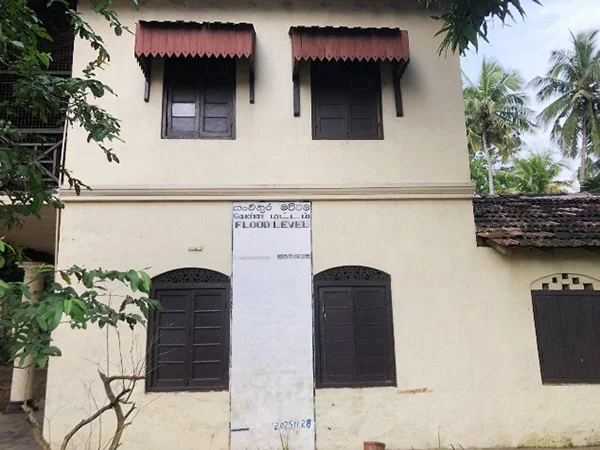
1957 and 2025 Cyclones Flood Marks written above window and below on the wall of a house by the banks of the Malwatu Oya in Anuradhapura.
As Ditwah-type floods occurred in 1911, 1957, 1978, and 2025, with a bit of luck, we can expect to have a few more decades of recess to work on cascading edifices along rivers, such as dams or diversions, before the next flood comes with roguish intentions. The Accelerated Mahaweli Diversion Program (AMDP), started in 1978, took 30 years to complete and now has over a dozen reservoirs between Kandy and the Dry Zone coastal belt, holding back its might. These reservoirs held their ground while Ditwah rained hell, so consulting the TCS’s ingenuity, though seems antiquated, is a good investment.
As soon as Cyclone Ditwah began to make noise, word spread that releasing water from a few of them on the Mahaweli and Kelani rivers could have made a difference. The problem with the Kelani River basin in Western Province and the Mahaweli basin in Central Province above Kandy is that, despite their combined population being nine times that of the NCP, they only have six reservoirs. On the contrary, the NCP has twice as much in the lower Mahaweli River basin, built under the AMDP. Furthermore, the NCP also has many ancient reservoirs it inherited from our ancestors. A string (cascade) of large reservoirs or minor dams in the hill country could have helped break the river’s energy which it accumulated along the way. G.T. Dharmasena, an irrigation engineer, had already raised the idea of “reorienting the operational approach of major reservoirs operators under extreme events, where flood control becomes a vital function.”
Unique Epitaphs for the Cyclones
The processes discussed above could have prevented the destruction of the railway track at the Peradeniya bridge, the image of which now stands like a pictorial epitaph to the malicious visit of the Ditwah and a reminder to us, “what if…?” or “what next…?”
As mentioned at the beginning of this essay, when the 1957 Cyclone dropped heavy rain on the NCP, a Railway Department employee at Anuradhapura made an exceptional effort to keep the memory of that saga for posterity with an epitaph still visible 70 years later. This person memorialised his near escape from the Malwatu Oya flood. As the river roared past over the railing of the bridge near the Lion Pillar roundabout, this employee, probably trapped in his two-storied house near the roundabout, day-stamped the visit of the flood with a red line on the wall of his house to mark the height it reached to trap him.
Three meters from the ground, right between two archtop windows facing the road to Sri Maha Bodhi, he wrote, “Flood level” in Sinhala, Tamil, and English. Right below it, at the end of the faded line, he added, “1957-12-25.”
As Cyclone Ditwah came along, the current resident of the house was not going to break this seven-decade-old tradition. After the flood receded this time, this duty-bound resident drew a line in blue ink and wrote at its end, ‘2025-11-28’, his contributing epitaph reminding us of infamous day Ditwah showed her might by driving the river off its banks. (See picture)
He added a coda to his epitaph – the numeral “8” in 28 is written in bold!
Lokubanda Tillakaratne is the author of Rata Sabhawa of Nuwarakalaviya: Judicature in a Princely Province – An Ethnographical and Historical Reading (2023).
by LOKUBANDA
TILLAKARATNE
In the imperiled IOR’s ‘Isle of Smiles’,
The vital ‘National Honesty Week’,
Has sadly gone unobserved,
In an unsettling sign of our times,
That honesty is no longer the best policy,
For neither smooth-talking rulers,
Taking after posh bourgeois predecessors,
Nor perhaps sections of the harried ruled,
Now sensing tremors of a repeat implosion.
By Lynn Ockersz

UN votes to recognise enslavement of Africans as ‘gravest crime against humanity’

Meta and YouTube found liable in landmark social media addiction trial

Showers expected in the Western and Sabaragamuwa provinces and in Galle and Matara districts after 2.00 pm.

Heat Index at ‘Caution level’ in the Western, Sabaragamuwa, Southern and North-western provinces and in Anuradhapura, Mannar, Vavuniya and Monaragala districts

US dodges question on AKD’s claim SL denied permission for military aircraft to land

No decrease in remittances from workers due to Gulf conflict, but significant drop in tourist arrivals – CB Governor

‘Dates have the highest sugar content to fight Coronavirus’

Sunday Island 27 December – Headlines

#SundayIsland 17th December – Headlines

Sunday Island – 28th March

Sunday Island Headlines – 21 March

Sunday Island – 21st February – Headlines
-

 Features3 days ago
Trincomalee oil tank farm: An engineering marvel
-
 News6 days ago
CIABOC tells court Kapila gave Rs 60 mn to MR and Rs. 20 mn to Priyankara
-
 Features6 days ago
Science and diplomacy in a changing world
-

 News1 day ago
Senior citizens above 70 years to receive March allowances on Thursday (26)
-

 Features3 days ago
The scientist who was finally heard
-
 News1 day ago
Japanese boost to Sri J’pura Hospital, an outright gift from Tokyo during JRJ rule
-

 News5 days ago
Colombo, Oslo steps up efforts to strengthen bilateral cooperation in key environmental priority areas
-

 News1 day ago
CEB Engineers warn public to be prepared for power cuts after New Year