
News
Parliament to give more powers to Labour Tribunal Presidents

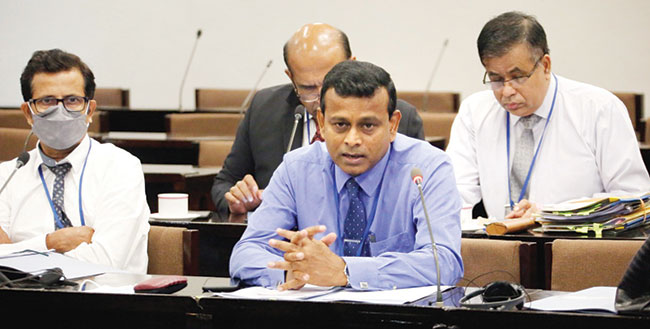
Parliament will take up for debate this week the Industrial Disputes (Special Provisions) Bill to give more powers to the Presidents of the labour tribunals as Additional Magistrates “to hear, try, determine and dispose of all suits or prosecutions under the provisions of specified enactments and for matters connected therewith or incidental thereto.”The decision to take up the Bill for debate was made at the last Ministerial Consultative Committee on Labour and Foreign Employment held at the parliamentary complex recently with Minister Manusha Nanayakkara presiding, Parliament sources said.
The new Bill, published in the Gazette dated April 8 2022, has provisions enabling the President of a labour tribunal to act as an Additional Magistrate and vesting him with power and authority to hear, try, determine and dispose of cases in a summary way “by virtue of the provisions of the Code of Criminal Procedure Act, No. 15 of 1979 in relation to the enforcement of any award made by any arbitrator or industrial court or any order made by the labour tribunal under the provisions of the Industrial Disputes Act (Chapter 131) or any decision of the Commissioner or recovery of payment upon a certificate issued by the Commissioner or implementation of the provisions of the specified enactments.
“The provisions of the Code of Criminal Procedure Act, No. 15 of 1979 and Evidence Ordinance (Chapter 14) shall apply to and in relation to the procedure to hear, try, determine and dispose of the suits or prosecutions before the labour tribunal,” the bill says.
Commissioner General of Labour Prabath Chandrakeerthi, explaining the provisions in the Bill said that currently cases where an employer terminated the employment of an employee are heard by a labour tribunal as per the provisions of existing Industrial Disputes Act. With regard to the cases pertaining to disputes on Employees’ Provident Fund, wages, other terms and conditions, litigation takes place at the Magistrates’ Courts. At present there are more than 16,000 cases that have been filed before about 80 Magistrate Courts countrywide. This limitation causes a delay and aggrieved parties are at a disadvantage because of the delayed justice. The dispute resolution process could be expedited if the presidents of labour tribunals give more powers to hear such cases. There are 37 established labour tribunals countrywide.
Minister Nanayakkara’s predecessor incumbent Minister of Ports, Shipping and Aviation Nimal Siripala de Silva, Deputy Chairman of the Committees, Angajan Ramanathan and MP Jagath Pushpakumara and officials from the Ministry of Labour and its statutory bodies were present at the meeting.

News
Establishment of an Institutional Framework to Inagurate Upper Hydro Catchment Areas Management Authority

Policy approval of the Cabinet of Ministers was granted at their meeting held on 08.06.2026 to establish the Upper Hydro Catchment Areas Management Authority for identification and
execution of a formal and long – lasting remedy to secure the central hills including the upper hydro catchment areas enabling them to sustain amidst extreme weather conditions
due to natural calamities and human activities as well as to be used for the sustainable development of the country.
Accordingly, a concept paper has been prepared including
institutional structure, activities, powers, active subject area as well as administrative and coordination mechanism for the proposed authority by an expert technical committee appointed by the Secretary to the President.
Based on the said concept paper, the Cabinet of Ministers granted approval to the resolution furnished by the President to instruct the Legal Draftsman to prepare a draft bill including legal provisions required for the establishment of Upper Hydro Catchment Areas Management Authority.
News
Introduction of Flora and Fauna (Regulation of actions of the Indigenous Community within the nominated areas) Regulations
With the objective of securing the traditional livelihood and the eco system of the indigenous community, it has been recognized the necessity of introducing a formal regulation methodology to secure their engagement in livelihood activities by being more sensitive to the existing laws.
Thereby, the Fauna and Flora (regularizing) regulations under the Fauna and Flora Protection Ordinance (Authority 469) have been prepared so that nominated activities within the prescribed area to a member of the indigenous community
who has been registered for securing the rights acquired from law or custom or usage or traditional stance to execute an act within a certain state land that is fundamental to the survival of the indigenous community permission can be granted
Accordingly, the Cabinet of Ministers granted approval to the resolution furnished by the Minister of Environment to publish the said regulations in the government gazette notification and thereby submit to the Parliament for its concurrence.
Latest News
M. M. D. J. Senarathne, appointed Director General of the Department of National Botanical Gardens
The Cabinet of Ministers approved the resolution furnished by the Minister of Environment to appoint M. M. D. J. Senarathne, who is the senior most officer in Grade I of Sri Lanka Scientific Service se

Establishment of an Institutional Framework to Inagurate Upper Hydro Catchment Areas Management Authority
Introduction of Flora and Fauna (Regulation of actions of the Indigenous Community within the nominated areas) Regulations
M. M. D. J. Senarathne, appointed Director General of the Department of National Botanical Gardens

Harmanpreet Kaur steps down as India captain

Turkiye, Pakistan agree Saudi Arabia military deployment under Mecca pact

Rumesh Tharanga among nominees announced for World Athlete of the Year 2026

‘Dates have the highest sugar content to fight Coronavirus’

Sunday Island 27 December – Headlines

#SundayIsland 17th December – Headlines

Sunday Island – 28th March

Sunday Island Headlines – 21 March

Sunday Island – 21st February – Headlines
-

 Latest News7 days ago
Gold winner Tharanga gets brand-new Honda Vezel from SLAAJ
-

 News6 days ago
US-assisted ‘Ice’ detection: NPC to examine IGP’s move to transfer drug-busting team
-

 Features7 days ago
Why Sri Lanka needs an Inclusive Civic Nationalism – urgently
-

 Editorial5 days ago
Colombo Port drug bust: The plot thickens
-

 News7 days ago
Civil society activist accuses govt. of favouring Ven. Gnanasara
-
 Midweek Review7 days ago
Dappula’s Easter Sunday ‘grand conspiracy’ claim demolished
-

 Editorial7 days ago
When crime bosses rise above law and shrines
-
Editorial6 days ago
Drug busting, transfers and trust deficit