
News
President presents budget replete with reforms

* SriLankan Airlines, Sri Lanka Telecom, Waters Edge and Sri Lanka Insurance to be sold to strengthen foreign reserves
* Presidential Commissions to review public service and tax
* BOI and EDB to be merged
* ETF law to be reformed
* Reforms to change economy going beyond IMF recommendations
* Insurance coverage for Private Sector Employees
* Selected SOE debt to be taken to government balance sheet
* New Financial Asset Management Companies Act
* Post-Harvest crop losses to be reduced and storage to be improved
* International University for Climate Change
* Safety Seal (Sticker) for bottles of Water
* Paying wards system in government hospitals
* ICTA to be dissolved
* Soldiers can retire after 18 years of service
by Saman Indrajith
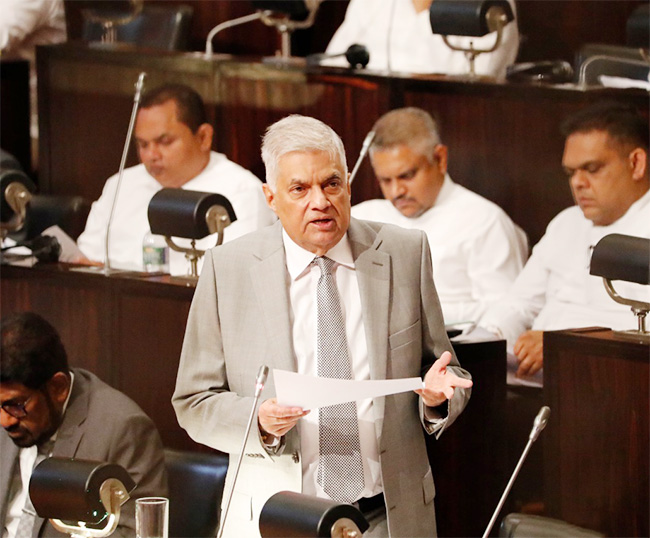
The government would ‘restructure’ SriLankan Airlines, Sri Lanka Telecom, Sri Lanka Insurance and Waters Edge through a state enterprise reform unit, President Ranil Wickremesinghe told Parliament yesterday, presenting the Budget 2023 in his capacity as the Minister of Finance.
The proceeds would be used to strengthen foreign reserves, he said.
The President said that the government would appoint presidential commissions to review the public service and tax policy. The presidential commission would review the public service which was consuming most taxes. The presidential commission on tax would also make recommendations on a revenue authority, he said.
President Wickrem-esinghe said that the Board of Investment (BOI) and Export Development Board (EDB) would be merged. The Employees Trust Fund (ETF) law would be reformed. The Information Communication Technology Agency (ICTA) would be dissolved.
Soldiers who had served for over 18 years would also be given the opportunity to retire on a voluntary basis, the President said.
The government was planning to reform labour laws to create an export-oriented economy, the President said.
“Labour laws have to be reformed for an export-oriented economy. There are also independent contractors.”
The government would bring a comprehensive law to regulate labour, he said, adding that the government would make reforms to change the economy going beyond the IMF recommendations.
The President said that the long-term development of the country (2023-2048) should be based on correct decisions and not popular decisions.
“To ensure a better future for the youth of our country, let’s create a new economy, tailored to meet the expectations of the youth through a new approach that goes beyond traditional protests, struggles, and strikes,” the President said.
Instead of a lifestyle tailored to per capita income, an economy tailored to the lifestyles of the youth.
A new economic foundation should be prepared to match the new trends of the world , said the President
It is expected to achieve a high economic growth rate of 7%-8% through the social market economy based on reforms and modernization.
Excerpts of the President’s budget speech titled ‘Sri Lanka, Towards a New Beginning’:
The real national wealth of our country is the youth. Can we be satisfied with the work we have done so far in order to create educational, social and economic opportunities for the youth? If we have done a proper role to protect that youth, why are they queuing up to leave the country…These young people hope for a better day. Hope for a good country. A new approach, a new program that goes beyond.

In this new economy, we focus on three main things: An export oriented competitive economy, An environmentally friendly green and blue economy and A digital economy. These budget proposals are different from traditional budget proposals. We are often used to get reductions in prices of goods, salary increases concessions etc. through budget proposals. We would like to see budget proposals that appear to be relief on the surface even if it means indebtedness to the world. We lost our way because of taking that popular route. Now we can no longer go down wrong paths and despair.
As Sri Lanka is facing forex shortages due to ongoing economic crisis, the inflows of forex should be reviewed. It is noted for some time that the coordination issues associated with the government agencies working for the external trade and investment affects the performance of the country’s exports. Besides, there are several incentive programmes being implemented by the government agencies to encourage exporters at present. Therefore, it is important to set up a single agency enabling to create a conducive environment for promoting investment and external trade. Accordingly, a new agency will be set up in place of the Board of Investment, Export Development Board, Sri Lanka Export Credit Insurance Corporation, National Enterprise Development Authority etc. with the enactment of a new law. For this purpose, I propose to allocate Rs. 100 million.
I propose to set up New Economic Zones in the Western Province, North-Western Province, Hambantota, and Trincomalee with a view to attracting foreign investments. Accordingly, steps will be taken for setting up of relevant infrastructure conducive for such investments. Investments and industrial zones currently operating under various government agencies will come under the New Economic Zone program for which a new law will be enacted soon. Besides, alternative mechanisms to the current practice of attracting foreign investors based on the tax concessions should also be examined. Rs. 300 million will be allocated for the propose of this programme.
Reforms in the labor sector is long overdue, in which both employee and employer should be protected in a manner to efficiently carry out productive economic activities. In a competitive export-oriented economy, both parties should productively participate in the promotion of country’s progress. The laws, policies and institutional arrangements in the sector should not stall entrepreneurial abilities and business development. In fact, all the environment should be conducive to make use of individual’s talents while entrepreneurs’ risk-taking behavior too should be properly rewarded. The country’s labor laws being outlived and fragmented, I propose to enact a new, updated and unified labor law in a manner to benefit both employer-employee segment and the economy.
A vast amount of land belonging to Janatha Estate Development Board (JEDB), Sri Lanka State Plantation Corporation (SPC), and Land Reform Commission (LRC) remains without being cultivated or productively utilized for a long time, due to various reasons: legal issues, institutional conflicts, lack of capital etc. There are possibilities of productively using such lands for the betterment of the economy. Accordingly, a programme will be devised to allow investors to productively utilize them in a manner to increase both the production and exports. Hence, it is expected that large parcels of unutilized/unproductively used lands will be leased out on long-term basis to grow exportable crops. Further, a new law to facilitate the proposed agricultural land lease program will also be presented to this house.
Although preliminary activities related to the disposal of government lands are carried out by District Secretaries/Government Agents through Divisional Secretaries/ Additional Government Agents, such duties were also allocated to Sri Lanka Mahaweli Authority and Land Reform Commission which were established for special requirements at a later stage. It is reported that there are occurrences of discrimination and malpractice as preliminary activities related to disposal of lands are done in various ways by the respective entities. Therefore, as the aforementioned special requirements have already being met, a programme will be prepared during the next year to enable preliminary activities in relation to disposal of all government lands including the disposal of lands under the above two institutes only by the Divisional Secretaries.
The country sees the benefit of using digital technology in various economic activities and service delivery systems. Its beneficial effects were seen very recently with the introduction of the QR system in the petroleum distribution by the Ministry of Power and Energy. Hence, I propose to appoint a Committee involving experts and relevant officials in the industry to examine and report to the Cabinet of Ministers on the requirement for furtherance of the digital technology industry, including required policy environment, laws, institutional support and facilities.
It is indispensable to provide internet facilities to the school system for advancement of the education system with the latest technology. Therefore, as the first step, free internet facilities to 1,000 senior and junior secondary schools located in remote areas will be facilitated with the contribution of the Telecommunication Regulatory Commission, along with the concept of Corporate Social Responsibility of institutions that provide internet facilities and other private sector institutions.
We have learned that the existing health and hygiene facilities in some rural schools are not sufficient. Accordingly, a provision of Rs. 200 million will be made for the construction of sanitary facilities, particularly toilets with proper water facilities, or to provide water facilities for existing toilets in 139 provincial schools and 23 national schools, as well as in rural schools with minimal facilities.
In admitting students to state universities, only all arts stream students are selected on island-wide merit basis currently. However, 40 percent of the students are admitted on the basis of island wide merit in commerce, technology, science and mathematics streams. In this context, a large number of students who demonstrate higher performance are deprived of the opportunity to enter the university. And also they suffer great inconvenience and injustice, and lost their opportunity to contribute for the country’s development. Therefore, it is necessary to introduce required steps to overcome the situation. Accordingly, I propose to gradually increase the percentage of admissions to state universities on island wide merit basis from 40 percent to 50 percent with effective from the academic year 2023/2024. Accordingly, the Ministry of Education should take action to amend the system of admission to state universities.
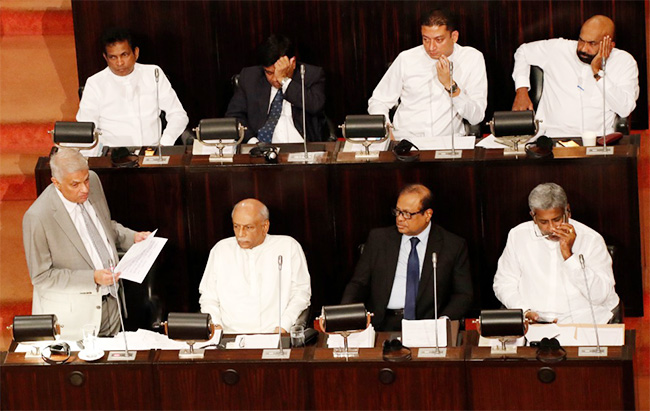
President Wickremesinghe delivering the budget speech
There are around fourteen hundred and fifty thousand (1,450,000) public servants currently working in the various government agencies. Hence, a large portion of the government revenue has to be spent on their salaries and wages. Therefore, it has become a challenge to allocate resources for other public purposes, including developmental purposes. Therefore, I propose to appoint a Presidential Commission to review all the aspects of public service in line with current requirement and make recommendations including necessary reforms.
It has been difficult to allocate resources to health, education and other important sectors due to the lower level of government revenue generated from taxes in comparison to other countries. Accordingly, measures should be taken gradually to increase the state revenue in the next few years. As such, I propose to establish a Presidential Commission on Taxation to study and make recommendations on the functioning, coordination and changes to be made in the tax structure, the institutions, procedures etc. This Commission will also examine the requirement for setting up of centralized institution for managing government revenue.
It is noted that the number of private sector employees who lose their jobs due to various reasons is on the increase. As this has become a very complex social issue with the current economic crisis, I propose to provide insurance coverage to provide a monthly allowance for a maximum of three months covering the period from the loss of employment and re-employment and to establish an insurance fund for this purpose.
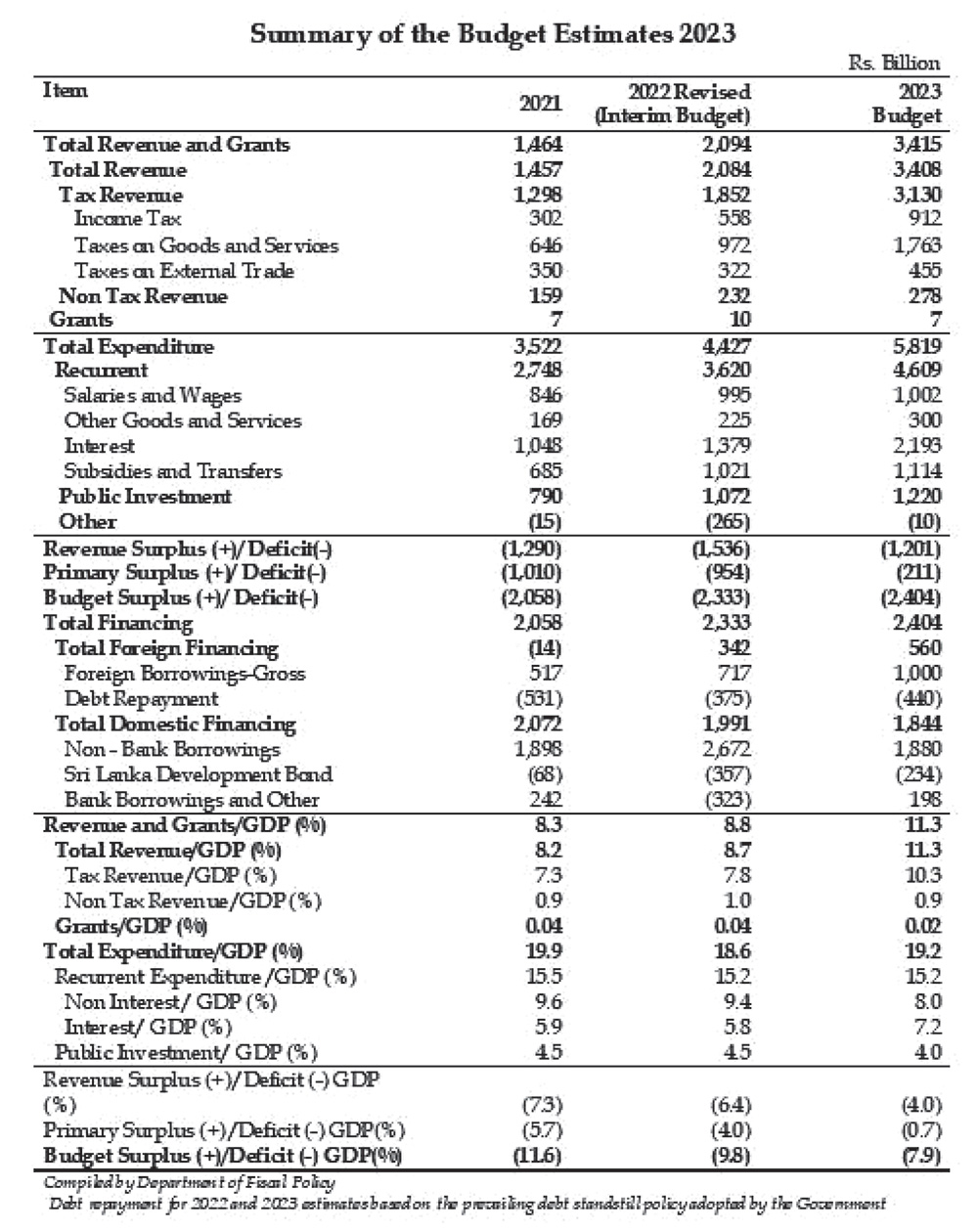
The need for increasing government revenue requires no explanation as many of the challenges that we face today is due to the lack of revenue of the government. The revenue has declined significantly to 8.3% of GDP in 2021, which is one of the lowest in the world. In order to correct this position while correcting the tax cuts introduced in late 2019, the government presented revenue measures in three occasions i.e. on 30 May 2022, the Interim Budget presented on 30 August 2022 and the Inland Revenue Bill presented in October 2022. The revenue proposals mainly included changes to the income tax and Value Added Tax (VAT) while addressing tax policy gaps and rationalizing tax concessions.
Increase in non-tax revenue is also important in the fiscal consolidation process. Hence, I propose to increase fees and charges by 20 percent with effect from 2023. However, fees and charges that have already been increased in the years of 2020, 2021, and 2022 will not be revised with this proposal.
I propose to daily transfer all revenue and receipts collections by Ministries and Departments, directly to the General Treasury with effect from January 2023 to reduce the substantial cost of finance due to delay in remitting revenue collection to the Consolidated Fund. In this regard, General Treasury will take necessary actions to issue the instructions in due course.
Recent announcements of tax policy measures should go hand in hand with the tax administration measures to have a broader tax base, better compliance, and stricter enforcement. Accordingly, tax administration measures will be enhanced through improvements in technology, regulations, process improvements, and investing in Human Resources related to the Department of Inland Revenue, Sri Lanka Customs, and Department of Excise.
Whilst the requirement of having everyone over 18 opening a tax file is a first step, many of those who open files will be below the tax-free thresholds. Therefore, it is important to introduce measures that identify high income earners specifically and get them into the tax net.
The importance of proper expenditure management to strengthen the fiscal consolidation process needs no elaboration. It should be in line with the efforts to increase the revenue as well.
The urgency of restructuring the most fiscally significant State-Owned Enterprises (SOEs) was reiterated several times during the last 6 months. As committed to in the Interim Budget, a Unit has now been established at the Ministry of Finance with the specific task of restructuring SOEs.
As a part of strengthening the balance sheets of selected SOEs, loans from China Exim Bank to the government which had earlier reclassified as debts of the CEB, SLPA and AASL will be recognized as central government debt by end of December 2022. Guaranteed foreign exchange debt of the CPC will also be recognized as
I propose to introduce a new Financial Asset Management Companies Act to enable banks and finance companies to separate and transfer their non-performing bad assets to an asset management company. This will smoothen the resolution process of financial institutions by creating a swift removal of bad debts from an affected institution.
I propose to establish a Microfinance and Credit Regulatory Authority (MCRA) to ensure the protection of customers of microfinance and money lending businesses, while necessitating the reporting requirement to Credit Information Bureau of Sri Lanka (CRIB) by the regulated institutions.
Honourable Speaker, I draw your attention to the 19th paragraph of the Interim Budget Speech presented by me to amend the Appropriation Act, No. 30 of 2021. According to the Welfare Benefits Act No. 24 of 2002, the preparation of the social registry has already started by Welfare Benefits Board (WBB). Accordingly, the beneficiary applications have been processed and the data systems are being processed. We have already published on 20th October 2022 the legal regulations to identify beneficiaries based on verifiable eligibility criteria.
As the next stage of the process, it is planned to go to the homes of the applicants who have already registered to validate their eligibility to receive benefits and get a declaration related to it according to the Law. Accordingly, the process of selecting beneficiaries using new eligibility criteria will start in January 2023 and the eligibility list will be published. In line with Welfare Benefits Act No. 24 of 2002, all welfare benefits payment schemes will be prepared based on that social registry system.
The WBB will coordinate payments of all welfare benefits. Electronic payments of benefits under this social registry and all welfare benefit payment schemes framed thereunder are facilitated to the bank accounts of eligible beneficiaries. Payment under the new welfare benefit payment schemes are expected to start by April 2023. Until then, the existing welfare benefits schemes will be maintained.
Elderly/disabled/low-income /widows are a segment that should receive more attention economically. It is possible to strengthen this community economically by utilizing their skills and labor, and thereby obtain their contribution towards the development of the national economy. In that respect, I propose that a program be arranged for this purpose by the Ministry of Women Affairs and the Ministry of Industry in collaboration with each other. I propose to allocate Rs. 250 million for the year 2023 in this respect. Further, action will be taken to obtain the participation of the private sector under public-private partnership for promotion and advertising of the products made by them in the market.
Amidst the current economic crisis, an increase in acute malnutrition among children under 5 years of age is observed. Hence, I propose a sum of Rs. 500 million be provided to further strengthen the existing nutrition supplemental programmes in order to reduce health problems arising as a consequence thereof.
As there are new opportunities to generate foreign exchange to be created by promoting the export of coconut and related products, facilities should be provided for encouraging more and more value-added exports of coconut. It is a fact that in recent times, coconut lands are upon fragmentation used for other purposes. Therefore, necessary steps should be taken to protect the present coconut lands as well as to encourage the replanting of coconuts.
Current legal provisions allow fragmentation of less than 4 hectares of coconut lands, resulting in fragmentation of many fertile coconut lands which has severely impacted on annual coconut production. Therefore, I propose to amend the existing legal provisions and limit the fragmentation of coconut lands with less than one acre in extent.
It is expected to transform the farmers involved in the agriculture industry into agro-entrepreneurs and thereby generate employment opportunities. For this purpose, I propose to establish 10 Agro-Entrepreneurship villages in order to encourage export-oriented products with the use of modern technology. I propose to allocate Rs. 250 million fr this purpose.
Even if we work hard to increase agricultural production, over 30% of our production is lost due to various issues, such as improper storage and transportation issues. Therefore, I propose to allocate Rs.150 million from the budget of the next year to develop required knowledge, technology and various infrastructure facilities to reduce post-harvest losses. I also propose to set up an export committee to obtain proposals, to present crop damages by animals.
The effects of global climate change are real and complex. Sri Lanka should also contribute to the program for common survival of the humanity by helping to mitigate the effects of climate change. Accordingly, I am planning to establish an International University for climate change for the purpose of furthering knowledge, sharing experience, education, training, building capacities, development of programs in the areas of climate change mitigation. For initial expenses for this purpose, I set apart Rs. 100 million.
It has become a necessary to introduce a safeguard mechanism for the drinking water bottles to ensure the quality of the drinking water bottles by considering the rapid increase of the usage of the same. Accordingly, the Ministry of Health should take necessary action to introduce procedures to apply a safety seal (Sticker) to drinking water bottles at the production point. Further, the Ministry should take follow up actions in this regard.
The sanctioned capacity of the prisons currently under the Prisons Department is 13,241. However, the current total number of detainees (including suspects) is 25,162. Accordingly, the existing sanitary facilities are grossly inadequate, and it is necessary to improve the existing facilities up to the required level. Therefore, I propose to allocate Rs 100 million for the purpose. The prison Department should consider this as a priority task.
I propose to upgrade Badulla, Kurunegala and Polonnaruwa hospital as teaching hospitals.
I also propose to re-implement the Paying Wards System in government hospitals. As the first phase, this system will be established in national and base hospitals.





News
Construction of Jet A-1 Aviation fuel pipeline and new oil tank complex at Muthurajawela begins under President’s patronage

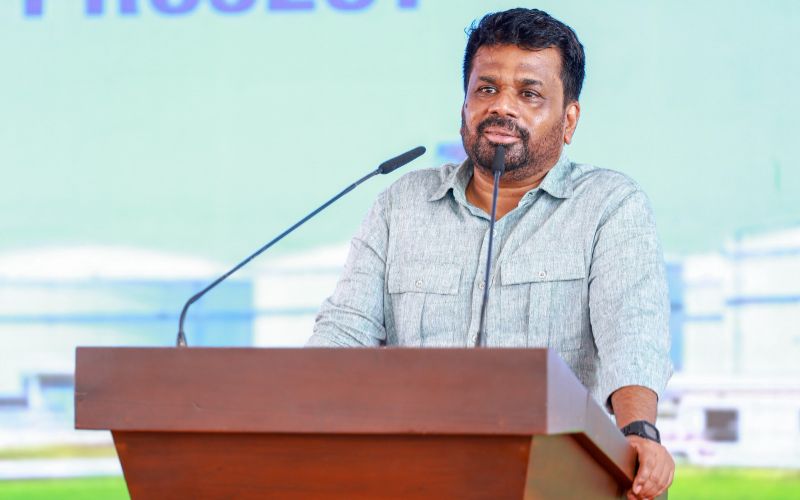
President Anura Kumara Dissanayake said that the Government’s objective is to maintain a strong state presence in the energy market while providing an efficient service to the people, adding that significant progress has been achieved towards this objective over the past two years and that a strong energy market that does not place a burden on the people is now being built in Sri Lanka.
The President made these remarks on Friday (02) morning while attending the commencement of construction of the Jet A-1 pipeline system of the Ceylon Petroleum Corporation (CPC) and two new oil storage tank systems belonging to the CPC and the Ceylon Petroleum Storage Terminal Limited (CPSTL).
The projects are being implemented in line with the Government’s national objective of developing infrastructure in the energy sector, with the aim of ensuring the security of aviation fuel supplies, reducing supply costs and providing the capacity required to meet future demand for aviation fuel.
A dedicated pipeline and associated tank complex are being constructed to connect Muthurajawela with the Bandaranaike International Airport in Katunayake, with the aim of meeting the future demand of the country’s aviation sector, ensuring the security of aviation fuel supplies and reducing transportation costs.
Construction has commenced on five new Jet A-1 fuel storage tanks with a total capacity of 92,000 cubic metres. These comprise two large Jet A-1 tanks, each with a capacity of 30,000 cubic metres; two medium-sized tanks, each with a capacity of 15,000 cubic metres; and an additional tank with a capacity of 2,000 cubic metres. The fuel supply pipeline system will be connected to the airport through a 21-kilometre-long underground pipeline with a diameter of 10 inches from the Muthurajawela tank complex. The project is scheduled for completion within 30 months.
Meanwhile, as part of ongoing efforts to strengthen and expand storage and infrastructure facilities in the petroleum industry, the Ceylon Petroleum Storage Terminal Limited (CPSTL) commenced construction today of three new storage tanks at the Muthurajawela Terminal.
Upon completion, the three-tank system, comprising two tanks with a capacity of 15,000 cubic metres each and one tank with a capacity of 10,000 cubic metres, will provide an additional total storage capacity of 40,000 cubic metres.
This will further enhance the petroleum storage capacity of the terminal and support the continued development of the country’s petroleum infrastructure. The project has a contractual period of 18 months and is scheduled for completion in April 2028.
The tanks are being constructed in compliance with relevant international standards and recognised industry best practices, ensuring enhanced safety, reliability and operational efficiency. The additional storage capacity will strengthen the country’s fuel reserves, improve operational flexibility and support the reliable and uninterrupted distribution of fuel products to meet the country’s growing energy requirements.
Minister of Ports and Civil Aviation and Minister of Energy Anura Karunathilaka said,
“We are now in an era of energy transition. The world is rapidly moving towards the use of clean energy. The use of electric vehicles is very important in this regard, and our country is also now moving in that direction.
The use of solar energy is also important. We expect to add 1,200 megawatts of solar power capacity to the national grid by 2029.
As a country, we must focus not only on controlling fuel prices but also on controlling fuel consumption. The public also has a major responsibility in this regard.
It is particularly important to change our patterns of energy consumption. Greater energy security can be achieved by avoiding periods of high energy demand, shifting towards electricity use and using fuel-efficient vehicles, particularly electric vehicles.”
Chairman of the Ceylon Petroleum Corporation D. J. Rajakaruna said,
“We faced a major challenge due to the war in the Middle East. However, with the intervention of the President, relief was provided to the people and the situation was managed very effectively.
As a result, while diesel prices in the global market increased by 91%, the increase in Sri Lanka was only around 39.5%. While petrol prices in the global market increased by 80%, the increase in Sri Lanka was only around 41%.
Despite providing fuel at lower prices in this manner, the Corporation has recorded a profit of Rs. 28 billion this year. We also recorded a profit of Rs. 36 billion last year.
This may raise the question of why fuel prices are not being reduced when there are such profits.
However, we have used those profits to commence a number of infrastructure development projects at the institution.
These include adding the capacity of 11 tanks, including the construction of six tanks that had previously been abandoned, to increase fuel storage capacity; modernising our oil-filling section, which is more than 90 years old, and establishing a gantry system similar to that at Muthurajawela; laying two new pipelines for unloading fuel from the port to Kolonnawa; constructing a new pipeline to transport Jet A-1 fuel to Katunayake; and upgrading the pipeline system and laying new pipelines, among many other projects.
We are implementing these projects using those profits. Therefore, we have returned the benefits to the people through these investments.”
The Minister of Science and Technology, Professor Chrishantha Abeysena; Deputy Minister of Energy, Arkam Ilyas; Member of Parliament Kumara Jayakody; Secretary to the Ministry of Energy and Senior Additional Secretary to the President, Russell Aponso; foreign ambassadors; government officials including officials of the Ministry of Energy and the Ceylon Petroleum Corporation; and representatives of Sinopec were among those present at the occasion.
President’s Media Division (PMD)


MONETABRIEF –The prosecution of high-profile individuals from the former Rajapaksa administrations is set to escalate this month with the clearing of legal hurdles and administrative bottlenecks, according to officials involved in the process.
Former president Gotabaya Rajapaksa’s attempt to secure an order preventing his arrest in connection with the Easter Sunday massacre was turned down by the Court of Appeal on Thursday.
An overseas travel ban has been in operation against Rajapaksa since June, but the Criminal Investigations Department made no move to question him. He instead filed a writ application seeking an order preventing his possible arrest.
President of the Court of Appeal Rohantha Abeysuriya noted that the court would not interfere with the investigative process. Any attempt by the court would amount to an obstruction of the investigation.
In an unrelated case, the same court rejected an application by opposition legislator Dilith Jayaweera seeking the quashing of a contempt charge filed against him by the Fort magistrate. The charges against Jayaweera and a few other opposition politicians are expected to be taken up in the coming week.
Jayaweera and other opposition politicians — Wimal Weerawansa, Udaya Gammanpila, Sugeeshwara Bandara, and Asanka Navaratne
— were hauled up over their remarks relating to the arrest of Suresh Sallay, the former head of the State Intelligence Service.
SLPP academic Mahinda Pathirana is also charged over his public comments about Sallay’s arrest in February under the draconian Prevention of Terrorism Act.
Former president Mahinda Rajapaksa’s son, legislator Namal Rajapaksa, is already in remand custody following his arrest in connection with three cases of bribery and money laundering relating to the 2013 Airbus deal and the Krrish property development in Colombo.
Although Namal has been granted bail in the Airbus money laundering charge, he is in custody until October 13 over the bribery charge relating to the same Airbus transaction. His arrest is under a provision of the Anti-Corruption Act that does not allow a magistrate to grant bail unless under exceptional circumstances.
Meanwhile, his mother Shiranthi Rajapaksa, who had been asked to report to the Financial Crimes Investigations Division on September 24, was a no-show and was yet to return from Singapore.
She had travelled overseas on September 16, and a family spokesman said she was handed the FCID summons at the departure lounge of Bandaranaike International Airport just before she boarded a flight to Singapore.
At the time, the family spokesman said she was due to return in three days.
“We will see greater momentum in the legacy cases in the coming weeks,” an official involved in the prosecutions said.
“We have cleared the legal hurdles to press ahead with more arrests,” he said.
“We are working on a few administrative issues which will be resolved very soon.”
The controversial prosecution of former President Ranil Wickremesinghe is dragging on without him being formally indicted since his arrest in August last year. The Fort magistrate has listed the case again for November 11, when the Attorney-General is expected to report on his decision regarding action against Wickremesinghe.

Police have reminded the public that courts have the power to take legal action against individuals who evade arrest or remain in hiding after warrants have been issued against them.
Police said that under Section 60 of the Code of Criminal Procedure Act No. 15 of 1979, a court could issue a written proclamation requiring a person evading arrest under a warrant to appear at a specified place and time.
The proclamation must allow the person at least 30 days to appear before court, Police said.
If the person fails to appear even after the proclamation has been issued, the court may take further action under Section 61 of the Act.
This includes issuing an order for the attachment of the movable or immovable property belonging to the person concerned.Police issued the reminder highlighting the legal measures available against persons who deliberately evade arrest and remain in hiding after warrants have been issued.

Debris found from plane that went missing off US coast

Construction of Jet A-1 Aviation fuel pipeline and new oil tank complex at Muthurajawela begins under President’s patronage

Landslide Early Warnings issued to the Districts of Kandy, Kegalle, Matale and Ratnapura

No handshakes and a delayed ceremony as India beat Pakistan at Asian Games

Showers or thundershowers will occur in most parts of the island after 1.00 p.m

Lanka enters new phase of prosecutions as hurdles clear

‘Dates have the highest sugar content to fight Coronavirus’

Sunday Island 27 December – Headlines

#SundayIsland 17th December – Headlines

Sunday Island – 28th March

Sunday Island Headlines – 21 March

Sunday Island – 21st February – Headlines
-

 News7 days ago
Police remove Thileepan statue in Jaffna
-

 Features7 days ago
The 22nd Amendment, constitutional recovery and illiberal slippage
-

 Features7 days ago
Of foreigners as CEOs of Lankan ventures
-

 Latest News4 days ago
Gold winner Tharanga gets brand-new Honda Vezel from SLAAJ
-

 News7 days ago
Sajith rejects Jt. Opp. protest sabotage claim; SJB TU chief demands remedial action
-

 Features5 days ago
Why Sri Lanka needs an Inclusive Civic Nationalism – urgently
-

 News4 days ago
US-assisted ‘Ice’ detection: NPC to examine IGP’s move to transfer drug-busting team
-

 Features6 days ago
Thailand’s biggest new global star …