
News
Parliament rejected two anti-corruption proposals

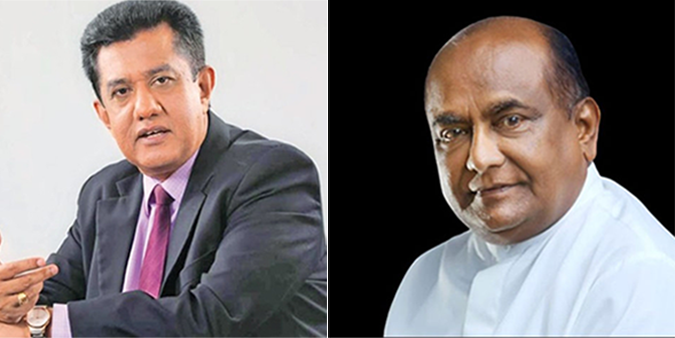
Ex-COPE Chairman makes another revelation:
By Shamindra Ferdinando
Parliament has blocked two specific proposals made by MP Prof. Charitha Herath in his capacity as the Chairman of the Committee on Public Enterprises (COPE) to enable the Parliamentary Watchdog Committee to engage the Attorney General in high profile corruption cases, directly.
SLPP National List MP Herath lost the COPE Chairmanship with the prorogation of the Parliament on 28 July by President Ranil Wickremesinghe. The prorogation results in suspension of all business before the House and quashed all proceedings pending at the time, except impeachments.
Prof. Herath told The Island yesterday (25) that in consultation with Auditor General W. P. C. Wickremaratne, he had requested for the modification of Standing Orders 120, several months back, to permit the COPE to call for Attorney General’s interventions as and when necessary. If that was not acceptable, Parliament should approve specific requests made by him on behalf of the COPE, he suggested.
Prof. Herath said that the alternative, too, has been rejected. Responding to another query, he said that he had submitted the proposals to the Parliamentary Committee on Standing Orders. The Committee consists of nine members, including the Speaker, the Deputy Speaker and the Deputy Chairman of Committees.
Appearing before the Parliamentary Committee on Standing Orders, Prof. Herath also suggested that if proposals submitted in writing weren’t acceptable then at least a representative of the Attorney General should be allowed to participate in the COPE proceedings. That proposal too was turned down.
Prof. Herath said that the rejection of specific measures to address corruption accusations should be examined against the backdrop of the economic fallout of waste, corruption, irregularities and mismanagement of the national economy as well as the unprecedented recommendation by the United Nations Human Rights Council (UNHRC) to investigate economic crimes that impact on human rights and the tracing and recovery of stolen assets.
Prof. Herath alleged that the Parliament should be seriously concerned over the Geneva intervention especially because the country was seeking immediate assistance from the International Monetary Fund (IMF). Asserting that the situation was so grave that even USD 2.9 bn loan facility spread over a period of four years couldn’t revive the national economy, Prof. Herath emphasised that streamlining of public sector enterprises was a prerequisite for the economic recovery process. Therefore, corruption had to be curtailed by taking tangible measures, he said.
Prof. Herath said that though the particular Standing Order had been amended it didn’t meet their aspirations. What has been approved by the Parliament was inadequate to meet the growing threat posed by influential racketeers, the outspoken MP said. Prof. Herath has closed ranks with the dissident SLPP group, led by Party Chairman Prof. G.L. Peiris, and Dullas Alahapperuma. Other members of the group are Prof. Channa Jayasumana, Dr. Nalaka Godahewa, Dilan Perera, Dr. Upali Galappatti, Dr. Thilak Rajapaksa, Lalith Ellawala, K.P. S. Kumarasiri, Wasantha Yapa Bandara, Gunapala Ratnasekera and Udayana Kiridigoda.
Prof. Herath said that as the SLPP declined to allocate time for members of the rebel group, he was compelled to obtain five minutes from the Opposition to take up the issue in Parliament.Appreciating Opposition Leader Sajith Premadasa and Chief Opposition Whip Lakshman Kiriella for giving him the opportunity, Prof. Herath pointed out how a carefully prepared set of proposals to strengthen the COPE had been rejected.
Prof. Herath stressed that the intervention of the COPE was required as the Secretaries to the Ministries often failed to proceed with the instructions issued to them. The MP found fault with section 3 and 4 of Standing Orders 120. Declaring that though the Parliament was routinely blamed for its failure to arrest corruption, MP Herath said that Members of Parliament weren’t aware of what was going on. He also called for the strengthening of Standing Orders 119, 120 and 121 that dealt with the Committee on Public Accounts (COPA), COPE and the Committee on Public Finance (COPF), respectively.
MP Herath declared in Parliament that the crux of the matter was that those appointed members of the Cabinet represented the interests of the Executive and thereby undermined the very basis of the responsibilities of the House. The undeniable truth was that the Cabinet ministers didn’t represent the interests of the Parliament. “In other words, they worked against the collective responsibility as members of Parliament to ensure financial discipline,” MP Herath said, pointing out that in some countries the lawmakers were not entrusted with the task of decision-making.
Referring to Executive Sub-Committees to be established, Prof. Herath emphasized the pivotal importance of recognizing their responsibilities. If they were answerable to the Executive there would be serious consequences pertaining to the parliamentary system. Executive Sub-Committees shouldn’t be at the expense of the Parliament, the MP said, underscoring the responsibility of the part of all political parties represented in Parliament to take immediate remedial measures.
The rejection of the COPE proposals meant that the Parliament,as an institution hadn’t been sensitive to the recent public upheaval that forced Gotabaya Rajapaksa, elected with a staggering 6.9 mn votes to give up the presidency and literally flee for his life.
Ranil Wickremesinghe, who had been elected by Parliament to complete the remainder of the five-year term secured by Gotabaya Rajapaksa, and the SLPP, hadn’t realised the need to introduce urgent reforms, the MP alleged.Prof. Herath also questioned the rationale behind setting up of the National Council when the powers that be deprived the existing mechanisms required power to achieve their objectives.








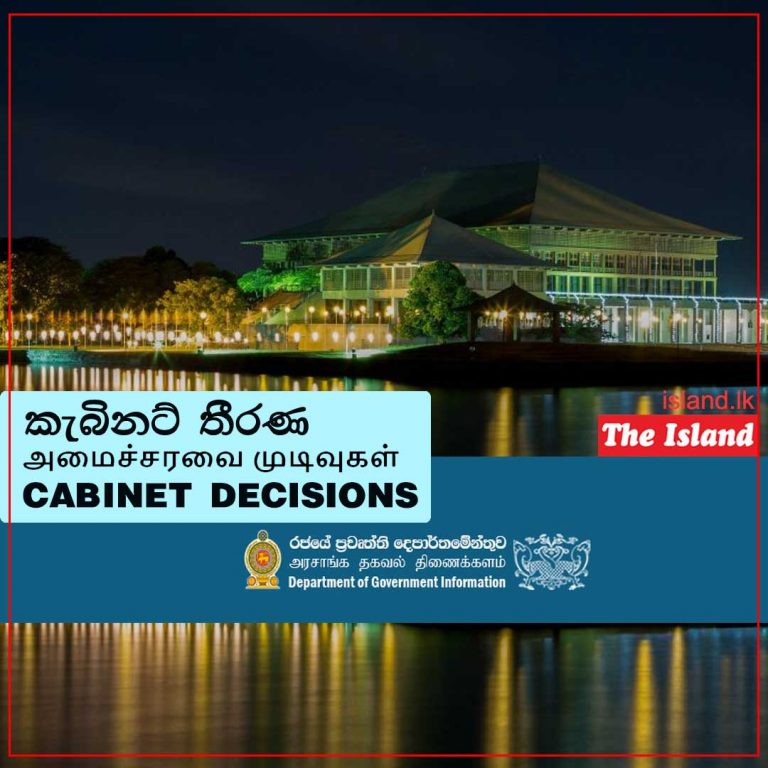
Approval of the Cabinet of Ministers was granted to the preparation of the Appropriation Bill for the financial year of 2027 at their meeting held on 30.06.2026.
Accordingly, clearance of the Attorney General has been given to the Appropriation Bill prepared by the Legal Draftsman.
Therefore, the Cabinet of Ministers approved the resolution furnished by the President in his capacity as the Minister of Finance, Planning and Economic Development to publish the aforementioned draft bill in the government gazette notification and thereby submit the same to the Parliament for its concurrence.
Latest News
Cabinet approves aditional Rs. 2,500 million to the Paddy Marketing Board to purchase 2026 Yala harvest

The Cabinet of Ministers has approved the resolution furnished by the Minister of Agriculture, Livestock, Land and Irrigation to provide an additional Rs. 2,500 million to the Paddy Marketing Board on a reimbursable basis from the Rs. 7,500 million additional allocations granted to the Ministry to implement
the expedited paddy purchasing program for the 2026 Yala harvest.
Latest News
Cabinet nod to host the 8th Asian Regional Conference of the Commonwealth Parliamentary Association and the 3rd Joint Asian and South-East Asian Regional Conference of the Commonwealth Parliamentary Association
The 8th Asian Regional Conference of the Commonwealth Parliamentary Association (CPA) and the 3rd Joint Asian and South-East Asian Regional Conference of the CPA are planned to be held over three days in Colombo during April/May 2027.
Approximately 90 delegates including speakers, Deputy Speakers, Member of Parliamentarians, and Parliamentary officers representing member countries of the Commonwealth Parliamentary Association, in the Asian and South-East Asian regions, are expected to participate in these conferences.
The Cabinet of Ministers has approved the resolution furnished by the Prime Minister of the Parliament of Sri Lanka to host the said conferences considering the opportunities to strengthen parliamentary diplomacy and regional cooperation, as well as to enhance international recognition of the Parliament of Sri Lanka within the Commonwealth Parliamentary Association.

Draft of the Appropriation Bill for the Financial Year 2027 su mitted to the Parliament
Cabinet approves aditional Rs. 2,500 million to the Paddy Marketing Board to purchase 2026 Yala harvest
Cabinet nod to host the 8th Asian Regional Conference of the Commonwealth Parliamentary Association and the 3rd Joint Asian and South-East Asian Regional Conference of the Commonwealth Parliamentary Association

SAARC Training Workshop on Financial Modeling for Renewable Energy Projects from 5th to 7th October in Colombo
National Children’s Week from 25th September to 01st October

Nairobi and Munich to host 2029 and 2031 World Athletics Championships

‘Dates have the highest sugar content to fight Coronavirus’

Sunday Island 27 December – Headlines

#SundayIsland 17th December – Headlines

Sunday Island – 28th March

Sunday Island Headlines – 21 March

Sunday Island – 21st February – Headlines
-

 Sports5 days ago
DDS set to lose Test captaincy
-

 News5 days ago
Sri Lanka faces new grid challenge as rooftop solar surges: former CEB GM
-

 Latest News5 days ago
Shafali, Deepti power India into sixth T20 Asia Cup final
-

 Opinion7 days ago
Navigating Sri Lanka’s Israeli Dilemma
-

 Latest News4 days ago
Sri Lanka thwart Fatima Sana challenge to secure Asia Cup final spot
-

 News3 days ago
Gnanasara Thero absconding after SC ruling
-
 Features6 days ago
Lost for 90 years: Rare Goby resurfaces in Jaffna
-

 News4 days ago
Ammunition cache found in old Kandy bungalow