Nepal has lifted a social media ban, which sparked protests and led to clashes with police that left at least 19 people dead and injured more than 100 others.
In the weeks before the ban, a “nepo kid” campaign, spotlighting the lavish lifestyles of politicians’ children and allegations of corruption, had taken off on social media.
When the government moved to ban 26 social media platforms, including Facebook and YouTube, protests erupted with thousands of young people storming parliament in the capital Kathmandu on Monday. Several districts are now under a curfew.
A government minister said they lifted the ban after an emergency meeting late on Monday night to “address the demands of Gen Z”.
Last week, Nepal’s government ordered authorities to block 26 social media platforms for not complying with a deadline to register with Nepal’s ministry of communication and information technology.
Platforms such as Instagram and Facebook have millions of users in Nepal, who rely on them for entertainment, news and business.
But the government had justified its ban, implemented last week, in the name of tackling fake news, hate speech and online fraud.
Young people who took to the streets on Monday said they were also protesting against what they saw as the authoritarian attitude of the government. Many held placards with slogans including “enough is enough” and “end to corruption”.
Some protesters hurled stones at Prime Minister KP Sharma Oli’s house in his hometown Damak.
One protester, Sabana Budathoki had earlier told the BBC that the social media ban was “just the reason” they gathered.
“Rather than the social media ban, I think everyone’s focus is on corruption,” she explained, adding: “We want our country back. We came to stop corruption.
On Monday, police in Kathmandu had fired water cannons, batons and rubber bullets to disperse the protesters.
Prime Minister Oli said he was “deeply saddened” by the violence and casualty toll, and blamed the day’s events on “infiltration by various vested interest groups”.
The government would set up a panel to investigate the protests, he said, adding that it would also offer financial “relief” to the families of those who died and free treatment to those injured.
Home Minister Ramesh Lekhak submitted his resignation on Monday evening following intense criticism over his administration’s use of force during the protests.
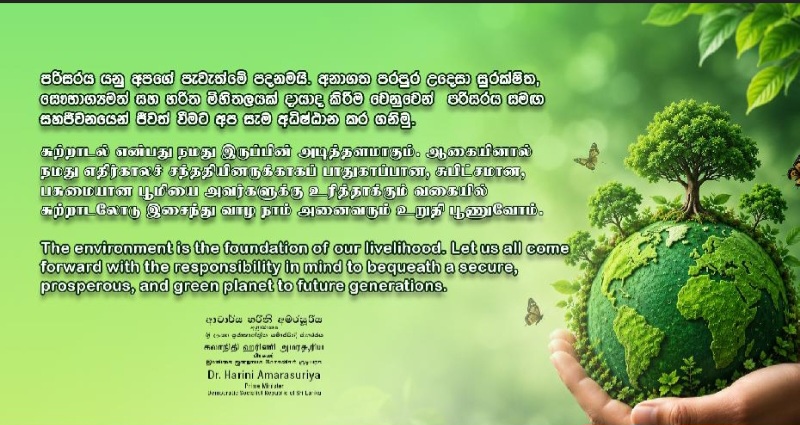
Prime Minister Dr Harini Amarasooriya in her Environment Day message said that the environment is the foundation of our livelihood and called upon all Sri Lankans to come forward with the responsibility in mind to bequeath a secure a secure, prosperous and green planet to future generations.The PM’s Environment Day message:
“The environment is the foundation of our livelihood. It is the responsibility of the government to bequeath a secure, prosperous, and green planet to future generations.
In line with the global theme, “Urgent Climate Action,” and guided by the vision of “A Sustainable Biosphere – An Evergreen Life,” Sri Lanka commemorates World Environment Day this year at a critical moment. Drawing lessons from the climate-related challenges we have recently experienced, special attention has been directed toward protecting the water catchment areas of the central highlands and restoring ecosystems.
Under the theme “Dalulanna Idadenna” ( Let it Bloom), the Ministry of Environment has organized a series of programmes across the island to mark World Environment Day. These initiatives include environmental conservation inspired by religious values, awareness programmes on climate change, the protection of the Diyawanna Oya, the development of infrastructure in the wildlife sector, the conservation of water resources, and the promotion of medicinal plant cultivation, and through these efforts, it is evident that environmental conservation has evolved beyond a mere concept and become a practical and active commitment.
At this significant moment in our nation’s history, as more than 63,000 hectares of forest land have been gazetted as protected reserves through the “Wanaspathi” National Programme, which was launched last year, every citizen must resolve to live in harmony with the environment.
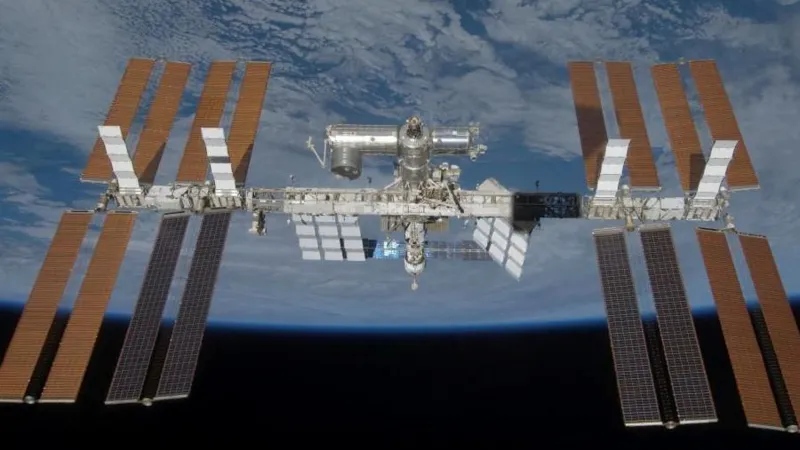
Astronauts on the International Space Station (ISS) were ordered to shelter in an attached spacecraft after the structure suddenly started leaking more air.
Five of the seven crew were directed to go into the docked SpaceX shuttle Dragon “Freedom” on Friday afternoon and were braced for a potential evacuation.
Meanwhile, two remaining personnel – a pair of Russian cosmonauts – attempted to repair a part of the Russian segment of the ISS, where the leaks had started increasing on Monday.
The repairs were paused and the crew ordered back onto the ISS by Nasa on Friday afternoon.
Jessica Meir, Jack Hathaway, Sophie Adenot and Andrey Fedyaev, who arrived on the ISS in February, had been sheltering on the docked ship, along with another astronaut Chris Williams.
They had been told to put on their spacesuits so they were ready to undock and return to Earth at short notice.
The Dragon effectively functions as a lifeboat – attached to the station but ready to detach the moment the order is given.
The trigger for the order was a worsening air leak in the transfer tunnel, known as PrK, leading to a section of the Russian segment of the station called the Zvezda service module.
Russian cosmonauts, station commander Sergey Kud-Sverchkov and flight engineer Sergei Mikaev, attempted to fix the problem. Their escape route was the separately docked Soyuz MS-28 spacecraft.
It is not the first time the station has had to deal with this problem – the cracks responsible have persisted on and off for around six years.
However, following the arrival of a Russian cargo ship last month, the Russian space agency Roscosmos noticed a fresh slow pressure drop in the tunnel, prompting the decision to move beyond patchwork fixes and attempt a more extensive repair operation on Friday.
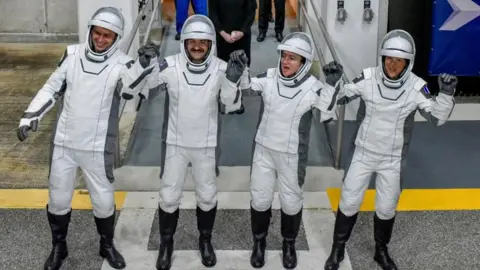
(Left to right) Russian cosmonaut Andrey Fedyaev, Nasa astronauts Jack Hathaway, Jessica Meir and ESA astronaut Sophie Adenot [BBC]
But it was the method they were planning to use that prompted the order to take shelter, according to news agency Reuters.
Kud-Sverchkov and Mikayev were said to be using a saw to try and get into an area to access the crack that was leaking air.
Nasa disagreed with the method they were using and mission control in Houston ordered five crew to take “safe-haven” procedures on the Dragon ship.
When Roscosmos told their crew to pause repairs, Nasa instructed the astronauts to return to the station.
Nasa spokeswoman Bethany Stevens said on X: “Given this development, Nasa has instructed the crew members inside the Dragon spacecraft to end the safe haven procedures and return to planned operations aboard the International Space Station.”
Russian news agency Tass, citing Roscosmos, reported that nothing had been threatening the safety of the crew or the ISS’s onboard systems.
The ISS, which spans the length of a football field, is the largest human-made object in space.
It has been continuously operated by a US-Russian-led consortium that includes Canada, Japan and 11 European countries since 1998.
Maja Chwalinska lost in the Wimbledon second round (2022) and Australian Open first round (2025) in her only two previous Grand Slam appearances (BBC)
Qualifier Maja Chwalinska is one win away from a fairytale French Open triumph after setting up a final showdown with Russian teenager Mirra Andreeva.
The Polish world number 114, who had only ever won one match at a Grand Slam before this tournament, continued her astonishing run at Roland Garros by beating 25th seed Diana Shnaider 7-6 (7-4) 6-4.
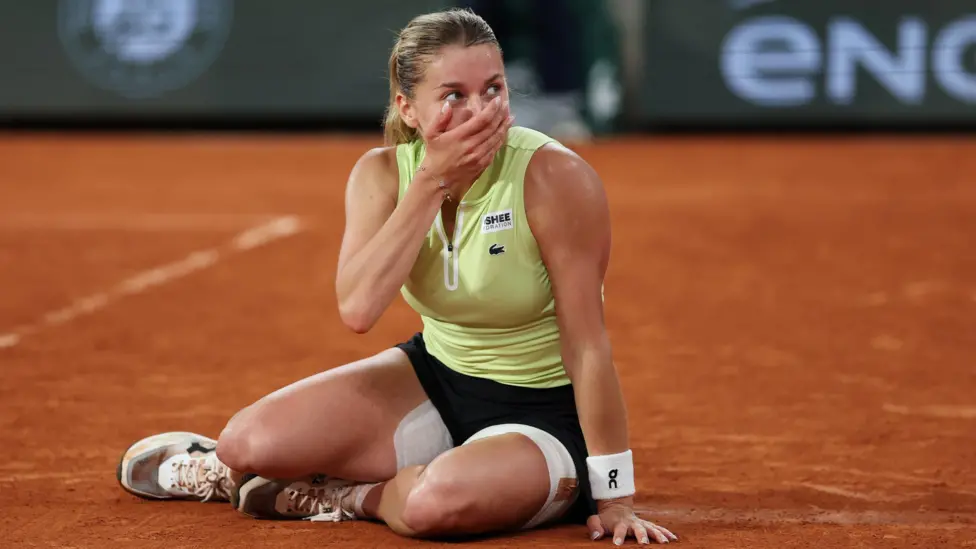
Three weeks and nine matches after her French Open campaign began, Chwalinska dropped to the ground after firing in the 32nd and final winner of another scintillating display.
With that, she became the first qualifier in history to reach the women’s singles final at Roland Garros, and the crowd chanted her name as she spoke in her post-match interview.
On Saturday, she will attempt to become only the second qualifier in the Open era to win a Grand Slam after Britain’s Emma Raducannu at the 2021 US Open.
It would be a fitting conclusion to a French Open filled with spectacular shocks from the outset.
But, on the evidence of her dominant victory over Ukraine’s Marta Kostyuk, the in-form Andreeva will provide the sternest test of her credentials to date.
A beaten semi-finalist in 2024, the 19-year-old was hugely impressive in a 6-1 6-3 victory that made her the third-youngest woman to reach the Roland Garros showpiece this century, after Coco Gauff and Kim Clijsters.
Should she prevail in her first major final, eighth seed Andreeva would become the third-youngest first-time Grand Slam champion this century, after Maria Sharapova and Raducanu.