
Latest News
Mirza, Faheem and Ayub star as marauding Pakistan make it 1-1


From the ruins of Rawalpindi,Pakistan rallied to level the T20I series against South Africa and romped to a nine wicket win in Lahore.
The match was all but over in the first 10 overs, when South Africa slipped to 66 for 6 after stunning spells from left-arm quick Salman Mirza, playing in his sixth T20I, Naseem Shah and Faheem Ashraf . Pakistan used pace-off balls to excellent effect and South Africa put on one of their poorer displays of shot selection in a performance they will want to forget. Only one batter, Dewald Brevis, got past 20, and only one partnership did the same. With Lhuan-dre Pretorius on the bench, South Africa may want to rethink their line-up heading into tomorrow’s decider.
On the other hand, Pakistan played the situation to perfection. Their bowlers read the surface well before the batters knocked off their target of 111 with 41 balls to spare. An opening stand of 54 between Sahibzada Farhan and Saim Ayub set them up before Ayub and Babar Azam finished things off with an unbroken 58 for the second wicket. In the process, Babar became the leading run-scorer in T20Is.
The series is 1-1 with the decider to come in less than 24 hours’ time.
Mirza was given an opportunity ahead of fellow left-armer Shaheeh Shah Afridi and made an immediate impact. He set Reeza Hendricks up with an opening delivery that moved away from him and then brought the second one back in and found leg stump to dismiss him for a duck. In the next over, Mirza angled a couple into Tony de Zorzi’s pads, then went for the surprise short ball and de Zorzi missed his pull. That was a warning. Two balls later, Mirza went for a slower-ball bouncer and de Zorzi pulled to Abrar Ahmed at short fine leg.
In between those dismissals, Quinton de Kock was caught at mid-off off a slower ball from Naseem Shah and dismissed cheaply for the third time since his comeback, and Naseem could have had more. Matthew Breetzke was dropped at short third off him, which only allowed Mirza to get a third. He delivered another cutter, beat Breetzke’s edge, and bowled him to leave South Africa 23 for 4 in the fifth over.
Brevis threatened to take control with a quickfire 25 off 16 balls including three sixes, all hit cleanly, but mishit a slower short ball from Faheem to cover point. South Africa were in all sorts at 49 for 5 in the eighth over, and stand-in captain Donovan Ferreria could barely rebuild. He chopped a Faheem short ball onto his stumps at the end of the 10th over. Two overs later, George Linde went almost exactly the same way, playing the pull rather than cut, but also edging onto his stumps. South Africa were 73 for 7 but dragged things into the 20th over before getting bowled out for 110.
After a duck on T20I comeback in Rawalpindi, expectation was high on Babar, especially on his home ground, and he was in the mood to deliver. He creamed the first ball he faced through the covers for four to send Lahore into a frenzy. Then he was stuck on 6 off 7 for two overs, with Ayub taking all the strike and carving big chunks off the target. Babar needed three more to overtake Rohit Sharma as the leading run-scorer in T20Is. He got there at the start of the 12th over with a single of Ferreira – his 4232nd run in the format – and the home fans knew exactly what he had achieved. Babar received appreciative applause from a packed crowd, and Ayub sealed the game with a six two overs later. Babar is now three runs ahead of Rohit, who is retired from the format.
Brief scores:
Pakistan 112 for 1 in 13.1 overs (Saim Ayub 71*, Sahibzada Farhan 28, Babar Azam11*; Corbin Bosch 1-17) beat South Africa 110 in 19.2 overs (Dewald Brevis 25, Donovan Ferreira 15, Corbin Bosch 11, Ottneil Baartman 12; Faheem Ashraf 4-23, Salman Mirza 3-14, Naseem Shah 2-28, AbrarAhmed1-26) by nine wickets
(Cricinfo)

Latest News
Advisory for Severe Lightning issued For Western, Sabaragamuwa and North-western province
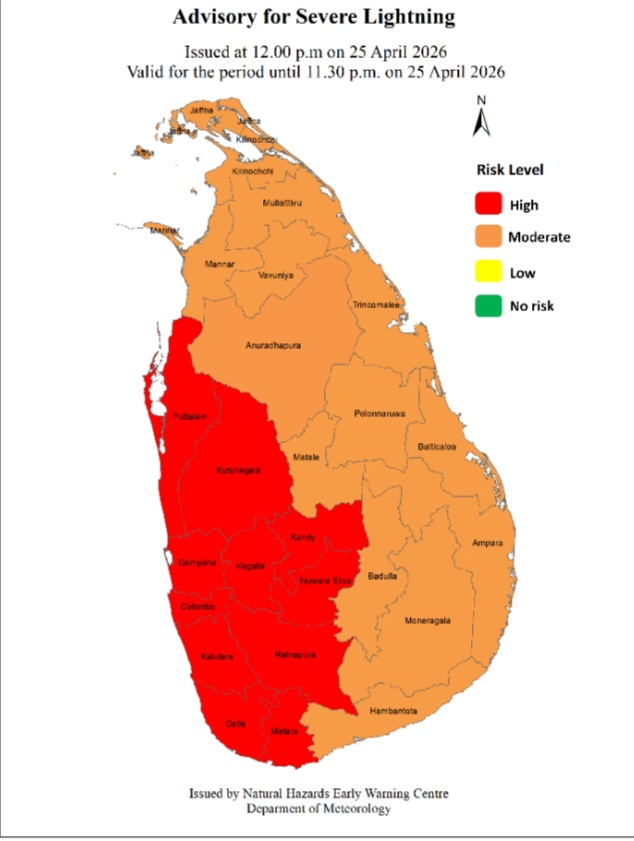
Advisory for Severe Lightning
Issued by the Natural Hazards Early Warning Centre
Issued at 12.00 noon 25 April 2026 valid for the period until 11.30 p.m. 25 April 2026
Thundershowers accompanied with severe lightning are likely to occur in the Western, Sabaragamuwa and North-western provinces and Galle, Matara, Kandy and Nuwara-Eliya
districts after 1.00 p.m.
There may be temporary localized strong winds during thundershowers. General public is kindly requested to take adequate precautions to minimize damages caused by lightning
activity.
ACTION REQUIRED:
The Department of Meteorology advises that
people should:
• Seek shelter, preferably indoors and never under trees.
• Avoid open areas such as paddy fields, tea plantations and open water bodies during thunderstorms.
• Avoid using wired telephones and connected electric appliances during thunderstorms.
• Avoid using open vehicles, such as bicycles, tractors and boats etc.
• Beware of fallen trees and power lines.
• For emergency assistance contact the local disaster management authorities.
Latest News
Kohli, Padikkal hit fifties as Royal Challengers Bengaluru ace the chase against Gujarat Titans
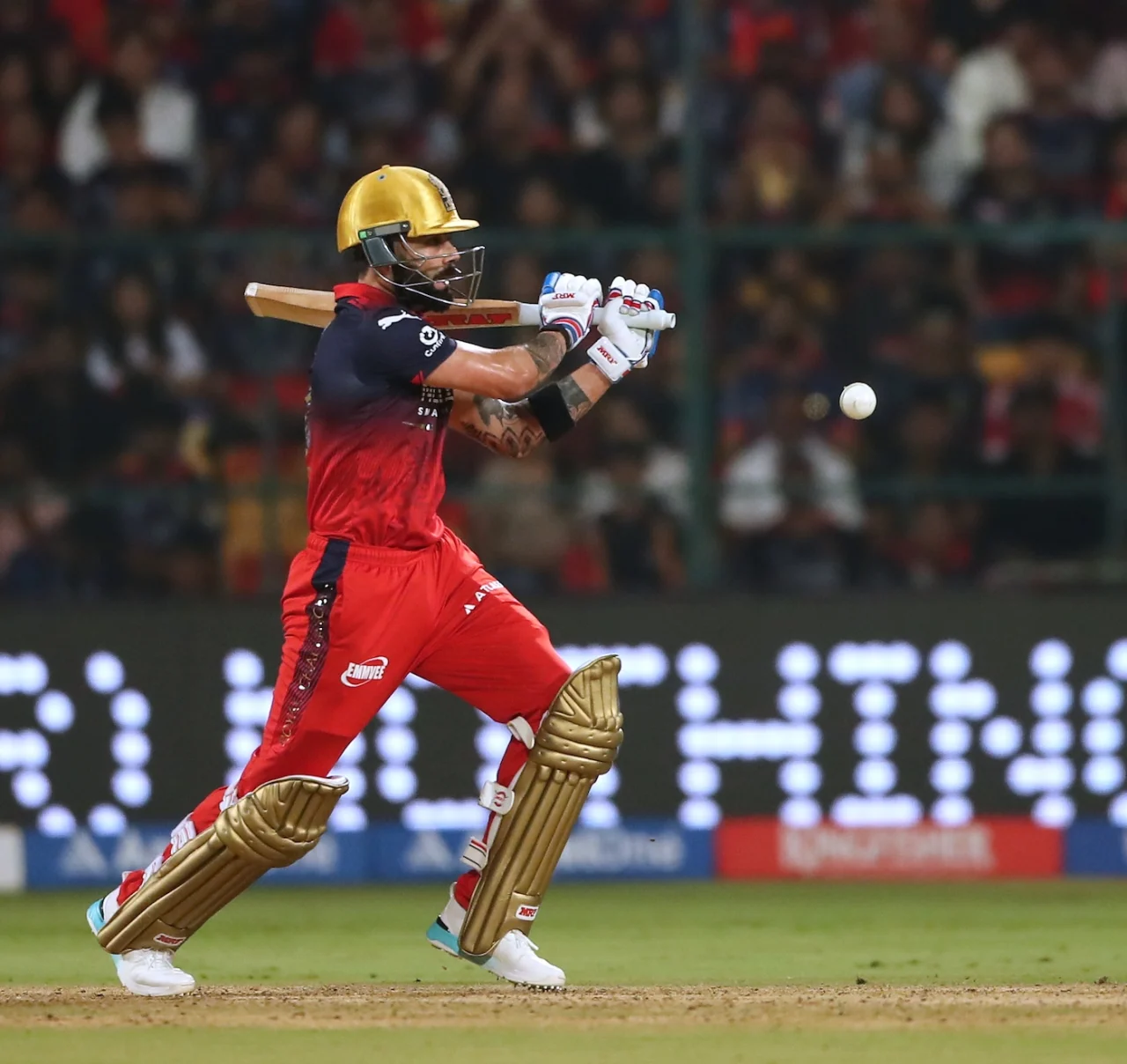
An exhibition of clean hitting by Virat Kohli and Devdutt Padikkal ensured Sai Sudarshan’s measured 100 off 58 balls ended in a losing cause as Royal Challengers Bengaluru (RCB) beat Gujarat Titans (GT) by five wickets at the Chinnaswamy Stadium.
After winning the toss, RCB captain Rajat Patidar had no hesitation in putting GT in. Sudharsan laid a strong foundation on a pitch he described as “two-paced and sticky to start with”. But even when the surface became easier to bat on, GT could not get into overdrive. They scored only 35 in the last four overs and finished on 205 for 3.
In response, Kohli, who was dropped on zero, smashed 81 off 44 balls and Padikkal blasted 55 off just 27. They put on 115 in 9.5 overs for the second wicket, and despite a bit of wobble towards the end, RCB romped home with seven balls to spare.
The GT openers prefer to take as few risks as possible and it was no different on Friday. Sudharsan was circumspect at the start and was on 17 off 16 after three overs. But he found his timing after that and moved to 41 off 27 by the end of the fifth. Gill had faced just three balls till then. GT finished the powerplay on 57 for no loss.
Sudharsan went inventive after the powerplay, scooping Romario Shepherd for a six. When Krunal Pandya bowled a bouncer, he uppercut him over deep third. Later in the over, he slog-swept the spinner for another six, reaching 2000 runs in the IPL. Taking 47 innings, he was the fastest to get there, bettering Chris Gayle’s record by one.
He and Gill added 128 in 12.4 overs, with Gill contributing 32 off 24 balls. The GT captain was starved of strike throughout his stay and holed out to long-on off Suyash Sharma. Sudharsan brought up his hundred off 57 balls, the slowest of the six so far this season. There was no cutting loose after reaching the milestone either. He was out on the very next ball he faced.
GT were 170 for 2 after 16 overs but Suyash, Bhuvneshwar Kumar and Hazlewood gave away only 17 in the next three. At 187 for 3, Rasikh Salam ran in to bowl the final over but he stopped even before he could bowl a delivery. It looked like cramps and despite the physio working on him, he had to walk off the field. Krunal replaced him and was hit for a six by Jason Holder off the first ball. After another ball, Krunal too pulled out of his delivery stride holding his groin. But after a bit of medical attention, he completed the over, but ended up leaking 18 runs.
With Phil Salt injured, Jacob Bethell finally got a chance to play this season. Opening the innings after coming in as Impact Player, he had a close shave in the second over. He got an inside edge to a length ball from Kagiso Rabada but it missed the stumps and beat Buttler for four. In the next over, he shuffled across and hit Mohammed Siraj for a four on either side of the wicket. But when he tried the same trick later in the over, he hit it straight to the backward point. He made 14 off ten.
Kohli was dropped off the first ball he faced. It was a length delivery from Siraj that he flicked uppishly towards short midwicket but Washington Sundar grassed a regulation chance. Kohli made his intentions clear in the following over when he hit Rabada over mid-on for a four.
Padikkal was even more ruthless. He opened his account with a first-ball six, picking up a 153.6kph length ball from Rabada over square leg. The GT bowlers didn’t help themselves by bowling onto his pads, and he kept flicking them fine for boundaries.
Rashid Khan wasn’t spared either. He dropped one short to Kohli and the batter duly pulled it over deep midwicket for a six before cutting the following delivery for four. In the spinner’s second over, Padikkal hit him for two sixes, the second one taking him to his fifty off just 20 balls. It made Kohli’s 30-ball fifty look pedestrian.
Rashid bowled Padikkal with a googly from around the wicket, and Kohli played Holder on but not before hitting the allrounder for back-to-back sixes.
Rajat Patidar and Jitesh Sharma kept the attack going. They hit a six each off Rashid but fell in quick succession. Suddenly, RCB were five down with 31 required from four overs. Krunal, though, bashed Manav Suthar for two fours and a six in the 18th over, bringing the equation down to seven needed from 12. In the penultimate over, he swatted Holder through midwicket for four before wrapping up the game with a gentle pull to fine leg.
Brief scores:
Royal Challengers Bengaluru 206 for 5 in 18.5 overs (Jacob Bethell 14, Virat Kohli 81, Devdutt Padikkal 55, Jitesh Sharma 10, Tim David 10*, Krunal Pandya 23*; Mohammed Siraj 1-25, Jason Holder 1-35, Rashid Khan 2-49, Manav Suther 1-19) beat Gujarat Titans 205 for 3 in 20 overs (Sai Sudharsan 100, Shubman Gill 32, Jos Buttler 25, Washington Sundar 19*,Jason Holder 23*; Bhuvneshwar Kumar 1-31, Josh Hazelwood 40, Suyash Sharma 1-36) by five wickets
[Cricinfo]
Latest News
Heat Index at Caution Level in the Northern, North-central, North-western, Western, Sabaragamuwa and Eastern provinces during the day time
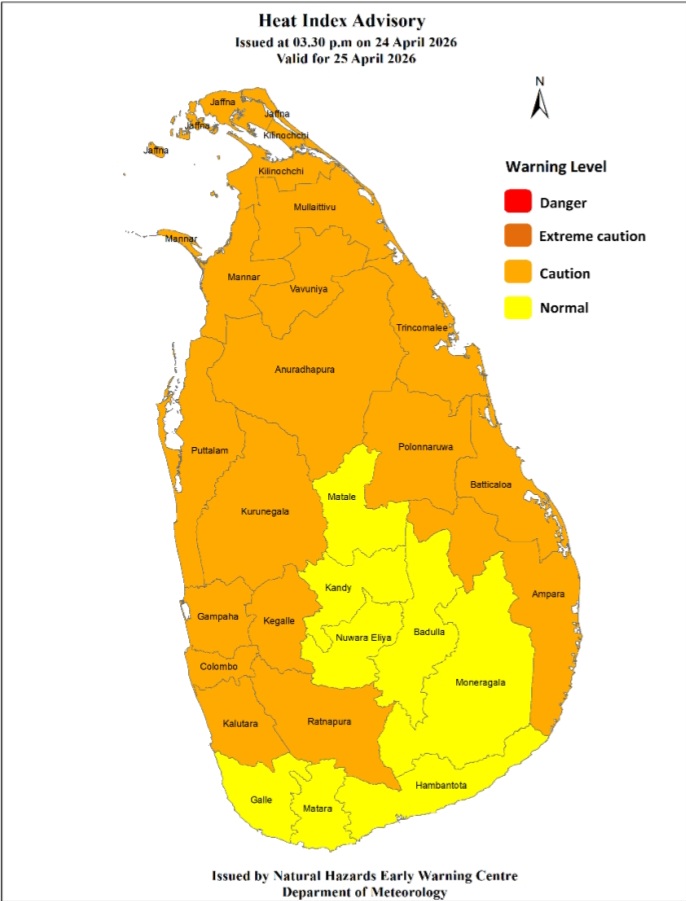
Warm Weather Advisory
Issued by the Natural Hazards Early Warning Centre
Issued at 3.30 p.m. on 24 April 2026, valid for 25 April 2026.
Heat index, the temperature felt on human body is likely to increase up to ‘Caution level’ at some places in Northern, North-central, North-western, Western, Sabaragamuwa and
Eastern provinces during the day time.
The Heat Index Forecast is calculated by using relative humidity and maximum temperature and this is the condition that is felt on your body. This is not the forecast of maximum temperature. It is generated by the Department of Meteorology for the next day period and prepared by using global numerical weather prediction model data.

Effect of the heat index on human body is mentioned in the above table and it is prepared on the advice of the Ministry of Health and Indigenous Medical Services.
ACTION REQUIRED
Job sites: Stay hydrated and takes breaks in the shade as often as possible.
Indoors: Check up on the elderly and the sick.
Vehicles: Never leave children unattended.
Outdoors: Limit strenuous outdoor activities, find shade and stay hydrated.
Dress: Wear lightweight and white or light-colored clothing.
Note:
In addition, please refer to advisories issued by the Disaster Preparedness & Response Division, Ministry of Health in this regard as well. For further clarifications please contact 011-7446491.

Advisory for Severe Lightning issued For Western, Sabaragamuwa and North-western province

AI chatbots could be making you stupider

‘A remarkable time capsule’: The enchanting history of Oxford University’s 750-year-old medieval library

Kohli, Padikkal hit fifties as Royal Challengers Bengaluru ace the chase against Gujarat Titans

Showers expected in the Western and Sabaragamuwa provinces and in Galle, Matara, Kandy, Nuwara-Eliya and Puttalam districts after 2.00 pm

Heat Index at Caution Level in the Northern, North-central, North-western, Western, Sabaragamuwa and Eastern provinces during the day time

‘Dates have the highest sugar content to fight Coronavirus’

Sunday Island 27 December – Headlines

#SundayIsland 17th December – Headlines

Sunday Island – 28th March

Sunday Island Headlines – 21 March

Sunday Island – 21st February – Headlines
-

 News5 days ago
Rs 13 bn NDB fraud: Int’l forensic audit ordered
-

 Opinion6 days ago
Shutting roof top solar panels – a crime
-

 News3 days ago
Lanka faces crisis of conscience over fate of animals: Call for compassion, law reform, and ethical responsibility
-

 News2 days ago
No cyber hack: Fintech expert exposes shocking legacy flaws that led to $2.5 million theft
-

 News7 days ago
From Nuwara Eliya to Dubai: Isha Holdings markets Agri products abroad
-

 News2 days ago
Whistleblowers ask Treasury Chief to resign over theft of USD 2.5 mn
-

 Life style7 days ago
After dark in Sri Lanka: Tiny wild cats step into the spotlight
-

 News6 days ago
Church calls for Deputy Defence Minister’s removal, establishment of Independent Prosecutor’s Office