
Latest News
Kohli, Padikkal hit fifties as Royal Challengers Bengaluru ace the chase against Gujarat Titans

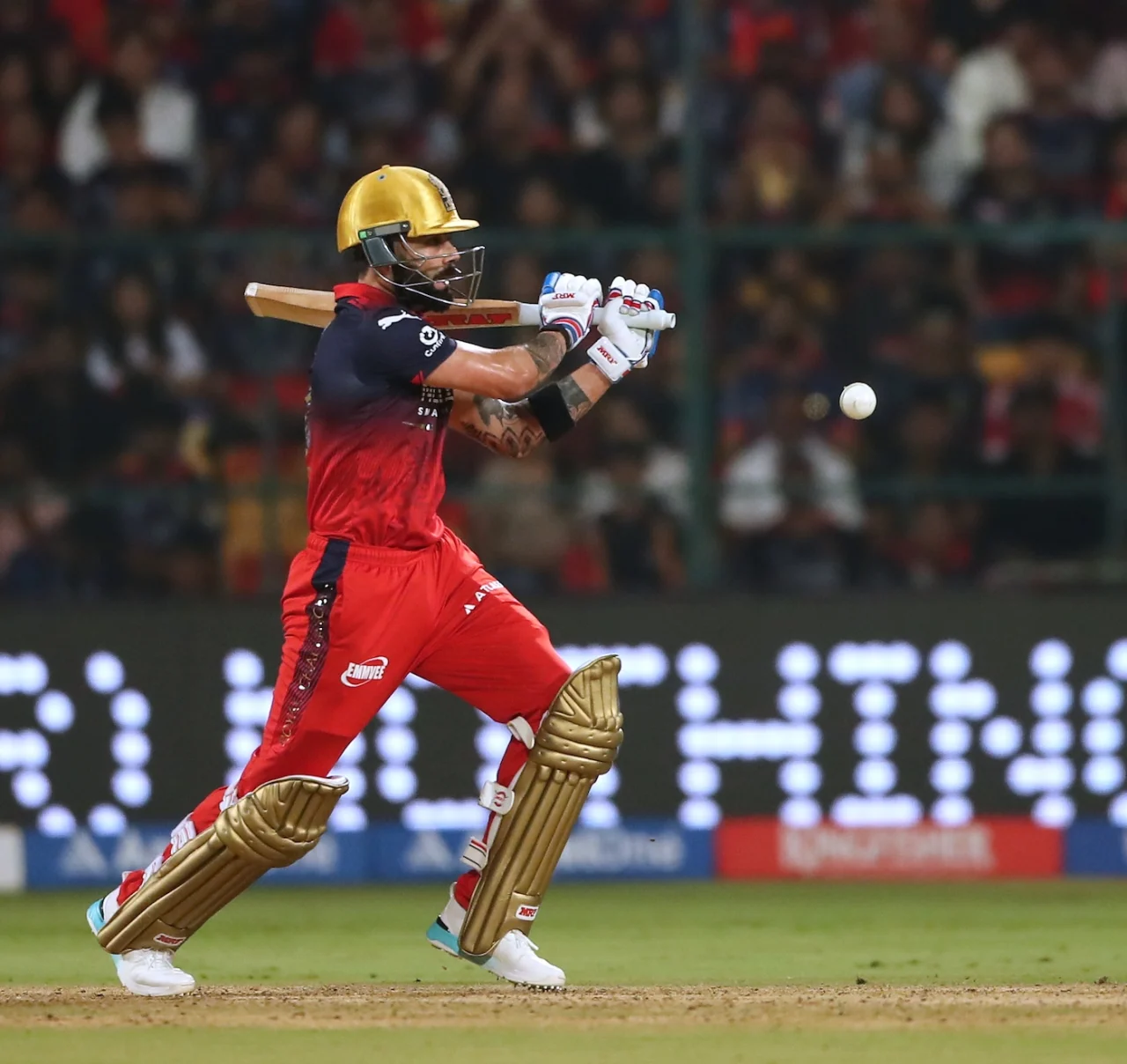
An exhibition of clean hitting by Virat Kohli and Devdutt Padikkal ensured Sai Sudarshan’s measured 100 off 58 balls ended in a losing cause as Royal Challengers Bengaluru (RCB) beat Gujarat Titans (GT) by five wickets at the Chinnaswamy Stadium.
After winning the toss, RCB captain Rajat Patidar had no hesitation in putting GT in. Sudharsan laid a strong foundation on a pitch he described as “two-paced and sticky to start with”. But even when the surface became easier to bat on, GT could not get into overdrive. They scored only 35 in the last four overs and finished on 205 for 3.
In response, Kohli, who was dropped on zero, smashed 81 off 44 balls and Padikkal blasted 55 off just 27. They put on 115 in 9.5 overs for the second wicket, and despite a bit of wobble towards the end, RCB romped home with seven balls to spare.
The GT openers prefer to take as few risks as possible and it was no different on Friday. Sudharsan was circumspect at the start and was on 17 off 16 after three overs. But he found his timing after that and moved to 41 off 27 by the end of the fifth. Gill had faced just three balls till then. GT finished the powerplay on 57 for no loss.
Sudharsan went inventive after the powerplay, scooping Romario Shepherd for a six. When Krunal Pandya bowled a bouncer, he uppercut him over deep third. Later in the over, he slog-swept the spinner for another six, reaching 2000 runs in the IPL. Taking 47 innings, he was the fastest to get there, bettering Chris Gayle’s record by one.
He and Gill added 128 in 12.4 overs, with Gill contributing 32 off 24 balls. The GT captain was starved of strike throughout his stay and holed out to long-on off Suyash Sharma. Sudharsan brought up his hundred off 57 balls, the slowest of the six so far this season. There was no cutting loose after reaching the milestone either. He was out on the very next ball he faced.
GT were 170 for 2 after 16 overs but Suyash, Bhuvneshwar Kumar and Hazlewood gave away only 17 in the next three. At 187 for 3, Rasikh Salam ran in to bowl the final over but he stopped even before he could bowl a delivery. It looked like cramps and despite the physio working on him, he had to walk off the field. Krunal replaced him and was hit for a six by Jason Holder off the first ball. After another ball, Krunal too pulled out of his delivery stride holding his groin. But after a bit of medical attention, he completed the over, but ended up leaking 18 runs.
With Phil Salt injured, Jacob Bethell finally got a chance to play this season. Opening the innings after coming in as Impact Player, he had a close shave in the second over. He got an inside edge to a length ball from Kagiso Rabada but it missed the stumps and beat Buttler for four. In the next over, he shuffled across and hit Mohammed Siraj for a four on either side of the wicket. But when he tried the same trick later in the over, he hit it straight to the backward point. He made 14 off ten.
Kohli was dropped off the first ball he faced. It was a length delivery from Siraj that he flicked uppishly towards short midwicket but Washington Sundar grassed a regulation chance. Kohli made his intentions clear in the following over when he hit Rabada over mid-on for a four.
Padikkal was even more ruthless. He opened his account with a first-ball six, picking up a 153.6kph length ball from Rabada over square leg. The GT bowlers didn’t help themselves by bowling onto his pads, and he kept flicking them fine for boundaries.
Rashid Khan wasn’t spared either. He dropped one short to Kohli and the batter duly pulled it over deep midwicket for a six before cutting the following delivery for four. In the spinner’s second over, Padikkal hit him for two sixes, the second one taking him to his fifty off just 20 balls. It made Kohli’s 30-ball fifty look pedestrian.
Rashid bowled Padikkal with a googly from around the wicket, and Kohli played Holder on but not before hitting the allrounder for back-to-back sixes.
Rajat Patidar and Jitesh Sharma kept the attack going. They hit a six each off Rashid but fell in quick succession. Suddenly, RCB were five down with 31 required from four overs. Krunal, though, bashed Manav Suthar for two fours and a six in the 18th over, bringing the equation down to seven needed from 12. In the penultimate over, he swatted Holder through midwicket for four before wrapping up the game with a gentle pull to fine leg.
Brief scores:
Royal Challengers Bengaluru 206 for 5 in 18.5 overs (Jacob Bethell 14, Virat Kohli 81, Devdutt Padikkal 55, Jitesh Sharma 10, Tim David 10*, Krunal Pandya 23*; Mohammed Siraj 1-25, Jason Holder 1-35, Rashid Khan 2-49, Manav Suther 1-19) beat Gujarat Titans 205 for 3 in 20 overs (Sai Sudharsan 100, Shubman Gill 32, Jos Buttler 25, Washington Sundar 19*,Jason Holder 23*; Bhuvneshwar Kumar 1-31, Josh Hazelwood 40, Suyash Sharma 1-36) by five wickets
[Cricinfo]


The head of AI company Anthropic has called for the pace of development of artificial intelligence models to slow down and to be closely monitored.
In an essay, Dario Amodei said developing AI was not in question, but the risks associated with it were “serious” and companies and governments must be given time to address them.
The bosses of two rival AI firms, Sam Altman of OpenAI and Elon Musk, have both said they agree with Amodei.
There have been growing concerns recently about the technology’s potential risks. An AI researcher who left Anthropic this week told the BBC that “if we don’t slow down at the current rate of progress, there is a strong chance that we could all die in the immediate future”.
Jacob Coxon told Laura Kuenssberg that people working at AI companies were “genuinely frightened… genuinely concerned about the fate of humanity in the next two years”.
“It’s not at all an exaggeration to say that the people who are involved with both founding these companies and building the tech believe there is a possibility of human extinction,” Coxon said.
“Many of the people who are sort of deep in the weeds on actually coding the thing believe that there is like a greater than ten percent chance, or even greater. Some smaller, but they all have different numbers for a probability that humans might die. And they all keep this in their head on a daily basis while working on the technology.”
In Amodei’s essay, called We Must Pace the Frontier and made public on Saturday, he proposed a three-point plan that includes independent monitoring of AI models as they are developed, industry-wide regulation and global regulation.
As his proposal made the rounds, even competitors voiced support for the idea of third-party monitors who could evaluate the safety of models as they are developed.
“I agree with Dario that we need to pace the frontier,” wrote OpenAI CEO Sam Altman on X. He called independent evaluators “a great idea.”
In a new interview with Fortune Magazine, Altman had sounded similar safety concerns, saying standards were “not at a place” to push AI capabilities much further.
He added that he believed AI beyond human control is “absolutely” possible.
Elon Musk meanwhile said the Anthropic boss was “right”.
The warnings have prompted calls to action, but US President Donald Trump has so far rejected such fears, saying on Thursday he was concerned “if we don’t win AI, we’re going to be put in a very bad position”.
Cyber-security concerns have grown as new models have exhibited more and more powerful hacking capabilities.
Anthropic withheld its Mythos model from public use when it was announced in April that it could independently escape the testing environment, known as the sandbox.
In the run-up to the release of its most recent Astra model, OpenAI cited cybersecurity concerns as it explained it had paused certain aspects of the model’s development.
Safety has also taken centrestage in the rivalry between Anthropic and OpenAI.
Amodei, who had previously worked as a vice president at OpenAI, has said he co-founded Anthropic in 2021 so he could build safer and more trusted AI models.
In his essay, Amodei pointed out that AI had advanced “drastically faster” including its “ability to build the next generation of AI” – and mentioned an incident involving rival OpenAI which has revealed that agents conducted cybersecurity attacks on targets they were not asked to attack in July.
The OpenAI agents had “essentially acted as a fanatically devoted collective”, Amodei said. OpenAI has said it is slowing down training of certain advanced AI models and tools as a result.
Amodei called for “building AI at a balanced rate that aims to ensure its safety while still achieving its benefits”.
This would not mean “halting model training or technical progress, but ensuring companies take adequate time to align and safeguard their models, and for third party evaluators to confirm this”.
He was committing Anthropic to this “unilaterally” – as well as calling on governments “to require other frontier companies to match”.
Amodei said he recognised that regulation might not be able to keep up with the pace of AI, and therefore called on AI companies to “voluntarily work together to set standard” in parallel with regulation.
The Anthropic CEO went on to address the impact that a slowdown would have on the industry and competition with leading developers worldwide, particularly China.
“I believe that if slowing down bought us even an extra year or two before models reach critical levels of capability, and we used that time to advance alignment, we could greatly reduce the risk that something goes seriously wrong,” Amodei said.
This would have to be done in a co-ordinated manner “without sacrificing commercial advantage or the United States’ lead in AI”. Any slowdown would have to be limited, he said, to avoid allowing China to pull ahead.
He urged the US government to take measures so that US companies’ AI chips could not be sold to China – or the technology shared with authoritarian countries.
His former employee, Jacob Coxon, told the BBC, however, that the initiative to slow down must go beyond the US – “there’ll need to be some sort of co-ordinated slowdown with China if we’re going to avoid a race at an international scale”.
Amodei’s post has prompted a wide range of responses.
Clement Delangue, the CEO of the AI platform Hugging Face, said he was launching a new project called the Open Alignment Initiative, adding he wanted to be among “embedded evaluators” that Amodei proposed could be part of a solution.
Hugging Face was hacked by OpenAI agents earlier this year prompting an outcry over AI safety.
“Let’s make AI safer by making it more transparent,” Delangue wrote on X.
Elon Musk also voiced his support, writing that “Dario is right”.
Musk, whose SpaceXAI makes the controversial chatbot Grok, once called Anthropic “evil” but has changed his tone since signing a $15bn deal to sell compute capacity to Anthropic in May.
However some observers suggested that Amodei’s post was less about safety than about consolidating control over AI technology.
“Dario makes the case to stop open source and concentrate enormous technological and economic power with Anthropic,” wrote Chamath Palihapitiya, investor and co-host of the tech podcast “All-In”.
Notions of slowing down or even pausing AI development have long been met with such cynicism in certain corners of Silicon Valley, with critics accusing leading AI developers of hyping their technology as a marketing ploy.
Anthropic and OpenAI are both reportedly preparing for potentially record-setting initial public offerings.
[BBC]

If spin is to decide the Women’s T20 Asia Cup final, both India and Sri Lanka have plenty to call upon. India’s spin attack, led by Deepti Sharma, has taken 26 wickets in the tournament, the most by a side. Sri Lanka are next with 25. That makes it seem like a spin vs spin and more spin kind of title contest.
On the plus side for India is that they have appeared well-rounded on the whole. Smriti Sharma and Shafali Verma have scored the bulk of the runs.
Sri Lanka, by contrast, have had to fight for momentum with the bat on the slow Dubai pitches. They were 33 for 4 in the semi final against Pakistan before Hrshitha Samarawickrema and Kavisha Dilhari revived and then completed the chase. Prior to that, they were 44 for 5 against Bangladesh and had to depend on Samarawickrama’s composed knock to seal their semi-final spot. They were also 45 for 5 against Indonesia in the league stage, before Nilakshi Silva lifted them.
That batting order has looked shaky. Chamari Athapaththu allying just 63 runs from four innings and Imesha Dulani 64 from four innings is a concern. And India’s bowling – quick bowler Nandani Sharma has been in good form too – might be tougher to handle than what Sri Lanka have faced so far.
India’s recent record against Sri Lanka also makes them favourites. They swept the five-match T20I series in December 2025 at home, and have won nine of their last ten T20Is against them.
But Sri Lanka’s one victory in that stretch came in the biggest game of all: the 2024 Asia Cup final in Dambulla, when they chased down 166 with eight wickets to spare to win the title.
That means Sri Lanka have both a challenge and a cause for optimism. They will need their batters to withstand Nandani and India’s spin trio – Deepti, N Shree Charani and Prema Rawat – and find a way to build partnerships, rather than leave too much for the middle and lower-middle order to do.
India have the balance and form while Sri Lanka, the defending champions, know better than most that a final can reset the equation. Not to forget, despite their struggles with the bat, Sri Lanka have an all-win record in the Asia Cup so far, the same as India.
Shafali Verma has made fast starts a recurring theme, scoring 168 runs in four matches at an impressive strike rate of 169.69. Two of her knocks have been 64s, and she has shown little sign of taking her foot off the accelerator. In the final, how she sets up the innings could be crucial.
Sri Lanka have found ways to recover from early collapses, with different players stepping up at different stages. But they need their talisman, Chamari Athapaththu, to come to the fore in the final. Athapaththu has made an impact with the ball – she is the tournament’s joint-highest wicket-taker – but her batting is yet to click. She has crossed 30 only once in four matches, in the opener against UAE. A noteworthy contribution with the bat, to go with her threat with the ball, could give Sri Lanka the spark they need against India.
India have fielded an unchanged XI in the tournament so far and, barring injuries, should do the same.
India Women (probable): Smriti Mandhana, Shafali Verma, Pratika Rawal, Harmanpreet Kaur (capt), Richa Ghosh (wk), Bharti Fulmali, Deepti Sharma, Prema Rawat, Kranti Gaud, N Shree Charani, Nandani Sharma
Sri Lanka have used 14 of their 17 players. In the semi-final against Pakistan, they left out Vishmi Gunaratne and Chethana Vimukthi for Hasini Perera and Mithali Ayodhya, which might be their ideal XI.
Sri Lanka Women (probable): Imesha Dulani, Chamari Athapaththu (capt), Sanjana Kavindi, Harsthitha Samarawickrama, Hasini Perera, Kavisha Dilhari, Nilakshika Silva, Kaushini Nuthyangana (wk), Sugandika Kumari, Chamudi Praboda, Mithali Ayodhya

The Italian Naval Vessel ‘ITS Giuseppe Garibaldi’ departed the Port of Colombo today, 12 September 2026, after completing a replenishment stop for logistics and services.
During the ship’s stay, the Commanding Officer of ITS Giuseppe Garibaldi, Captain Marco GUERRIERO, called on the Commander Western Naval Area, Rear Admiral Harsha De Silva, at the Western Naval Command Headquarters.
Members of the visiting crew also toured several tourist attractions across the Colombo area during their port call.

Death toll from Philippines ferry fire rises to 76, with more still missing

Anthropic boss Dario Amodei calls for AI development to slow down

It’s spin vs spin as India and Sri Lanka battle for Asia Cup title

Atmospheric conditions are favorable for afternoon thundershowers in most parts of the Island today [13]

Gnanasara Thero absconding after SC ruling

House to debate 22A, Judicature Bill next week

‘Dates have the highest sugar content to fight Coronavirus’

Sunday Island 27 December – Headlines

#SundayIsland 17th December – Headlines

Sunday Island – 28th March

Sunday Island Headlines – 21 March

Sunday Island – 21st February – Headlines
-

 Sports3 days ago
DDS set to lose Test captaincy
-

 Features7 days ago
After the parade: What a traffic OIC’s walk-out tells us
-

 Editorial7 days ago
Arrests as theatre
-

 News6 days ago
Thailand shuts door on undesirables from Sri Lanka
-

 Latest News7 days ago
Harshitha’s composed knock seals Sri Lanka’s semi-final berth
-

 News3 days ago
Sri Lanka faces new grid challenge as rooftop solar surges: former CEB GM
-
 Business6 days ago
CEB successor company breaks into top three in competitive BESS tender
-

 News7 days ago
‘Choka Malli’ slips out of country before travel ban