
Latest News
Iran warns it will retaliate if US attacks as protesters defy crackdown

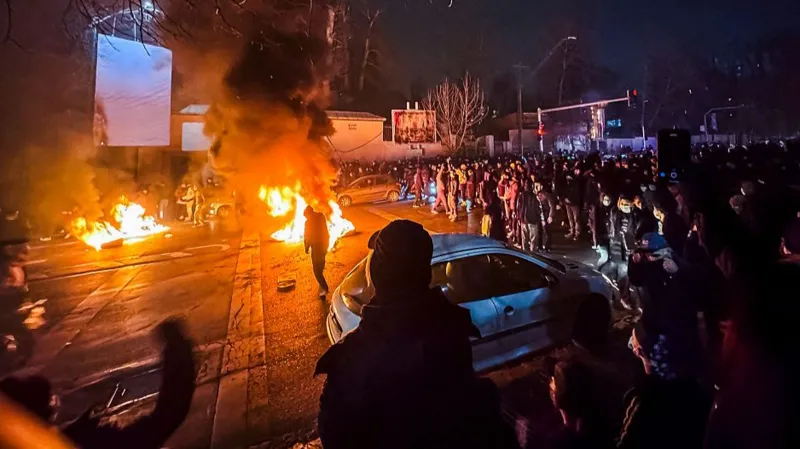
Iran has warned it will retaliate if attacked by the US, as protesters defied a deadly government crackdown on Saturday night.
Videos verified by the BBC and eyewitness accounts appeared to show the government ramping up its response to the protests, which have spread to more than 100 cities and towns across every province in Iran.
Medics at two hospitals have told the BBC that more than 100 bodies had been brought in over a two day period. The nationwide death toll is feared to be far higher.
The US has threatened to strike Iran over the killing of protesters. Iran’s parliament speaker warned that if the US attacked, Israel along with US military and shipping centres in the region would become legitimate targets.
The protests were sparked in the capital, Tehran, by soaring inflation, and are now calling for an end to the clerical rule of Iran’s Supreme Leader Ayatollah Ali Khamenei.
Iran’s attorney general said anyone protesting would be considered an “enemy of God” – an offence that carries the death penalty – while Khamenei has dismissed demonstrators as a “bunch of vandals” seeking to “please” Trump.
US President Donald Trump said on Saturday that the US “stands ready to help” as Iran “is looking at FREEDOM”.
Iran’s President Masoud Pezeshkian has blamed the US and Israel for the unrest.
“They have trained certain individuals inside the country and abroad, brought terrorists into the country from outside, set mosques on fire, and attacked markets and guilds in Rasht, setting the bazaar ablaze,” he said without providing evidence.
As protests intensify, the number of deaths and injuries recorded by human rights monitors continues to rise.
Footage authenticated by BBC Persian and BBC Verify shows security officers shooting at gatherings of protesters in Tehran, in the western Kermanshah province and the southern Bushehr region.
Multiple verified videos filmed in the centre of the western city of Ilam last weekend show security forces firing shots towards Imam Khomeini Hospital, where a group of protesters had been holding a rally.
Staff at several hospitals have since told the BBC they have been overwhelmed with the injured and dead.
BBC Persian has verified that 70 bodies brought to one hospital in the city of Rasht on Friday night, while a health worker reported around 38 people dying at a Tehran hospital.
Sources inside Iran have told BBC Persian that plain-clothes officers have been targeting people filming and on their own at the protests.
Iran’s police chief said on state TV that the level of confrontation with protesters had been stepped up, with arrests on Saturday night of what he called “key figures”. He blamed a “significant proportion of fatalities” on “trained and directed individuals”, not security forces, but did not give specific details.
More than 2,500 people have been arrested since protests began on 28 December, according to a human rights group.
The BBC and most other international news organisations are unable to report from inside Iran, and the Iranian government has imposed an internet shutdown since Thursday, making obtaining and verifying information difficult.
Nonetheless, some footage has emerged.
Several videos, confirmed as recent by BBC Verify, show clashes between protesters and security forces in Mashhad, Iran’s second-largest city.
Masked protesters can be seen taking cover behind bins and bonfires, while a row of security forces is seen in the distance. A vehicle that appears to be a bus is engulfed in flames.
Multiple gunshots and what sounds like banging on pots and pans can be heard.
A figure standing on a nearby footbridge appears to fire multiple gunshots in several directions as a couple of people take cover behind a fence.
In Tehran, a verified video from Saturday night shows protesters also taking over the streets in the Gisha district.
Other verified videos from the capital show a large group of protesters and the sound of banging on pots in Punak Square, and a crowd of protesters marching on a road and calling for the end of the clerical establishment in the Heravi district.
Internet access in Iran is largely limited to a domestic intranet, with restricted links to the outside world. But during the current round of protests, authorities have for the first time severely restricted that too.
An expert told BBC Persian the shutdown is more severe than during the “Women, Life, Freedom” uprising in 2022.Alireza Manafi, an internet researcher, said the only likely way to connect to the outside world was via Starlink satellite, but warned users to exercise caution as such connections could potentially be traced by the government.
Trump did not elaborate on what the US was considering. However, he has been briefed on options for military strikes on Iran, an official told the BBC’s US news partner CBS.
The Wall Street Journal reports these were “preliminary discussions” and that there was no “imminent threat” to Iran.
US Secretary of State Marco Rubio also spoke to Israeli Prime Minister Benjamin Netanyahu on Saturday about the possibility of US intervention in Iran, they told CBS.
On Sunday, Reza Pahlavi , the exiled son of Iran’s last Shah, who lives in the US and whose return protesters have been calling for, told demonstrators that Trump had “carefully observed your indescribable bravery” in a social media post.
“Your compatriots around the world are proudly shouting your voice,” he wrote, pledging: “I know that I will soon be by your side.”
Pahlavi claimed the Islamic Republic was facing a “severe shortage of mercenaries” and that “many armed and security forces have left their workplaces or disobeyed orders to suppress the people”. The BBC could not verify these claims.
He encouraged people to continue protesting on Sunday evening, but to stay in groups or with crowds and not “endanger your lives”.
(BBC)

Latest News
Kohli, Padikkal hit fifties as Royal Challengers Bengaluru ace the chase against Gujarat Titans
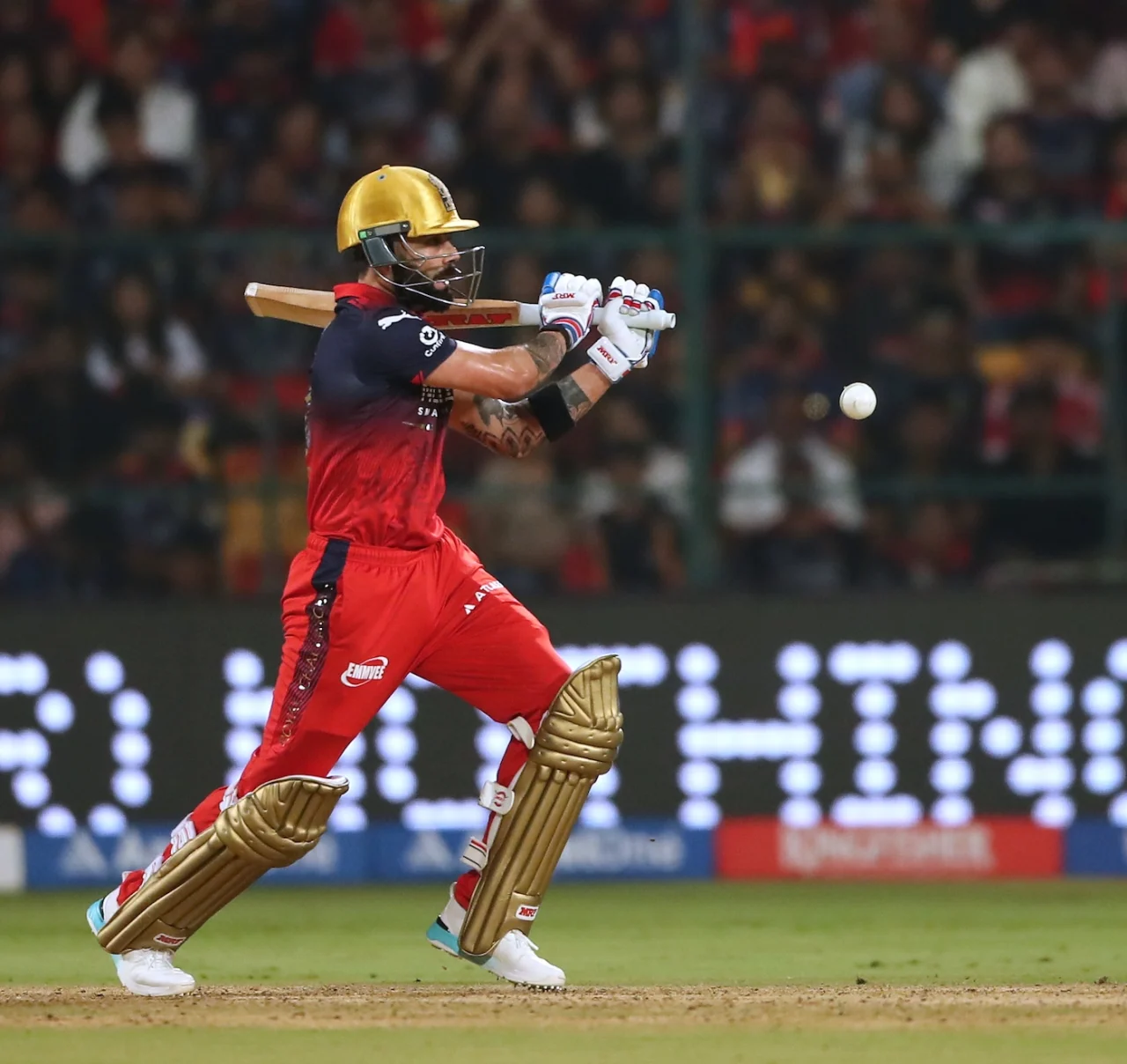
An exhibition of clean hitting by Virat Kohli and Devdutt Padikkal ensured Sai Sudarshan’s measured 100 off 58 balls ended in a losing cause as Royal Challengers Bengaluru (RCB) beat Gujarat Titans (GT) by five wickets at the Chinnaswamy Stadium.
After winning the toss, RCB captain Rajat Patidar had no hesitation in putting GT in. Sudharsan laid a strong foundation on a pitch he described as “two-paced and sticky to start with”. But even when the surface became easier to bat on, GT could not get into overdrive. They scored only 35 in the last four overs and finished on 205 for 3.
In response, Kohli, who was dropped on zero, smashed 81 off 44 balls and Padikkal blasted 55 off just 27. They put on 115 in 9.5 overs for the second wicket, and despite a bit of wobble towards the end, RCB romped home with seven balls to spare.
The GT openers prefer to take as few risks as possible and it was no different on Friday. Sudharsan was circumspect at the start and was on 17 off 16 after three overs. But he found his timing after that and moved to 41 off 27 by the end of the fifth. Gill had faced just three balls till then. GT finished the powerplay on 57 for no loss.
Sudharsan went inventive after the powerplay, scooping Romario Shepherd for a six. When Krunal Pandya bowled a bouncer, he uppercut him over deep third. Later in the over, he slog-swept the spinner for another six, reaching 2000 runs in the IPL. Taking 47 innings, he was the fastest to get there, bettering Chris Gayle’s record by one.
He and Gill added 128 in 12.4 overs, with Gill contributing 32 off 24 balls. The GT captain was starved of strike throughout his stay and holed out to long-on off Suyash Sharma. Sudharsan brought up his hundred off 57 balls, the slowest of the six so far this season. There was no cutting loose after reaching the milestone either. He was out on the very next ball he faced.
GT were 170 for 2 after 16 overs but Suyash, Bhuvneshwar Kumar and Hazlewood gave away only 17 in the next three. At 187 for 3, Rasikh Salam ran in to bowl the final over but he stopped even before he could bowl a delivery. It looked like cramps and despite the physio working on him, he had to walk off the field. Krunal replaced him and was hit for a six by Jason Holder off the first ball. After another ball, Krunal too pulled out of his delivery stride holding his groin. But after a bit of medical attention, he completed the over, but ended up leaking 18 runs.
With Phil Salt injured, Jacob Bethell finally got a chance to play this season. Opening the innings after coming in as Impact Player, he had a close shave in the second over. He got an inside edge to a length ball from Kagiso Rabada but it missed the stumps and beat Buttler for four. In the next over, he shuffled across and hit Mohammed Siraj for a four on either side of the wicket. But when he tried the same trick later in the over, he hit it straight to the backward point. He made 14 off ten.
Kohli was dropped off the first ball he faced. It was a length delivery from Siraj that he flicked uppishly towards short midwicket but Washington Sundar grassed a regulation chance. Kohli made his intentions clear in the following over when he hit Rabada over mid-on for a four.
Padikkal was even more ruthless. He opened his account with a first-ball six, picking up a 153.6kph length ball from Rabada over square leg. The GT bowlers didn’t help themselves by bowling onto his pads, and he kept flicking them fine for boundaries.
Rashid Khan wasn’t spared either. He dropped one short to Kohli and the batter duly pulled it over deep midwicket for a six before cutting the following delivery for four. In the spinner’s second over, Padikkal hit him for two sixes, the second one taking him to his fifty off just 20 balls. It made Kohli’s 30-ball fifty look pedestrian.
Rashid bowled Padikkal with a googly from around the wicket, and Kohli played Holder on but not before hitting the allrounder for back-to-back sixes.
Rajat Patidar and Jitesh Sharma kept the attack going. They hit a six each off Rashid but fell in quick succession. Suddenly, RCB were five down with 31 required from four overs. Krunal, though, bashed Manav Suthar for two fours and a six in the 18th over, bringing the equation down to seven needed from 12. In the penultimate over, he swatted Holder through midwicket for four before wrapping up the game with a gentle pull to fine leg.
Brief scores:
Royal Challengers Bengaluru 206 for 5 in 18.5 overs (Jacob Bethell 14, Virat Kohli 81, Devdutt Padikkal 55, Jitesh Sharma 10, Tim David 10*, Krunal Pandya 23*; Mohammed Siraj 1-25, Jason Holder 1-35, Rashid Khan 2-49, Manav Suther 1-19) beat Gujarat Titans 205 for 3 in 20 overs (Sai Sudharsan 100, Shubman Gill 32, Jos Buttler 25, Washington Sundar 19*,Jason Holder 23*; Bhuvneshwar Kumar 1-31, Josh Hazelwood 40, Suyash Sharma 1-36) by five wickets
[Cricinfo]
Latest News
Heat Index at Caution Level in the Northern, North-central, North-western, Western, Sabaragamuwa and Eastern provinces during the day time
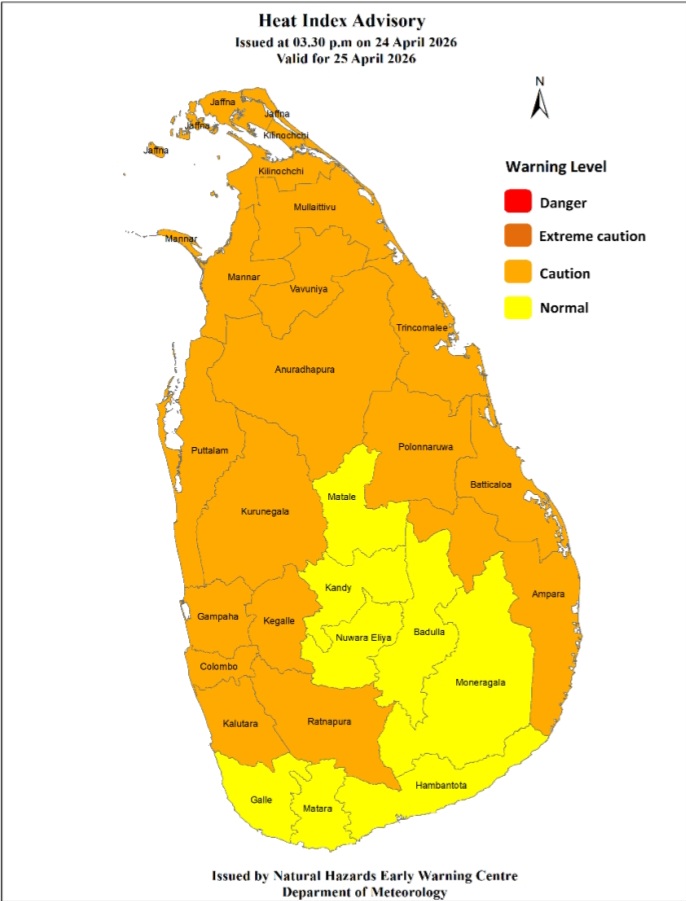
Warm Weather Advisory
Issued by the Natural Hazards Early Warning Centre
Issued at 3.30 p.m. on 24 April 2026, valid for 25 April 2026.
Heat index, the temperature felt on human body is likely to increase up to ‘Caution level’ at some places in Northern, North-central, North-western, Western, Sabaragamuwa and
Eastern provinces during the day time.
The Heat Index Forecast is calculated by using relative humidity and maximum temperature and this is the condition that is felt on your body. This is not the forecast of maximum temperature. It is generated by the Department of Meteorology for the next day period and prepared by using global numerical weather prediction model data.

Effect of the heat index on human body is mentioned in the above table and it is prepared on the advice of the Ministry of Health and Indigenous Medical Services.
ACTION REQUIRED
Job sites: Stay hydrated and takes breaks in the shade as often as possible.
Indoors: Check up on the elderly and the sick.
Vehicles: Never leave children unattended.
Outdoors: Limit strenuous outdoor activities, find shade and stay hydrated.
Dress: Wear lightweight and white or light-colored clothing.
Note:
In addition, please refer to advisories issued by the Disaster Preparedness & Response Division, Ministry of Health in this regard as well. For further clarifications please contact 011-7446491.

Oil prices have jumped on heightened tensions between the United States and Iran in the Strait of Hormuz following Washington and Tehran’s tit-for-tat captures of commercial vessels.
Brent crude, the international benchmark, topped $106 per barrel early on Friday morning as Washington and Tehran stepped up their confrontation over the key maritime route for transporting the world’s energy.
Brent stood at $106.80 as of 01:00 GMT, up nearly 5 percent from its closing price on Wednesday, when it surpassed $100 per barrel for the first time in two weeks.
US stocks fell overnight, with the benchmark S&P 500 index dipping 0.41 percent and the tech-heavy Nasdaq Composite dropping 0.89 percent.
Shipping in the Strait of Hormuz, which normally carries about one-fifth of the world’s supply of oil and natural gas, remains at a standstill as Iran continues to demand the right to decide which vessels may pass and the US blocks Iran’s maritime trade.
US President Donald Trump said in a Truth Social post on Thursday that he had ordered the US Navy to destroy any Iranian boats laying mines in the strait, shortly after the Pentagon announced that it had seized a tanker carrying sanctioned Iranian oil for the second time in less than a week.
Trump also appeared to expand the scope of the US naval blockade beyond Iranian ports, writing on Truth Social that no ship “can enter or leave” the strait without the approval of the US Navy.
“It is ‘Sealed up Tight,’ until such time as Iran is able to make a DEAL!!!” Trump said.
Trump’s threats came a day after Iran’s Islamic Revolutionary Guard Corps announced the capture of two foreign cargo ships in the waterway.
The IRGC said it had seized the Panamanian-flagged MSC Francesca and Greek-owned Epaminondas after the vessels had endangered maritime security “by operating without the necessary permits and tampering with navigation systems”.
The Greek Maritime Affairs and Insular Policy Ministry has denied that the Epaminondas was captured and said the vessel remains under the control of its captain.
Only nine commercial vessels transited the strait on Wednesday, compared with seven on Tuesday and 15 on Monday, according to maritime intelligence platform Windward.
Before the US and Israel launched their war against Iran on February 28, the waterway saw an average of 129 transits each day, according to United Nations Trade and Development.
[Aljazeera]

AI chatbots could be making you stupider

‘A remarkable time capsule’: The enchanting history of Oxford University’s 750-year-old medieval library

Kohli, Padikkal hit fifties as Royal Challengers Bengaluru ace the chase against Gujarat Titans

Showers expected in the Western and Sabaragamuwa provinces and in Galle, Matara, Kandy, Nuwara-Eliya and Puttalam districts after 2.00 pm

Heat Index at Caution Level in the Northern, North-central, North-western, Western, Sabaragamuwa and Eastern provinces during the day time

Opposition holds NPP Cabinet responsible for coal scam, three times bigger than bond fraud

‘Dates have the highest sugar content to fight Coronavirus’

Sunday Island 27 December – Headlines

#SundayIsland 17th December – Headlines

Sunday Island – 28th March

Sunday Island Headlines – 21 March

Sunday Island – 21st February – Headlines
-
 News4 days ago
Rs 13 bn NDB fraud: Int’l forensic audit ordered
-

 Opinion5 days ago
Shutting roof top solar panels – a crime
-

 News6 days ago
From Nuwara Eliya to Dubai: Isha Holdings markets Agri products abroad
-

 News1 day ago
No cyber hack: Fintech expert exposes shocking legacy flaws that led to $2.5 million theft
-

 News2 days ago
Lanka faces crisis of conscience over fate of animals: Call for compassion, law reform, and ethical responsibility
-
 News1 day ago
Whistleblowers ask Treasury Chief to resign over theft of USD 2.5 mn
-

 News5 days ago
Church calls for Deputy Defence Minister’s removal, establishment of Independent Prosecutor’s Office
-

 Life style6 days ago
After dark in Sri Lanka: Tiny wild cats step into the spotlight