
Foreign News
ICJ orders Israel to halt its offensive on Rafah, Gaza in new ruling

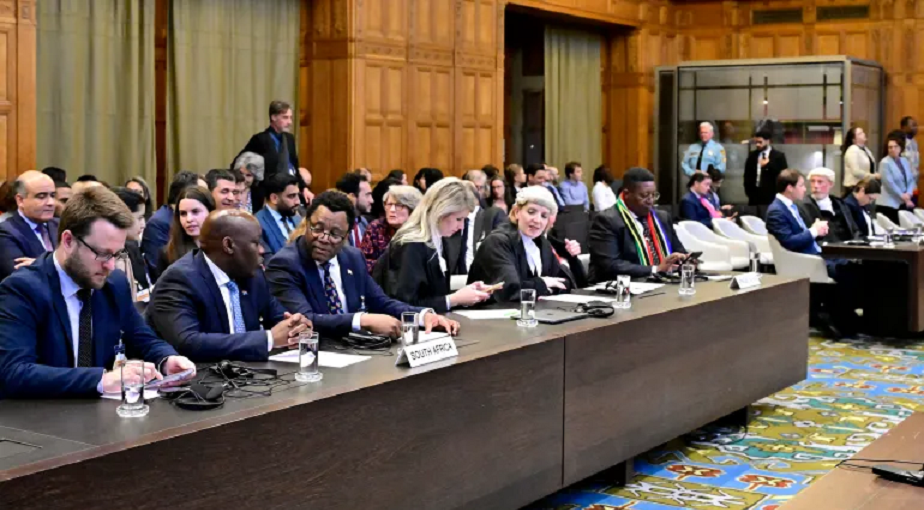
Judges at the top United Nations court ordered Israel to halt its offensive in the southern Gaza city of Rafah and withdraw from the enclave, in a case brought by South Africa accusing Israel of genocide, citing “immense risk” to the Palestinian population.
Friday’s decision marked the third time this year the 15-judge panel has issued preliminary orders seeking to rein in the death toll and alleviate humanitarian suffering in Gaza. While orders are legally binding, the court has no police to enforce them.
Reading out a ruling by the International Court of Justice or World Court, the body’s president, Nawaf Salam, said provisional measures ordered by the court in March did not fully address the situation in the besieged Palestinian enclave now, and conditions had been met for a new emergency order.
Israel must “immediately halt its military offensive, and any other action in the Rafah Governorate, which may inflict on the Palestinian group in Gaza conditions of life that could bring about its physical destruction in whole or in part,” Salam said, and called the humanitarian situation in Rafah “disastrous”.

South Africa’s lawyers had asked the ICJ in The Hague last week to impose emergency measures, saying Israel’s attacks on Rafah must be stopped to ensure the survival of the Palestinian people.
Reporting from The Hague, in the Netherlands, Al Jazeera’s Step Vaessen said that 13 of the 15 ICJ judges agreed to call on Israel to halt its assault.
“Salam said 800,000 are displaced, and that he doesn’t believe Israel’s word that they are provided safety and humanitarian access. He said there was no evidence of that,” she noted.
“That’s why the court has now made a very strong order that Israel should immediately stop its offensive and military operation in Rafah and withdraw its troops from there. He also made a ruling on border crossings, that they must be reopened as soon as possible to get humanitarian aid in,” Vaessen added.
She said that the judge also stressed that observers from the UN have to get access as soon as possible to make sure that no evidence of any possible war crimes disappear from the region.
The ICJ has also ordered Israel to report back to the court within one month over its progress in applying measures ordered by the institution.
Israel launched its assault on the southern city of Rafah this month, forcing hundreds of thousands of Palestinians to flee a city that had become a refuge to about half of the population’s 2.3 million people.
Rafah, on Gaza’s southern edge, has also been the main route in for aid, and international organisations say the Israeli operation has cut off the enclave and raised the risk of famine.
Reporting from Deir el-Balah in central Gaza, Al Jazeera’s Hind Al Khoudary said that people in the Gaza Strip have not yet reacted to the ICJ ruling since many of them do not have internet connection.
“People here in the Gaza Strip are currently trying to feed themselves … after being constantly displaced. So people are not very well aware of what’s going on. They’re asking journalists … if there is anything positive,” she said.
Khoudary added that, as journalists in Gaza, they do not want to give people in the region false hope and are waiting to hear more information about how the ICJ’s ruling will be implemented in Rafah, where the situation remains tense.
The Palestinian Authority has welcomed the decision on Friday from the International Court of Justice, saying it represents an international consensus to end the war on the Gaza Strip, Palestinian presidential spokesman Nabil Abu Rudeina told the Reuters news agency.
Shortly after the ruling, Israel’s finance minister, Bezalel Smotrich said on the social media platform X that “the State of Israel is at war for its existence.”
“Those who demand that the State of Israel stop the war, demand that it decree itself to cease to exist. We will not agree to that,” he said.
“We continue to fight for ourselves and for the entire free world. History will judge who today stood by the Nazis of Hamas and ISIS [ISIL],” he added.
Reporting from Amman, Jordan, Al Jazeera’s Imran Khan said that diplomatic sources have told Israel’s Channel 13 that Prime Minister Benjamin Netanyahu will convene an emergency meeting.
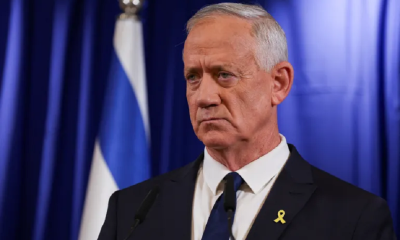
“Foreign Minister Israel Katz, war cabinet minister Benny Gantz and the government’s judicial adviser will be in the meeting. This is how seriously they are taking this ruling,” Khan said.
“We are hearing from political sources speaking to local media that Israel will not respond to the decision of the court, both politically or militarily,” he added.
According to war crimes prosecutor Reed Brody, the ICJ has stepped up to confront the reality in the Gaza Strip.
“I’m really impressed, first of all by South Africa’s tenacity and perseverance and coming back to the court. And the court has responded almost unanimously,” he told Al Jazeera.
Brody noted that South Africa has been asking for an order for Israel to stop its military offensive since the start of the war on Gaza, with the court saying it cannot make a move because Hamas and the Palestinian side is not present on the stand.
“But that’s what they have finally chosen to do here and it’s a testament to this court and what it does,” he said.
“Together with the decision by the ICC prosecutor [to recommend arrest warrants against top Israeli officials], it is a real one-two legal punch.”
against top Israeli officials], it is a real one-two legal punch.”
The ICJ, also known as the World Court, is the highest UN body for hearing disputes between states. Its rulings are final and binding, but have been ignored in the past.
In a highly charged ruling in January, the court ordered Israel to do everything in its power to prevent genocidal acts in Gaza, but stopped short of ordering a halt in the fighting.
Israel has repeatedly dismissed the case’s accusations of genocide as baseless, arguing in court that its operations in Gaza are self-defence and targeted at Hamas fighters who attacked Israel on October 7.
(Aljazeera)









Saudi Arabia has surpassed its record for the number of executions carried out annually for a second year in a row.
At least 347 people have now been put to death this year, up from a total of 345 in 2024, according to the UK-based campaign group Reprieve, which tracks executions in Saudi Arabia and has clients on death row.
It said this was the “bloodiest year of executions in the kingdom since monitoring began”.
The latest prisoners to be executed were two Pakistani nationals convicted of drug-related offences.
Others put to death this year include a journalist and two young men who were children at the time of their alleged protest-related crimes. Five were women.
But, according to Reprieve, most – around two thirds – were convicted of non-lethal drug-related offences, which the UN says is “incompatible with international norms and standards”.
More than half of them were foreign nationals who appear to have been put to death as part of a “war on drugs” in the kingdom.
The Saudi authorities have not responded to the BBC’s request for comment on the rise in executions.
“Saudi Arabia is operating with complete impunity now,” said Jeed Basyouni, Reprieve’s head of death penalty for the Middle East and North Africa. “It’s almost making a mockery of the human rights system.”
She described torture and forced confessions as “endemic” within the Saudi criminal justice system.
Ms Basyouni called it a “brutal and arbitrary crackdown” in which innocent people and those on the margins of society have been caught up.
On Tuesday, a young Egyptian fisherman, Issam al-Shazly, was executed. He was arrested in 2021 in Saudi territorial waters and said he had been coerced into smuggling drugs.
Reprieve says 96 of the executions were solely linked to hashish.
“It almost seems that it doesn’t matter to them who they execute, as long as they send a message to society that there’s a zero-tolerance policy on whatever issue they’re talking about – whether it’s protests, freedom of expression, or drugs,” said Ms Basyouni.
There has been a surge of drug-related executions since the Saudi authorities ended an unofficial moratorium in late 2022 – a step described as “deeply regrettable” by the UN human rights office.
Speaking anonymously to the BBC, relatives of men on death row on drugs charges have spoken of the “terror” they’re now living in.
One told the BBC: “The only time of the week that I sleep is on Friday and Saturday because there are no executions on those days.”
Cellmates witness people they have shared prison life with for years being dragged kicking and screaming to their death, according to Reprieve.
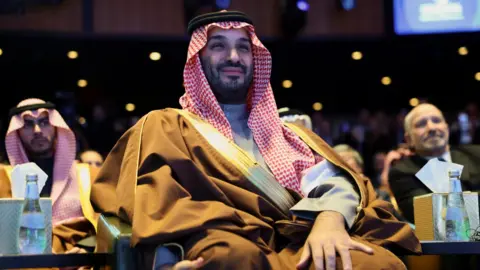
The de facto ruler of Saudi Arabia, Mohammed bin Salman – who became crown prince in 2017 – has changed the country profoundly over the past few years, loosening social restrictions while simultaneously silencing criticism.
In a bid to diversify its economy away from oil, he has opened Saudi Arabia up to the outside world, taken the religious police off the streets, and allowed women to drive.
But the kingdom’s human rights record remains “abysmal”, according to the US-based campaign group Human Rights Watch, with the high level of executions a major concern. In recent years, only China and Iran have put more people to death, according to human rights activists.
“There’s been no cost for Mohammed bin Salman and his authorities for going ahead with these executions,” said Joey Shea, who researches Saudi Arabia for Human Rights Watch. “The entertainment events, the sporting events, all of it is continuing to happen with no repercussions, really.”
According to Reprieve, the families of those executed are usually not informed in advance, or given the body, or informed where they have been buried.
The Saudi authorities do not reveal the method of execution, although it is believed to be either beheading or firing squad.
In a statement sent to the BBC, the UN’s special rapporteur on extrajudicial, summary or arbitrary executions, Dr Morris Tidball-Binz, called for an immediate moratorium on executions in Saudi Arabia with a view to abolition,.
He also pressed for “full compliance with international safeguards (including effective legal assistance and consular access for foreign nationals), prompt notification of families, the return of remains without delay and the publication of comprehensive execution data to enable independent scrutiny”.
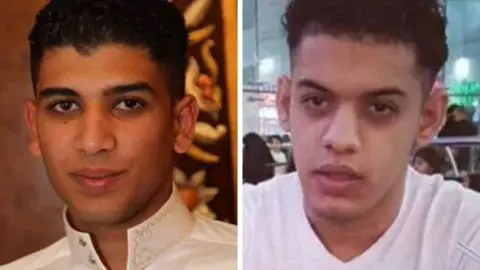
Among the Saudi nationals executed this year were Abdullah al-Derazi and Jalal al-Labbad, who were both minors at the time of their arrest.
They had protested against the government’s treatment of the Shia Muslim minority in 2011 and 2012, and participated in the funerals of people killed by security forces. They were convicted of terrorism-related charges and sentenced to death after what Amnesty International said were grossly unfair trials that relied on torture-tainted “confessions”. UN human rights experts had called for their release.
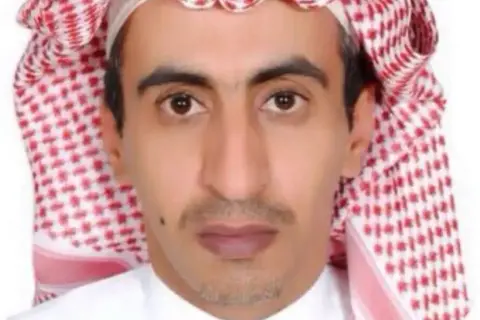
The UN also condemned the execution in June of journalist Turki al-Jasser, who had been arrested in 2018 and sentenced to death on charges of terrorism and high treason based on writings he was accused of authoring.
“Capital punishment against journalists is a chilling attack on freedom of expression and press freedom,” Unesco’s Director-General, Audrey Azoulay, said.
Reporters Without Borders said he was the first journalist to be executed in Saudi Arabia since Mohammed bin Salman came to power, although another journalist, Jamal Khashoggi, was murdered by Saudi agents at the Saudi consulate in Istanbul in 2018.
Last December, UN experts wrote to the Saudi authorities to express concern over a group of 32 Egyptians and one Jordanian national sentenced to death on drugs charges, and their “alleged absence of legal representation”. Since then, most of the group have been executed.
A relative of one man put to death earlier this year said he had told her that people were being “taken like goats” to be killed.
The BBC has approached the Saudi authorities for a response to the allegations but has not received one.
But in a letter dated January 2025 – in reply to concerns raised by UN special rapporteurs – they said Saudi Arabia “protects and upholds” human rights and that its laws “prohibit and punish torture”.
“The death penalty is imposed only for the most serious crimes and in extremely limited circumstances,” the letter stated. “It is not handed down or carried out until judicial proceedings in courts of all levels have been completed.”
[BBC]
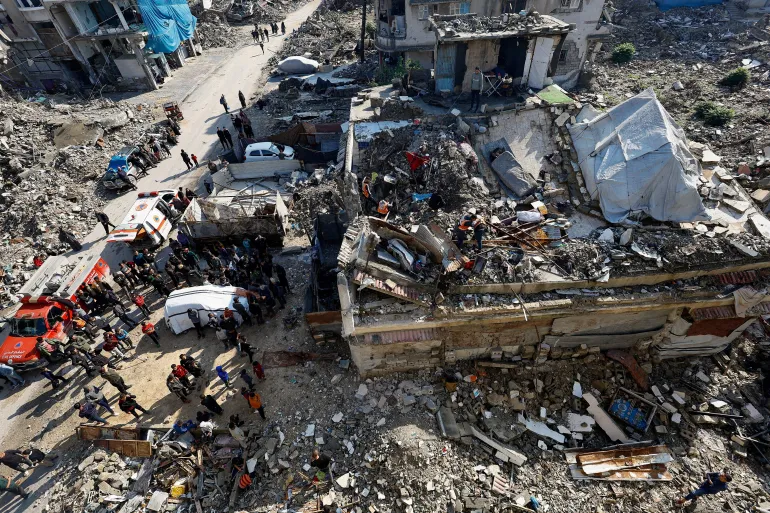
The United States Middle East envoy, Steve Witkoff, will hold talks in Miami, Florida, with senior officials from Qatar, Egypt and Turkiye as efforts continue to advance the next phase of the Gaza ceasefire, even as Israel repeatedly violates the truce on the ground.
A White House official told Al Jazeera Arabic on Friday that Witkoff is set to meet representatives from the three countries to discuss the future of the agreement aimed at halting Israel’s genocidal war on Gaza.
Axios separately reported that the meeting, scheduled for today [Friday], will include Qatari Prime Minister and Foreign Minister Sheikh Mohammed bin Abdulrahman bin Jassim Al Thani, Turkish Foreign Minister Hakan Fidan and Egyptian Foreign Minister Badr Abdelatty.
At the same time, Israel’s public broadcaster, quoting an Israeli official, said Prime Minister Benjamin Netanyahu is holding a restricted security consultation to examine the second phase of the ceasefire and potential scenarios.
That official warned that Israel could launch a new military campaign to disarm Hamas if US President Donald Trump were to disengage from the Gaza process, while acknowledging that such a move was unlikely because Trump wants to preserve calm in the enclave.

Despite Washington’s insistence that the ceasefire remains intact, Israeli attacks have continued almost uninterrupted, as it continues to renege on the terms of the first phase and blocks the free flow of desperately needed humanitarian aid into the besieged Palestinian territory.
[Aljazeera]

A former Nascar driver and his family were among the seven people killed in a plane crash at a regional airport in North Carolina, the car-racing organisation has said.
A highway patrol spokesman said people on the ground confirmed that Greg Biffle was among those who boarded the plane.
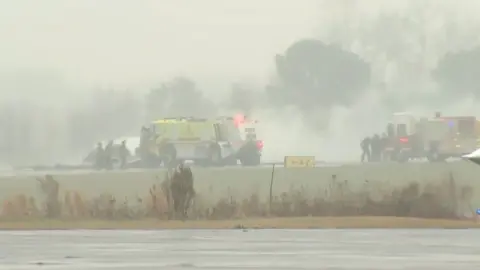
The Cessna C550 crashed while landing at Statesville Regional Airport around 10:20 local time (15:20GMT), officials investigating the incident told reporters.
“Greg was more than a champion driver, he was a beloved member of the NASCAR community, a fierce competitor, and a friend to so many,” Nascar said in a statement where it confirmed Biffle had died along with his wife, daughter, son, and three others.
“His passion for racing, his integrity, and his commitment to fans and fellow competitors alike made a lasting impact on the sport,” the company added.
Beyond the racetrack, Biffle was remembered for helping in North Carolina in the aftermath of last year’s Hurricane Helene, when he used his personal helicopter to rescue stranded residents and deliver supplies.
Tributes to the former racer poured in on Thursday.
“Heartbreaking news out of Statesville,” North Carolina Governor Josh Stein posted on X. “Beyond his success as a NASCAR driver, Greg Biffle lived a life of courage and compassion and stepped up for western North Carolina after Hurricane Helene.”
Motorsport YouTuber Garrett Mitchell wrote on Facebook that Biffle and his family were on their way to spend the afternoon with him.
“Unfortunately, I can confirm Greg Biffle, his wife Cristina, daughter Emma, and son Ryder were on that plane… because they were on their way to spend the afternoon with us,” he wrote on Facebook. “We are devastated. I’m so sorry to share this.”
Statesville Airport Director John Ferguson described the aircraft as a corporate jet and said it was already engulfed in flames when he arrived on the scene.
The Cessna C550 aircraft is owned by a private company associated with Biffle, CBS, the BBC’s US partner, reported.
The jet took off around 10:06 local time and was in the air briefly before it crashed on the east end of the runway.
Authorities are investigating the cause of the crash.
Statesville Airport will remain closed until further notice as crews clear debris off the runway, Mr Ferguson told reporters.
Officials did not provide any information about deaths or people aboard the aircraft during their first media conference.
The National Transportation Safety Board, which is leading the investigation has sent in a team to investigate the fatal crash.
The Statesville Regional Airport (KSVH) is owned by the City of Statesville, which is about 45 minutes north of Charlotte.
It also provides aviation facilities for Fortune 500 companies and several Nascar racing teams.
[BBC]

Financial contributions received for ‘Rebuilding Sri Lanka’ Fund

UNICEF representatives and PM discuss rebuilding schools affected by the Disaster

A few showers may occur in the Uva province and in Ampara, Batticaloa, Matale, Nuwara-Eliya, and Hambantota districts

NMRA laboratory lacks SLAB accreditation

Air quality deteriorating in Sri Lanka

Cardinal urges govt. not to weaken key socio-cultural institutions

‘Dates have the highest sugar content to fight Coronavirus’

Sunday Island 27 December – Headlines

#SundayIsland 17th December – Headlines

Sunday Island – 28th March

Sunday Island Headlines – 21 March

Sunday Island – 21st February – Headlines
-

 Midweek Review5 days ago
How massive Akuregoda defence complex was built with proceeds from sale of Galle Face land to Shangri-La
-
 News4 days ago
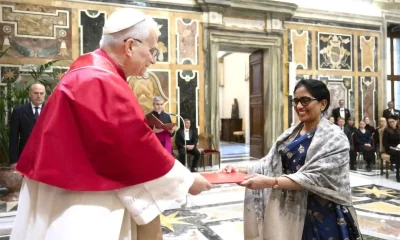
Pope fires broadside: ‘The Holy See won’t be a silent bystander to the grave disparities, injustices, and fundamental human rights violations’
-

 News4 days ago
Pakistan hands over 200 tonnes of humanitarian aid to Lanka
-

 News5 days ago
Burnt elephant dies after delayed rescue; activists demand arrests
-

 Business3 days ago
Unlocking Sri Lanka’s hidden wealth: A $2 billion mineral opportunity awaits
-

 Editorial5 days ago
Colombo Port facing strategic neglect
-

 News3 days ago
Army engineers set up new Nayaru emergency bridge
-

 News5 days ago
Sri Lanka, Romania discuss illegal recruitment, etc.