
Foreign News
ICJ orders Israel to halt its offensive on Rafah, Gaza in new ruling

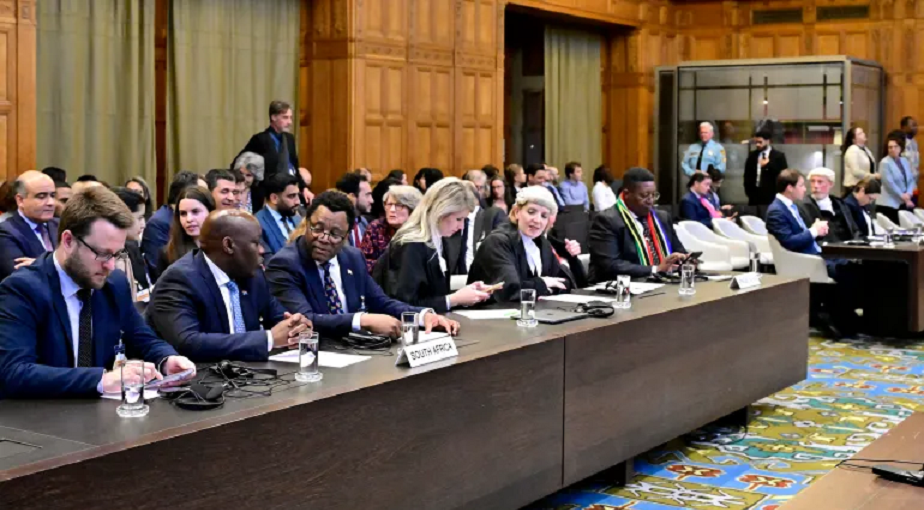
Judges at the top United Nations court ordered Israel to halt its offensive in the southern Gaza city of Rafah and withdraw from the enclave, in a case brought by South Africa accusing Israel of genocide, citing “immense risk” to the Palestinian population.
Friday’s decision marked the third time this year the 15-judge panel has issued preliminary orders seeking to rein in the death toll and alleviate humanitarian suffering in Gaza. While orders are legally binding, the court has no police to enforce them.
Reading out a ruling by the International Court of Justice or World Court, the body’s president, Nawaf Salam, said provisional measures ordered by the court in March did not fully address the situation in the besieged Palestinian enclave now, and conditions had been met for a new emergency order.
Israel must “immediately halt its military offensive, and any other action in the Rafah Governorate, which may inflict on the Palestinian group in Gaza conditions of life that could bring about its physical destruction in whole or in part,” Salam said, and called the humanitarian situation in Rafah “disastrous”.

South Africa’s lawyers had asked the ICJ in The Hague last week to impose emergency measures, saying Israel’s attacks on Rafah must be stopped to ensure the survival of the Palestinian people.
Reporting from The Hague, in the Netherlands, Al Jazeera’s Step Vaessen said that 13 of the 15 ICJ judges agreed to call on Israel to halt its assault.
“Salam said 800,000 are displaced, and that he doesn’t believe Israel’s word that they are provided safety and humanitarian access. He said there was no evidence of that,” she noted.
“That’s why the court has now made a very strong order that Israel should immediately stop its offensive and military operation in Rafah and withdraw its troops from there. He also made a ruling on border crossings, that they must be reopened as soon as possible to get humanitarian aid in,” Vaessen added.
She said that the judge also stressed that observers from the UN have to get access as soon as possible to make sure that no evidence of any possible war crimes disappear from the region.
The ICJ has also ordered Israel to report back to the court within one month over its progress in applying measures ordered by the institution.
Israel launched its assault on the southern city of Rafah this month, forcing hundreds of thousands of Palestinians to flee a city that had become a refuge to about half of the population’s 2.3 million people.
Rafah, on Gaza’s southern edge, has also been the main route in for aid, and international organisations say the Israeli operation has cut off the enclave and raised the risk of famine.
Reporting from Deir el-Balah in central Gaza, Al Jazeera’s Hind Al Khoudary said that people in the Gaza Strip have not yet reacted to the ICJ ruling since many of them do not have internet connection.
“People here in the Gaza Strip are currently trying to feed themselves … after being constantly displaced. So people are not very well aware of what’s going on. They’re asking journalists … if there is anything positive,” she said.
Khoudary added that, as journalists in Gaza, they do not want to give people in the region false hope and are waiting to hear more information about how the ICJ’s ruling will be implemented in Rafah, where the situation remains tense.
The Palestinian Authority has welcomed the decision on Friday from the International Court of Justice, saying it represents an international consensus to end the war on the Gaza Strip, Palestinian presidential spokesman Nabil Abu Rudeina told the Reuters news agency.
Shortly after the ruling, Israel’s finance minister, Bezalel Smotrich said on the social media platform X that “the State of Israel is at war for its existence.”
“Those who demand that the State of Israel stop the war, demand that it decree itself to cease to exist. We will not agree to that,” he said.
“We continue to fight for ourselves and for the entire free world. History will judge who today stood by the Nazis of Hamas and ISIS [ISIL],” he added.
Reporting from Amman, Jordan, Al Jazeera’s Imran Khan said that diplomatic sources have told Israel’s Channel 13 that Prime Minister Benjamin Netanyahu will convene an emergency meeting.
“Foreign Minister Israel Katz, war cabinet minister Benny Gantz and the government’s judicial adviser will be in the meeting. This is how seriously they are taking this ruling,” Khan said.
“We are hearing from political sources speaking to local media that Israel will not respond to the decision of the court, both politically or militarily,” he added.
According to war crimes prosecutor Reed Brody, the ICJ has stepped up to confront the reality in the Gaza Strip.
“I’m really impressed, first of all by South Africa’s tenacity and perseverance and coming back to the court. And the court has responded almost unanimously,” he told Al Jazeera.
Brody noted that South Africa has been asking for an order for Israel to stop its military offensive since the start of the war on Gaza, with the court saying it cannot make a move because Hamas and the Palestinian side is not present on the stand.
“But that’s what they have finally chosen to do here and it’s a testament to this court and what it does,” he said.
“Together with the decision by the ICC prosecutor [to recommend arrest warrants against top Israeli officials], it is a real one-two legal punch.”
against top Israeli officials], it is a real one-two legal punch.”
The ICJ, also known as the World Court, is the highest UN body for hearing disputes between states. Its rulings are final and binding, but have been ignored in the past.
In a highly charged ruling in January, the court ordered Israel to do everything in its power to prevent genocidal acts in Gaza, but stopped short of ordering a halt in the fighting.
Israel has repeatedly dismissed the case’s accusations of genocide as baseless, arguing in court that its operations in Gaza are self-defence and targeted at Hamas fighters who attacked Israel on October 7.
(Aljazeera)










At least 139 people, including 15 children, have died and 84 are missing after a boat capsized off the coast of Djibouti, according to the United Nations migration agency.
In a statement on Sunday, the International Organization for Migration (IOM) quoted survivors as saying that the incident happened near Guhere off Djibouti’s eastern coast in the Gulf of Aden near the Bab al-Mandeb strait from Thursday night to before dawn on Friday.
The boat was heading from Djibouti to Yemen with more than 300 people on board. More than 80 people – all Ethiopians – survived the shipwreck while Djiboutian search and rescue operations continued.
“Our teams are on the ground alongside local authorities to provide emergency assistance,” IOM Chief of Mission in Djibouti Alexandre Coissac said, lamenting the “devastating loss of life”.
That number only includes those buried by authorities in Djibouti. Others have been buried by the migrants themselves but they won’t be added to the official count until authorities can verify the bodies, Alexandre Coissac, IOM Chief of Mission in Djibouti, told the Associated Press.
“This tragedy is a stark reminder of the dangers faced by migrants along this migration corridor as they seek economic opportunities,” Coissac added.
[Aljazeera]
Foreign News
‘Time for Ukraine to get new president,’ says Trump after Zelensky condemns diesel deal

US President Donald Trump has said he thinks “it’s time for Ukraine to get a new president” as he responded to Volodymyr Zelensky’s criticism of the US diesel deal with Russia.
The Ukrainian president warned a new deal to release millions of tonnes of Russian diesel into the US would provide Moscow with money to continue its war against his nation, calling it a gift to Russian President Vladimir Putin.
Trump told reporters outside the White House on Saturday that Zelensky “wants to make problems for the world” by continuing to authorise attacks on Russian refineries.
“He’d better damn well stop,” Trump said, before suggesting Ukraine should “get a new leader who can make a deal”.
Global fuel supplies, including diesel, have been severely limited by the war against Iran launched by the US and Israel, which led to the effective closure of the Strait of Hormuz, through which roughly a fifth of the world’s oil products usually flows.
Russia – a major producer – and Ukraine have recently intensified their strikes on each other’s energy infrastructure and transport facilities, further straining energy markets.
“We said, ‘you can do whatever you want to Russia, don’t hit the refineries’, because that’s a world problem that’s caused,” Trump continued.
“He could have made many deals and for some reason, he never does.”
Putin’s envoy Kirill Dmitriev described Trump’s intervention as “iconic and historic”, saying that Ukraine “needs leadership actually focused on peace”.
The US president confirmed on Friday that an agreement had been reached with Moscow to suspend sanctions on Russian diesel exports until 7 April.
Zelensky reacted by saying it would allow Moscow to raise new funds to source new military equipment to continue the war.
He also accused Moscow of taking the deal “to mean they can keep fighting, to mean they keep dropping bombs on cities” following deadly new strikes on Zaporizhzhia.
The Ukrainian president spoke to several allies on Saturday to discuss the latest developments, calling for “real decisions to protect lives in Ukraine” and to protect European security.
A Downing Street spokesperson said UK Prime Minister Andy Burnham had spoken to Zelensky and offered his “complete solidarity”.
The pair had agreed Russia should acquiesce to “an immediate energy ceasefire” and end its attacks on shipping in the Black Sea, the spokesperson said, as “this would immediately release more energy and food supplies into the global market”.
News of the US-Russia diesel deal was also met with criticism by EU’s foreign affairs chief Kaja Kallas, who echoed Zelensky in saying that suspending sanctions “provides Moscow with more revenues to wage war”, adding: “This is not the time to ease pressure on Russia, and Europe won’t.”
She said European foreign ministers intended to approve the biggest set of sanctions on Russia since the start of its full-scale invasion on Monday.
The deal with Russia is the latest effort from Trump to lower fuel prices in the US ahead of the midterm elections, after months spent grappling with the political consequences of the Iran war.
That conflict, which began in February, has sent the cost of petrol and in particular diesel skyrocketing, which has soured his standing with the American public who have been stung by the higher pump prices and knock-on effects that led to across-the-board inflation.
The average price of diesel is currently $6.28 (£4.74) a gallon, according to the AAA – up from last month’s $5.94 average, and $3.68 last year.
Under the deal, Russia would release an initial 300,000 tonnes of diesel “to the American and global marketplace” followed by an additional 500,000 tonnes in November.
A further million would follow, Trump wrote on Truth Social, and then another 3m tonnes “within a short period of time” – but he noted that this delivery will be “based on the condition of their diesel refineries”.
In the past 10 months, Russia experienced two waves of severe fuel shortages across the country due to Ukrainian drones strikes on its oil refineries.
Diesel production in Russia dropped by an estimated 30%, according to the International Energy Agency.
Trump had already called for new elections in Ukraine last December, saying Ukrainian voters should have the choice to replace Zelensky.
Since the war broke out in 2022 Ukraine has been under martial law, meaning elections are suspended.
[BBC]
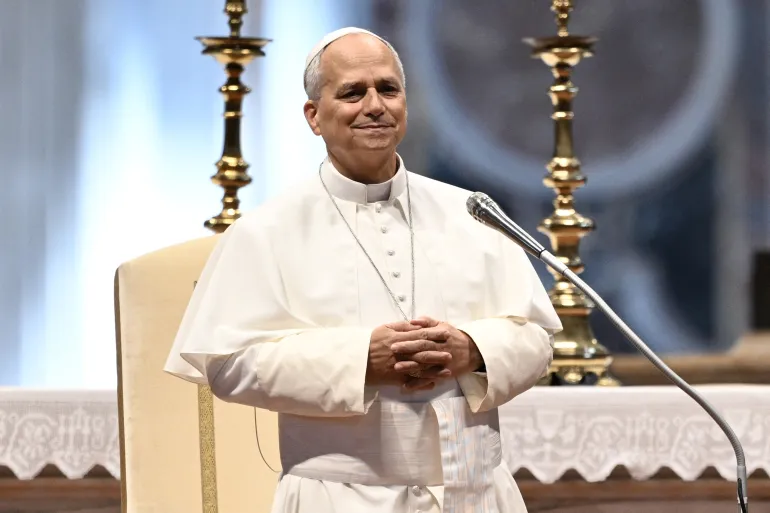
Pope Leo XIV has declared that the death penalty is “inadmissible” while his home country, the United States, announces plans to livestream an execution by firing squad.
Marking World Day Against the Death Penalty on Saturday, the pope reiterated the Catholic Church’s teaching on capital punishment, writing on X that it was “inadmissible because it is an attack on the inviolability and dignity of the person”.
“The common good can be safeguarded and the requirements of justice can be met without recourse to capital punishment,” his post said.
“Effective systems of detention have been developed that protect citizens while at the same time do not completely deprive those who are guilty of the possibility of redemption,” added the leader of the Catholic Church.
The American Pope’s comments come days after US Secretary of Defense Pete Hegseth said on Thursday that the firing squad execution of Nidal Malik Hasan on December 3 will be livestreamed.
Hasan was convicted of killing 13 people and wounding 32 others in a shooting at the Fort Hood military base in 2009.
Pope Leo did not specifically refer to the planned execution, or last month’s botched execution attempt on Christa Pike, who survived two doses of the lethal injection in Tennessee.
But his post came hours after his top deputy, Cardinal Pietro Parolin, the Vatican secretary of state, told Vatican News that the plan to livestream Hasan’s execution was “unacceptable”.
It was Leo’s predecessor, Pope Francis, in 2018 who first amended official Catholic teaching to declare capital punishment “inadmissible” in all circumstances.
[Aljazeera]

Showers above 75 mm are likely at some places in the Western, Sabaragamuwa, Central, Southern, Uva and North-Western provinces and in Anuradhapura and Mannar districts.

New prison regulations for monks serving jail terms soon: President’s Office

CP alleges NPP has taken the blame for illegal US sanctions on Iranian vessels

Ex-Tiger witness claims Ekneligoda proposed to fire missile at MR’s plane

Chandrasekaran welcomes Indian stand of Katchatheevu

Alleged killer of couple apprehended

‘Dates have the highest sugar content to fight Coronavirus’

Sunday Island 27 December – Headlines

#SundayIsland 17th December – Headlines

Sunday Island – 28th March

Sunday Island Headlines – 21 March

Sunday Island – 21st February – Headlines
-

 Features4 days ago
The Sri Lankan who made Scottish history
-

 Features6 days ago
Preventing grievances from becoming communal
-

 Sports4 days ago
Nissanka absence opens door for Sri Lanka’s young guns
-

 News5 days ago
Gnansara Thera to be assigned to prison printing section: Officials
-

 News3 days ago
NDB fraud Rs 60mn more than reported
-

 News3 days ago
Removing monk’s robes matter for Sangha to decide: Mahanayake Theras
-

 Features4 days ago
Future of Sri Lanka’s state university system: Should it be shut down and reopened?
-
 News5 days ago
OIC of FCID summoned before Maligakanda Magistrate