
News
‘Govt must hide its head in shame for allowing the crisis to deepen’

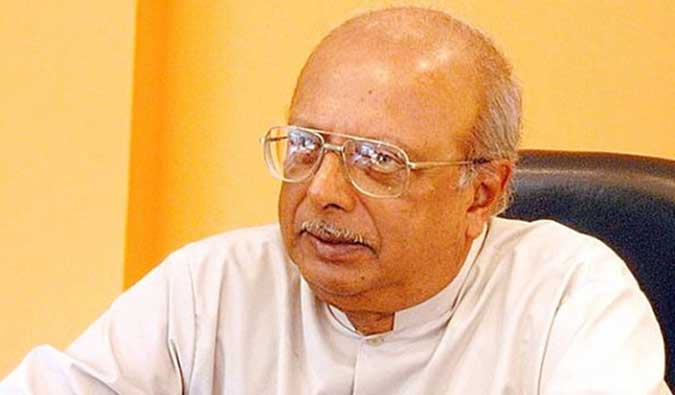
by Prof.TISSA VITARANA
Looking back at 2022, Sri Lanka cannot look forward to 2023, with any sense of hope. The economic, social and political crisis deepens without any clear plan by the Government to emerge from the crisis. Inflation is increasing with the Government, which is short of money due to its reluctance to tax the rich, resorting to massive printing of currency notes. This rise in the cost of living is fed by the support given to the private traders and big rice mill owners to fleece the cultivator and the producer who are in perpetual debt to them on the one hand and the consumer on the other. Survey data indicates that more than 65% of families live below the poverty line and that the malnutrition rate has approached 20%. Thus one out of five children below five years of age is suffering from severe under nutrition, and are both physically stunted and thin, but also mentally defective.
The future generation will be badly affected. Thus people with fixed or diminishing incomes faced with the high cost of living are suffering from hunger. In many families the parents have one meal a day and the children two, but the meals lack protein which is essential for development as well as vitamins and key minerals. Rampant bribery and corruption in the Administrative service has added to the suffering of the average person in his daily life; it is no longer a Public Service, it only serves the rich, the crooks and those with influence Instead of Government action to stop this exploitation by the middleman, like strengthening the Cooperative Movement among producers and consumers, reviving the Marketing and Food Control Departments, the Government supports the exploiter, rather than the exploited.
Ranil Wickremasinghe (RW) as Finance Minister tries to control the inflation by increasing the bank interest rate to a massive 30%. This not only deters the startup of new companies but also hits the established ones. The outcome of these policies is that the economy will continue to shrink, with more closures and job losses in the private sector together with the near complete stop to infrastructure development in the public sector. RW claimed that he would revive the economy through the private sector but his policies are undermining the private sector. The lack of jobs especially among the youth is leading to their leaving the country in huge numbers. The brain drain among professionals like doctors due to wrong tax policies is also increasing in an alarming manner. The youth that remain are driven to illicit activities like drug addiction and trafficking, and prostitution. Criminal activities like robberies, petty thefts, abductions, rape, assaults and murders are increasing so that people fear to venture out, especially after dark. Conflicts within families and between families and among criminal gangs are increasing. In society as a whole the collective cooperative spirit is being replaced by neoliberal individualism. Social cohesion is being lost. There is a complete breakdown of law and order.
The policy of taking more and more foreign loans is being persisted with. But even the International Monetary Fund (IMF) has yet to come forward with any part of its promised 3.9 billion US dollar (USD) aid package, despite several months of negotiations. Even if we get the IMF loan it will be too little too late. The terms demanded, if fully implemented, will reverse all the gains of the post-1956 era towards building a national economy as a sovereign independent state and emerge from our colonial past. The IMF demands would lead to de-nationalization and privatization of state-owned enterprises, but worst of all to the ownership passing over even to foreign hands. Sri Lanka would become a neo-colony subject to direct Imperialist exploitation once again.
The Government expects that by bowing down to the IMF terms Sri Lanka would be able to access more multilateral and bilateral loans and emerge from the dollar crisis and restore the ability to import using letters of credit from local banks. But getting deeper into foreign debt, which is the main cause of our dollar shortage and crisis, will only make matters worse. In 2021 we had to pay USD seven billion to service our 52 billion USD foreign debt, and Sri Lanka will be drawn further into the foreign debt trap. The fact that nearly 50% of the foreign loans are International Sovereign Bonds (which are short term high interest private loans) which are difficult to re-negotiate to delay payment makes matters worse. To further aggravate the situation the ban on the import of half of over 1500 non-essential items by this Government has been lifted recently. The dollar shortage will get worse and the fuel and gas queues will return and the shortage and high price of medicines and essential food items will also continue to rise.
The wrong policies of the present Government should be radically changed. There must be “a system change”. The way to increase productivity and national income is not by going back to the purely profit oriented privatization policy, but to move with the times and turn to a solidarity economy, as in Scandinavia and some provinces in Germany. In our agricultural economy the biggest export income earner is tea. But the private companies say they are running at a loss and cannot pay the employees a living wage. After 5 years of struggle the employees won a wage increase, the total allowance was raised to Rs.1000/day. But the employees are now being forced to increase their green leaf quota from 18 kilos per day to an impossible 24 kilos.
Even if they provide 20 or even 22 kilos, their pay is cut by Rs 50 per Kg, so that they are back to the status quo ante. We must learn from Kerala, India, where the solidarity economy is now in action. The ownership has been given to the employees by the Left regime, and as owners with shares in the company, in addition to their salary, they have increased the output tremendously and produce a large profit, which also benefits the society.
The present Government should also promote value added industry based on local raw material. I am happy to mention that as Minister of Science and Technology I developed the nanotechnology centre, SLNTEC, which can do this. In addition I was happy to learn that the Vidatha Centres for the development of SMEs in every Division have now topped the mark of thousand entrepreneurs that have successfully exported their products. Thus the answer is to make Sri Lanka an industrialized exporter of finished products.



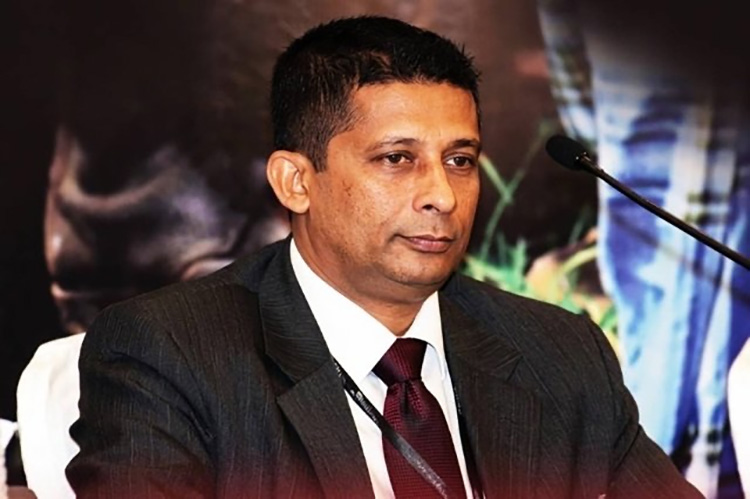
The government has chosen not to respond to questions raised by the United Nations Human Rights Council (UNHRC) regarding the detention of retired Maj. Gen. Suresh Sallay in connection with the ongoing investigations into the 2019 Easter Sunday attacks.
The Criminal Investigation Department (CID) arrested the ex-official in late February this year. The Special Rapporteur on the promotion and protection of human rights and fundamental freedoms while countering terrorism, the Working Group on Arbitrary Detention, the Special Rapporteur on the right of everyone to the enjoyment of the highest attainable standard of physical and mental health and the Special Rapporteur on the independence of judges and lawyers have jointly raised the issue on 20 July, 2026.
Drawing attention of President Anura Kumara Dissanayake to what they called alleged arbitrary detention of Sallay, former Director General of the State Intelligence Service (SIS) and former Director of Military Intelligence (DMI), under the Prevention of Terrorism Act (PTA), as well as allegations of torture and other cruel, inhuman or degrading treatment while in custody, resulting in the grave deterioration of his health, and imminent risks of retaliation through further torture and ill-treatment resulting in irreparable harm, should he be released from hospital and returned to custody, the UN sought the government explanation with a 60-day period.
The UN has stated: “This communication, and any response received from your Excellency’s Government, will be made public via the communications reporting website at the 60 days mark. Should your Excellency’s Government respond within 60 days, both the communication and the response, may be published before the 60 days mark. The communications and responses
will also be made available in the subsequent periodic report to be presented to the Human Rights Council.”
In the absence of the government’s response, the UN posted the letter, dated 20 July, 2026, addressed to President Dissanayake. The full letter can be accessed https://spcommreports.ohchr.org/TMResultsBase/DownLoadPublicCommunicationFile?gId=31125
News
Section of wartime KKS High Security Zone vacated to facilitate economic development in the area
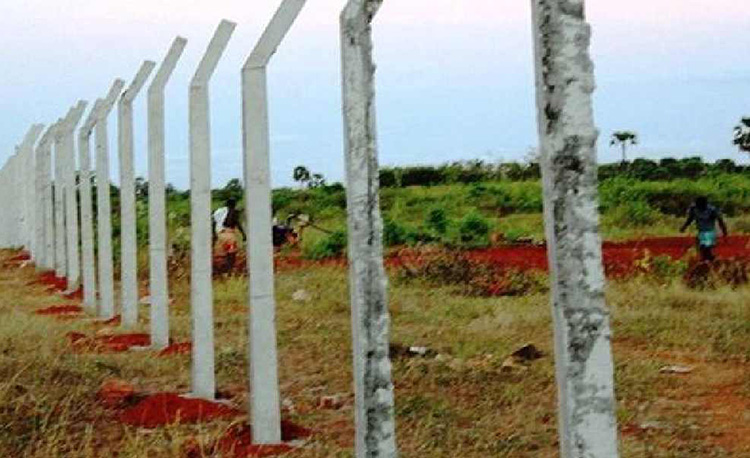
The Army, last week, vacated an area, within the wartime high security zone in the Jaffna peninsula. The Defence Ministry said that an extent of 187.56 acres of land, belonging to the Cement Corporation in Kankesanthurai, Jaffna, has been released by the military. The released land, located in Grama Niladhari Division J/233, Kankesanthurai West, within the Valikamam North (Tellippalai) Divisional Secretariat Division, had been utilised by the Sri Lanka Army since the middle of 1997.
The release of the 187.56-acre extent forms part of the initiative to make State land available for the proposed investment zone in Kankesanthurai, thereby facilitating future investment and economic development in the area.
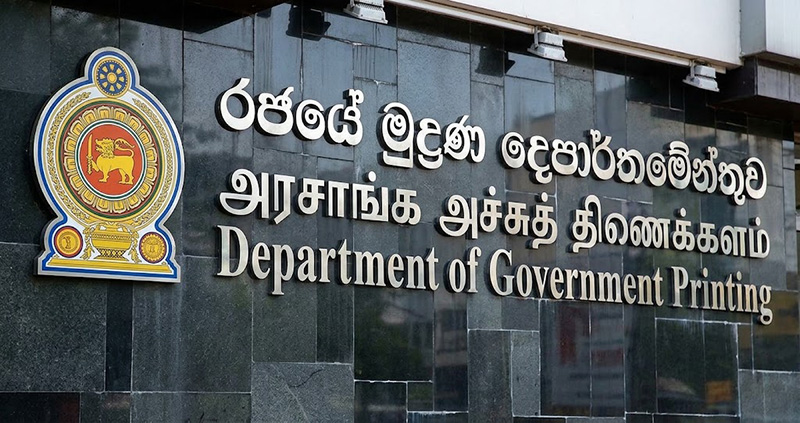
A complaint has been lodged with the Colombo Fraud Investigation Bureau against the Government Printer and the Secretary to the Ministry of Media regarding the online release of falsified documents bearing a forged Speaker’s certificate.
Attorney-at-Law Aruna Laksiri has lodged a complaint with the Colombo Fraud Investigation Bureau requesting legal action against the Government Printer of the Department of Government Printing (No. 118, Dr. Danister de Silva Mawatha, Colombo 08), Prasanna Jayaratne, and the Secretary to the Ministry of Mass Media (Asidisi Medura, 163, Kirulapone Mawatha, Polhengoda, Colombo 05), Dr. Anil Jasinghe.
The complaint alleges the commission of offences by forging and uploading falsified documents online using a forged Speaker’s certification, failure to perform statutory duties, and misappropriation of public property.
The complaint states that a copy of the English translation of the 22nd Amendment to the Constitution was downloaded and printed from the official website of the Government Printing Department (www.documents.gov.lk), which operates under the Ministry of Mass Media. On its outer cover and on page 1, the text “certified on 25th of September, 2026” is inscribed inside brackets.
The complaint pointed out that the Speaker has certified an English translation. Under Articles 23, 79, 83, and 80 of the Constitution, Parliament enacts laws and the Speaker certifies bills strictly in the Sinhala and Tamil languages; under the Constitution, therefore the Speaker cannot apply such certification to an English translation.

GS1 Lanka drives Sri Lanka’s shift to 2D barcodes

Geneva takes up Sallay’s case and govt. ignores opportunity to answer accusations

Section of wartime KKS High Security Zone vacated to facilitate economic development in the area

Lawyer lodges complaint against Govt. Printer, Media Ministry Secy.

Sri Lankan troops in joint anti-terrorist exercise in Russia

Nine Indian poachers brought to KKS with their boat

‘Dates have the highest sugar content to fight Coronavirus’

Sunday Island 27 December – Headlines

#SundayIsland 17th December – Headlines

Sunday Island – 28th March

Sunday Island Headlines – 21 March

Sunday Island – 21st February – Headlines
-

 Latest News5 days ago
Gold winner Tharanga gets brand-new Honda Vezel from SLAAJ
-

 Features5 days ago
Why Sri Lanka needs an Inclusive Civic Nationalism – urgently
-

 News4 days ago
US-assisted ‘Ice’ detection: NPC to examine IGP’s move to transfer drug-busting team
-

 Features6 days ago
Thailand’s biggest new global star …
-
 News6 days ago
First cases taken up by SC after enactment of 22A dismissed
-

 News5 days ago
Civil society activist accuses govt. of favouring Ven. Gnanasara
-

 Editorial6 days ago
Aftershocks of 22A
-

 Editorial3 days ago
Colombo Port drug bust: The plot thickens