
Sports
Ethir: Legendary high jumper and humanitarian


On Thursday, 18 April 2024 at 11:55 am Dr. Nagalingam Ethirveerasingam (PhD) passed away peacefully at his home in Los Angeles, California, USA. He was surrounded by his family. He was 89 years old.
Nagalingam Ethirveerasingam (Ethir) was born in 1934 in a one-room hut with a palmyrah palm leaf roof and a mud floor in Periyavillan, a small village on the Jaffna Peninsula. He taught himself to high jump in his backyard by analysing pictures in an athletics book he had won as a prize after one of his first meets at Jaffna Central College.
He made a silent promise to himself that he would make it to the Olympics after watching a newsreel of the 1948 Olympic Games at a theatre in Jaffna Town. Four years later, at the age of 17, he competed at the 1952 Olympic Games in Helsinki, Finland. His athletics journey continued as he went on to compete at the 1956 Melbourne Olympic Games and won the first Gold Medal in any sport for Ceylon at the 1958 Asian Games in Toyoko, followed by a Silver Medal at the 1962 Asian Games In Jakarta, Indonesia.
Ethir broke high jump records at every age while at Jaffna Central College, performing strengthening exercises with homemade weights using old bus axles and other bus parts. After winning the National Meet in Colombo in 1951, he finally acquired a specialist athletics coach, P.E. Rajendra, and a workout regime. He was then selected to be on the team for the 1952 Olympic Games in Helsinki, traveling by ship for over one month to reach Finland. He next participated in the 1954 Asian Games, where he placed fourth despite jumping the same height as the medal winners, setting a new Asian Record that he shared with them.
In 1955 and 1956, Ethir was voted the Ceylon Daily News “Sports Star of the Year.” He transferred to St. Joseph’s College, Colombo, for his ‘A’ Levels and to be nearer his coach. In 1956, he was awarded a full athletic scholarship to the University of California, Los Angeles (UCLA). He later earned a Master’s Degree from California Polytechnic University, San Luis Obispo, and a PhD from Cornell University in 1971.
In 1958, despite co-holding the Asian High Jump record, as well as the Ceylon record, he was initially not selected to be on the team for the Asian Games in Tokyo, Japan. However, due to a series of newspaper articles written by Daily News Sports Editor Carlton Seneviratne, the selection committee relented, allowing Ethir to participate.
But being selected so late, the committee told him he had to find and pay his own way to Tokyo from Los Angeles. A benefactor, Donavan Andre, donated US$ 5,000 for his travel just a few days before the games. He arrived shortly before the Games began, wearing his UCLA track suit with the Ceylon insignia patch pinned on, as he wasn’t provided with a uniform by the association. His fellow teammates then elected him captain of the team.
Ethir not only won the Gold Medal but also set a new Asian and Ceylon record of 6 feet 8 inches (2.03 meters). His Ceylon record lasted until 1989. Meanwhile, back in Ceylon, the 1958 Anti-Tamil riots were occurring at the same time that he was competing. He was unaware of the events unfolding in his country until he spoke to his brother upon returning to the USA.
History repeated itself in 1960 and 1962. In 1960, despite being the Asian and Ceylon High Jump record holder, and jumping the qualifying height for the Olympics, he was not selected for the Mexico City Olympic Games. Again, in 1962, a campaign was required for his selection, and he won a Silver Medal at the Asian Games in Jakarta.
Ethir was a witness to several pivotal events in the troubled pre-war history of Ceylon/Sri Lanka. In 1956, he was almost killed when he and two friends went to observe the Federal Party’s Satyagraha at the Galle Face esplanade against the “Sinhala Only Bill” that was to be introduced in Parliament. In the attacks against the peaceful protesters that ensued and anti-Tamil riots that spread across the country, Ethir and his two friends were almost killed by rioters. Fortunately, one of the rioters recognised him from the pictures in the newspapers when he won the Ceylon “Sports Star of the Year” award. This man then took them into a pharmacy and told the pharmacist to let them stay until it was safe.
Another historic event that he witnessed was the 20 February 1961 Satyagraha at the Jaffna Kachcheri by members of the Tamil political parties. This peaceful protest was also met with violence by the state.
After graduating from UCLA with a bachelor’s degree, he returned to Ceylon but struggled to find employment in his field – Agriculture Education. He returned to the United States to earn his Master’s Degree and then attempted to find employment in Ceylon again. However, like many thousands of Tamils, he was unable to do so and instead accepted an offer to teach in Sierra Leone at the University of Njala. Over his academic career, he worked at Universities in Sierra Leone, Nigeria, and Papua New Guinea. He also worked for UNESCO.
It was in 1965 in Sierra Leone that he met and married the love of his life, Juliet Ann Power. She had joined the US Peace Corps after graduating from university and was also posted to Sierra Leone. They had three children and eight grandchildren and would have celebrated their 58th wedding anniversary in May of this year.
In 1994, after retiring at the age of sixty, Ethir wanted to ‘give back’ to his country and people for all the support he had received during his athletics career. He applied for a position at the University of Jaffna, Kilinochchi Campus (Agriculture) at the height of the war. His application was accepted and despite the dangers due to the ongoing war and severe embargoes on fuel, electricity, medicine, and other essential items to most of Northern Sri Lanka, he returned to his homeland to work in the LTTE-controlled Vanni on a one-year contract.
Rather than working for only one year and returning to the US, he stayed on in the Vanni as an unpaid volunteer after his contract ended, working tirelessly on humanitarian, education, and sports projects to aid civilians impacted by the conflict. He was in Kilinochchi in October 1995 when 500,000 civilians were displaced from the Jaffna Peninsula to the Vanni and other areas. He was part of the team in Kilinochchi that received the Internally Displaced Persons and coordinated their emergency food and shelter.
He felt that all his training and academic career had prepared him for this mission and remained an unpaid volunteer for the rest of his life; living and working in the North & East of Sri Lanka for 6 to 10 months of every year from 1994 until the COVID pandemic in 2020. He relied on benefactors in the Tamil Diaspora and the support of his wife, Juliet, to cover his expenses. His work focused on education, sports, and helping the most marginalised communities. All his life he was a forceful opponent of the caste system.
His last trip to Sri Lanka, whose citizenship he never relinquished despite being eligible for US citizenship, was February to April of 2023 when, at the age of 88 and despite contracting COVID while in Jaffna, he gave workshops in Jaffna and Kilinochchi for athletics coaches and athletes on coaching methods and talent recognition.
During the years from 1994 until the end of the war, Ethir worked tirelessly for peace and a negotiated end to the war. He traveled the world, meeting with governments, political leaders, human rights groups, and the Tamil Diaspora to advocate for civilians affected by the war, and later, the 2004 Tsunami. Some of the most important work was what he accomplished after the end of the war in 2009. His sporting achievements and fame ensured that he had access to and was well respected by all sides in the conflict. As a result, he was able to meet with and act as a conduit for unofficial messages between the warring parties aimed at creating the conditions for peace talks. The Harvard Initiative in 1997 was one of these efforts, which like countless others unfortunately failed.
He directly impacted thousands of people through humanitarian and development projects in education and sports for war and tsunami-affected persons, inspiring others to live selflessly and work for the betterment of society. These projects and initiatives spanned various sectors and included the differently-abled for whom he was a lifelong advocate. Notably, after the war ended he co-conceived the SERVE Institute, which made educational videos that were distributed to schools throughout the North and East. Due to the lack of qualified teachers in some of the remote areas of the North and East most severely affected by the war, especially the areas inhabited by marginalised persons due to their caste. The Institute made videos in Tamil of expert teachers.
teaching lessons in Mathematics, Chemistry, Physics, and other subjects and distributed these to schools throughout the North and East. They were a valuable resource for students when the COVID pandemic made attending school impossible.
Ethir was also the force behind the groundbreaking study of the Northern education system in 2014 that consulted thousand of parents, educators, community leaders, and administrative staff. The resulting Northern Education System Review (NERS) made wide-ranging, revolutionary recommendations to improve the education system. Many of these recommendations were incorporated by the Northern Province Ministry of Education. The National Ministry of Education in Colombo was also impressed and incorporated some of the recommendations and conducted similar studies in other parts of the country. (Link to the report: https://www.edudept.np.gov.lk/reviewreporteng.html)
Ethir believed in helping people no matter their ethnicity, religion, or linguistic background. In his travels and coaching throughout Sri Lanka, he identified athletes who he thought could compete at an international level. The first of these was Manjula Kumara Wijesekara, who would go on to be the Sri Lankan record holder in High Jump. Manjula could only speak a little English and Ethir almost no Sinhalese when Ethir invited him to the US to live with his family in Los Angeles. Manjula lived with Ethir’s family for a year during which Ethir coached him and he took intensive English classes. He eventually earned a full scholarship to the University of Southern California (USC).
Ethir did the same with current Sri Lankan high jump record holder Ushan Thiwanka Perera, and high jumpers Nalin Priyadarshana, and Purnima Gunarathna who all stayed at his home in LA while he coached them and assisted them in their quest to receive scholarships to US universities.
Sri Lankan Olympic Silver medalist Susanthika Jayasinghe also stayed at his home and was coached by him for three months in 2007 when she made her ‘comeback’ to athletics. She won the Bronze medal at the World Championships in Osaka, Japan that year. Both Susanthika and Manjula helped in post-war coaching clinics that Ethir conducted in Northern Sri Lanka.
In 1998, Sri Lankan President Chandrika Kumaratunga Bandaranaike offered him the honorific ‘Deshabandu,’ which he respectfully declined, stating in his letter to her, “I cannot in good conscience accept such a title when my people are suffering and the war is continuing.”
He was the last of his six siblings: brothers Sellathurai Nithiyanantham, Nagalingam Ratnasingam, Nagalingam Rajasingam, Nagalingam Segarajasingam, Nagalingam Pararajasingam, and sister Parameswary Nadarajah.
Nagalingam Ethirveerasingam is survived by his wife of 57 years, Juliet Ethirveerasingam (Power); his children Sakunthala, Nahulan, and Arjunan; his eight grandchildren Ryan Corsaut, Samantha Quezada, Cassandra Quezada, Benjamin Quezada, Devin Ethirveerasingam, Lila Ethirveerasingam, Hayden Ethirveerasingam, and Nara Ethirveerasingam; his son-in-law Paul
Quezada, and daughters-in-law Jennifer Ethirveerasingam and Nimmi Harasgama.



Pakistan flexed their muscle in the first T20I in Dambulla, beating Sri Lanka by six wickets with 20 balls to spare. The win was set up by their bowling unit. On a two-paced pitch, Salman Mirza and Abrar Ahmed picked up three wickets each and a returning Shadab Khan two.
Sri Lanka’s innings never got going. Sent in, they found themselves on 38 for 4 in the seventh over. They recovered to reach 127 for 6 in the 18th but lost the last four wickets for the addition of just one more run.
In reply, Sahibzada Farhan and Saim Ayub gave Pakistan a start of 59 in 5.5 overs. Ayub fell for 24 but Farhan carried on, bringing up his fifty off 35 balls. Pakistan did lose three quick wickets when they were around 100 but by then, the result was all but decided. Shadab scored a quick 18 not out off 12 balls and picked up the Player-of-the-Match award.
Given the rain concerns, the pitch had been under covers for the last couple of days. When Salman Agha opted to bowl after winning the toss, he expected his bowlers to make use of the moisture in the surface. He was’t let down. Mirza and Mohammad Wasim largely bowled good lines and lengths, and with some balls skidding through and some holding into the pitch, the run scoring wasn’t easy. When the Sri Lanka openers, Kamil Mishara and Pathum Nissanka, tried to attack, they lost their wickets. As a result, Sri Lakna could manage only 35 for 2 in the powerplay.
Playing his first match for Pakistan since June 2025, Shadab Khan didn’t take long to make an impact. With his third ball, he trapped Kusal Mendis lbw. Two balls later, he had Dhananjaya de Silva caught behind with a googly. De Silva, who was playing his first T20I since the 2024 T20 World Cup, made a run-a-ball 10.
At times, Shadab turned his legbreak square. In his third over, he should have had Janith Liyanage caught at long-on. However, Farhan not only dropped the catch but also parried the ball for a six. Still, Shadab finished with 2 for 25 from his four.
Abrar Ahmed, introduced in the 12th over, also struck in his first over. He had Charith Asalanka caught behind to make it 72 for 5. He also had Liyanage dropped off his bowling; this time Mirza grassed a chance at short fine leg. Liayanage rode his luck and added 38 off 23 balls with Wanindu Hasaranga for the sixth wicket. The pair was severe on Mohammad Nawaz, taking 16 off him in the 15th over.
At 106 for 5 with five overs to go and Dasun Shanaka yet to bat, Sri Lanka must have had their sights on 150. But Abrar got rid of Hasaranga and Liyanage in his successive overs. From there on, the end was swift. Mirza and Wasim shared the last three wickets to wrap up the innings.
Sri Lanka had hit their first six in the tenth over of the innings, Pakistan off the tenth ball. Maheesh Theekshana bowled one full outside off and Ayub launched him over extra cover. In the next over, Farhan took Pakistan’s six tally to three with back-to-back hits off Nuwan Thushara. Sri Lanka, in their whole innings, had managed only two.
The pitch had eased out by then but at the same time, the Sri Lanka bowlers showed none of the discipline of their counterparts. Theekshana did bowl Ayub in the sixth over but Sri Lanka needed much more than that.
Shanaka brought Hasaranga on immediately after the powerplay. It was like a last throw of the dice. But with no scoreboard pressure, Farhan and Agha could afford to play him out. Eventually, he dismissed Agha – ironically off a full toss that the batter tried to hit for a six – and finished with 1 for 17 from his quota.
In the meantime, Farhan kept smashing the seamers and took the side past 100 in the 12th over. There was a little hiccup around that time as Pakistan lost three wickets for 12 runs in the space of 19 balls but it did not change anything.
Brief scores:
Pakistan 129 for 4 in 16.4 overs (Sahibzada Farhan 51, Saim Ayub 24, Salman Agha 16, Shadab Khan 18*; Maheesh Theekshana 1-31, Dushmantha Chameera 1-34, Wanindu Hasaranga 1-17, Dhananjaya de Silva 1-04) beat Sri Lanka 128 in 19.2 overs (Pathum Nissanka 12, Kusal Mendis 14, Dhananjaya de Silva 10, Charith Asalanka 18, Janith Liyanage 40, Wanidu Hasaranga 18, Dasun Shanaka 12; Salman Mirza 3-18, Mohammad Wasim 2-07, Shadab Khan 2-25, Abrar Ahmed 3-25) by six wickets
(Cricinfo)

Pakistan captain Salman Agha won the toss and opted to field in the first T20I against Sri Lanka in Dambulla.
Given the rain concerns, the pitch had been under covers for the last couple of days, and Agha hoped to use the moisture in the surface. Shanaka, though, expected it to be a typical Dambulla pitch, full of runs.
Both sides were packed with allrounders. Shadab Khan who last played for Pakistan in June 2025, returned for Pakistan. Apart from him, Pakistan had Faheem Ashraf and Saim Ayub, both more than capable with both bat and ball.
For Sri Lanka, Dhanajaya de Silva made a comeback. His last T20I was back in June 2024. Apart from contributing with the bat, he will support the spin duo Wanindu Hasaranga and Maheesh Theekshana.
Given both teams play their group matches and Super Eight games (assuming they reach there) in Sri Lanka, this three-match series, about a month out of the World Cup, is a great opportunity to get acclimatised to the conditions.
Sri Lanka: Pathum Nissanka, Kamil Mishara, Kusal Mendis (wk), Dhananjaya de Silva, Charith Asalanka, Dasun Shanaka (capt), Janith Liyanage, Wanindu Hasaranga, Dushmantha Chameera, Maheesh Theekshana, Nuwan Thushara
Pakistan: Saim Ayub, Sahibzada Farhan, Fakhar Zaman, Salman Agha (capt), Usman Khan (wk), Shadab Khan, Mohammad Nawaz, Faheem Ashraf, Mohammad Wasim, Salman Mirza, Abrar Ahmed
[Cricinfo]
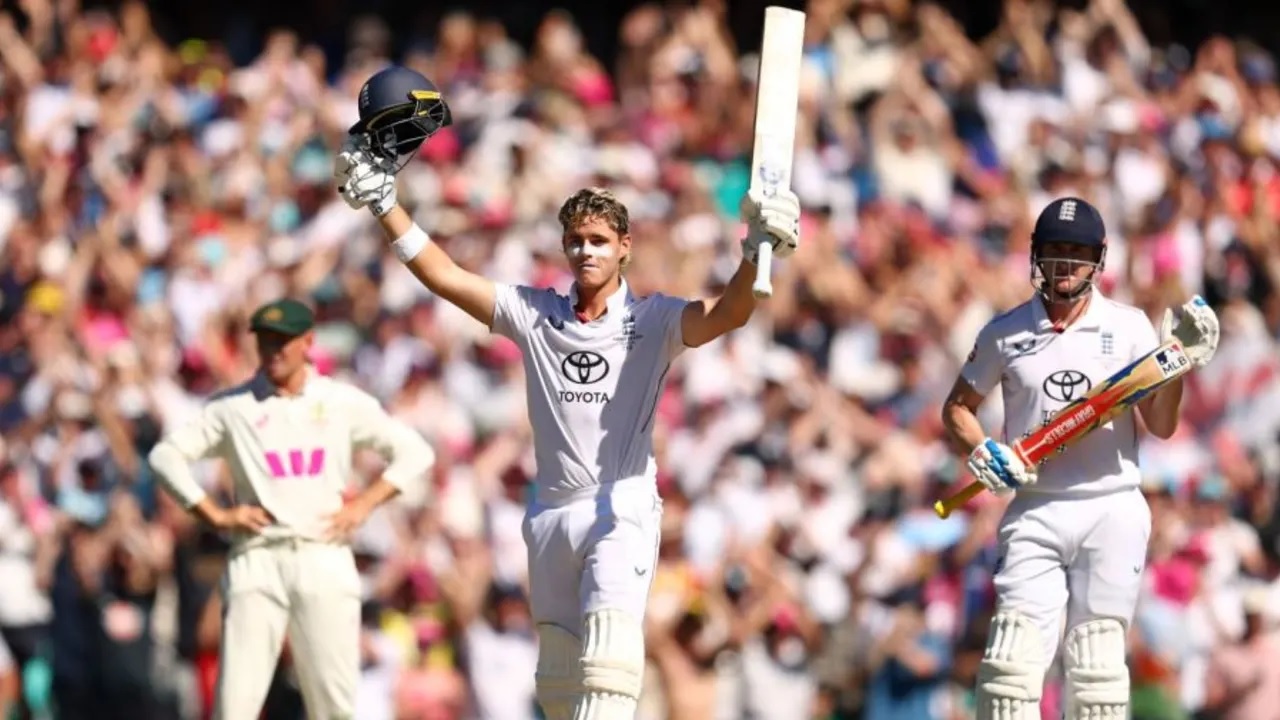
Jacob Bethell hit a memorable maiden Test century to ensure the Ashes finale of this rather bizarre series reached a fifth day. But England’s push to set Australia a challenging fourth-innings target was stymied by familiar, baffling dismissals and an SCG surface conjuring unexpected sharp turn.
A composed Bethell, 22, defied Australia with an unbeaten 142 off 229 balls, also his maiden century in first-class cricket, in an innings that struck a perfect balance between attack and defence. But he lacked support and a nerve-jangling fourth-innings chase for Australia appears unlikely despite the surface starting to prove challenging.
England had started believing a second consecutive victory was in the works when they reached 219 for 3 in their second innings, with a lead of 36 runs, before Beau Webster turned the game on its head when he trapped Harry Brook lbw for 42. He finished with 3 for 51 from 13 overs in a big effort late in the day.
With sharp turn evident, Webster reverted from seam to offspin and it did the trick, although he was aided by dreadful batting from Will Jacks, while skipper Ben Stokes, batting at No. 8, was compromised by an adductor injury.
After all the debate over the future of spin bowling in Australia, compounded by the non-selection of Todd Murphy, the familiar sight of rampant turn at the SCG would have caused a lump in the throats of traditionalists.
A calamitous mix-up saw Jamie Smith run-out for 26 to add to his list of wretched dismissals as Australia appear on the brink of a convincing 4-1 series victory.
Among the possibilities for the final day of the series, with a thrilling conclusion highly unlikely, Usman Khawaja might still get the chance at a fairy tale finish to his Test career.
There was a sense that the match could finish on day four, with England facing a mountain after toiling through 133.5 overs in the field as Australia compiled 567 – the highest total of the series – with a first-innings lead of 183 runs. Their task was made even more difficult after Stokes trudged off the field early in the day’s play and there was an unknown whether he would bat.
England’s bid for a strong start to their second innings was dashed when Mitchell Starc picked up a first-over wicket for the fourth time this series when he trapped Zak Crawley lbw on 1.
Crawley, who had not played a shot, unsuccessfully reviewed and he ended a typically erratic and ultimately unfulfilling series with 273 runs from ten innings. There was the feeling that England might implode, but Bethell brought composure to the crease while Ben Duckett shaped up well as he looked to end a wretched tour on a good note.
Duckett moved to his highest score of the series and put the pressure on maligned allrounder Cameron Green, who did respond by delivering a brute of a 141kph short delivery that cannoned into Bethell’s helmet and flew over the slips.
Just before lunch, Duckett on 38 gloved a sharp Michael Neser delivery that was dropped by Green, whose torrid time continued when he dived to his right from second slip only to spill the ball in front of Steven Smith, who had moved into good position.
Duckett’s bid for an elusive maiden series half-century was dashed when Neser had the last laugh when he chopped onto his stumps. Having worked so hard in the morning session, Duckett threw his head back in anguish with England’s hopes seemingly resting on Joe Root, coming off his brilliant 160 in the first innings.
But Root was pinned down by Scott Boland, who was in the zone after lunch. Root was unable to find fluency or manipulate the field and his tortuous 6 off 37 balls ended when he was rapped on the pads by a Boland delivery that seamed back sharply.
Root was reluctant to review, but trudged off the field disappointed when ball tracking had it hitting the top of the bail. He received a warm reception in what is likely to be his last Test match on the ground, finishing the series with exactly 400 runs with his two centuries providing the heavy lifting.
Still trailing by 66 runs, England’s chances appeared over but Bethell and Brook scored briskly and took advantage of an Australia attack feeling the pinch in the sunshine.
Bethell was imperious as he unfurled several exquisite cover drives while he also swatted away short balls in brutal fashion. Bethell rolled past his highest first-class score of 96, made against New Zealand in 2024, before facing an excruciating wait for his century. His moment arrived when he skipped down the pitch and launched Webster over wide long-on and he celebrated in steely fashion while his teary-eyed father gave a fist pump in the terraces.
Not for the first time in the series, England merely teased as Brook, who had played relatively calmly, lost focus and luckily edged Starc through the slips to bring up the century partnership. But he was soon pinned on the back foot by Webster as Australia reviewed in the nick of time at the urging of wicketkeeper Alex Carey and it proved a masterstroke.
Jacks, batting at No. 6 following Stokes’ injury, holed out for a second-ball duck in an awful dismissal as England’s hopes sank. Stokes’ limited movement contributed to his dismissal when he edged Webster to a giddy Smith at slip.
Smith took his 14th catch of the series when Boland removed Brydon Carse as England’s resistance appears to have finally been broken despite Bethell batting through to stumps.
Earlier, Australia resumed their first innings on 518 for 7 as they aimed to grind England’s flagging attack further into the ground. But England, to their credit, have risen several times in the series just when a capitulation appeared inevitable.
And they did so again to win the opening session, a feat that appeared extremely unlikely when Smith and Webster scored at ease with England’s woes compounded when Stokes limped off the field midway through his second over of the day.
Stokes had impressively pushed through the entire series, but his battered body finally gave way in his 28th over of the innings.
Unlucky to be dropped ahead of the series, Webster made the most of his recall and reached his fifth half-century from just eight Tests having been pushed down by the nighwatcher Neser to No. 9.
Webster’s hopes of a maiden Test century evaporated when Smith, who added just nine runs to his overnight total, fell for the sixth time to Josh Tongue across formats when he nicked off a delivery that shaped away.
Australia’s innings was soon wrapped up, leaving Webster stranded on 71, one run short of his highest Test score.
Webster’s performance – which was made even better by stumps – was a notable contrast to fellow Ashes debutant Matthew Potts, who finished with none for 141 from 25 overs. But he was spared the most expensive none-for by an English seamer after not being used in the morning’s play.
Brief scores:
England 384 in 97.3 overs and 302 for 8 in 75 overs (Jacob Bethell 142*, Ben Duckett 42, Harry Brook 42; Scott Boland 2-34, Beau Webster 3-51) lead Australia 567 in 133.5 overs (Travis Head 163, Marnus Labuschagne 48, Steven Smith 138, Beau Webster 71*; Josh Tongue 3-97, Brydon Carse 3-130, Ben Stokes 2-95) by 119 runs
[Cricinfo]

Shadab, Mirza, Abrar set up Pakistan’s easy win in first T20I

Shadab, Dhananjaya back as Pakistan chase in first T20I

Russia sends navy to guard oil tanker being pursued by US forces

Landslide Early Warnings issued to the Districts of Badulla, Kandy, Matale, Monaragala and Nuwara Eliya

Indian gang rape survivor back home after a week in hospital

Brilliant Bethell hundred pushes SCG Test to fifth day but Australia on target for 4-1

‘Dates have the highest sugar content to fight Coronavirus’

Sunday Island 27 December – Headlines

#SundayIsland 17th December – Headlines

Sunday Island – 28th March

Sunday Island Headlines – 21 March

Sunday Island – 21st February – Headlines
-
 News2 days ago
Broad support emerges for Faiszer’s sweeping proposals on long- delayed divorce and personal law reforms
-

 News2 days ago
Interception of SL fishing craft by Seychelles: Trawler owners demand international investigation
-

 News3 days ago
Private airline crew member nabbed with contraband gold
-

 News23 hours ago
Prez seeks Harsha’s help to address CC’s concerns over appointment of AG
-

 News23 hours ago
Govt. exploring possibility of converting EPF benefits into private sector pensions
-

 News5 days ago
Health Minister sends letter of demand for one billion rupees in damages
-

 Opinion7 days ago
Remembering Douglas Devananda on New Year’s Day 2026
-

 Features2 days ago
Educational reforms under the NPP government