
Sports
Ethir: Legendary high jumper and humanitarian


On Thursday, 18 April 2024 at 11:55 am Dr. Nagalingam Ethirveerasingam (PhD) passed away peacefully at his home in Los Angeles, California, USA. He was surrounded by his family. He was 89 years old.
Nagalingam Ethirveerasingam (Ethir) was born in 1934 in a one-room hut with a palmyrah palm leaf roof and a mud floor in Periyavillan, a small village on the Jaffna Peninsula. He taught himself to high jump in his backyard by analysing pictures in an athletics book he had won as a prize after one of his first meets at Jaffna Central College.
He made a silent promise to himself that he would make it to the Olympics after watching a newsreel of the 1948 Olympic Games at a theatre in Jaffna Town. Four years later, at the age of 17, he competed at the 1952 Olympic Games in Helsinki, Finland. His athletics journey continued as he went on to compete at the 1956 Melbourne Olympic Games and won the first Gold Medal in any sport for Ceylon at the 1958 Asian Games in Toyoko, followed by a Silver Medal at the 1962 Asian Games In Jakarta, Indonesia.
Ethir broke high jump records at every age while at Jaffna Central College, performing strengthening exercises with homemade weights using old bus axles and other bus parts. After winning the National Meet in Colombo in 1951, he finally acquired a specialist athletics coach, P.E. Rajendra, and a workout regime. He was then selected to be on the team for the 1952 Olympic Games in Helsinki, traveling by ship for over one month to reach Finland. He next participated in the 1954 Asian Games, where he placed fourth despite jumping the same height as the medal winners, setting a new Asian Record that he shared with them.
In 1955 and 1956, Ethir was voted the Ceylon Daily News “Sports Star of the Year.” He transferred to St. Joseph’s College, Colombo, for his ‘A’ Levels and to be nearer his coach. In 1956, he was awarded a full athletic scholarship to the University of California, Los Angeles (UCLA). He later earned a Master’s Degree from California Polytechnic University, San Luis Obispo, and a PhD from Cornell University in 1971.
In 1958, despite co-holding the Asian High Jump record, as well as the Ceylon record, he was initially not selected to be on the team for the Asian Games in Tokyo, Japan. However, due to a series of newspaper articles written by Daily News Sports Editor Carlton Seneviratne, the selection committee relented, allowing Ethir to participate.
But being selected so late, the committee told him he had to find and pay his own way to Tokyo from Los Angeles. A benefactor, Donavan Andre, donated US$ 5,000 for his travel just a few days before the games. He arrived shortly before the Games began, wearing his UCLA track suit with the Ceylon insignia patch pinned on, as he wasn’t provided with a uniform by the association. His fellow teammates then elected him captain of the team.
Ethir not only won the Gold Medal but also set a new Asian and Ceylon record of 6 feet 8 inches (2.03 meters). His Ceylon record lasted until 1989. Meanwhile, back in Ceylon, the 1958 Anti-Tamil riots were occurring at the same time that he was competing. He was unaware of the events unfolding in his country until he spoke to his brother upon returning to the USA.
History repeated itself in 1960 and 1962. In 1960, despite being the Asian and Ceylon High Jump record holder, and jumping the qualifying height for the Olympics, he was not selected for the Mexico City Olympic Games. Again, in 1962, a campaign was required for his selection, and he won a Silver Medal at the Asian Games in Jakarta.
Ethir was a witness to several pivotal events in the troubled pre-war history of Ceylon/Sri Lanka. In 1956, he was almost killed when he and two friends went to observe the Federal Party’s Satyagraha at the Galle Face esplanade against the “Sinhala Only Bill” that was to be introduced in Parliament. In the attacks against the peaceful protesters that ensued and anti-Tamil riots that spread across the country, Ethir and his two friends were almost killed by rioters. Fortunately, one of the rioters recognised him from the pictures in the newspapers when he won the Ceylon “Sports Star of the Year” award. This man then took them into a pharmacy and told the pharmacist to let them stay until it was safe.
Another historic event that he witnessed was the 20 February 1961 Satyagraha at the Jaffna Kachcheri by members of the Tamil political parties. This peaceful protest was also met with violence by the state.
After graduating from UCLA with a bachelor’s degree, he returned to Ceylon but struggled to find employment in his field – Agriculture Education. He returned to the United States to earn his Master’s Degree and then attempted to find employment in Ceylon again. However, like many thousands of Tamils, he was unable to do so and instead accepted an offer to teach in Sierra Leone at the University of Njala. Over his academic career, he worked at Universities in Sierra Leone, Nigeria, and Papua New Guinea. He also worked for UNESCO.
It was in 1965 in Sierra Leone that he met and married the love of his life, Juliet Ann Power. She had joined the US Peace Corps after graduating from university and was also posted to Sierra Leone. They had three children and eight grandchildren and would have celebrated their 58th wedding anniversary in May of this year.
In 1994, after retiring at the age of sixty, Ethir wanted to ‘give back’ to his country and people for all the support he had received during his athletics career. He applied for a position at the University of Jaffna, Kilinochchi Campus (Agriculture) at the height of the war. His application was accepted and despite the dangers due to the ongoing war and severe embargoes on fuel, electricity, medicine, and other essential items to most of Northern Sri Lanka, he returned to his homeland to work in the LTTE-controlled Vanni on a one-year contract.
Rather than working for only one year and returning to the US, he stayed on in the Vanni as an unpaid volunteer after his contract ended, working tirelessly on humanitarian, education, and sports projects to aid civilians impacted by the conflict. He was in Kilinochchi in October 1995 when 500,000 civilians were displaced from the Jaffna Peninsula to the Vanni and other areas. He was part of the team in Kilinochchi that received the Internally Displaced Persons and coordinated their emergency food and shelter.
He felt that all his training and academic career had prepared him for this mission and remained an unpaid volunteer for the rest of his life; living and working in the North & East of Sri Lanka for 6 to 10 months of every year from 1994 until the COVID pandemic in 2020. He relied on benefactors in the Tamil Diaspora and the support of his wife, Juliet, to cover his expenses. His work focused on education, sports, and helping the most marginalised communities. All his life he was a forceful opponent of the caste system.
His last trip to Sri Lanka, whose citizenship he never relinquished despite being eligible for US citizenship, was February to April of 2023 when, at the age of 88 and despite contracting COVID while in Jaffna, he gave workshops in Jaffna and Kilinochchi for athletics coaches and athletes on coaching methods and talent recognition.
During the years from 1994 until the end of the war, Ethir worked tirelessly for peace and a negotiated end to the war. He traveled the world, meeting with governments, political leaders, human rights groups, and the Tamil Diaspora to advocate for civilians affected by the war, and later, the 2004 Tsunami. Some of the most important work was what he accomplished after the end of the war in 2009. His sporting achievements and fame ensured that he had access to and was well respected by all sides in the conflict. As a result, he was able to meet with and act as a conduit for unofficial messages between the warring parties aimed at creating the conditions for peace talks. The Harvard Initiative in 1997 was one of these efforts, which like countless others unfortunately failed.
He directly impacted thousands of people through humanitarian and development projects in education and sports for war and tsunami-affected persons, inspiring others to live selflessly and work for the betterment of society. These projects and initiatives spanned various sectors and included the differently-abled for whom he was a lifelong advocate. Notably, after the war ended he co-conceived the SERVE Institute, which made educational videos that were distributed to schools throughout the North and East. Due to the lack of qualified teachers in some of the remote areas of the North and East most severely affected by the war, especially the areas inhabited by marginalised persons due to their caste. The Institute made videos in Tamil of expert teachers.
teaching lessons in Mathematics, Chemistry, Physics, and other subjects and distributed these to schools throughout the North and East. They were a valuable resource for students when the COVID pandemic made attending school impossible.
Ethir was also the force behind the groundbreaking study of the Northern education system in 2014 that consulted thousand of parents, educators, community leaders, and administrative staff. The resulting Northern Education System Review (NERS) made wide-ranging, revolutionary recommendations to improve the education system. Many of these recommendations were incorporated by the Northern Province Ministry of Education. The National Ministry of Education in Colombo was also impressed and incorporated some of the recommendations and conducted similar studies in other parts of the country. (Link to the report: https://www.edudept.np.gov.lk/reviewreporteng.html)
Ethir believed in helping people no matter their ethnicity, religion, or linguistic background. In his travels and coaching throughout Sri Lanka, he identified athletes who he thought could compete at an international level. The first of these was Manjula Kumara Wijesekara, who would go on to be the Sri Lankan record holder in High Jump. Manjula could only speak a little English and Ethir almost no Sinhalese when Ethir invited him to the US to live with his family in Los Angeles. Manjula lived with Ethir’s family for a year during which Ethir coached him and he took intensive English classes. He eventually earned a full scholarship to the University of Southern California (USC).
Ethir did the same with current Sri Lankan high jump record holder Ushan Thiwanka Perera, and high jumpers Nalin Priyadarshana, and Purnima Gunarathna who all stayed at his home in LA while he coached them and assisted them in their quest to receive scholarships to US universities.
Sri Lankan Olympic Silver medalist Susanthika Jayasinghe also stayed at his home and was coached by him for three months in 2007 when she made her ‘comeback’ to athletics. She won the Bronze medal at the World Championships in Osaka, Japan that year. Both Susanthika and Manjula helped in post-war coaching clinics that Ethir conducted in Northern Sri Lanka.
In 1998, Sri Lankan President Chandrika Kumaratunga Bandaranaike offered him the honorific ‘Deshabandu,’ which he respectfully declined, stating in his letter to her, “I cannot in good conscience accept such a title when my people are suffering and the war is continuing.”
He was the last of his six siblings: brothers Sellathurai Nithiyanantham, Nagalingam Ratnasingam, Nagalingam Rajasingam, Nagalingam Segarajasingam, Nagalingam Pararajasingam, and sister Parameswary Nadarajah.
Nagalingam Ethirveerasingam is survived by his wife of 57 years, Juliet Ethirveerasingam (Power); his children Sakunthala, Nahulan, and Arjunan; his eight grandchildren Ryan Corsaut, Samantha Quezada, Cassandra Quezada, Benjamin Quezada, Devin Ethirveerasingam, Lila Ethirveerasingam, Hayden Ethirveerasingam, and Nara Ethirveerasingam; his son-in-law Paul
Quezada, and daughters-in-law Jennifer Ethirveerasingam and Nimmi Harasgama.


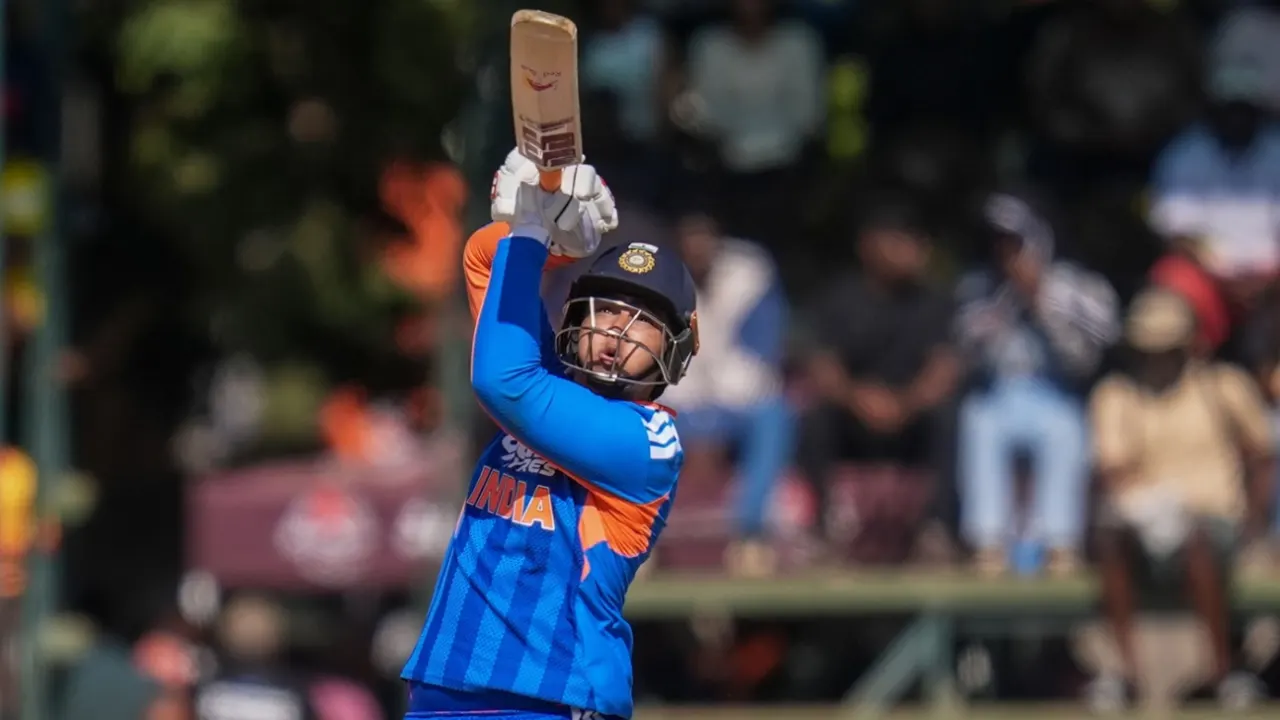
After six abandoned matches, five of them without a toss, because of incessant rain – Shreyas Iyer called it a “torrential downpour” – in Nisshin, we might finally get some cricket again at the men’s Asian Games.
The timing couldn’t have been better because the four remaining games will decide the positions on the podium. Pakistan and Bangladesh still don’t have a gold in this edition (as of Wednesday morning); Sri Lanka have just one; India have seven but that’s well behind the 28 they finished with in 2023.
India are the defending champions, and it will take a gargantuan effort from the second string Sri Lanka side to throw them off their path. Even the full-strength Sri Lanka T20I side has not been able to score 150 of late, or win a match since June, and have only one win from their last ten attempts. The Sri Lanka squad that hasn’t played even a moment of cricket since landing in Japan has a captain – Sahan Arachchige – with just one T20I to his name, which came back in the 2023 Asian Games, when they lost to Afghanistan. The more recognisable names are Niroshan Dickwella and Ashen Bandara, who haven’t featured in a T20I since 2021 and 2023 respectively. There are six other players in that squad of 15 who have played fewer than ten T20Is each, and another four who are uncapped.
India, unlike most other Full Member sides, have sent their big guns to Japan.
There’s also an ODI series going on at home, and the ODI World Cup is just a year away. But they chose to send the likes of Jasprit Bumrah, Shreyas Iyer and Ishan Kishan, among others, to Japan instead, which shows their commitment to the gold-medal cause.
Rain or shine, Sri Lanka will have to sweat it out on Thursday to try and get the better of India.
India have been plagued by injuries of late and one of the names on that list was that of Washington Sundar, who returned to action in the Japan T20I last week. He didn’t get to bat, but bowled two overs and took two wickets in his first game in two months. India would want to give him more game time before he heads back home for the West Indies T20Is that start on October 6. Washington has otherwise had an impressive year across formats with an unbeaten 52 in an ODI to give India their first win of their UK tour after he took a four-for in the Test against Afghanistan, in which he also scored 52*.
Niroshan Dickwella last played a T20I in 2021 and he is back in the scheme of things despite an underwhelming Lanka Premier League a couple of months ago, where he scored only 110 runs in six innings at a strike rate of 142.85 while averaging 18.33. He has, however, been among the runs of late, and scored a brisk 80 off 115 balls in the first Test against India. If he gets to bat on Tuesday, this could be a great chance for Dickwella to show why he was once an all-format regular for Sri Lanka.
India had rested Bumrah for the one-off T20I against Japan and played Arshdeep Singh and Yash Thakur as the quicks, and Ravi Bishnoi, Axar Patel and Washington as the lead spinners. India will now have to decide whom to leave out for Bumrah. The other question will be whether to give Vaibhav Sooryavanshi a game, although neither Abhishek Sharma nor Sanju Samson have any reason to be dropped.
India (possible): Abhishek Sharma, Sanju Samson (wk), Ishan Kishan, Shreyas Iyer (capt), Tilak Varma, Axar Patel, Shivam Dube, Washington Sundar, Ravi Bishnoi, Yash Thakur/Arshdeep Singh, Jasprit Bumrah
Sri Lanka will be expected to hand out a few debut caps and give game time to some of the more inexperienced players.
Sri Lanka (possible): Niroshan Dickwella (wk), Lasith Croospulle, Sahan Arachchige (capt), Nuwanidu Fernando, Ashen Bandara, Chamika Karunaratne, Tharindu Ratnayake, Wanuja Sahan, Vijayakanth Viyaskanth, Nuwan Thushara, Binura Fernando
[Cricinfo]
by Reemus Fernando
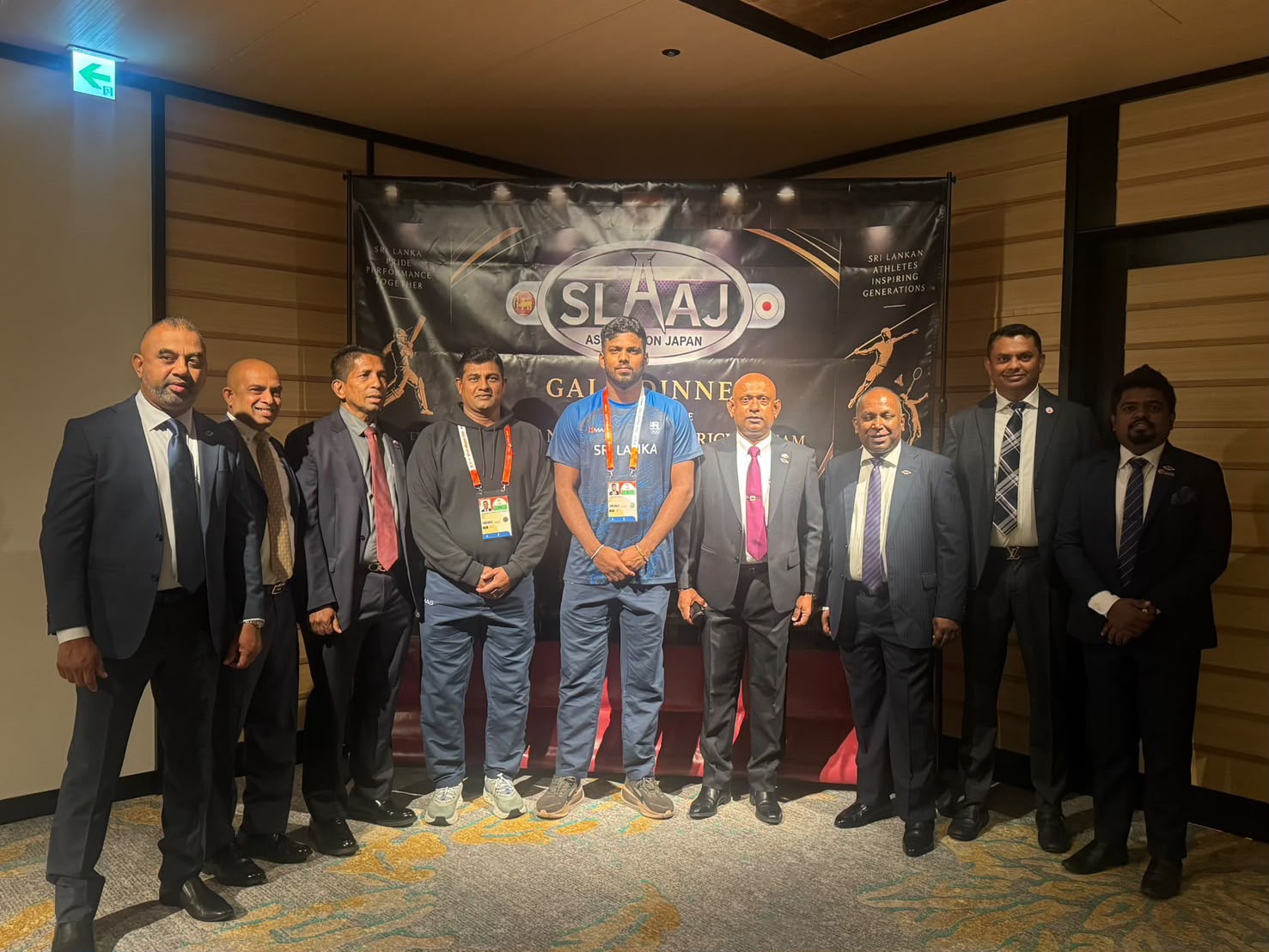
The Sri Lanka Automobile Association in Japan (SLAAJ) has awarded a brand-new Honda Vezel to gold medallist Rumesh Tharanga at a felicitation ceremony for the Sri Lankan team that competed at the Asian Games in Nagoya, Japan.
The gift was announced at the ceremony, held on the eve of the team’s departure from Nagoya.
”We decided to reward every Sri Lankan athlete who wins a gold medal with a brand-new vehicle. We invited all the Sri Lankan athletes taking part in the Games to the felicitation, and at the time of the event, only Tharanga had won gold,”
Nishantha Meegalla, Vice President of the Nagoya Prefecture of the Sri Lanka Business Council of Japan, told ‘The Island’.
Tharanga, the world’s top-ranked javelin thrower this season, won Sri Lanka’s first-ever javelin medal at the Asian Games on Monday, sealing the historic victory with a throw of 88.55 metres.

by Rex Clementine
Every cricket fan remembers that Angelo Mathews was Sri Lanka’s captain when Australia were whitewashed 3-0 in the Test series of 2016. Most will also remember Graham Ford, the master tactician, was Head Coach. But hardly anyone remembers the curator.
Perhaps they are not expected to. Curators rarely make headlines. Yet the truth remains that Godfrey Dabare produced the surfaces tailor made for Rangana Herath to weave his magic and the rest, as they say, is history.
Godfrey breathed his last on Tuesday morning after a brief illness. He was 62.
He had no degree in science or agriculture, qualifications that have become almost mandatory for chief curators these days. His university was the cricket field. His knowledge came from countless hours spent under the sun, studying soil, grass, weather and wickets, learning the craft the old fashioned way.
It is a little known fact that Godfrey spent three months in Galle preparing the venue ahead of its inaugural Test in 1998. He did a similar job in Dambulla before it became an international venue in 2001. He was a loyal lieutenant of former board chief Thilanga Sumathipala and both, Galle and Dambulla, were Thilanga’s treasured projects.
I first met Godfrey in 2000 when he was managing Chilaw Marians, then a club playing Division Three cricket. Within two years, the Marians had climbed into First Class cricket and soon became a thorn in the flesh of many fashionable Colombo clubs.
Did Godfrey occasionally use his influence as national curator to prepare pitches that suited his club? Of course he did. He was no paragon of virtue. But neither was he the villain some tried to paint him as.
He would often complain that he would unearth a rare gem from the beaches of Marawila or Wennappuwa, nurture him and give him a platform, only for one of the posh Colombo clubs to come along and pinch the player. Godfrey took those raids personally. And he was determined to teach them a lesson.
Above everything else, he cared deeply about his players.
Without his tireless work, Chilaw Marians would hardly have survived nearly three decades of First Class cricket. Now that he is gone, you cannot help but fear for the future of the club he built with such devotion, a club that has produced many fine cricketers, the latest being fast bowler Asitha Fernando.
Godfrey also had a soft spot for the press.
When England toured Sri Lanka in 2021, Sri Lanka Cricket kept journalists out of the grounds because of COVID restrictions. The press were not prepared to take it lying down, so several reporters climbed Galle Fort and covered the Tests from there.
That did not go down particularly well with SLC. The issue eventually reached Parliament, where there was rare cross party agreement that journalists should be allowed into the venue.
Relations between the cricket establishment and the press were frosty, to put it mildly. What those running the show did not know was that Godfrey was quietly sending food and drinks from inside the ground to the journalists perched on Galle Fort.
That was Godfrey.
His finest hour, however, came during the Asia Cup in 2023.
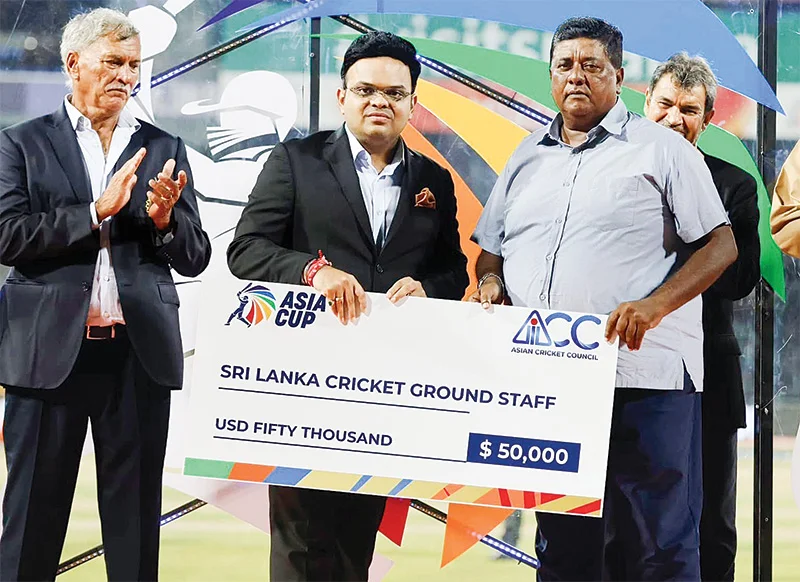
The tournament had been battered by bad weather and the ground staff worked around the clock, often in miserable conditions, to keep it moving. At the end of the tournament, the Asian Cricket Council recognised their extraordinary efforts by awarding the ground staff US$50,000. Godfrey received the cheque from ACC President Jay Shah.
Soon, murmurs began doing the rounds in Colombo. Would all that money actually reach the men who had sweated for it? There were plenty who had their doubts given the questions surrounding SLC’s financial management.
Godfrey made sure there could be no such suspicion.
Every groundsman received an equal share. Godfrey documented the payments, complete with bank and contact details of the recipients, and then, twisting the knife just a little, shared the information with the press.
He was an honest man, although often a misunderstood one.
There was another episode that summed up both Godfrey’s character and the world he occasionally had to navigate.
During a game at the R. Premadasa Stadium, the visiting team’s dressing room door had been smashed with brute force. Nobody quite knew what had happened.
When journalists rang Godfrey, he gave us chapter and verse. Bangladesh star Shakib Al Hasan, furious over an umpiring decision, had taken a bat to the dressing room door. Godfrey said he had CCTV footage and eyewitnesses to back up the claim.
The press went to town.
Shakib was summoned by the Match Referee and a suspension appeared to be looming.
Then, suddenly, Godfrey’s phone went silent.
The following day Shakib escaped with a slap on the wrist. There was apparently insufficient evidence.
A few weeks later, while journalists were watching Sri Lanka train at the R. Premadasa Stadium, Godfrey wandered over, put an arm around me and said: “Sorry, Rex. Bangladesh Cricket Board wanted the matter settled amicably. They agreed to pay for the damage. Board President (go figure who it was), called me and told me to delete the CCTV recording.”
That was Godfrey too.
Loyal to his friends. Loyal to his bosses. Sometimes caught between the two.
Sri Lankan cricket has lost one of those colourful characters who operated away from the television cameras but whose fingerprints were all over the game. Players came and went, administrators fought their battles and coaches collected the applause, but Godfrey was there in the background, preparing the stage on which they performed.
He will be missed.
His remains lie at his residence in Kurukulawa, Ragama. The burial will take place on Thursday in his hometown of Chilaw.

Waste management and recycling to receive priority in the 2027 Budget – PM

Rain stays away as India and Sri Lanka look for fair contest to enter final

Gold winner Tharanga gets brand-new Honda Vezel from SLAAJ

Showers above 50 mm are likely at some places inthe Uva, Eastern and Central provinces and in Polonnaruwa and Mullaittivu districts after 1.00 p.m.

Civil society activist accuses govt. of favouring Ven. Gnanasara

More cops than cones

‘Dates have the highest sugar content to fight Coronavirus’

Sunday Island 27 December – Headlines

#SundayIsland 17th December – Headlines

Sunday Island – 28th March

Sunday Island Headlines – 21 March

Sunday Island – 21st February – Headlines
-
 Latest News7 days ago
Showers above 100 mm are likely at some places in the Western, Sabaragamuwa, Central and North-western provinces and in Galle and Matara Districts
-

 Editorial7 days ago
Crimes punished and unpunished
-

 Features6 days ago
Beyond traditional jobs: Why Sri Lanka needs to facilitate the gig economy
-

 Editorial5 days ago
Birth of a bad law
-

 News3 days ago
Police remove Thileepan statue in Jaffna
-
 Latest News6 days ago
Kusal, Wellalage star as Sri Lanka defend 322 in Headingley thriller
-

 News5 days ago
TIN mandatory for key transactions from Nov. 1
-

 News7 days ago
IMF: Sri Lanka on course for 2027 market return