
News
Discover the Wonders of Wilpattu National Park via Wildlife Streaming

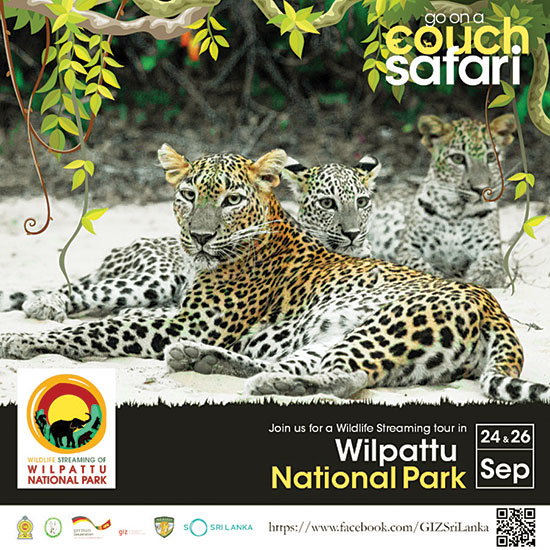
The Wilpattu National Park goes live on 24 and 26 September with the ‘Couch Safari’ which takes viewers on a wildlife streaming tour of Sri Lanka’s oldest and largest national park, allowing them to experience the wonders of Wilpattu from the safety of their homes.
The COVID-19 pandemic has indefinitely postponed travel plans for many tourists and Sri Lankans alike. Sri Lanka Tourism and the Department of Wildlife and Conservation together with Deutsche Gesellschaft für Internationale Zusammenarbeit (GIZ) GmbH teamed up to design this initiative with the aim of promoting Sri Lanka’s wildlife to the world whilst offering a glimpse of what awaits them, once it is safe to travel again.
“In a time where most travel plans are put on hold, we are excited to showcase our national parks to the world once again via “couch safari” by partnering up with GIZ and the Department of Wildlife and Conservation,” said Chairperson of Sri Lanka Tourism, Kimarli Fernando.
With the successful completion of the novel ‘Couch Safari’ initiative by Sri Lanka Tourism, the team behind this project hopes to showcase what Wilpattu National Park holds in store for the viewers, who can enjoy Sri Lanka’s amazing wildlife from the safety of their homes. Presented by wildlife experts in Sri Lanka, the first live streaming of Wilpattu National Park is scheduled on 24th September 2021 4.00 PM- 5.00 PM IST (+5.30 GMT) and the second live streaming on 26th September 2021 7.30AM -8.30- AM IST (+5.30 GMT). Viewers can tune into the live stream via www.facebook.com/GIZSriLanka.
The project “Supporting Wilpattu National Park and Influence Zone Management in Sri Lanka” is implemented by the Department of Wildlife Conservation of the Ministry of Wildlife and Forest Conservation and the Deutsche Gesellschaft für Internationale Zusammenarbeit (GIZ) GmbH, on behalf of the German Federal Ministry of Economic Cooperation and Development (BMZ). The project combines the conservation efforts within the Wilpattu National Park with the sustainable development of its influence zones. The project aims to improve Wilpattu National Park’s management capacity with emphasis on the Park Operations, Environmental and Visitor Use Programmes, in technical and specialist terms, in support of the Wilpattu National Park Management Plan (2019-2024).
Wilpattu National Park is located 30 km west of Anuradhapura and is well known among local and foreign visitors as one of the best places to watch the elusive and charismatic largest cat of Sri Lanka; the Leopard. It is one of the oldest and largest national parks declared in 1938, covering an extent of 131,693 hectares. The Park is known for its archeological heritage but much of the archeological evidence is taken over by the jungles. Out of all the ecological features of Wilpattu, the natural water holes identified as Villus are very unique to the park as these water pools cannot be found anywhere else in Sri Lanka. Villus are the main scenic attraction and animal activities around it enhance the value of this unique habitat of Wilpattu. Wilpattu National Park has recorded some 605 flowering plant species harboring rich floristic heritage of the dry zone flora of Sri Lanka. A total of 41 species of mammals have been recorded in Wilpattu, 149 species of birds, 17 species of amphibians and 57 species of reptiles. Venomous snakes such as vipers, cobras, and kraits as well as the rare and near threatened Chameleon lizard are also recorded from the scrub habitats of Wilpattu.
Join the Couch Safari and experience Wilpattu National Park from your home, as wildlife experts explain the mysteries of the land and its creatures in this exciting wildlife escapade.



Former first lady Shiranthi Rajapaksa, wife of former President Mahinda Rajapaksa was produced before the Hulftsdorp court, after being arrested by officers of the Commission to Investigate Allegations of Bribery or Corruption (CIABOC) and produce
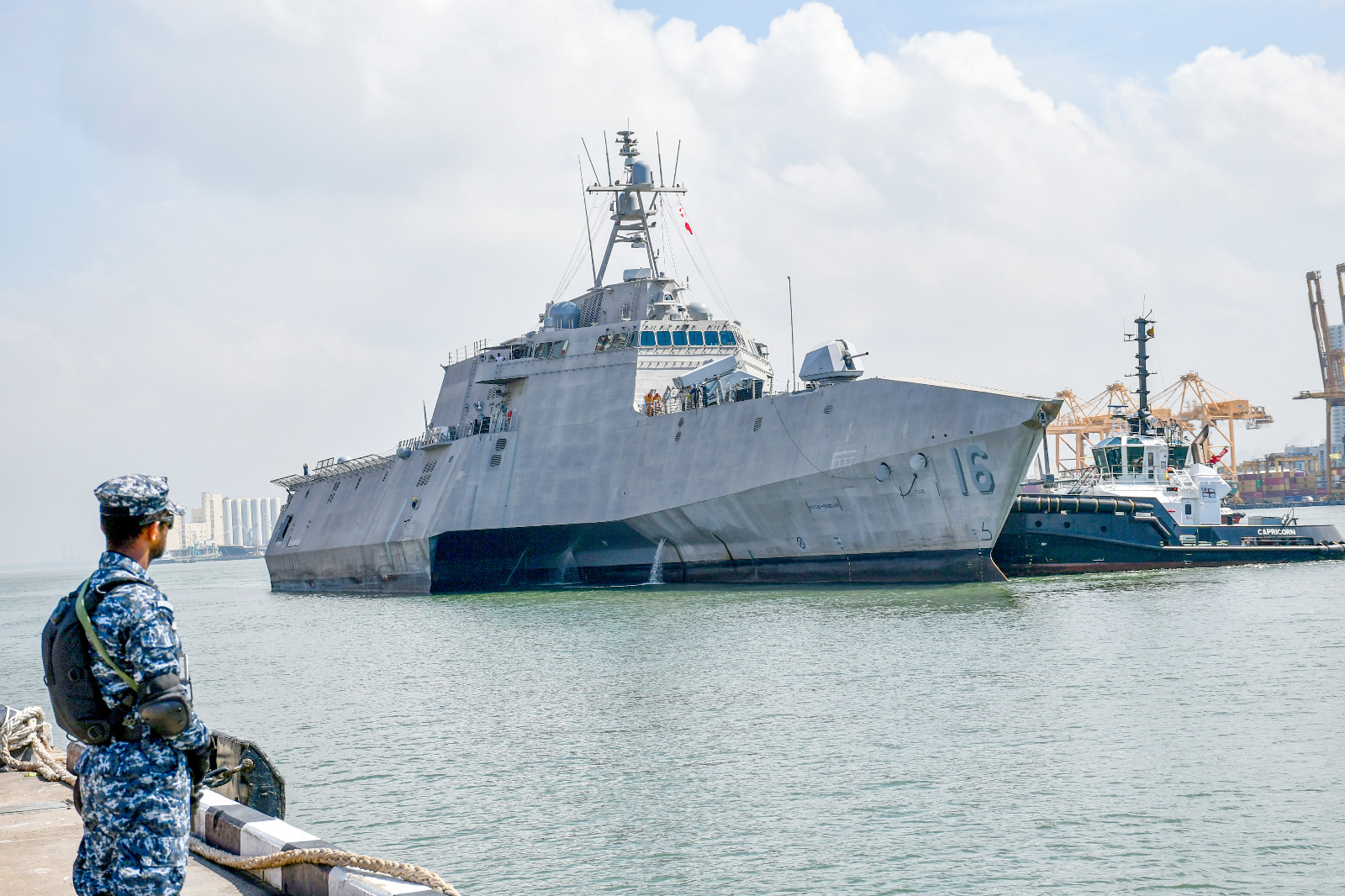
The U.S. Navy ship USS Tulsa (LCS 16) arrived at the Port of Colombo this morning, 7 October 2026 for replenishment purposes.
The visiting ship was welcomed by the Sri Lanka Navy in accordance with naval traditions.
The 127.7-metre-long platform is a Littoral Combat Ship commanded by Commander BM Wanier. Commissioned on 16 February 2019, USS Tulsa has since been in service with the US Navy.
The ship previously made a port call in Sri Lanka on 27 August 2025.

Govt. tells fuel distributors to maintain stocks to ensure uninterrupted supplies
by Saman Indrajith and Norman Palihawadane
The government had instructed private fuel distributors to maintain minimum stocks and ensure uninterrupted supplies to the market, Energy Minister Anura Karunathilaka told Parliament yesterday (06).
Karunathilaka said the Ministry of Energy Secretary had notified the relevant companies of the requirement, following a reduction in supplies by some private distributors, amid higher international fuel prices.
The Minister said private companies had informed the government that they were facing losses because international prices had risen while fuel was being sold, locally, at prevailing prices. As a result, some companies had reduced the volumes released to the market.
The reduced supplies had increased the burden on the Ceylon Petroleum Corporation (CPC), whose share of the diesel market had risen from about 54% to 82%, the Minister said.
“The CPC currently holds an 82% share of the market,” he said, adding that it had increased its supplies, compared with February, to compensate for the reduction by private distributors.
Karunathilaka said the government could not, under the existing agreements with private companies, specify the quantities they should supply to individual filling stations. However, it could require them to maintain minimum stocks in the country.
The Minister said the Energy Ministry had already instructed companies that had failed to maintain the required stocks to take steps to prevent supply disruptions.
The Minister attributed the queues reported at some filling stations to reduced supplies from private distributors, as well as normal variations in fuel distribution. He also said demand for CPC fuel had increased because private companies generally did not provide fuel to dealers on credit, while the CPC offered a three-day credit facility.
“We expect that, as the Ceylon Petroleum Corporation takes on this additional burden, the problem will ease to some extent by Wednesday or Thursday,” Karunathilaka said.
He said instructions had also been issued to increase supplies to CPC filling stations. A special discussion on the issue is scheduled for today (07), with officials of the Energy Ministry and CPC expected to participate,
along with President Anura Kumara Dissanayake.
Meanwhile, Petroleum Dealers’ Association officials have called for an early solution to the supply issue. Association Chairman D.V. Shantha Silva said queues had been reported at many filling stations, mainly those operated by private distributors.
He said the situation was not due to an overall shortage of fuel, but was linked to reduced orders by Lanka IOC, Sinopec and R.M. Parks amid concerns over losses incurred on fuel sales.
The Ceylon Petroleum Private Tanker Owners Association has urged motorists to refrain from panic buying, saying there was no nationwide disruption to fuel supplies.
The government earlier increased fuel prices and introduced a per-litre diesel subsidy following concerns raised by distributors over rising international prices.

Showers above 100 mm are likely at some places in the Western, Sabaragamuwa, Central, Uva and Southern provinces and in Anuradhapura district

Remembering Juvenal, Coke, Acton and Machiavelli

West Asian conflict undergoing manifold complications

Nissanka absence opens door for Sri Lanka’s young guns

The prelate who walked the talk

Needs of populace hit by Cyclone Ditwah seen as waiting to be addressed

‘Dates have the highest sugar content to fight Coronavirus’

Sunday Island 27 December – Headlines

#SundayIsland 17th December – Headlines

Sunday Island – 28th March

Sunday Island Headlines – 21 March

Sunday Island – 21st February – Headlines
-

 Editorial6 days ago
Colombo Port drug bust: The plot thickens
-

 Features4 days ago
The first woman in the foreign service or Ceylon Overseas Service it was then called
-

 Editorial5 days ago
Fuelling discontent and protest
-

 News3 days ago
Geneva takes up Sallay’s case and govt. ignores opportunity to answer accusations
-

 Latest News5 days ago
Tharindu Rathnayake, bowlers secure Asian Games Bronze for Sri Lanka
-

 Foreign News5 days ago
Ten injured after car crashes into rugby supporters in Australia
-

 Features3 days ago
Sri Lanka Cricket Bill: Governance reform is not yet a cricket strategy
-

 News4 days ago
Nearly 20 Iranian tankers stranded off Lanka amid US sanctions