
News
Cash-strapped govt. seeks Indian lifeline: Basil to visit New Delhi

By Shamindra Ferdinando
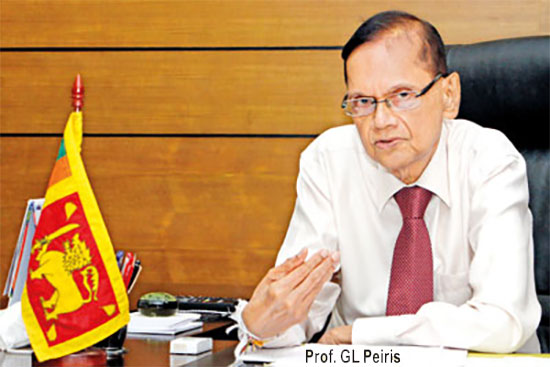
Declaring that Sri Lanka was experiencing the worst ever post-independence economic crisis, Foreign Minister Prof. G.L. Peiris yesterday said Finance Minister Basil Rajapaksa’s forthcoming visit to New Delhi might give the country an opportunity to explore ways and means of overcoming the overwhelming challenges.
Prof. Peiris, who is also the Chairman of the ruling SLPP, emphasised that the Finance Minister’s visit was meant to seek not only loans but also wider cooperation on a range of other matters, including investment, trade and tourism.
Addressing the regular weekly SLPP briefing at its Battaramulla party office yesterday (22), Prof. Peiris said Indian High Commissioner in Colombo Gopal Baglay and Sri Lankan High Commissioner in New Delhi Milinda Moragoda had made arrangements for Minister Basil Rajapaksa’s visit.
Minister Rajapaksa is scheduled to meet Indian Premier Narendra Modi, Foreign Secretary Harsh Vardhan Shringla and other officials.
Both Prof. Peiris and SLPP General Secretary Attorney-at-Law Sagara Kariyawasam strongly argued against repeated calls led by the main Opposition Samagi Jana Balavegaya (SJB) for seeking the assistance of the International Monetary Fund (IMF).
Prof. Peiris asserted that the IMF wasn’t the only solution but one of the alternatives whereas lawmaker Kariyawasam asked whether any country had benefited from such a course of action.
Referring to the unprecedented crisis triggered by Covid-19 eruption in early 2020, Prof. Peiris said there were external factors, and current challenges couldn’t be taken in isolation. Emphasising that Sri Lanka maintained friendly relations with all foreign governments, Prof. Peiris explained the special relations Sri Lanka was having with India.
Finance Minister Rajapaksa on 12 Nov. presented Budget 2022. He declared that the government was confident that the country would not default on its debts and would work to improve its foreign exchange reserves. “Sri Lanka has never defaulted in its history and that record will be maintained,” Minister Rajapaksa assured.
The Indian High Commission in Colombo has repeatedly stated that Sri Lanka would receive priority in line with India’s ‘neighbourhood first policy’ widely described as Premier Narendra Modi’s signature foreign policy initiative that sought to develop better relations with the country’s neighbours.
Prof. Peiris also briefed the media on the status of the drafting of the new Constitution undertaken by an expert committee, and the Parliamentary Select Committee handling electoral reforms. The SLPP Chairman said that the government was going ahead with the process in spite of other issues at hand and confident of bringing the project to a successful conclusion. Prof. Peiris said that a new Constitution was a long felt need. The public expected electoral reforms as all accepted the need for far reaching changes.
Quad member India is a major investor in Sri Lanka. Recently, India has reached agreement with Sri Lanka as regards the proposed West Container Terminal (WCT) against the backdrop Sri Lanka reneging previous tripartite agreement involving India and Japan to develop the East Container Terminal (ECT) amidst stiff opposition from port unions. The Quad security alliance comprises the US, Japan, Australia and India.

News
Cabinet nod to increase the number of new automated passenger clearance gates at the Bandaranayake International Airport to 12

Approval of the Cabinet of Ministers was granted at their meeting held on 19.05.2025 to purchase four (04) automated passenger clearance gates for Bandaranayake International Airport.
In addition, it is expected to extend the automated passenger clearance gates facility so far given only to the Sri Lankans
parallel to the e – passport issuance system to be introduced in the year 2027 also to the foreigners who travel to and from this country.
Furthermore, considering also the number of air passengers rapidly increasing with the fast – forwarding business and tourism field, the appropriateness to increase the total automated passenger clearance gates up to twelve (12) in number has been recognized.
Accordingly, the Cabinet of Ministers, approved the resolution furnished by the Minister of Public Security and Parliamentary Affairs to initiate the procurement and installation of 12
automated passenger clearance gates altogether with the already approved four (04) and another eight (08) automated passenger clearance gates adhering to the formal procurement procedure
Based on the observations submitted by the Task Force on Prevention of Money Laundering and Financing for Terrorism, approval of the Cabinet of Ministers was granted at their meeting held on 18.12.2024 to amend the Trust Ordinance No. 9 of 1917 including amendments proposed by the Financial
Intelligence Unit of the Central Bank of Sri Lanka.
Accordingly, clearance of the Attorney General has been granted for the Trust (Amendment) Draft Bill formulated by the Legal Draftsman.
Therefore, the Cabinet of Ministers approved the resolution furnished by the Minister of Justice and National Integration
to publish the said draft bill in the government gazette notification and thereby, submit the same to the Parliament for its concurrence.
Action was taken to provide a fuel relief for the fuel consumers during the months of April, May and June of 2026 to redress by minimizing the impact caused to the day today life of the citizens of this country as well as the entire economy due to the price hike of petroleum fuel in the global market resulting from the war situation in the Middle East.
Government mediation is essential for minimizing the impact on the day to today life of citizens in this country due to that war situation not being ended further. Therefore, it has been planned to redress on the sale price for Auto Diesel and Industrial Diesel for a period of 03 months by the Government to provide relief to the public as well as to maintain the prices at a bearable level to the consumers without escalating the fuel prices in this country compared to the escalation of fuel prices
in the international market.
Therefore, the Cabinet of Ministers granted approval for the resolution furnished by the President in his capacity as the Minister of Finance, Planning and Economic Development to
allocate provisions subject to the monthly limitations respectively as rupees 15 billion for the month of October, rupees 13.5 billion for the month of November and rupees 12.15 billion for the month of December to provide the said relief

Cabinet nod to increase the number of new automated passenger clearance gates at the Bandaranayake International Airport to 12
Draft Bill for amending the Trust Ordinance
Implementing further relief programme to Public sffected by the Middle East conflict situation
Establishment of a Spectrum Management and Monitoring System and a Quality of Service and Quality of Experience System for the Telecommunications Regulatory Commission of Sri Lanka
Appointment of a Committee for the Restitution of Sri Lankan Cultural Heritage Held Abroad
Ten-Year National Action Plan on the Social Protection Sector (2026–2035)

‘Dates have the highest sugar content to fight Coronavirus’

Sunday Island 27 December – Headlines

#SundayIsland 17th December – Headlines

Sunday Island – 28th March

Sunday Island Headlines – 21 March

Sunday Island – 21st February – Headlines
-

 News7 days ago
Mastermind Naufer Moulavi among 15 found guilty
-
 Midweek Review7 days ago
Thileepan’s fast unto death: An authentic narrative that many missed
-

 Latest News6 days ago
Showers above 100 mm are likely at some places in the Western, Sabaragamuwa, Central and North-western provinces and in Galle and Matara Districts
-

 Editorial7 days ago
Big Bad Bills
-
Editorial6 days ago
Crimes punished and unpunished
-

 Features5 days ago
Beyond traditional jobs: Why Sri Lanka needs to facilitate the gig economy
-

 News7 days ago
No referendum needed for passage of 22 A: SC
-

 News7 days ago
One clause in Anti-Corruption (Amendment) Bill requires referendu: SC