
News
AGM of SUCCESS Sri Lanka with a Naval Hero as Chief Guest

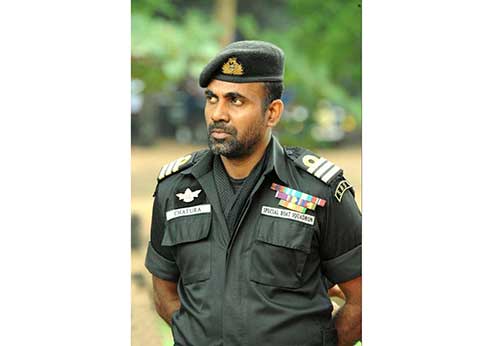
The annual General Meeting of the Society for the Upliftment of Conservation of Cultural, Economic and Social Standards (SUCCESS) was held at the International Buddhist Centre, Wellawatte, on April 5, 2021. The highlight of the event was the person selected to grace the occasion as Chief Guest: Navy Commando Chathura Gamage.
Immense help given
SUCCESS was inaugurated by Prof M B Ariyapala and others in 1995 and has continued doing much to promote the aim and vision of the organization. They work mostly in hamlets marked as threatened villagers during the civil war and these lie principally in Vavuniya, Ampara, Trincomalee and Welioya. The temples in the area are the centres for SUCCESS activities and thus, the villagers being too disadvantaged to do much for the temples, the Organization has helped greatly in reconstruction, expansion and installation of facilities. The village people are helped with frequent medical clinics, which Dr Anula Wijesundere, President of SUCCESS for 22 of its 27-year existence, leads. We know full well how selflessly and diligently she conducted health clinics in the poorest of poor villages, doubly suffering due to proximity to LTTE held areas; with like-minded medical and nursing volunteers.
Additionally, the supply of clean water for drinking and water for households and cultivated fields is a special concern of SUCCESS. Water pumps, containers, pipes and taps are supplied; also tube wells sunk. Children are supplied with school necessities and bicycles so they can attend school notwithstanding very poor bus services in most areas.
Choice of Chief Guest of 2021 AGM
Anula spoke on her choice of invitee to be chief guest which was unanimously approved by the Committee. “l first came to know of Chathura’s bravery when I read an article by Admiral Ravindran Wijegunaratne in the Sunday Island of May 26, 2020.” We all agree he is undoubtedly an admirable man, intrepid and loyal to this fellow sailors, and the country.
Just as Dr Wijesundere is well known due to her social service, her commitment to the country and support given to the armed forces, and being an excellent specialist physician; so also well known is Navy Hero Chathura Gamage.
On joining the Navy when the civil war was raging, he was selected with a few others for special training to man small boats that were seen to be more capable than larger vessels of hitting enemy craft the LTTE had successfully built. The trainees were selected for their stature, demonstrated fearlessness and determination. Thus the trained Commandos of the Special Boat Squadron did deadly damage to the LTTE at sea, moving silently into enemy territory at night. Excellent night vision was a requirement. They dealt severe blows to LTTE ships, particularly those smuggling in arms and ammunition. To cap it all, they were almost invisible and escaped detection, capture or being blown up at sea. Victories were many – in the Jaffna Lagoon, Pooneryn and Karainagar.
Unfortunately during a battle between Tamil Tiger ships and the Special Boat Squadron, , Chathura was injured and his boat began drifting to enemy territory. Some of his mates escaped and swam to safety; a few died; and Chathura decided to escape capture by risking his life attempting to swim with a grievous injury. He had been shot in the abdomen. Holding his protruding intestines, he swam two and a half hours until picked-up by a government boat. He spent nine months in hospitals in Trincomalee, Colombo and the Army Hospital. He was first operated on by surgeon Dr Thavendran in Trincomalee. Thereafter he had to undergo several surgeries by Dr S S Jayaratne and Dr Indrani Amarasinghe who performed specialized bowel surgery so he could take solid food after five years of being solely on liquid nourishment. These two doctors were at the SUCCESS AGM.
Another even harder blow was losing his best friend, Sudesh Dalugama, in a sea battle. This was one reason why, when only partly recovered, he returned to the North and the Navy and worked administratively and as advisor. In his address at the AGM he thanked the doctors who saved his life and got him back to near normalcy, especially the skilled surgeons, both Tamil and Sinhalese.
Chathura harboured this one ambition from a very tender age to join the Armed Forces. Even now, though retired and living in Ratnapura, he gives of his know-how and experience as a Motivator to the SL Navy
Dr Anula Wijesundere presented the year’s work done by SUCCESS followed by a video on the assistance given to the S L Army. She delivered a citation on the Chief Guest which visibly moved him to tears. He then addressed those present, often turning emotional. After tumultuous applause for Chathura, the Ranaviru song. ‘Muhuda de be Karana’ was sung by all present. Chathura was almost mobbed with everyone, young and old, wanting to speak with him. Anula says: “No other chief Guest at our AGMs for the past 27 years received such warmth, affection and adulation.”
N P Wanasundera



Over 40 persons have been injured (some critically) as two buses one travelling from Galle to Ampara and the other from Tangalle to Matara crashed head on at Talalla Matara this morning.
The injured have been admitted to the Matara General Hospital and Bathhegama District Hospital.

Turkiye beat a heavily changed United States 3-2 with a late Kaan Ayhan winner in an action-packed dead-rubber clash that gave the 2026 World Cup cohosts their sternest test so far ahead of the knockout rounds.
Already crowned the Group D winners, the US arrived in Los Angeles seeking to extend a perfect start with a third win, but with more than an eye on next Wednesday’s last 32 meeting against Bosnia and Herzegovina.
For Turkiye, already eliminated and without even a goal after disastrous losses to Paraguay and Australia, the only objective was to restore some pride.
Despite the low stakes and substantially reshuffled lineups for both teams, a packed Los Angeles Stadium was in a deafening mood.

For the third game running, the US got off to a dream start. One of nine changes, backup centre-back Auston Trusty, was unmarked at the far post from a US corner, given time to cushion the ball with his left foot, then blast it home.
It was the Celtic defender’s first international goal, and – at just under three minutes – the second-fastest by the US at a World Cup.
But Turkiye did not surrender. Having not scored in 62 efforts across their first two games, it was the 63rd time lucky for the Turks, and their star man, Arda Guler.
The Real Madrid forward duped Mark McKenzie with a clever dummy, allowing the ball to run down the right flank to Baris Alper Yilmaz.
Yilmaz crossed it back to Guler, who smashed it past Matt Turner to equalise in the 10th minute.

With Brad Pitt and Edward Norton among the Hollywood crowd, the game threatened to become a fight club, as Turkiye’s bench rushed the field to protest a foul by the combative Sebastian Berhalter, who earned a yellow.
The Americans thought they had restored the lead, with McKenzie the second US centre-back to put the ball in the net. But his sharp response to Ricardo Pepi’s saved shot was ruled offside.
In the 31st minute, the US found themselves behind for the first time this World Cup.
Guler spotted Eren Elmali’s overlapping run, feeding it to the wing-back, who cut the ball back from the left byline to Yilmaz, who steered it beyond the keeper.
‘Captain America’ returns

The half-time break proved the perfect tonic for the US. In the 49th minute, they were back level from a long throw by McKenzie.
The ball was cleared by Turkiye only as far as Berhalter, who did well to smash his shot low into the bottom corner.
The crowd erupted again just before the hour mark as Mauricio Pochettino sent on Christian Pulisic, undoubtedly the US’s biggest star, who will shoulder much of the cohosts’ hopes of a deep run into the knockouts.
Nicknamed “Captain America”, Pulisic earned his own round of “USA” chants, having not appeared since aggravating an injury in the first half of the opening win against Paraguay two weeks ago.
Pulisic immediately looked lively, twice having his effort blocked from close range after darting runs from the left. He knew less about a ball that looped off his shin onto the post.
Turkiye began to knock on the door again. A Yildiz effort curled inches wide in the 72nd minute.
And deep into stoppage time, Ayhan spoiled the US party, slamming the ball home from close range.
Turkiye were jubilant, while the American players clustered in a circle after the final whistle, seemingly determined not to let the gut punch spoil a campaign that had been off to a flying start.

[Aljazeera]

A delegation from UNICEF, accompanied by the United Nations Special Representative of the Secretary-General on Violence Against Children (VAC), Dr. Najat Maalla M’jid, met with Prime Minister Dr. Harini Amarasuriya on Thursday [25 June] at the Parliament premises.
The discussion was focused on further strengthening cooperation and engagement with the Government of Sri Lanka on ensuring the protection and well-being of children, and efforts to prevent and respond to all forms of violence against children.
During the meeting, the Prime Minister acknowledged UNICEF’s continued support to Sri Lanka, particularly during the response to Cyclone Ditwah, as well as its longstanding contributions to reforms in education and early childhood education and initiatives aimed at preventing and addressing violence against children.
The Prime Minister noted that while Sri Lanka has made significant progress in developing policies, the challenge lies in ensuring their effective implementation. She emphasized the need to address gaps in institutional capacity and human resources, while strengthening coordination among the various parts responsible for child protection while highlighting the critical role of frontline workers in the delivery of child protection services.
During the discussion, representatives of UNICEF emphasized the importance of bringing together all relevant stakeholders to address gaps in child protection procedures and referral pathways. Particular attention was given to ensuring that children have clear and accessible mechanisms through which they can report abuse and seek assistance.
Dr. Najat Maalla M’jid highlighted the importance of strengthening the competencies of frontline professionals on psycho social support, early detection, defining direct signs, techniques of effective listening, and safeguarding privacy. The discussions also underscored the growing importance of protecting children from online violence and abuse, and the need to strengthen measures to ensure children’s safety in digital environments.
The meeting was attended by Dr. Najat Maalla M’jid, United Nations Special Representative of the Secretary-General on Violence Against Children; Ms. Emma Brigham, UNICEF Representative; Mr. Marc-André Franche, United Nations Resident Coordinator; officials from the Ministry of Foreign Affairs; and additional secretaries and officials from the Ministry of Education.
[Prime Minister’s Media Division]

Over 40 persons injured in head on crash at Talalla

Turkiye beat US 3-2 with stoppage-time goal in dead rubber

Japan draw 1-1 with Sweden at World Cup to finish second in Group F

Netherlands beat Tunisia 3-1, enter World Cup knockouts as group winners

Australia reach 2026 World Cup knockouts after 0-0 draw with Paraguay

Rescuers search rubble for survivors as Venezuela earthquakes kill at least 235

‘Dates have the highest sugar content to fight Coronavirus’

Sunday Island 27 December – Headlines

#SundayIsland 17th December – Headlines

Sunday Island – 28th March

Sunday Island Headlines – 21 March

Sunday Island – 21st February – Headlines
-

 News6 days ago
Creditor not yet paid
-
 News6 days ago
Consumers bearing 22% tax burden despite 18% VAT claim: Dr. Harsha de Silva
-

 Features5 days ago
Nanda Pethiyagoda Wanasundara as three generations of family saw her
-

 Features4 days ago
Sri Lanka developing independent hydrographic capabilities
-

 Editorial5 days ago
Fuel crisis: Beyond price debate
-

 Latest News5 days ago
Sooryavanshi thumps fastest List A fifty as India A win tri-series
-
 Opinion3 days ago
Ranasinghe Premadasa: The man who would not take ‘No’ for an answer
-

 News3 days ago
US Assistant Secretary of State for South and Central Asian Affairs meets President