
Business
A life devoted to tea & kindness

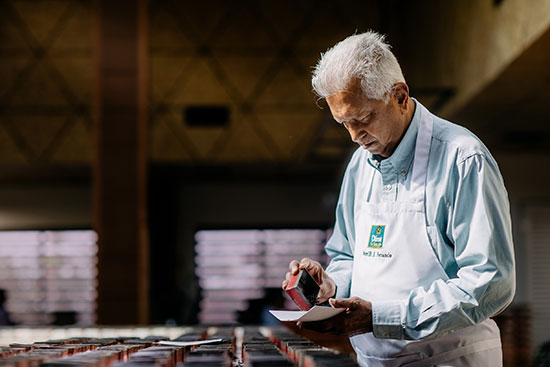
Sri Lanka’s Mr. Dilmah, celebrates 71 years of brewing cups of kindness
The unmistakable face of the Sri Lankan family tea company Dilmah, is Merrill J. Fernando, and his invitation to customers – ‘do try it!’. The first tea grower to offer his tea to the world – picked, perfected, packed at source – and kindness was his cup of tea. The family tea business he formed around an uncompromising commitment to Taste, Goodness & Ethical Purpose offers a playbook for business in a post pandemic era. Faith, determination, dedication to taste, goodness, and ethical purpose characterize the Ceylon Teamaker’s story as he turns 91, and celebrates 71 years in tea.
Milestones are important. They chart one’s progress, whether success or failure. Merrill J. Fernando, the founder of Dilmah, entered the tea trade in 1950, as one of a batch of five local youth to be trained in the art of tea tasting, then the preserve of the British. Despite the unshakeable self-belief that has taken him to his present eminence in the industry, even he would not have imagined the varied successes that he would eventually garner.
Dilmah is, undeniably, the global face of Ceylon tea. The brand, with the image of its founder, has carried the message of the purity and authenticity of Ceylon tea to over a hundred countries in the world. However, it is not only in the promotion of the product that Fernando has made his contribution. Over the years he has lent his weight to many initiatives that have benefited the industry and Ceylon tea in its totality.
In the early years, he championed several initiatives which created facilitations and remedied inequalities which hampered the local exporter of value added tea. The tea industry then represented a long value chain, stretching from the local plantation to the retail market overseas, designed for the benefit of the British, allied multinationals and their local associates. He was successful in interposing his authority on this tightly closed system, with a mixture of guile, confrontation and leverage of influence, for the benefit of the local entrepreneur.
The conversion of many traditional Orthodox Tea factories to the more industrial CTC manufacture, in an uncritical emulation of the Kenyan model, would have become a reality decades ago, if not for his reasoned but unrelenting opposition. Had that proposal been implemented, the diversity of Ceylon tea, its uniqueness, would have been obliterated by the depressing sameness of a mass-market product without individuality.
Similarly, the more recent effort to import cheap tea for blending and re-export, the “Tea Hub” concept, proposed by exporters who were prepared to sacrifice the singularity of Pure Ceylon Tea, in favour of short-term profit and denial of long-term damage, would have been launched if not for Merrill Fernando’s fierce opposition. His was the lone voice raised against this scheme which, had it been implemented, would have temporarily enriched a few but impoverished the hundreds of thousands of producers.
Merrill embodies the philosophy he has always advocated, focusing on the significance that lies beyond success. His desire to share his profits has made an unquantifiable and lasting contribution to his community and beyond. In less fortunate communities in his own country and overseas, thousands of lives have been touched by the initiatives of the Merrill J Fernando Charitable Foundation – all funded by the profits of Dilmah tea. The Foundations’ guiding principle of empowerment with dignity underlines its Settlor’s wish to genuinely & positively impact people.
Then there are the multitude of biodiversity conservation, restoration, environmental education & research initiatives of Dilmah Conservation, again endowed by the profits from tea. As the passionate Teaman celebrates his 91st birthday, his commitment is undimmed. In a corruptible and acquisitive society it is rarely that a successful businessman also becomes a force for the common good. Merrill J Fernando is clearly one of the very few exceptions.


by SK Samaranayake
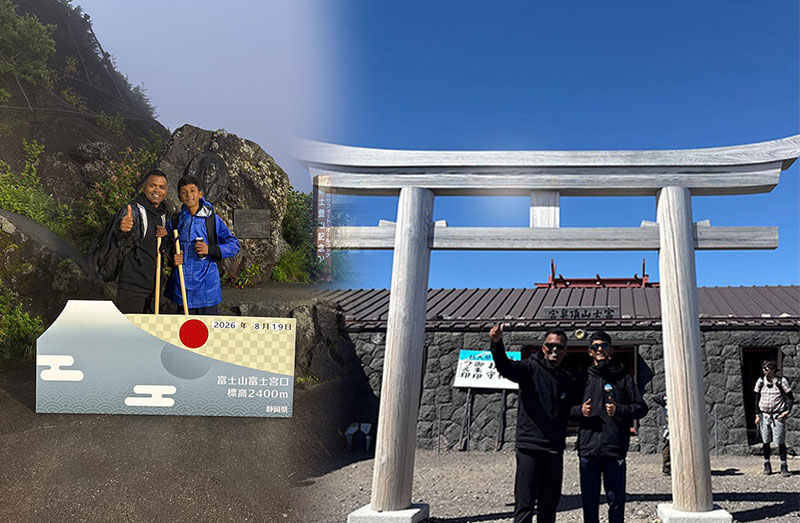
For Daham Gunasena, reaching the summit of Mt. Fuji with his 12-year-old son was not the end of the journey but the beginning of a different kind of lesson.
Gunasena, Director – Commercial at SPAR Sri Lanka and a senior business leader, academic and Chartered Accountant, spent nearly 12 hours on August 19 climbing Japan’s highest mountain with his son, Methum. After eight hours of climbing, the pair reached the 3,776-metre summit before beginning a demanding four-hour descent to Fujinomiya 5th Station.
“The summit was only halfway,” Gunasena reflected, describing the experience as a lesson in preparation, perseverance and responsibility.
Their journey began two days earlier with a trial excursion to the 6th Station and the volcanic landscape around Mt. Hoei. The experience allowed Gunasena to assess the altitude, terrain, weather and equipment before deciding whether his son was ready for the summit attempt.
The climb itself reinforced the value of taking one step at a time. Rather than focusing on the distant summit, father and son concentrated on the next marker, the next few steps and short periods of rest.
Reaching the summit brought another lesson. After taking photographs and celebrating, they still had four hours of descent ahead of them over loose volcanic terrain.
“Reaching the top was an achievement. Returning safely was success,” Gunasena said.
The experience also prompted him to reflect on how Japan manages Mt. Fuji, including visitor education, digital information, sanitation, transport, safety and environmental protection.
Having climbed Sri Pada 12 times last year and five times so far this year, Gunasena sees opportunities to apply some of these principles in Sri Lanka without compromising the mountain’s unique pilgrimage traditions.
He suggested a comprehensive digital platform for Sri Pada providing information on weather, congestion, transport, sanitation, first aid and emergencies, while educating foreign visitors about its religious significance.
For Gunasena, however, the most enduring lesson was personal: a mountain can teach what lectures cannot—through preparation, perseverance, respect for nature and the shared experience of taking each step together.

Sri Lankan industries are being encouraged to adopt advanced condition monitoring technologies to detect equipment problems before they develop into costly failures, as global technology company FLIR and its local partner Marlbo Trading Company strengthen their collaboration.
The companies brought together industry professionals at a technical seminar held on August 20 at Taj Samudra, Colombo, focusing on the use of thermography and acoustic imaging to reduce unplanned downtime, improve energy efficiency and lower maintenance costs.
Organised by Marlbo under the theme “Condition Monitoring Using Thermography and Acoustic Imaging for Measurable ROI,” the seminar highlighted the growing importance of proactive and predictive maintenance in improving equipment reliability and operational efficiency.
FLIR Sales Director – Instrumentation, India, Bhaskar Lala, and APAC Condition Monitoring Specialist David Gambarte shared their expertise on the latest diagnostic technologies and their practical industrial applications.
Thermal imaging can identify abnormal heat patterns linked to electrical and mechanical faults, while acoustic imaging can detect problems that may go unnoticed during routine inspections.
The technology is particularly useful in identifying compressed-air leaks, which can cause significant energy losses and increase operating costs.
Shevon Liyanage, Engineer – Measuring Instruments at Marlbo, also shared insights into applying condition monitoring technologies in the Sri Lankan industrial environment.
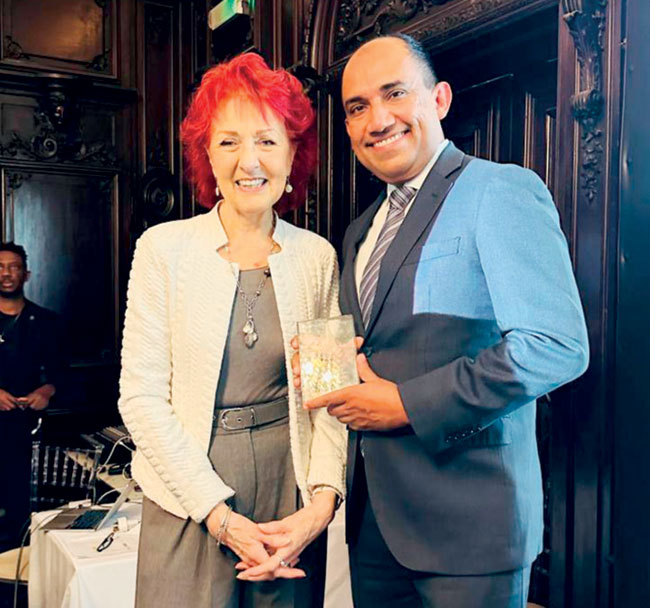
Lumbini Tea Valley Ceylon won an award for its Singharaja Wirytips at The Leafies: International Tea Awards held in London in 2024, marking another international recognition for the Sri Lankan tea producer.
The award comes as the company marks two decades of direct exports, with its premium and organic Ceylon teas now reaching 35 countries across six continents.
Established in 1984, Lumbini Tea Valley began its direct export drive after Chaminda Jayawardana joined the family business in 2000 alongside his father, Dayapala Jayawardana. The initiative materialised in 2006 with the company’s first direct shipment—a 15-kilogram consignment of Flowery Broken Orange Pekoe (FBOP) tea to the United States.
Since then, the company has expanded its direct-export operations, which now account for around 20% of its total manufacturing output. Following its transition to organic production, approximately half of its organic tea output is exported directly by the company.
Its key export markets include Japan, the United States, France, the Netherlands, Switzerland and Australia, with direct shipments now reaching 35 countries.
The company said its direct-export model would continue to expand amid growing international demand for traceable, single-origin Ceylon tea, with premium and organic grades at the centre of its export strategy.

UPDATE: Seven killed and 23 missing after boat capsizes off northern Cyprus, says Turkish Cypriot PM

Iceland votes against restarting talks on joining EU

“Rathuwewi Mihimadala” Book Launched with the Participation of the Prime Minister

Turkiye, Somalia forces free cargo vessel hijacked by pirates

Ferry carrying 260 people capsizes off northern Cyprus coast

Imam unlikely to play rest of Lord’s Test after picking up left calf tear

‘Dates have the highest sugar content to fight Coronavirus’

Sunday Island 27 December – Headlines

#SundayIsland 17th December – Headlines

Sunday Island – 28th March

Sunday Island Headlines – 21 March

Sunday Island – 21st February – Headlines
-

 News6 days ago
Missing doctor’s body found in Mahiyanganaya
-

 News6 days ago
Australia declines to release Finance Secy Suriyapperuma’s citizenship details
-

 News6 days ago
22A: BASL suggests CJ recuse himself from hearing petitions
-

 News3 days ago
Eight politicians in drug kingpin probe
-

 Editorial7 days ago
Govts. drag feet as undergrads age
-

 Business3 days ago
Sri Lanka opens up: A new season of direct connectivity
-
 Features5 days ago
Insights from Chieftains of Uva: Genealogy of two Kandyan Families – Part II
-

 Features3 days ago
Redefining ageing in Sri Lanka