
Business
A life devoted to tea & kindness

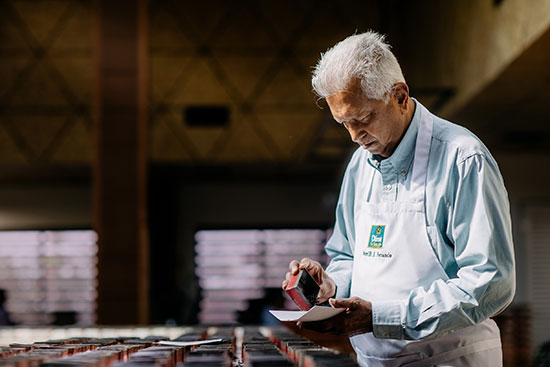
Sri Lanka’s Mr. Dilmah, celebrates 71 years of brewing cups of kindness
The unmistakable face of the Sri Lankan family tea company Dilmah, is Merrill J. Fernando, and his invitation to customers – ‘do try it!’. The first tea grower to offer his tea to the world – picked, perfected, packed at source – and kindness was his cup of tea. The family tea business he formed around an uncompromising commitment to Taste, Goodness & Ethical Purpose offers a playbook for business in a post pandemic era. Faith, determination, dedication to taste, goodness, and ethical purpose characterize the Ceylon Teamaker’s story as he turns 91, and celebrates 71 years in tea.
Milestones are important. They chart one’s progress, whether success or failure. Merrill J. Fernando, the founder of Dilmah, entered the tea trade in 1950, as one of a batch of five local youth to be trained in the art of tea tasting, then the preserve of the British. Despite the unshakeable self-belief that has taken him to his present eminence in the industry, even he would not have imagined the varied successes that he would eventually garner.
Dilmah is, undeniably, the global face of Ceylon tea. The brand, with the image of its founder, has carried the message of the purity and authenticity of Ceylon tea to over a hundred countries in the world. However, it is not only in the promotion of the product that Fernando has made his contribution. Over the years he has lent his weight to many initiatives that have benefited the industry and Ceylon tea in its totality.
In the early years, he championed several initiatives which created facilitations and remedied inequalities which hampered the local exporter of value added tea. The tea industry then represented a long value chain, stretching from the local plantation to the retail market overseas, designed for the benefit of the British, allied multinationals and their local associates. He was successful in interposing his authority on this tightly closed system, with a mixture of guile, confrontation and leverage of influence, for the benefit of the local entrepreneur.
The conversion of many traditional Orthodox Tea factories to the more industrial CTC manufacture, in an uncritical emulation of the Kenyan model, would have become a reality decades ago, if not for his reasoned but unrelenting opposition. Had that proposal been implemented, the diversity of Ceylon tea, its uniqueness, would have been obliterated by the depressing sameness of a mass-market product without individuality.
Similarly, the more recent effort to import cheap tea for blending and re-export, the “Tea Hub” concept, proposed by exporters who were prepared to sacrifice the singularity of Pure Ceylon Tea, in favour of short-term profit and denial of long-term damage, would have been launched if not for Merrill Fernando’s fierce opposition. His was the lone voice raised against this scheme which, had it been implemented, would have temporarily enriched a few but impoverished the hundreds of thousands of producers.
Merrill embodies the philosophy he has always advocated, focusing on the significance that lies beyond success. His desire to share his profits has made an unquantifiable and lasting contribution to his community and beyond. In less fortunate communities in his own country and overseas, thousands of lives have been touched by the initiatives of the Merrill J Fernando Charitable Foundation – all funded by the profits of Dilmah tea. The Foundations’ guiding principle of empowerment with dignity underlines its Settlor’s wish to genuinely & positively impact people.
Then there are the multitude of biodiversity conservation, restoration, environmental education & research initiatives of Dilmah Conservation, again endowed by the profits from tea. As the passionate Teaman celebrates his 91st birthday, his commitment is undimmed. In a corruptible and acquisitive society it is rarely that a successful businessman also becomes a force for the common good. Merrill J Fernando is clearly one of the very few exceptions.

Business
Sri Lanka worthy of being ranked as the world’s top holiday spot – cricketing great Wasim Akram

Pakistani cricketing legend Wasim Akram said Sri Lanka is the best tourist destination and is worthy of being ranked the world’s top holiday spot. ‘The island’s natural beauty and my decades-long connection with the country, are factors that enhance Sri Lanka’s value, he explained.
Speaking at a Softlogic Life investor forum in Colombo last Tuesday Akram said Sri Lanka remained one of his favourite destinations despite having traveled extensively around the world.
Akram who captained the Pakistani national cricket team and was celebrated as Softlogic Life’s brand ambassador said filming the company’s latest television commercial gave him another opportunity to experience some of the country’s most scenic locations, including Galle and the central highlands.
Akram said Sri Lanka’s landscapes, rivers and coastline were among the most beautiful he had beheld during his travels and expressed surprise that the country was not already considered one of the world’s leading tourism destinations.
Having first visited Sri Lanka as a teenager in 1985, Akram said he had returned numerous times over the years as a player, commentator and tourist. He added that he plans to continue visiting the island regularly and hopes to explore more of the east coast in the future.
Softlogic Life had impressive growth last year and is looking forward to introducing new life insurance products to the local market considering the increasing the aging population in Sri Lanka.
By Hiran H. Senewiratne
Business
Veenath Indrajith from the University of Sri Jayewardenepura wins the 2026 Saman Kelegama Memorial Research Grant

Veenath Indrajith, a fourth-year undergraduate from the Department of Business Economics at the University of Sri Jayewardenepura, has been selected as the winner of the Saman Kelegama Memorial Research Grant for 2026. Indrajith’s academic and professional interests lie in economics, finance, investment, and policy-oriented research. In addition to his undergraduate studies, he is currently pursuing the Chartered Accountancy qualification in Sri Lanka, demonstrating a strong commitment to analytical rigour and professional excellence. He aspires to contribute to evidence-based policymaking through applied economic research.
Indrajith’s research study, titled “Small Vehicle Businesses and Household Investors Using the Second-Hand Car Market as an Alternative Investment Method in the Colombo District of Sri Lanka,” will adopt a qualitative research approach to explore the motivations, experiences, perceived returns, and risks associated with investing in used vehicles. By analysing household-level decision-making and investment behaviour, the research aims to shed light on a relatively underexplored area of Sri Lanka’s alternative investment landscape. The findings are expected to provide valuable insights for policymakers, particularly in relation to financial literacy, household investment strategies, and the development and regulation of alternative investment markets in Sri Lanka.
The Saman Kelegama Memorial Research Grant, established in 2018, honours the legacy of the late Dr. Saman Kelegama, former Executive Director of the Institute of Policy Studies of Sri Lanka (IPS), whose work significantly shaped public policy discourse on socio-economic development in Sri Lanka and the broader South Asian region. The grant is awarded annually to an outstanding undergraduate student from a Sri Lankan university, with the aim of encouraging innovative, policy-relevant research and nurturing the next generation of policy thinkers. As part of this grant, Indrajith will receive training and mentoring from IPS senior researchers to complete the proposed study.

Delmege Consumer, the flagship FMCG cluster of the Delmege Group, has evolved into one of Sri Lanka’s most trusted household names, building lasting relationships with communities across the island through a diverse portfolio of quality products that have become an integral part of consumers’ everyday lives for generations. Renowned for enriching households with Delmege’s own brands, leading local brands, and world-renowned international brands, the company continues to strengthen its presence, reputation, and connection with consumers nationwide.
A key strength of the FMCG cluster lies in the strong and enduring partnerships it has cultivated with suppliers, enabling the company to establish a responsive, time-sensitive, and mutually beneficial distribution network that has made a significant impact across Sri Lanka. Through its extensive reach and customer-focused approach, Delmege Consumer serves retail, wholesale, HoReCa, export, and modern trade channels, supported by flexible channel management strategies and winning consumer-centric propositions that cater to evolving market needs.
Further strengthening its distribution network and expanding its digital footprint, Delmege Consumer has partnered with Daraz, Sri Lanka’s leading e-commerce platform, to offer customers a more convenient, seamless, and accessible way to purchase its extensive range of FMCG products online.
Commenting on the partnership, Anil Meegahage, CEO of Delmege Consumer, stated:
“At Delmege Consumer, we are committed to innovation, continuously strengthening our product portfolio, and enhancing customer convenience and experience. Our partnership with Daraz enables us to serve customers across the country more efficiently by providing them with an easy, secure, and reliable platform to purchase trusted Delmege FMCG products online.”
Adding further, Baratha Piyadigama, Head of Group Marketing, Delmege, said:
“This partnership with Daraz marks another important milestone in our journey to enhance brand positioning, visibility, and awareness, especially at a time when digital and online commerce continue to gain significant momentum. As one of Sri Lanka’s leading FMCG distributors, we are proud to extend our trusted portfolio of products into the digital space through Daraz, ensuring customers across the island can conveniently access their favourite products with just a few clicks.”
Delmege’s extensive FMCG portfolio includes well-known Delmege branded products such as Canned Fish, Hiru Kahata Tea, Delmege Soya, Flavours and Colours, Delmege Pasta,
Delmege Noodles, and Salt, together with the much-loved Motha range of dessert ingredients, beverages, and mixes. The company also represents globally renowned international brands including Kellogg’s cereals such as Corn Flakes, Muesli, and Oats; Pringles; and the Ferrero portfolio featuring Ferrero Rocher, Nutella, Kinder Joy, and Tic Tac. Through its diverse and trusted brand portfolio, Delmege Consumer continues to reinforce its position as one of Sri Lanka’s leading FMCG companies.

Modern computer network for Department of Exam8nations
July 6th declared as Sri Lanka National Legal Aid Day
New circular for grade 1 admission to government schools
Appointment of a special Committee for protection of lands in Eastern Province

Ellyse Perry runs the show as Australia brush past Pakistan

Zambia ex-president’s family wins latest legal battle over what should happen to his body

‘Dates have the highest sugar content to fight Coronavirus’

Sunday Island 27 December – Headlines

#SundayIsland 17th December – Headlines

Sunday Island – 28th March

Sunday Island Headlines – 21 March

Sunday Island – 21st February – Headlines
-

 Features7 days ago
Killing of Colombo’s ancient trees — a warning on UN’s World Desertification Day – 17 June
-

 News5 days ago
Creditor receives USD 2.5 mn as Lankan public bears loss from theft of Treasury funds
-

 News4 days ago
Creditor not yet paid
-

 News4 days ago
Consumers bearing 22% tax burden despite 18% VAT claim: Dr. Harsha de Silva
-

 Opinion6 days ago
Beyond diagnosis: A strategic design for 7% growth by 2029 (Part I)
-
 News7 days ago
India provides military stores worth USD 5.5 mn to SL
-

 Opinion5 days ago
SriLankan Airbus struck by lightning
-

 Latest News2 days ago
Sooryavanshi thumps fastest List A fifty as India A win tri-series