
News
USAID’s Accelerator Programme showcases innovative entrepreneurs supporting climate resilient approaches

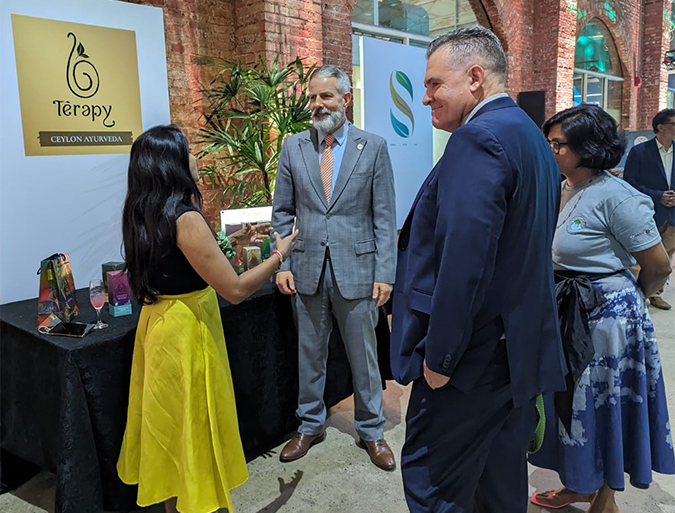
August 3, 2023, COLOMBO: Ten entrepreneurs who received intensive help from the United States Agency for International Development (USAID) and Good Life X (GLX) business accelerator to develop their climate adaptation ideas displayed their results in a Demo Day event on 02 August.
This Demo Day marked the end of an eight-month program to help early-stage businesses grow into scalable and sustainable enterprises that can enhance the climate resilience of agriculture, fisheries, and tourism-associated livelihoods in Sri Lanka. The 10 businesses showcased their innovations at the event before an audience of more than 80 investors, partners and collaborators.
Climate smart innovations introduced at the live-streamed event included products to better preserve food, solar charging kits, energy efficient tea dryers, urban farming models, and seaweed-based organic fertilizer among others. The businesses were coached by experts in innovation, business, climate change, agriculture and tourism through a Climate Change Accelerator activity of GLX and USAID’s Climate Change Adaptation project.
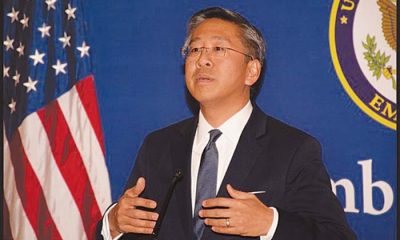
“It is inspirational to think that one of the greatest challenges facing our world also presents some of the best business opportunities,” said United States Embassy Deputy Chief of Mission Douglas Sonnek, who addressed the event. “I am impressed with the leadership these enterprises have shown in tackling climate change.”
Randhula de Silva, Founder CEO of GLX noted the importance of applying the innovations of entrepreneurs to tackling climate change adaptation.
“Climate change, whether we like it or not, is real,” she said. “And is the most urgent threat to food security, biodiversity, and livelihoods; in short, to life on earth. This program was tailored to bring climate adaptation into the hands of entrepreneurs, so that our communities and ecosystems stand resilient and thriving amidst the changes.”
The 10 showcased businesses and their innovations were: Food Things, an enterprise that is engaged in preservation of food products explained their new vacuum sealer machine that increases the shelf-life of the food and their plans to use a solar powered food dryer;
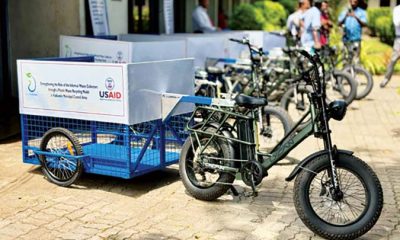
• Kulumoto, the eco-transport enterprise explained the prototype solar charging kit that offers a zero-carbon footprint solution to potential buyers, as opposed to their earlier model relying on the power grid;
• Saruketha Organics, which produces homemade organic forest tea with a few small-scale tea growers, explained their new energy efficient tea drying machine.
• Ceylon Green and Aqua, explained its urban farming model that combines aquaponics and integrated outdoor farming methods;
• Carbon Blueprint, explained its new seaweed cultivation plan with an expanded value addition process for cultivated seaweed to manufacture liquid organic fertilizers for vegetables and ornamental plants;
• Tourmate.lk (re-branded as Eco Escape- Galle), an eco-tourism venture committed to the conservation of the Keppu Ela (river) and its mangroves, explained its new business model with an electric motor-powered boat to facilitate tours with near zero environmental footprint;
• Inova explained its bio-char production business as a soil conditioner as a waste reduction process;
• Therapy Ceylon explained its business of producing infused tea using native herbs, spices and flowers;
• Iluktenne Plant Nursery, which produces plants and seeds of export crops, explained its expansion to introduce forest plant seedlings in nurseries, ensuring the conservation of forest plants that are at risk of climate change and deforestation, and;
• The Raawana Agro Limited, explained its venture of educating rural farmers on polytunnel greenhouses and other climate-smart technologies that can be used by farmers to better adapt to climate change related impacts.









BY IfhAm NIzAm
Sri Lanka could soon face a new electricity-grid challenge—not from too little power, but from having too much solar generation in the wrong places and at the wrong times, a former Ceylon Electricity Board (CEB) General Manager told The Island.
The former CEB GM who insisted not to be named warned that the rapid growth of rooftop and utility-scale solar could place increasing pressure on CEB and LECO distribution feeders, substations and the national grid unless transmission, storage and grid-management systems are upgraded at the same pace.
“The issue is no longer simply how much solar we can install. The question is whether the grid can absorb those electrons when and where they are produced,” he told The Island.
He said Sri Lanka should learn from China and India, where the enormous expansion of renewable generation is now forcing policymakers to focus increasingly on storage, transmission capacity, intelligent dispatch and grid flexibility.
“China has already exceeded 1.28 TW of installed solar, while India’s grid-connected installed solar capacity stood at around 162.15 GW as of June 30, 2026. The difficult question now is what you actually do with so much solar when everyone is generating at almost the same time,” he said.
For Sri Lanka, he said, the warning is particularly relevant to the distribution network.
A feeder carrying a high concentration of rooftop solar can, during periods of strong sunshine and low local demand, move from the traditional one-way flow of electricity towards consumers to reverse power flow back towards the transformer and upstream network.
“That means the feeder is no longer simply a one-way road for electricity. At certain times of the day, it becomes a two-way road,” he said.
This can create voltage-rise, protection-coordination and transformer-loading issues and could eventually limit the amount of additional rooftop solar that can safely be connected to particular feeders.
“What matters is where those megawatts are connected,” he told The Island.
He said Sri Lanka therefore needs to begin looking at solar hosting capacity feeder by feeder and substation by substation, rather than treating the national grid as having unlimited capacity to absorb new distributed generation.
The problem is compounded by the evening transition, when solar generation falls rapidly just as electricity demand can increase.
“If the system has a lot of solar in the middle of the day and then loses that generation rapidly in the evening, something else has to respond. That is a flexibility problem,” he said.
This is where battery energy storage systems (BESS) are likely to become increasingly important—but the former CEB chief cautioned against allowing cheap imported battery hardware to drive the market.
“Sri Lanka could soon have huge BESS demand, very cheap battery hardware and everyone suddenly becoming a BESS pundit. What could possibly go wrong?” he said.
He cited fire safety, degradation, poor integration, weak energy-management systems, questionable warranties, incorrect sizing, inappropriate grid locations and poor thermal management as major risks.
“A system can look fantastic in Excel on Day One but perform very differently in Year Two,” he told The Island.
He said the future BESS market would therefore be determined less by who could supply the cheapest container and more by who understood the complete system.
“The future BESS business will not be about who can assemble the cheapest container. It will be about who understands battery, PCS, EMS, grid, safety, degradation and dispatch economics as one system,” he said.
For Sri Lanka, storage should also be considered as a distribution-grid asset, rather than solely as a large transmission-level installation.
Strategically located batteries could absorb excess rooftop solar on constrained feeders during the middle of the day and release electricity later when local demand rises, potentially reducing network congestion and improving the value of distributed generation.
“The question is not simply, ‘How many megawatt-hours of batteries do we need?’ The question is, ‘Where does the battery create the greatest system value?’” he said.
He said China’s and India’s experience could broadly be viewed as three stages: Phase One—build solar and wind; Phase Two—build storage; and Phase Three—redesign the grid around renewables.
Sri Lanka, he said, should learn from that progression before renewable penetration makes grid problems significantly more expensive to solve.
“Installing another large amount of solar is one thing. Absorbing those electrons when the sun is shining everywhere at once is quite another,” he said.
“Solar taught us how to generate cheap electrons. BESS and the grid will decide whether those cheap electrons are actually useful when they are needed.”
“That is perhaps the biggest lesson Sri Lanka should take from China and India’s energy transition right now,” he added.

The Supreme Court yesterday ruled that former President Maithripala Sirisena’s decision to grant a presidential pardon to Bodu Bala Sena (BBS) General Secretary Ven. Galagoda Atte Gnanasara Thera was arbitrary and invalid in law.
A three-judge bench headed by Justice Janak de Silva delivered the judgment in response to fundamental rights petitions filed by the Centre for Policy Alternatives (CPA) and Sandhya Ekneligoda, challenging the former President’s decision to release the monk from prison.
Gnanasara Thera had been sentenced by the Court of Appeal in August 2018 to 19 years’ rigorous imprisonment, to run concurrently as six years, after being found guilty of contempt of court over his conduct inside the Homagama Magistrate’s Court on January 25, 2016, during proceedings related to the disappearance of Prageeth Ekneligoda.
The Supreme Court subsequently upheld the Court of Appeal’s finding of guilt on October 5, 2018.
However, Gnanasara Thera was released from Welikada Prison on May 23, 2019, after the then President Sirisena granted him a presidential pardon.
The petitioners challenged the legality of the pardon, prompting the Supreme Court to examine the exercise of the President’s constitutional power of clemency.
The Court’s ruling yesterday effectively nullifies the pardon granted to the BBS leader.
Viran Corea, PC, with Luwie Ganeshathasan and Khyati Wikramanayake appeared for the CPA, while Counsel Asthika Devendra, with Pulasthi Hewamanne, instructed by Manjula Balasuriya, appeared for Sandhya Ekneligoda.Counsel Thishya Weragoda, with Sanjaya Marambe and Iresh Senevirathne, appeared for Gnanasara Thera. Faiszer Musthapha, PC, with Pulasthi Rupesinghe, appeared for former President Sirisena.
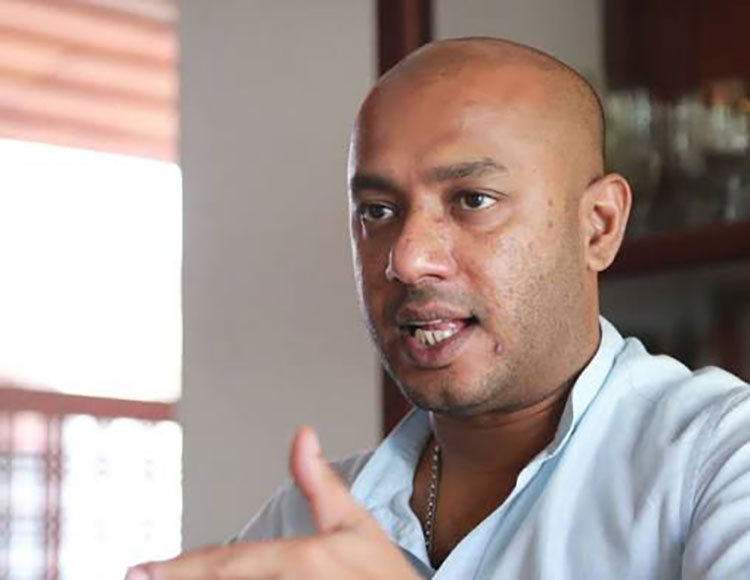
The Colombo High Court yesterday served indictments on former Minister Duminda Dissanayake and a woman in connection with the discovery of a gold-plated T-56 assault rifle at the Havelock City apartment complex in Wellawatte.
Following the indictments, the High Court Judge ordered that both accused be released on bail.
Court records indicate that indictments had also been filed against Dissanayake and the same co-accused on September 9, after which they were granted bail.
The case relates to the discovery of the gold-plated firearm at the apartment complex in May 2025.
Two women, aged 40 and 68, were initially arrested in connection with the possession of the weapon, before the investigation was handed over to the Terrorism Investigation Division (TID).
Subsequent investigations by the TID led to Dissanayake being arrested and produced before court. However, he was later released after the Attorney General’s Department informed court that there was insufficient evidence at the time to proceed with legal action against him.

Showers will occur in the Western and Sabaragamuwa provinces and in Kandy, Nuwara-Eliya, Galle and Matara districts.

Sri Lanka faces new grid challenge as rooftop solar surges: former CEB GM

SC rules President Sirisena’s pardon of Gnanasara thera invalid

Duminda, another indicted in gold-plated T-56 case

‘Commissions paid to aircraft buyers standard practice’: Ex-AASL Board Member

Catholic bishops call for impartial probe into Chemmani mass grave

‘Dates have the highest sugar content to fight Coronavirus’

Sunday Island 27 December – Headlines

#SundayIsland 17th December – Headlines

Sunday Island – 28th March

Sunday Island Headlines – 21 March

Sunday Island – 21st February – Headlines
-

 News6 days ago
Namal remanded until Sept. 18 over Airbus deal investigation
-

 Latest News5 days ago
Tharanga creates history with Diamond League crown in Brussels
-

 News5 days ago
Dispute which triggered listed company director being detained at BIA resolved
-

 Features4 days ago
After the parade: What a traffic OIC’s walk-out tells us
-

 Editorial6 days ago
Power vs Equality
-
Editorial4 days ago
Arrests as theatre
-

 Latest News4 days ago
Harshitha’s composed knock seals Sri Lanka’s semi-final berth
-

 Latest News7 days ago
SLPP MP Namal Rajapaksa arrested by CIABOC