
Opinion
Unity can be decisive


Even the most tenacious optimist would agree that the country is in bad shape. Perhaps, even at this eleventh hour of our country’s relentless spiraling down towards a state of chaos, the leaders, who have been holding the reins alternately-those whom we believe can make a difference-do not seem to have realised the importance of changing track and putting the country before every other consideration.
The present predicament makes it clear that two-party politics, as it has been practiced in our country, has not benefitted the people much. The elected party, after a few weeks in power, gives enough evidence to show that people are mistaken in thinking that our chosen “representatives” have anything but our interests in their mind. The contempt with which they treat the voice of the people and the condescension with which they “explain” away everything they do ,leave no room for doubt that parliamentary politics, as it has been practiced all these years, does not much reflect the representative character of the ruling party, whichever it may be. Only when they lose an election and are demoted to the “Opposition” would they begin to “voice” the wishes of the people and be sensitive to every single problem of the constituents who they choose to treat as a bunch of rabble-rousers when they were in power. Judging by how people-friendly every Opposition has been, people may, after every General Election, plead with all the newly elected members, “Please, ladies and gentlemen, be the opposition.” A cynic may suggest that “the political party which is on the side of the people until they come to power” may be added to the OED as another increasingly relevant meaning of the word “opposition.”
It is not difficult to see that this kind of cynicism is not at all an exaggeration considering the conduct of the “Oppositions” we have had in our parliamentary politics. As we know, in our normal human relations, disapproval, condemnation or rejection begets animosity. Not in the relationship between a political party and the general public! Politics seems to be an odd game in which rejection engenders friendship and compassion. Every time a political party is rejected at a General Election, it immediately begins to love the very people who have shooed them away unceremoniously. However, as our political records show, every “opposition” has amply demonstrated the art of settling scores after a period of wound-licking. Our entire exercise of electing our rulers, if shorn of its periodical fits of “sound and fury,” boils down to a vicious cycle of hope, disappointment, disbelief and rejection. Unfortunately, today, the moments of “disbelief” of the people are becoming ever more frequent and acute with each new decision made by the ruling party. A presenter may invite a weary audience to just look at the present Sri Lankan society to get a rough idea about how shock-absorbers work.
There is something essentially wrong with the existing mechanism of politics. You may blame individual leaders; you may blame parties, the system or even the populace. Each of these entities has been blamed enough with no tangible results forthcoming. Perhaps the problem lies in isolating the entity when we choose to blame it. Perhaps, we have missed the wood for the trees.
It is quite likely that all these actors: leaders, parties and the masses are nearly equally responsible for the present predicament and thus have to be taken together when we look for the underlying problem. If we can agree on that, what is needed is a mechanism where all the stakeholders can get together for the sake of the whole nation. As we know, the country can boast of experts in every important field, be it science, politics, economics, social sciences etc., but each of them has been working, more or less, in his or her “little corner.” Those who love the country as strongly as they profess can take the first step towards pooling all that expertise together to push the country forward; but first, “Leaders of all parties, unite!” For the betterment of all, including you worthies, we may add.
Susantha Hewa

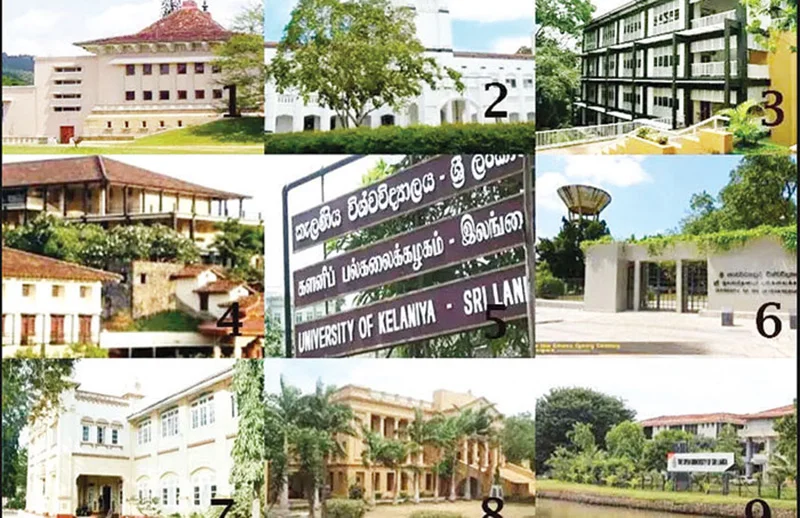
130,000 students are left out each year—academics hold the key
Each year, Sri Lanka’s G.C.E. Advanced Level examination produces a wave of hope—this year, nearly 175,000 students qualified for university entrance. Yet only 45,000 will be admitted to state universities. That leaves more than 130,000 young people stranded—qualified, ambitious, but excluded. This is not just a statistic; it is a national crisis. And while policymakers debate infrastructure and funding, the country’s academics must step forward as catalysts of change.
Beyond the Numbers: A National Responsibility
Education is the backbone of Sri Lanka’s development. Denying access to tens of thousands of qualified students risks wasting talent, fueling inequality, and undermining national progress. The gap is not simply about seats in lecture halls—it is about the future of a generation. Academics, as custodians of knowledge, cannot remain passive observers. They must reimagine the delivery of higher education to ensure opportunity is not a privilege for the few.
Expanding Pathways, Not Just Campuses
The traditional model of four-year degrees in brick-and-mortar universities cannot absorb the demand. Academics can design short-term diplomas and certificate programmes that provide immediate access to learning. These programmes, focused on employable skills, would allow thousands to continue their education while easing pressure on degree programmes. Equally important is the digital transformation of education. Online and blended learning modules can extend access to rural students, breaking the monopoly of physical campuses. With academic leadership, Sri Lanka can build a reliable system of credit transfers, enabling students to begin their studies at affiliated institutions and later transfer to state universities.
Partnerships That Protect Quality
Private universities and vocational institutes already absorb many students who miss out on state admissions. But concerns about quality and recognition persist. Academics can bridge this divide by providing quality assurance and standardised curricula, supervising joint degree programmes, and expanding the Open University system. These partnerships would ensure that students outside the state system receive affordable, credible, and internationally recognised education.
Research and Advocacy: Shaping Policy
Academics are not only teachers—they are researchers and thought leaders. By conducting labour market studies, they can align higher education expansion with employability. Evidence-based recommendations to the University Grants Commission (UGC) can guide strategic intake increases, regional university expansion, and government investment in digital infrastructure. In this way, academics can ensure reforms are not reactive, but visionary.
Industry Engagement: Learning Beyond the Classroom
Sri Lanka’s universities must become entrepreneurship hubs and innovation labs. Academics can design programmes that connect students directly with industries, offering internship-based learning and applied research opportunities. This approach reduces reliance on classroom capacity while equipping students with practical skills. It also reframes education as a partnership between universities and the economy, rather than a closed system.
Making the Most of What We Have
Even within existing constraints, academics can expand capacity. Training junior lecturers and adjunct faculty, sharing facilities across universities, and building international collaborations for joint programmes and scholarships are practical steps. These measures maximise resources while opening new avenues for students.
A Call to Action
Sri Lanka’s university admission crisis is not just about numbers—it is about fairness, opportunity, and national development. Academics must lead the way in transforming exclusion into empowerment. By expanding pathways, strengthening partnerships, advocating for policy reform, engaging with industry, and optimizing resources, they can ensure that qualified students are not left behind.
“Education for all, not just the fortunate few.”
Dr. Arosh Bandula (Ph.D. Nottingham), Senior Lecturer, Department of Agricultural Economics & Agribusiness, Faculty of Agriculture, University of Ruhuna
by Dr. Arosh Bandula
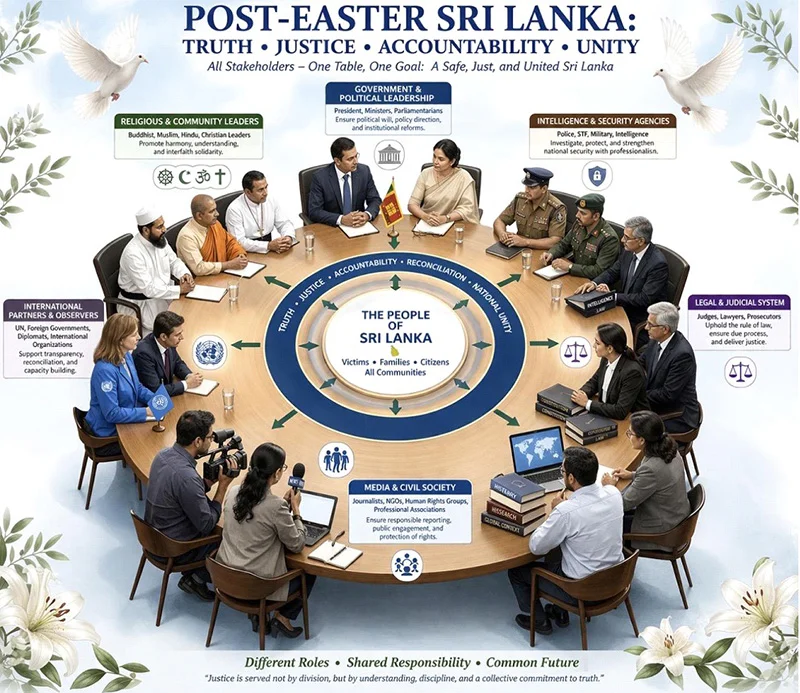
As Sri Lanka approaches the seventh commemoration of the Easter Sunday attacks, the national mood is once again marked by grief, reflection, and an enduring sense of incompleteness. Nearly seven years later, the tragedy continues to cast a long shadow not only over the victims and their families, but over the institutions and narratives that have since emerged.
Commemoration, however, must go beyond ritual. It must be anchored in clarity, accountability, and restraint. What is increasingly evident in the post-Easter landscape is not merely a search for truth, but a contest over how that truth is framed, interpreted, and presented to the public.
In recent times, public discourse has been shaped by book launches, panel discussions, and media interventions that claim to offer new insights into the attacks. While such contributions are not inherently problematic, the manner in which certain narratives are advanced raises legitimate concerns. The selective disclosure of information particularly when it touches on intelligence operations demands careful scrutiny.
Sri Lanka’s legal and institutional framework is clear on the sensitivity of such matters. The Official Secrets Act (No. 32 of 1955) places strict obligations on the handling of information related to national security. Similarly, the Police Ordinance and internal administrative regulations governing intelligence units emphasize confidentiality, chain of command, and the responsible use of information. These are not mere formalities; they exist to safeguard both operational integrity and national interest.
When individual particularly those with prior access to intelligence structures enter the public domain with claims that are not subject to verification, it raises critical questions. Are these disclosures contributing to justice and accountability, or are they inadvertently compromising institutional credibility and future operational capacity?
The challenge lies in distinguishing between constructive transparency and selective exposure.
The Presidential Commission of Inquiry into the Easter Sunday Attacks provided one of the most comprehensive official examinations of the attacks. Its findings highlighted a complex web of failures: lapses in intelligence sharing, breakdowns in inter-agency coordination, and serious deficiencies in political oversight. Importantly, it underscored that the attacks were not the result of a single point of failure, but a systemic collapse across multiple levels of governance.
Yet, despite the existence of such detailed institutional findings, public discourse often gravitates toward simplified narratives. There is a tendency to identify singular “masterminds” or to attribute responsibility in ways that align with prevailing political or ideological positions. While such narratives may be compelling, they risk obscuring the deeper structural issues that enabled the attacks to occur.
Equally significant is the broader socio-political context in which these narratives are unfolding. Sri Lanka today remains a society marked by fragile intercommunal relations. The aftermath of the Easter attacks saw heightened suspicion, polarisation, and, in some instances, collective blame directed at entire communities. Although there have been efforts toward reconciliation, these fault lines have not entirely disappeared.
In this environment, the language and tone of public discourse carry immense weight. The framing of terrorism whether as a localized phenomenon or as part of a broader ideological construct must be handled with precision and responsibility. Overgeneralization or the uncritical use of labels can have far-reaching consequences, including the marginalization of communities and the erosion of social cohesion.
At the same time, it is essential to acknowledge that the global discourse on terrorism is itself contested. Competing narratives, geopolitical interests, and selective historiography often shape how events are interpreted. For Sri Lanka, the challenge is to avoid becoming a passive recipient of external frameworks that may not fully reflect its own realities.
A professional and unbiased approach requires a commitment to evidence-based analysis. This includes:
· Engaging with primary sources, including official reports and judicial findings
·
· Cross-referencing claims with verifiable data
·
· Recognizing the limits of publicly available information, particularly in intelligence matters

It also requires intellectual discipline the willingness to question assumptions, to resist convenient conclusions, and to remain open to complexity.
The role of former officials and subject-matter experts in this discourse is particularly important. Their experience can provide valuable insights, but it also carries a responsibility. Public interventions must be guided by professional ethics, respect for institutional boundaries, and an awareness of the potential impact on national security.
There is a fine balance to be maintained. On one hand, democratic societies require transparency and accountability. On the other, the premature or uncontextualized release of sensitive information can undermine the very systems that are meant to protect the public.
As Sri Lanka reflects on the events of April 2019, it must resist the temptation to reduce a national tragedy into competing narratives or political instruments. The pursuit of truth must be methodical, inclusive, and grounded in law.
Easter is not only a moment of remembrance. It is a test of institutional maturity and societal resilience.
The real question is not whether new narratives will emerge they inevitably will. The question is whether Sri Lanka has the capacity to engage with them critically, responsibly, and in a manner that strengthens, rather than weakens, the foundations of its national security and social harmony.
In the end, justice is not served by noise or conjecture. It is served by patience, rigor, and an unwavering commitment to truth.
Mahil Dole is a former senior law enforcement officer and national security analyst, with over four decades of experience in policing and intelligence, including serving as Head of Counter-Intelligence at the State Intelligence Service of Sri Lanka and a graduate of the Asia Pacific Center for Security Studies in Hawai, USA.
by Mahil Dole
Former Senior Law Enforcement Officer National Security Analyst; Former Head of Counter-Intelligence, State Intelligence Service)
Opinion
Need to consult, compromise and reach optimal common ground on critical issues of national interest

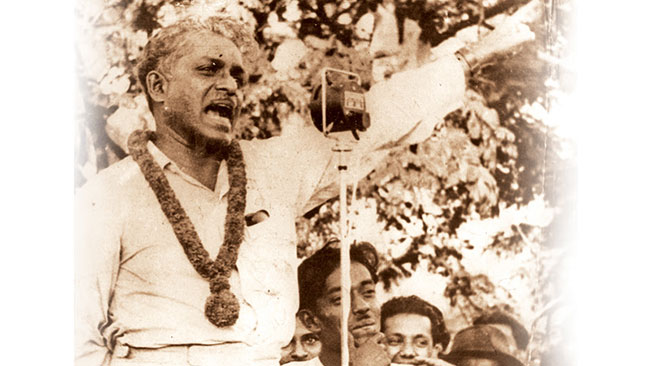
Delivering the keynote address at the 54th Memorial of the late Minister Philip Gunawardena, former Foreign Secretary HMGS Palihakkara, called for a culture of consensus on key public policy issues in the country as the way forward from recovery to sustainable growth in a world of deepening violence and diminishing cooperation.
Excerpts.
Today, we gather to honour and remember the late Hon. Philip Gunawardena—virtually a household name to my generation, fondly known to the ordinary folks just as Philip ‘Mathithuma’- a leader whose life was woven into the very fabric of Sri Lanka’s struggle for justice, dignity, and independence.
Philip Gunawardena was not merely a political leader; he was a visionary, a reformer, and a fearless voice for the common people. While he was an iconic figure and a staunch socialist, he remained a pragmatic modernist as well. This, obviously, is quite a complex and difficult political binary to maintain. As history has it, he did acquit himself doing it. At a time when speaking truth to power demanded immense courage, he stood unwavering. He believed deeply that a nation’s strength lies not in privilege, but in equality—in uplifting farmers, workers, and the forgotten voices of society. The famous Paddy Land Act and the concept of Apex Cooperative Bank which later transformed into the present-day Peoples Bank and many other public policy and institutional creations are emblematic of his deep knowledge of the economic challenges and his holistic approach to development.
On the other hand, others saw Philip demonstrating hard-nosed pragmatism, not a naïve ideological bent.
Dr. Sarath Amunugama, a friend and a public servant turned politician said of Philip:
“On Socialism itself Philip had a different perspective – You talk of Socialism. You cannot socialise poverty. You can only socialise plenty. And if people cannot work, if they cannot produce, you cannot have Socialism.” *
The volume being launched today contains Philip Gunawardena’s speeches and initiatives, documents in great detail the drive and substance he deployed to deliver social justice and economic outcomes to those working classes.
He was aptly called the “Father of Socialism” in Sri Lanka, even lionised as the Boralugoda Sinhaya. But titles and appellations alone cannot capture the spirit of the man. People were captivated not only by the inimitable force of his articulation and commitment but perhaps equally or even more, by substance and cogency of his argument.
He was a bridge between the ideal and the actionable.
In my official work overlap with his capacity as the Minister of Industries in the 1960s, I personally experienced Minister Philip’s ability to refurbish concepts in relation to ground realities. His work in land reform and his commitment to social justice were not abstract ideas—they were real, tangible efforts to improve lives and reshape the nation’s future. The analysis Philip presented and prescriptions he passionately advocated, in both legislative and policy realms, are touched upon in good detail here in this book being launched today. I must say it is a trove for a researcher.
Beyond his public life, Philip Gunawardena was a man of conviction and principle. He carried with him a profound sense of responsibility to his people, and he never wavered from his beliefs, even when it came at great personal cost. That is a legacy not easily measured, but deeply felt.
Today, as we reflect on his life, we are reminded that true leadership is not about power, but about purpose. It is about working tirelessly for the greater good of the Nation State and its people while standing firm in one’s values
Philip’s words -more importantly his deed- brought into sharp relief a truism prevalent in divisive politics
esp. here in Sri Lanka. It is that while blinkered politicians build opinions, only true leaders can build consensus. The former does it for parochial transactional gain the latter does it for strategic and sustainable national gain.
Philip of course was emblematic of the latter.
The decision by Philip to join the ‘National Govt’ of Dudley Senanayake was a much debated but little understood affair. – Optics were basically reduced to a celebrated Socialist icon joining a gentle Capitalist to form a
National Government. It was inevitably a controversial move. Equally, it was also a bold manifestation of that consensus building spirit. More so because his decision was predicated on his unwavering support for a fundamental human right- the freedom of expression, and opposition to nationalisation of the free press- a fundamental tenet of the democratic-socialist binary. Leave aside the unfinished or open-ended debate about democracy or socialism. Philip was signalling that consensual statecraft is the way forward for the nation’s progress and prosperity of its people. The motto was that what is best ideologically should not stand in the way of what is consensually good for the nation and the common man. When Philip famously said that I will work with the ‘Devil or even his grandmother if that brings about common good’, he in a way articulated the inherent quality of consensus on key public policy matters like the press freedom and other foundational things.
That certainly is the interpretation in my Book!
Consensus is not about making any or all contending parties absolutely happy about the issue at hand- it is about dispensing managed unhappiness among all parties in order to advance a common cause benefitting the people at large. It is the ‘equitable distribution of reasonable unhappiness’ among all parties concerned. When that occurs, consensus happens. It is the most potent algorithm to produce win-win solutions in human relations within or among states.
This is a great lesson in statecraft and public policy making for present day politicians in our country who seem to quarrel like street vendors on a rainy day, on all issues. They have thus reduced the grave responsibility of democratic governance to a trivial zero-sum formula of the Government proposing and the Opposition opposing most of the time- if not all the time! They are either unable or unwilling to explore and reach a consensual middle ground to advance the national interests on a host of public policy issues ranging from economic reforms, security and foreign policies, the rule of law, accountability, reconciliation and so on.
All issues are thus a game for the govt toppling game.
This is a lesson for some of the current crop of politicians in this country who easily conflate polemics with substance and verbiage with eloquence.
All this ignores the national interest of building consensus as opposed to building polarisation for vote winning.
May I express the hope that all of us, especially those involved in that dreadful art form called politics in this country, revisit the thought processes of Philip Gunawardena documented in this volume to understand that compromise and consensus is possible in this country- especially on key public policy issues that profoundly touch our fundamental national interests.
Speaking of a culture of consensus the likes of Philip Gunawardena advocated in eloquent words and courageous deeds more than half a century ago, let me conclude with a brief comment on their relevance and resonance with the inventory of sri Lanka’s foreign policy and diplomacy challenges.
We all know that Sri Lanka’s overriding national priority in recent times was and remains the process of recovery from a crippling economic crisis and dovetailing it into a sustainable growth pathway. For this we must carefully prepare ourselves to prudently navigate the critical gauntlet of 2028 when we have to resume debt repayment- a challenge looming larger and larger every single day. Especially so in a world convulsed by violent conflict and economic and financial disruption like what is unfolding in West Asia right now. The violent spiral that has peaked there now will impact our foreign relations and recovery effort in most profound ways. If one is serious about making our recovery and growth stable and sustainable in this volatility, it must therefore be firmly anchored in a domestic political consensus on economic reform and foreign policy framework that is programmed towards three things:
– first, liberate the indispensable economic reforms from the destructive politics of government toppling,
– second, insulate us from the adversities of the ongoing geopolitical violence,
-third, guide us towards securing opportunities for our economic interests in this evolving geopolitical vortex.
Of course, the ‘prime-mover’ responsibility of this common ground building process lies with the government which has an unprecedented and strong voter’ mandate to do it. It must therefore stop acting as if it is still in an election campaign mode and must take cognizance of the fact that they are governing now. The Opposition must understand too that their job is not to oppose everything that the govt proposes and that they are the ‘shadow govt.,’ in the best traditions of parliamentary democracy. They must therefore stop acting like a shadow of the Opposition bent on Govt toppling game 24/7 but behave like a true ‘shadow government’ promoting consensus until the voters in due course do the regime change, when necessary.
Both sides should therefore consult, compromise and reach optimal common ground on critical issues of vital national interest. If our politicians don’t embrace a culture of consensus on such public policy issues of foundational importance, yet another crisis will embrace us in due course, perhaps sooner than they expect. Templates of statesmanship provided by the likes of Philip to reach consensual grounds through informed and timely compromises shedding ideological or parochial interests, might come in handy here.
In memoriam of PHILIP GUNAWARDENA, 26 March 2026. National Library Auditorium

Trump announces two-week ceasefire as Iran agrees to reopen Hormuz Strait

Yashasvi Jaiswal powers Royals past Mumbai Indians in 11-over thrash

Showers will occur at several places in the Western, Sabaragamuwa, Southern and North-western provinces and in Kandy, Nuwara-Eliya and Monaragala districts after 1.00 p.m.

The Sun is directly overhead Warakapola, Aranayaka, Gampola, Bibile, Inginiyagala, and Akkaraipattu at about 12:12 noon today (08)

AKD admits import of substandard coal, blames technicalities and supplier

‘Sri Lanka – China relations: Community with a Shared Future’ launched

‘Dates have the highest sugar content to fight Coronavirus’

Sunday Island 27 December – Headlines

#SundayIsland 17th December – Headlines

Sunday Island – 28th March

Sunday Island Headlines – 21 March

Sunday Island – 21st February – Headlines
-

 Features4 days ago
Ranjith Siyambalapitiya turns custodian of a rare living collection
-

 News7 days ago
2025 GCE AL: 62% qualify for Uni entrance; results of 111 suspended
-

 News4 days ago
Global ‘Walk for Peace’ to be held in Lanka
-

 Editorial7 days ago
Search for Easter Sunday terror mastermind
-

 News2 days ago
Lankan-origin actress Subashini found dead in India
-

 Opinion6 days ago
Hidden truth of Sri Lanka’s debt story: The untold narrative behind the report
-

 Opinion7 days ago
Is there hope for Palestine?
-

 Features4 days ago
Beyond the Blue Skies: A Tribute to Captain Elmo Jayawardena